

Recognize that artificial intelligence is fundamentally restructuring research and development across every industry, creating career opportunities that didn’t exist five years ago. Pharmaceutical companies now use AI to predict drug interactions in days rather than years. Manufacturing firms deploy machine learning to optimize materials before physical prototypes exist. Even small biotech startups rely on AI-powered simulation tools that once required massive computational resources available only to tech giants.
Position yourself strategically by understanding that building an AI career in R&D doesn’t require becoming a data scientist overnight. Companies desperately need professionals who bridge domain expertise with AI literacy. A materials engineer who understands how to frame research questions for machine learning algorithms becomes more valuable than either a pure engineer or pure AI specialist working in isolation.
Focus on three transferable skill clusters that span industries. First, learn to identify which research problems AI can actually solve versus those requiring traditional methods. Second, develop basic fluency in data preparation and interpretation, as R&D generates vast datasets that fuel AI systems. Third, cultivate the ability to communicate between technical AI teams and research scientists who speak entirely different languages.
The transformation happening now mirrors the digital revolution of the 1990s. Professionals who adapted early gained decades of competitive advantage. Those who understand both research methodologies and AI capabilities will shape the next generation of innovation, whether in pharmaceuticals, aerospace, agriculture, or emerging fields we haven’t yet imagined.
Why R&D Departments Are Racing to Adopt AI
The race to adopt AI in research and development isn’t just about staying current with technology trends. It’s fundamentally reshaping how companies innovate, compete, and survive in their markets.
Cost reduction stands as one of the most compelling drivers. Traditional R&D processes can burn through millions of dollars testing hypotheses that lead nowhere. AI changes this equation dramatically. In the pharmaceutical industry, for example, developing a new drug typically costs around $2.6 billion and takes over a decade. Companies like Atomwise are using AI algorithms to screen millions of chemical compounds in days rather than years, slashing both time and expenses. One chemistry startup reduced their materials testing budget by 60% after implementing machine learning models that predicted compound behaviors before physical testing.
Accelerated innovation cycles create another powerful incentive. In the technology sector, getting products to market faster often determines winners and losers. Samsung and other electronics manufacturers now use AI to simulate thousands of design iterations overnight, a process that previously required weeks of manual prototyping. This speed advantage translates directly into market share and revenue.
Competitive pressure may be the strongest motivator of all. When your competitors harness AI to innovate faster and cheaper, standing still means falling behind. Manufacturing companies are particularly feeling this pressure. Siemens reported that their AI-driven R&D processes helped them reduce product development time by 30%, forcing competitors to respond or risk obsolescence.
The technology sector shows how quickly this adoption spreads. Google, Microsoft, and Amazon aren’t just using AI in their products but have reorganized entire R&D departments around AI-first methodologies. This creates a cascading effect as smaller companies must adapt to work with these industry giants.
For professionals watching these shifts, the message is clear: AI adoption in R&D isn’t a distant future scenario. It’s happening now, creating new roles while transforming existing ones across every industry.

AI’s Game-Changing Applications in Cross-Industry R&D
Drug Discovery and Chemical Research
Imagine discovering a life-saving drug in months instead of years. That’s the promise AI brings to drug discovery and chemical research. Traditional methods require scientists to test thousands of molecular combinations in the lab, a process that can take over a decade and cost billions of dollars. AI is dramatically changing this timeline.
At the heart of this transformation is AI’s ability to predict how molecules will behave before they ever enter a test tube. Take protein folding, for example. Proteins are the building blocks of life, and understanding their 3D structure is crucial for developing new medicines. DeepMind’s AlphaFold solved a 50-year-old challenge by accurately predicting protein structures in hours rather than years, opening doors to treatments for previously untreatable diseases.
Compound screening is another area where AI shines. Instead of physically testing millions of chemical compounds to find one that works, AI algorithms can analyze vast chemical libraries virtually, identifying promising candidates in a fraction of the time. This means researchers can focus their lab work only on the most promising options, saving both time and resources.
AI also predicts chemical reactions with remarkable accuracy, helping scientists understand which molecular combinations will produce desired results. This reduces failed experiments and accelerates the path from laboratory discovery to real-world applications. For professionals entering this field, understanding how AI tools augment traditional chemistry knowledge is becoming essential, creating exciting opportunities for those who can bridge computational and laboratory sciences.
Electronics and Hardware Development
The electronics industry has embraced AI as a game-changer in hardware development, dramatically reducing the time from concept to production. Consider chip design, traditionally a painstaking process that could take years. AI algorithms now analyze millions of design configurations in hours, optimizing layouts for performance, power efficiency, and heat management. Companies like NVIDIA and Google have used machine learning to design chips that are faster and more efficient than those created through conventional methods alone.
Circuit optimization represents another frontier where AI excels. Engineers feed historical performance data into neural networks that learn to predict how design changes will affect real-world functionality. This means fewer physical prototypes and faster iteration cycles. One smartphone manufacturer reduced its testing phase by 40% using AI-powered predictive models that identified potential failures before building expensive prototypes.
In semiconductor R&D, predictive testing has become invaluable. AI systems analyze microscopic defects during manufacturing, catching issues that human inspectors might miss. These systems learn from millions of images, continuously improving their accuracy and helping maintain the quality standards essential for modern electronics.
For professionals in this space, understanding both hardware fundamentals and machine learning basics opens doors to roles that blend traditional engineering with cutting-edge AI applications. The skill combination is increasingly valuable as electronics companies compete to bring smarter products to market faster.

Software and Algorithm Development
AI is revolutionizing how software gets built in R&D environments, acting like a highly capable coding partner that’s available 24/7. Modern development teams increasingly rely on AI-powered tools that transform how they write, test, and optimize code.
GitHub Copilot leads the charge in code generation, suggesting entire functions based on simple comments or partial code snippets. Imagine typing a comment like “function to sort user data by timestamp” and watching as the AI proposes complete, working code. This doesn’t replace programmers but accelerates their work, allowing them to focus on creative problem-solving rather than repetitive syntax.
Debugging has become remarkably faster with AI assistants like Amazon CodeWhisperer and Tabnine. These tools identify potential bugs before code even runs, highlighting security vulnerabilities and suggesting fixes in real-time. One pharmaceutical company reported cutting debugging time by 40% after implementing AI-assisted code review.
Performance optimization tools powered by machine learning analyze code execution patterns and recommend efficiency improvements. DeepCode, for instance, scans codebases to identify bottlenecks and suggest refactoring opportunities that human reviewers might miss.
For R&D professionals looking to advance their careers, familiarity with these AI development tools has become essential. The key isn’t just using them but understanding when to trust AI suggestions and when human judgment should prevail, creating a powerful collaboration between human creativity and machine efficiency.
Materials Science and Manufacturing
AI is revolutionizing how companies develop and manufacture products across industries, from aerospace to consumer goods. In materials science, machine learning algorithms can predict the properties of new compounds without extensive lab testing. For example, researchers at Toyota used AI to discover a new battery electrolyte material in just two weeks, a process that traditionally takes years. The system analyzed millions of potential chemical combinations to identify promising candidates.
Manufacturing has also been transformed. AI-powered systems now monitor production lines in real-time, detecting defects that human inspectors might miss. At semiconductor facilities, computer vision systems examine microchips at microscopic levels, catching imperfections before they become costly failures. This technology has reduced defect rates by up to 90% in some factories.
Process optimization represents another breakthrough area. AI analyzes thousands of variables simultaneously, from temperature and pressure to raw material quality, recommending adjustments that improve efficiency and reduce waste. Steel manufacturers have used these systems to decrease energy consumption by 15% while maintaining product quality.
For professionals entering this field, skills in data analysis, basic programming, and understanding manufacturing processes create valuable career opportunities. The key is combining domain knowledge with AI literacy rather than becoming a deep technical expert.
The New R&D Career Skills That Matter Now
AI Literacy Without the Computer Science Degree
You don’t need to code neural networks from scratch to leverage AI effectively in your R&D work. Instead, focus on developing what matters most: understanding what AI can and cannot do for your specific challenges.
Think of AI literacy as learning to drive rather than building the car. You need to know how to operate the vehicle, understand its limitations, and recognize when it’s the right tool for the journey. For R&D professionals, this means grasping three core concepts.
First, understand model capabilities. Large language models excel at pattern recognition, text analysis, and generating hypotheses based on existing knowledge. Computer vision models can identify defects, classify samples, or analyze microscopy images. Predictive models forecast outcomes based on historical data. Knowing which tool fits which problem saves countless hours of trial and error.
Second, recognize limitations. AI models trained on pharmaceutical data won’t suddenly understand aerospace engineering. They can hallucinate confident-sounding but entirely incorrect information. They require quality input data and can perpetuate biases present in training sets. Understanding these boundaries prevents costly mistakes.
Third, develop judgment about when AI adds value. Automating repetitive literature reviews? Excellent use case. Replacing critical safety decisions without human oversight? Dangerous territory. The essential AI skills include this discernment between appropriate and inappropriate applications.
Your goal isn’t becoming a data scientist. It’s becoming an R&D professional who strategically deploys AI to accelerate discovery, reduce costs, and unlock insights previously hidden in your data.
Data Fluency for Research Professionals
Think of data fluency as learning to read a new language rather than becoming a translator. In R&D roles enhanced by AI, you don’t need to build algorithms from scratch, but you do need to understand what the data is telling you and spot when something looks off.
Start by getting comfortable with spreadsheet tools and basic data visualization platforms like Tableau or Power BI. Practice asking good questions of your datasets: What patterns emerge? Are there outliers that need explanation? Real-world example: A pharmaceutical researcher might notice AI flagging unusual protein interactions, but human judgment determines whether that’s a breakthrough or a data error.
The communication piece is equally critical. You’ll often translate AI-generated insights for colleagues who lack technical backgrounds. This means creating clear visualizations, writing concise summaries, and explaining confidence levels in plain language. For instance, instead of saying “the model shows 87% accuracy,” explain what that means for decision-making: “We can be quite confident in these results, though we should verify the remaining cases manually.”
Focus on developing a healthy skepticism. Question assumptions, verify sources, and always consider context that AI might miss. These practical skills matter far more than memorizing statistical formulas.
Cross-Functional Collaboration Skills
Modern R&D success increasingly depends on teams where AI specialists and domain experts speak each other’s language. A pharmaceutical researcher and a machine learning engineer might both be brilliant in their fields, but without effective collaboration, breakthrough discoveries remain out of reach.
The key is developing AI cross-industry skills that bridge technical and domain expertise. AI professionals should learn to ask clarifying questions about research problems rather than jumping straight to technical solutions. Meanwhile, subject matter experts benefit from understanding AI’s capabilities and limitations without needing to code.
Practical tips for better collaboration include scheduling regular translation sessions where technical concepts get explained through domain-specific examples, creating shared glossaries that define terms in both languages, and establishing feedback loops where domain experts validate AI outputs early and often. Consider pairing team members from different backgrounds on smaller projects first to build mutual understanding before tackling larger initiatives. This investment in communication pays dividends through faster project cycles and more relevant solutions.
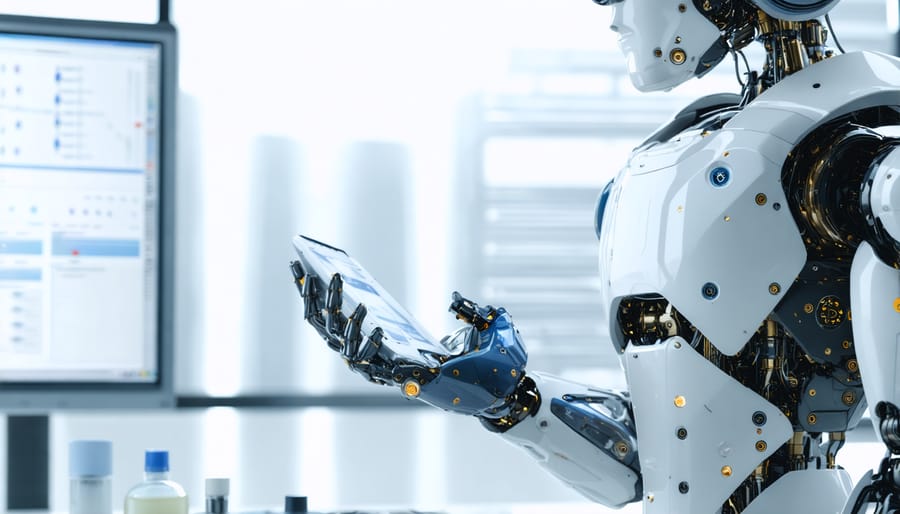
Career Paths Emerging at the Intersection of AI and R&D
AI-Assisted Research Scientist
The traditional research scientist role is undergoing a significant transformation. Rather than replacing researchers, AI is becoming their most powerful collaborator. Today’s research scientists are increasingly adopting hybrid roles where they combine domain expertise with AI literacy to accelerate discovery and innovation.
Consider pharmaceutical research, where scientists now work alongside machine learning models to identify drug candidates in weeks rather than years. These researchers don’t need to be expert programmers, but they do need to understand how to frame questions for AI systems, interpret algorithmic outputs, and validate results against real-world contexts.
For current scientists, this evolution means developing new competencies. Understanding basic data science principles, learning to work with AI-powered research platforms, and cultivating critical thinking about AI-generated insights are becoming essential skills. Many institutions now offer specialized training programs bridging traditional scientific methods with computational approaches.
Aspiring researchers entering the field have a unique advantage. By building interdisciplinary foundations early—combining scientific training with computational thinking—they position themselves at the forefront of innovation. The future belongs to scientists who can seamlessly blend human intuition, domain knowledge, and AI capabilities to tackle complex research challenges.
R&D Data Analyst and ML Engineer
The bridge between traditional research and AI implementation requires specialized professionals who speak both languages fluently. R&D Data Analysts and ML Engineers serve as crucial translators, converting complex research questions into machine learning models while making AI-generated insights understandable for scientists and researchers.
Consider a pharmaceutical company testing new drug compounds. An R&D Data Analyst transforms years of experimental data into formats that algorithms can process, then interprets the AI’s predictions about molecular effectiveness in terms chemists actually use in their daily work.
This role demands a unique skill combination: strong analytical capabilities, programming knowledge in Python or R, and genuine curiosity about the research domain. Unlike pure software engineering, you’ll need to grasp enough biology, chemistry, or materials science to ask meaningful questions and spot when AI results don’t align with scientific reality.
The career path typically starts with a background in data science or a scientific field, then grows through hands-on project experience. Many professionals enter through interdisciplinary graduate programs or by gradually adding ML skills to existing research positions, making this an accessible transition for current R&D professionals.
Innovation Manager and AI Strategy Roles
As organizations embrace AI-powered research and development, they need visionary leaders who can bridge the gap between cutting-edge technology and business strategy. Innovation Managers with AI expertise spearhead the integration of machine learning tools into existing R&D workflows, identifying where automation can accelerate discovery and where human creativity remains essential. These roles require a unique blend of technical literacy and change management skills.
AI Strategy roles focus on long-term planning, helping companies determine which AI investments will deliver the greatest return in their research processes. For example, an AI strategist at a pharmaceutical company might evaluate whether to prioritize drug discovery algorithms or clinical trial optimization tools based on competitive advantage and resource availability.
These leadership positions are ideal for professionals with several years of R&D experience who understand both the scientific method and business objectives. You don’t need a computer science PhD, but you should be comfortable interpreting AI capabilities, communicating with data science teams, and championing organizational transformation. Many successful candidates come from project management, research leadership, or business development backgrounds and supplement their experience with executive AI education programs.

Your Action Plan for Positioning Yourself in AI-Driven R&D
Learning Resources That Actually Work
Getting started with AI in R&D doesn’t require going back to university for another degree. For beginners, Coursera’s “AI For Everyone” by Andrew Ng provides a non-technical foundation, while DataCamp offers hands-on Python and machine learning courses tailored for scientists. If you’re already in a technical role, fast.ai’s free “Practical Deep Learning for Coders” teaches you to build real models quickly.
Industry-specific learners should explore domain-focused platforms. Pharmaceutical professionals benefit from MIT’s online courses on computational drug discovery, while materials scientists can dive into the Materials Project tutorials. Google’s Cloud AI Hub offers pre-built models you can experiment with immediately, perfect for understanding practical applications without coding from scratch.
The most effective approach combines structured learning with real projects. Follow an AI career roadmap that matches your background, then apply concepts to your current work challenges. Kaggle competitions provide realistic datasets and problems, letting you practice on scenarios similar to actual R&D work. Remember, consistent small steps beat sporadic intensive study. Dedicate 30 minutes daily to hands-on practice rather than just watching lectures, and you’ll build applicable skills faster than you expect.
Building Your AI-R&D Portfolio
Your AI-R&D portfolio serves as tangible proof of your capabilities, going beyond what a resume can convey. Start by showcasing projects that mirror real-world R&D challenges. For instance, if you’re interested in pharmaceutical research, create a machine learning model that predicts molecular properties or analyzes clinical trial data. These projects demonstrate both technical skills and domain awareness.
Focus on quality over quantity. Two well-documented projects with clear problem statements, methodologies, and results make a stronger impression than five half-finished experiments. Include GitHub repositories with clean code, detailed README files, and visualizations that tell a story about your approach and findings.
Collaboration amplifies your portfolio’s impact. Contribute to open-source AI projects relevant to R&D, such as scientific computing libraries or data analysis tools. Participating in Kaggle competitions centered on scientific datasets shows you can work with messy, real-world data under constraints.
Document your learning journey through blog posts or technical write-ups that explain AI concepts in R&D contexts. This demonstrates communication skills that hiring managers value highly, as R&D roles increasingly require translating complex AI insights for cross-functional teams. Publishing on platforms like Medium or maintaining a personal website creates a professional digital presence that sets you apart from candidates who rely solely on traditional credentials.
The shift toward AI in R&D isn’t about replacing scientists and researchers—it’s about amplifying what they can accomplish. If you’re already working in research or considering this path, you’re in a stronger position than you might think. Your domain expertise in chemistry, biology, materials science, or any specialized field remains invaluable. AI simply becomes another tool in your toolkit, much like microscopes or statistical software once were.
Start small. You don’t need to become a machine learning expert overnight. Begin by exploring how AI tools can streamline parts of your current workflow—perhaps automating data analysis or identifying patterns in literature reviews. Many organizations offer internal training programs, and countless online resources cater specifically to beginners. As you build AI literacy gradually, you’ll discover applications unique to your field that others might miss.
The opportunities emerging at the intersection of AI and R&D favor those who can bridge both worlds. Companies need professionals who understand scientific challenges and can communicate effectively with data scientists. This transition isn’t reserved for computer science graduates—it’s open to anyone willing to learn and adapt, bringing their irreplaceable domain knowledge along for the journey.