
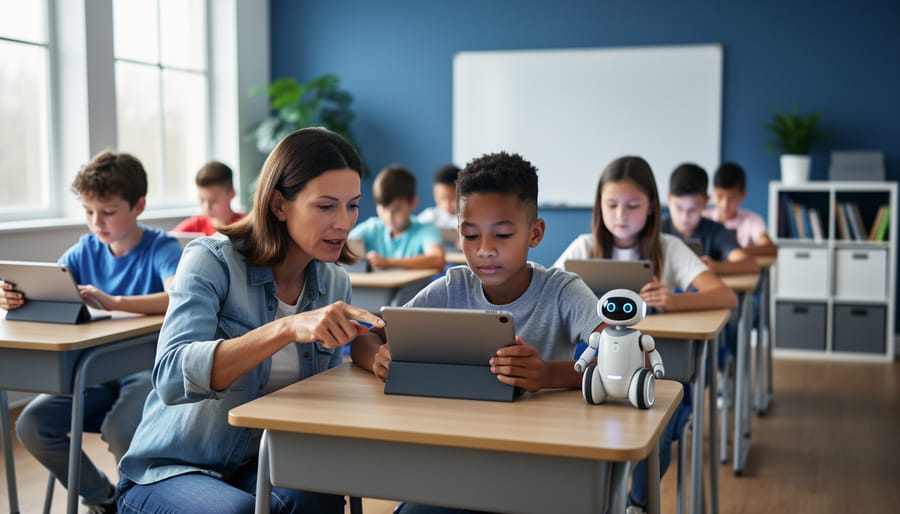
Artificial intelligence is reshaping classrooms faster than most people realize. From elementary schools experimenting with adaptive learning software to universities deploying AI-powered grading systems, educational institutions worldwide are making billion-dollar bets on this technology. The global AI in education market reached $4 billion in 2022 and is projected to exceed $30 billion by 2032, signaling a transformation that will touch every student, teacher, and parent.
But this rapid adoption raises crucial questions. Will AI truly personalize learning for every child, or will it widen the digital divide? Can intelligent tutoring systems replace the irreplaceable human connection between teachers and students? As schools rush to integrate chatbots, automated assessment tools, and predictive analytics into their curricula, understanding both the promises and pitfalls becomes essential for anyone involved in education.
This analysis examines five key advantages AI brings to learning environments alongside five significant concerns that deserve serious consideration. Whether you’re an educator deciding if AI tools belong in your classroom, a parent evaluating your child’s AI-enhanced curriculum, or a student navigating AI-powered learning platforms, this balanced exploration provides the factual foundation you need. The future of education isn’t simply about adopting technology—it’s about implementing it wisely, with eyes wide open to both its transformative potential and legitimate risks.
The Bright Side: 5 Compelling Advantages of AI in Education
Personalized Learning That Actually Adapts to Each Student
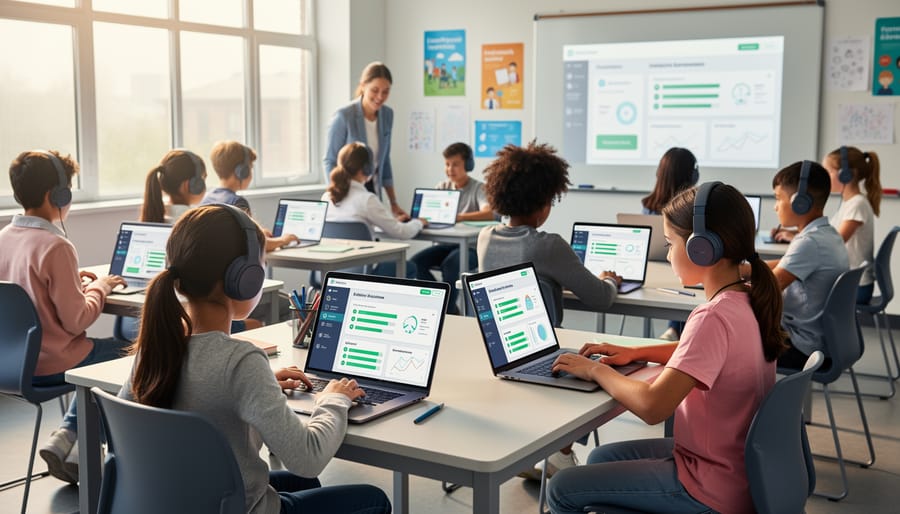
Imagine a classroom where every student receives exactly the lesson they need, when they need it. That’s the promise of AI-powered personalized learning, and it’s already transforming how millions of people study.
Traditional education follows a one-size-fits-all approach—everyone gets the same lecture, completes the same assignments, and moves forward at the same pace. AI changes this fundamentally by analyzing how individual students learn. These systems track which problems you struggle with, how long you spend on different topics, and which explanation styles help concepts click for you.
Khan Academy’s AI tutor, for example, monitors your performance across thousands of practice problems. When you consistently miss questions about fractions, it doesn’t just mark them wrong—it identifies the specific concept you’re missing and adjusts future lessons accordingly. If you’re breezing through geometry, it accelerates your progression rather than making you wait for classmates to catch up.
Duolingo takes a similar approach with language learning. Its AI notices patterns in your mistakes, like confusing verb conjugations, and creates targeted practice sessions. The app adjusts difficulty in real-time, ensuring you’re challenged but not overwhelmed.
This personalization happens instantly and continuously. While a human teacher manages thirty students simultaneously, AI systems provide individual attention to each learner. They identify knowledge gaps before they become major obstacles, offer alternative explanations when the first approach doesn’t work, and create custom learning paths based on your strengths and weaknesses.
The result? Students spend less time on material they’ve mastered and more time reinforcing concepts that need work—making learning significantly more efficient and less frustrating.

24/7 Support Through AI Tutors and Chatbots
Picture this: It’s 2 AM, and Sarah is staring at her calculus homework, completely stuck on a problem that’s due in six hours. In the past, she’d have to wait until morning to ask her teacher or classmate for help. Today, she opens an AI tutoring app that immediately breaks down the problem step-by-step, adapting its explanation to her learning pace.
This scenario represents one of AI’s most transformative contributions to education: round-the-clock academic support. AI-powered chatbots and virtual tutors never sleep, never take breaks, and remain endlessly patient with students who need multiple explanations of the same concept.
Take Carnegie Learning’s MATHia platform, which serves over 600,000 students across the United States. The system provides personalized math tutoring at any hour, recognizing when students struggle with specific concepts and offering alternative approaches until understanding clicks. Similarly, platforms like Duolingo’s chatbot feature allows language learners to practice conversations at midnight or during their morning commute, fitting education into their unique schedules.
For teachers, this technology offers welcome relief. Rather than fielding dozens of emails about homework questions or basic clarifications, educators can focus their energy on complex instruction and meaningful student interactions. Studies show that AI tutors handle approximately 40 percent of routine student queries, freeing teachers to address higher-level concerns.
The benefits extend beyond convenience. Students in different time zones, those balancing jobs with studies, or learners who simply process information better at unconventional hours all gain equal access to support. This democratization of educational assistance helps level the playing field, ensuring that learning doesn’t stop when the school bell rings.
Automated Grading Saves Hundreds of Teacher Hours
Imagine a high school English teacher with 150 students, each submitting a weekly essay. Grading those assignments could consume 15-20 hours every week—time that vanishes from lesson planning, one-on-one student support, and professional development. This is where AI-powered automated grading systems are transforming education.
Modern AI tools can evaluate multiple-choice tests instantly, a capability educators have relied on for decades through basic scanners. But today’s systems go much further. Advanced algorithms now assess written responses, essays, and even coding assignments, analyzing grammar, structure, argument coherence, and content accuracy. A teacher who once spent entire weekends grading can now receive preliminary assessments within minutes.
The time savings are substantial. Research indicates that teachers spend approximately 5-7 hours weekly on grading tasks. AI automation can reduce this by 50-70%, freeing up three to five hours that teachers can redirect toward activities that genuinely move the needle on student success. These reclaimed hours enable educators to design more creative lessons, provide personalized feedback during class discussions, or offer struggling students the extra attention they need.
Consider a middle school math department that implemented AI grading for homework assignments. Teachers reported reclaiming 200+ hours collectively over a single semester. They used this time to develop interactive problem-solving workshops and conduct small-group tutoring sessions, directly addressing individual learning gaps.
The efficiency extends beyond time. Automated grading provides immediate feedback to students, allowing them to understand mistakes while the material remains fresh, accelerating the learning cycle and keeping momentum strong.
Breaking Down Accessibility Barriers for All Learners
AI has emerged as a powerful equalizer in education, opening doors for students who face physical, cognitive, or language barriers. These technologies transform learning environments into inclusive spaces where every student can participate fully.
For students with visual impairments, text-to-speech tools like Microsoft’s Immersive Reader and Amazon Polly convert written content into clear audio, allowing them to access textbooks, articles, and assignments independently. Natural Voices technology has advanced so dramatically that students report feeling more engaged with materials when they can adjust reading speed and voice preferences to match their learning style.
Speech-to-text applications serve students with hearing challenges or those who struggle with traditional writing. Tools like Otter.ai and Google’s Live Transcribe capture classroom discussions in real-time, ensuring no student misses important information. Consider Maria, a high school student with dysgraphia who increased her essay completion rate by 85% after using Dragon NaturallySpeaking to dictate her thoughts rather than struggling with handwriting.
Language barriers crumble with AI-powered translation tools. AI accessibility tools like Google Translate and Microsoft Translator enable non-native English speakers to understand course materials in their primary language while simultaneously building English proficiency. These systems now support over 100 languages with impressive accuracy.
The beauty of these innovations lies in their discretion and personalization. Students can access support without calling attention to their needs, fostering confidence and independence. As these technologies continue improving, they’re not just accommodating differences—they’re celebrating them, proving that with the right tools, every learner can succeed.
Data-Driven Insights That Predict Student Struggles Early
One of AI’s most powerful advantages in education is its ability to spot struggling students long before traditional methods would notice. Instead of waiting for a failing grade on a midterm exam, AI-powered learning platforms continuously monitor student behavior, creating early warning systems that can literally change academic trajectories.
Here’s how it works in practice: AI algorithms track dozens of engagement signals simultaneously—how long students spend on assignments, which problems they revisit multiple times, when they log in to study, and even their mouse movement patterns during online tests. At Georgia State University, an AI system called the Student Success Collaboration Platform analyzes over 800 risk factors to identify students who might drop out. Since implementing this system in 2012, the university has awarded 7,000 additional degrees than projected, with particularly strong improvements among minority students.
These systems don’t just flag problems; they provide actionable insights. When a student’s assignment completion rate drops or they consistently struggle with specific math concepts, the AI alerts instructors with concrete suggestions. A middle school in Seattle uses an AI platform that noticed a seventh-grader’s reading comprehension scores declining over three weeks—a pattern her teacher might have missed amid a class of 30 students. The early notification led to a vision screening that revealed the student needed glasses.
The intervention timing makes all the difference. Research shows students who receive support within the first few weeks of showing struggle are significantly more likely to recover academically than those who fall further behind. AI transforms what was once educated guesswork into precise, data-backed decision-making, allowing educators to deploy their limited time and resources exactly where they’ll have maximum impact.
The Dark Side: 5 Critical Drawbacks You Need to Consider
Privacy Concerns and Student Data Collection
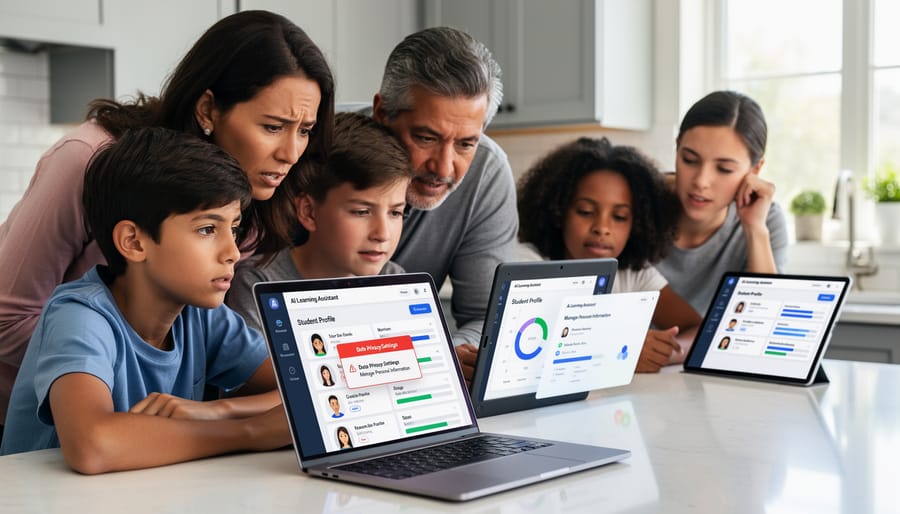
When AI systems enter classrooms, they often become silent observers, collecting vast amounts of information about students. Every quiz answer, reading speed, mouse click, and even how long a student hesitates before responding gets recorded and analyzed. While this data helps personalize learning, it raises serious questions about privacy and control that educators and parents are only beginning to address.
The scope of data collection can be staggering. AI-powered learning platforms track not just academic performance, but behavioral patterns, login times, peer interactions, and emotional responses detected through facial recognition or sentiment analysis. Imagine a middle school student using an AI tutoring app that records how frustrated they become with math problems, how often they’re distracted, and which topics make them anxious. This sensitive information paints an intimate portrait that goes far beyond traditional grade books.
Who actually owns this data remains murky territory. Education technology companies often retain rights to student information, potentially sharing it with third-party advertisers, data brokers, or other commercial entities. A 2022 study found that many popular educational apps shared student data with an average of four outside companies without clear disclosure to parents or schools.
The risks extend beyond privacy invasion. Data breaches in education technology have exposed millions of student records, including names, addresses, social security numbers, and learning disabilities. These breaches can follow students for years, affecting college applications or future employment.
Perhaps most troubling is the lack of transparency in how algorithms use this information. Parents and students rarely understand what data gets collected, how long it’s stored, or how AI systems make decisions that could impact educational opportunities. This black-box problem means families cannot make truly informed consent decisions about the technology shaping children’s academic futures.
The Widening Digital Divide Between Schools
While AI promises to revolutionize education, it’s simultaneously creating a troubling gap between schools that have resources and those that don’t. Imagine two students graduating in the same year—one who spent their education interacting with AI tutors, virtual reality labs, and personalized learning platforms, and another who barely had access to reliable internet. This isn’t a hypothetical scenario; it’s happening right now.
The infrastructure requirements for implementing AI in schools are substantial. Beyond just purchasing software licenses, schools need high-speed internet, modern computers, cloud storage, and technical staff to maintain these systems. A 2023 report found that while 95% of well-funded private schools had adopted some form of AI-assisted learning, only 34% of under-resourced public schools had access to similar tools. The annual cost for comprehensive AI integration can range from $50,000 to over $200,000 per school, depending on student population.
This digital divide extends beyond just hardware and software. Teachers in wealthier districts receive training on how to effectively integrate AI into their classrooms, while educators in underfunded areas often lack professional development opportunities. Students in affluent communities gain familiarity with AI tools that will likely shape their future careers, building technological literacy and confidence. Meanwhile, students without access fall further behind, limiting their college readiness and career prospects.
The result is a self-perpetuating cycle where educational inequality deepens, potentially creating two distinct classes of graduates in an AI-driven economy. Without intentional intervention and equitable funding policies, AI could widen rather than bridge the achievement gap.
Over-Reliance That Weakens Critical Thinking Skills
When students can instantly summon answers from AI assistants, the temptation to skip the challenging work of learning becomes overwhelming. This convenience carries a hidden cost: the erosion of critical thinking skills that develop through struggle and persistence.
Consider Sarah, a college sophomore who began using AI tools to help with her economics assignments. What started as occasional assistance for understanding difficult concepts gradually evolved into complete dependence. By midterm, she couldn’t analyze case studies independently because she’d never actually practiced the skill—the AI had done the thinking for her. Her grades looked strong on paper, but her actual understanding remained shallow.
This pattern reveals one of the darker implications of AI in educational settings. When students bypass the productive struggle that builds neural connections and problem-solving abilities, they’re essentially renting knowledge rather than owning it. The temporary convenience masks a long-term deficit in their intellectual development.
Research shows that wrestling with difficult problems builds resilience and cognitive flexibility. Students who persevere through challenging math problems or complex writing assignments develop metacognitive skills—learning how to learn. They build confidence in their ability to tackle unfamiliar problems. AI shortcuts rob them of these formative experiences.
The issue extends beyond academic skills. Problem-solving resilience translates to professional and personal life. Employers consistently report wanting graduates who can think independently, adapt to challenges, and persist through setbacks. Students who’ve outsourced their thinking to AI throughout their education arrive in the workplace unprepared for situations where no algorithm can provide the answer.
Bias Baked Into Algorithms
While AI promises personalized learning experiences, these systems can inadvertently carry the biases of their creators and training data into classrooms. When algorithms learn from historical educational data that reflects past inequalities, they risk reinforcing those same patterns with today’s students.
Consider what happened when a major educational software company analyzed their AI-powered grading system. Researchers discovered the algorithm consistently scored essays from students with African American Vernacular English lower than similar-quality essays written in standard academic English. The system had learned to associate certain linguistic patterns with lower grades based on historical grading data, essentially automating discrimination.
Another troubling example emerged from college admission prediction tools. An investigation found these AI systems frequently underestimated the potential of students from underfunded schools, partly because the algorithms weighted factors like access to Advanced Placement courses—opportunities not equally available across different communities. Students from wealthier districts received more favorable predictions despite comparable academic abilities.
Facial recognition systems used for remote exam proctoring have shown significantly higher error rates when identifying students with darker skin tones, sometimes flagging them incorrectly for cheating. This technical limitation disproportionately affects minority students, creating additional stress and unfair scrutiny during assessments.
The challenge extends beyond obvious discrimination. AI recommendation systems might subtly steer female students away from advanced mathematics courses or discourage students with learning disabilities from challenging content, based on patterns the algorithm identifies but shouldn’t perpetuate. These automated decisions happen invisibly, making them harder to identify and correct than human bias. Without careful oversight and diverse development teams, AI risks creating a more inequitable educational landscape while appearing objective and data-driven.
Loss of Human Connection in Learning
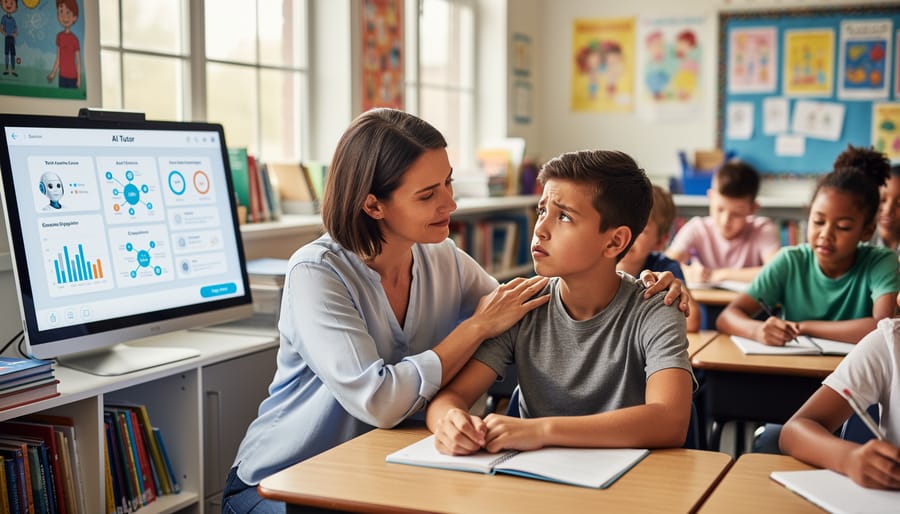
While AI brings remarkable efficiency to education, it fundamentally lacks the human qualities that make learning truly transformative. Think about a moment when a teacher noticed you were struggling—not just academically, but personally. Maybe they stayed after class to listen, adjusted their teaching approach specifically for you, or offered encouragement that changed your entire perspective. These irreplaceable human connections form the emotional backbone of education, something no algorithm can replicate.
Human teachers bring empathy, intuition, and mentorship that extend far beyond content delivery. When a student faces family challenges, anxiety, or self-doubt, a teacher’s compassionate response can make the difference between giving up and pushing forward. They read body language, detect subtle changes in behavior, and respond with emotional intelligence that AI simply cannot possess. A chatbot might provide factually correct answers, but it cannot offer the genuine understanding that comes from shared human experience.
The shift toward AI-driven education raises legitimate concerns about diminishing face-to-face interaction. Students develop critical social and emotional skills through classroom dynamics—learning to collaborate, navigate disagreements, read social cues, and build relationships. These experiences shape character and emotional maturity in ways that isolated digital learning cannot match. Young children especially need human interaction for healthy psychological development.
Education has always been about more than information transfer. It’s about inspiration, role modeling, and the mentorship relationships that guide students through formative years. A passionate teacher sharing their love for a subject, celebrating student breakthroughs, or challenging learners to exceed their own expectations creates memorable experiences that fuel lifelong learning. While AI can supplement education effectively, over-reliance on technology risks creating emotionally disconnected learning environments where students miss the human warmth that makes education meaningful and memorable.
Finding the Balance: What This Means for Your Educational Journey
Navigating AI in education doesn’t have to feel overwhelming. The key is approaching these tools with clear intentions and healthy boundaries.
For students, think of AI as your study companion, not your replacement brain. Use chatbots to explain difficult concepts or generate practice questions, but always engage with the material yourself. When writing essays, let AI help you brainstorm or outline, then put it aside and craft your own arguments. This approach builds critical thinking while still benefiting from AI’s capabilities.
Parents should maintain open conversations about AI usage. Ask your children to walk you through how they’re using these tools. Set expectations early—AI can help with homework, but submitting AI-generated work as your own crosses an ethical line. Encourage transparency and model good digital citizenship.
Educators face perhaps the toughest balancing act. Instead of banning AI outright, integrate it thoughtfully into your curriculum. Design assignments that require personal reflection, original analysis, or real-world application—tasks where AI becomes a starting point rather than a finish line. Staying informed about AI developments is essential, including what teachers need to know about emerging educational technologies.
Remember that AI is fundamentally a tool. Like calculators didn’t eliminate the need to understand mathematics, AI won’t replace the human elements that make education meaningful—curiosity, creativity, mentorship, and genuine understanding. The goal isn’t choosing between traditional methods and AI, but finding the sweet spot where technology amplifies human potential rather than diminishing it.
AI in education isn’t a magical solution that will revolutionize learning overnight, nor is it a dangerous threat that will replace teachers and dehumanize classrooms. The reality falls somewhere in between. As we’ve explored, AI brings remarkable benefits like personalized learning experiences, instant feedback, and greater accessibility for diverse learners. Yet it also presents genuine challenges including privacy concerns, potential bias, and the risk of over-dependence on technology.
The key lies in thoughtful, intentional implementation. Schools and educators who succeed with AI will be those who view it as a complement to human instruction rather than a replacement. By understanding both the advantages and limitations, we can harness AI’s potential while guarding against its pitfalls. This means asking critical questions about data protection, ensuring diverse training datasets, and maintaining the irreplaceable human elements of education like empathy, creativity, and critical thinking.
As teaching AI in schools becomes increasingly common, staying informed about these developments empowers everyone involved in education to make better decisions. Whether you’re an educator, student, parent, or administrator, keep engaging with these conversations as AI continues evolving in educational spaces.