

Governments worldwide are investing billions in national artificial intelligence strategies, recognizing that AI literacy is no longer optional but essential for economic competitiveness and citizen preparedness. As of 2024, over 60 countries have launched comprehensive AI initiatives aimed at educating their populations, from elementary students to working professionals, about this transformative technology.
National AI programs represent coordinated efforts by governments to democratize artificial intelligence knowledge, making it accessible beyond elite research institutions and tech companies. These initiatives typically combine three core elements: free educational resources available to all citizens, integration of AI concepts into formal education systems, and workforce retraining programs for industries facing automation.
The urgency stems from a simple reality: the World Economic Forum estimates that 85 million jobs may be displaced by 2025 due to automation, while 97 million new roles requiring AI understanding will emerge. Countries like Singapore, Canada, and the United Arab Emirates have responded by creating national AI academies, offering certifications, and providing citizens with hands-on learning platforms at no cost.
What makes these programs particularly valuable is their focus on practical application rather than theoretical computer science. A factory worker in Finland can access government-funded courses on how AI affects manufacturing. A teacher in South Korea receives training on integrating AI tools into classrooms. A small business owner in India learns to implement AI-powered customer service solutions.
Understanding national AI initiatives helps you identify legitimate, high-quality learning resources backed by governmental oversight and academic rigor. These programs cut through the noise of commercial AI hype, offering structured pathways tailored to different skill levels and career goals, ensuring no one gets left behind in the AI revolution.
Why Nations Are Racing to Build AI Education Programs
The Economic Stakes of AI Literacy
Countries worldwide increasingly recognize AI literacy as essential infrastructure, similar to roads or electricity, because their economic futures depend on it. When Singapore launched its national AI strategy, officials noted that 60% of jobs would require AI-related skills by 2030. This isn’t speculation—the shift is already happening.
Consider the finance sector, where traditional bank tellers are transitioning to roles managing AI-powered customer service systems. In manufacturing, assembly line workers now oversee robotic systems that require basic programming knowledge. Even creative industries like marketing demand professionals who understand how AI tools generate content and analyze consumer behavior.
The numbers tell a compelling story. Estonia invested 2% of its GDP in digital education, resulting in a tech sector that now contributes 15% to the national economy. Meanwhile, South Korea’s AI workforce development program aims to train 10,000 AI specialists annually, recognizing that every specialist creates approximately five supporting jobs in data analysis, system maintenance, and AI ethics consulting.
Companies are feeling the pressure too. A 2023 report showed that 75% of businesses struggle to find employees with adequate AI skills, leaving millions of positions unfilled. This skills gap costs the global economy an estimated $500 billion annually in lost productivity.
Nations treating AI education as critical infrastructure position themselves to capture these economic opportunities, while those delaying risk being left behind in the global marketplace.
Closing the AI Skills Gap
The world faces a significant talent shortage in artificial intelligence. According to recent industry reports, there are currently three job openings for every qualified AI professional, creating a bottleneck that threatens innovation across sectors. This gap isn’t just about advanced researchers—companies need AI specialists at every level, from data analysts to machine learning engineers to AI ethics officers.
Recognizing this challenge, governments worldwide are launching comprehensive programs to build a talent pipeline starting from the classroom. Singapore’s AI Singapore initiative, for example, partners with schools to introduce computational thinking and basic AI concepts to students as young as 10. These early interventions demystify AI and spark interest before career paths solidify.
At the university level, national programs often subsidize AI-focused degrees and bootcamps. India’s National Programme on AI funds scholarships for students pursuing machine learning studies, while simultaneously upskilling working professionals through free online courses. The goal is twofold: prepare the next generation while reskilling the current workforce facing automation.
Perhaps most innovative are apprenticeship models connecting students directly with industry. France’s AI for Humanity strategy places graduate students in company-sponsored research projects, giving them real-world experience while solving actual business problems. This bridges the notorious theory-to-practice gap that often leaves new graduates underprepared.
These coordinated efforts recognize that closing the skills gap requires more than individual initiative—it demands systematic investment in education infrastructure, accessible training resources, and clear pathways from learning to employment.
What National AI Education Programs Actually Look Like
School-Level AI Integration
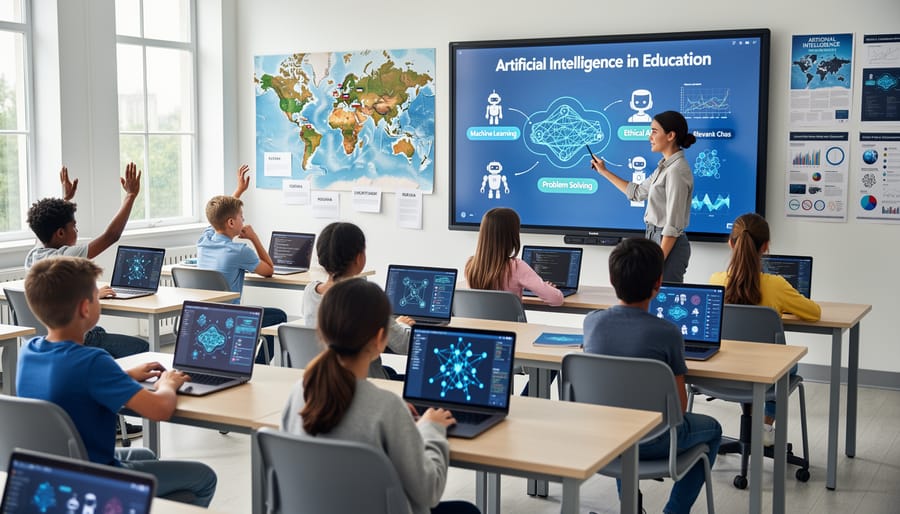
Countries worldwide are recognizing that teaching AI in schools must start early to prepare students for an AI-driven future. These initiatives aren’t about turning every child into a programmer, but rather building fundamental literacy in how artificial intelligence works and impacts daily life.
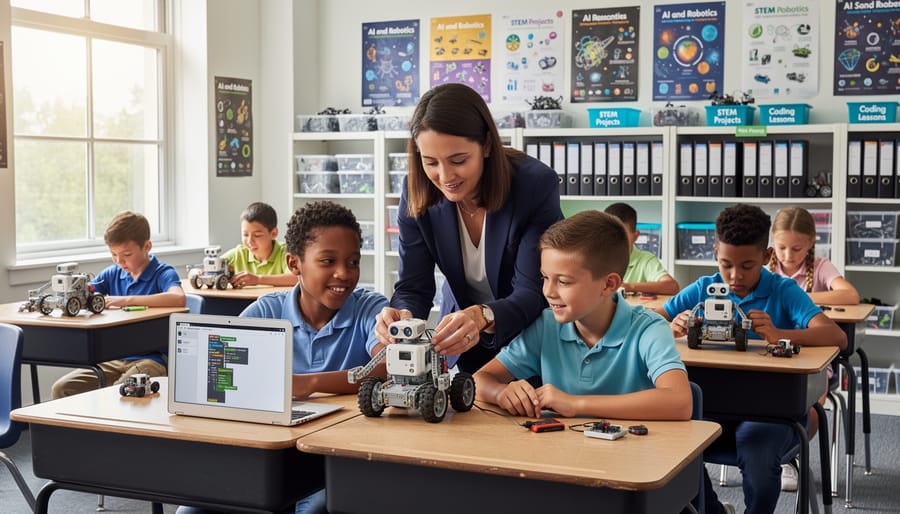
China has integrated AI education into its national curriculum, with students as young as eight learning basic concepts through interactive tools and robotics. The curriculum progresses from understanding simple algorithms to creating basic machine learning projects by high school. Students use visual programming platforms that make abstract concepts tangible.
South Korea’s approach emphasizes hands-on experimentation. Elementary students learn pattern recognition through games, while middle schoolers train simple AI models to recognize images or predict outcomes. Teachers receive specialized training to deliver these lessons confidently, even without technical backgrounds.
Singapore has incorporated AI literacy across multiple subjects rather than treating it as standalone content. Students might analyze how AI affects storytelling in language arts or explore its role in environmental science projects. This cross-curricular approach helps students see AI as a practical tool rather than an intimidating technology.
Finland focuses on ethical considerations alongside technical skills. Students discuss bias in algorithms, data privacy, and AI’s societal impact through age-appropriate discussions and case studies. The goal is developing critical thinkers who can navigate an AI-augmented world responsibly, understanding both opportunities and limitations these technologies present.
University and Research Partnerships
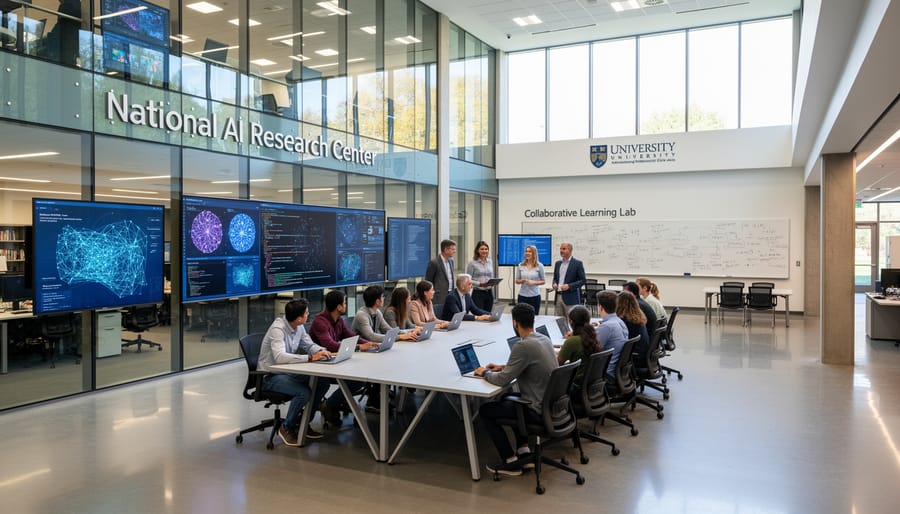
Governments worldwide are investing heavily in university-based AI research centers to accelerate innovation and develop homegrown talent. These partnerships typically involve substantial funding for dedicated AI labs, attracting top researchers and creating specialized degree programs. For example, Canada’s Vector Institute collaborates with the University of Toronto to advance machine learning research while training the next generation of AI experts. Similarly, France established national AI institutes within major universities, each focusing on specific applications like healthcare or autonomous systems.
Scholarship programs play a crucial role in making AI education accessible. Countries like Singapore offer full scholarships for students pursuing AI-related degrees, ensuring diverse representation in the field. These programs often include internships with industry partners, giving students hands-on experience with real-world challenges.
The academia-industry bridge is perhaps the most transformative aspect. Through these partnerships, students work on actual business problems while companies gain access to cutting-edge research. Germany’s AI Competence Centers exemplify this model, hosting joint projects where researchers and engineers collaborate on everything from manufacturing automation to natural language processing applications. This approach ensures that academic discoveries quickly translate into practical solutions, while industry feedback shapes research priorities to address genuine market needs.
Public Access and Lifelong Learning
Governments worldwide recognize that AI literacy shouldn’t be reserved for university students or tech professionals. That’s why many national AI strategies now include free educational resources designed for everyone, regardless of background or current career path.
Take Finland’s Elements of AI course as a prime example. This completely free online program has trained millions of people across Europe in basic AI concepts, requiring no prior technical knowledge. The course uses everyday scenarios, like how streaming services recommend movies, to explain machine learning fundamentals in plain language.
Similar initiatives are emerging globally. India’s National Programme on AI offers certification courses targeting working professionals who want to transition into AI roles. These programs typically combine video lectures with hands-on projects, allowing learners to build portfolios while maintaining their current jobs.
Many countries also partner with online learning platforms to provide subsidized or free access to specialized AI training. These reskilling initiatives often focus on industries facing automation, helping workers understand how AI will change their fields rather than replace them entirely.
The beauty of these programs lies in their accessibility. Whether you’re a teacher curious about AI in education, a healthcare worker exploring diagnostic tools, or simply someone wanting to understand the technology shaping our world, national AI education initiatives provide clear pathways to get started without financial barriers.
Leading Countries and Their Unique Approaches
China’s AI Education Ecosystem
China has built one of the world’s most ambitious AI education ecosystems, starting education at the elementary level. In 2018, the country introduced AI textbooks for students as young as first grade, making it among the first nations to integrate artificial intelligence into primary school curricula. These textbooks use colorful illustrations and hands-on projects to teach children basic concepts like pattern recognition and decision-making algorithms through age-appropriate activities.
The commitment extends far beyond textbooks. China’s government has invested billions of dollars in establishing AI research centers at top universities, including Tsinghua and Peking University. These institutions receive substantial funding to develop cutting-edge research labs and attract global talent. The government has also launched aggressive talent retention programs, offering generous subsidies, housing benefits, and research grants to keep Chinese AI graduates within the country rather than losing them to Silicon Valley or other international tech hubs.
This comprehensive strategy creates a pipeline from curious elementary students to world-class researchers, positioning China as a formidable force in the global AI landscape. The ecosystem demonstrates how coordinated government support across all education levels can accelerate national AI capabilities while democratizing access to this transformative technology.
Finland’s AI for Everyone Initiative
Finland took a remarkably inclusive approach to artificial intelligence education in 2018 when it launched the “Elements of AI” initiative. The ambitious goal? To teach AI basics to 1% of its population—approximately 55,000 people. What made this groundbreaking wasn’t just the scale, but the philosophy: AI literacy should be a democratic right, not a privilege reserved for tech professionals.
The Finnish government partnered with the University of Helsinki and tech company Reaktor to create a free online course that strips away intimidating jargon. The program covers everything from understanding what AI can and cannot do, to exploring machine learning fundamentals through everyday examples like email spam filters and music recommendations.
The results exceeded expectations. Over 750,000 people from more than 170 countries have completed the course, proving that accessible education can spark global interest. Finland didn’t stop there—they released “Building AI,” a follow-up course teaching participants to create simple AI applications using practical, hands-on exercises.
This initiative demonstrates how governments can democratize AI knowledge by removing barriers to entry. Rather than focusing solely on training elite programmers, Finland recognized that broad public understanding of AI would benefit society as a whole, from informed policymaking to workplace adaptation.
Singapore’s AI Apprenticeship Model
Singapore takes a hands-on approach to AI education by bridging the gap between classroom learning and industry needs. Through its apprenticeship model, students partner directly with companies on live AI projects while still pursuing their studies. This means working on real challenges like optimizing supply chains, improving customer service chatbots, or developing predictive maintenance systems for manufacturing.
The program connects polytechnic and university students with tech firms, startups, and established corporations for 6 to 12-month placements. Students gain practical skills in data analysis, machine learning implementation, and project management while companies benefit from fresh perspectives and cost-effective innovation support. For example, a student might help a retail company build a recommendation engine or assist a healthcare provider in developing diagnostic tools.
This industry-focused strategy ensures graduates enter the workforce with portfolio-ready experience and established professional networks, making them immediately valuable to employers in Singapore’s growing AI ecosystem.
Other Innovative National Programs
Beyond the major initiatives, several countries have adopted creative strategies worth noting. Canada’s Pan-Canadian Artificial Intelligence Strategy, launched in 2017, distinguished itself by investing heavily in AI research institutes across Montreal, Toronto, and Edmonton. This distributed approach created regional hubs of excellence rather than concentrating resources in one location, fostering collaboration between universities and industry partners while making AI education accessible to diverse communities nationwide.
The United Arab Emirates took a unique path by appointing the world’s first Minister of State for Artificial Intelligence in 2017, signaling government-level commitment to AI integration. Their national strategy emphasizes practical applications in healthcare, transportation, and education, with programs designed to train Emiratis in AI skills to reduce dependency on foreign talent.
South Korea’s approach combines substantial funding with ambitious timelines. Their AI strategy focuses on training AI specialists through university programs while simultaneously upskilling workers in traditional industries facing automation, ensuring no one gets left behind in the technological transition.
Educational Resources Born from National AI Programs
Free Courses and Platforms
Several countries have launched government-backed AI education platforms that welcome international learners, making cutting-edge knowledge accessible to anyone with an internet connection.
Finland’s Elements of AI stands out as a pioneering initiative. Created by the University of Helsinki and tech company Reaktor, this free course has educated over two million people worldwide. It breaks down AI concepts into digestible modules, requiring no programming experience. The course covers everything from machine learning basics to ethical considerations, using real-world scenarios like how Netflix recommends shows.
Singapore’s AI Singapore offers several programs through its AI for Everyone initiative. While primarily designed for Singaporeans, many resources remain freely accessible globally. Their courses explain practical applications in healthcare, transportation, and finance through case studies from Singaporean smart city projects.
The European Union’s Digital Skills and Jobs Platform provides curated AI learning paths through partnerships with leading universities. These interactive online courses include hands-on exercises and certification options.
India’s NPTEL (National Programme on Technology Enhanced Learning) features university-level AI courses with video lectures, assignments, and discussion forums. While exam certificates require fees, course access remains completely free for international students seeking foundational knowledge in neural networks, computer vision, and natural language processing.

Open Datasets and Tools
Many countries have opened their AI research and development resources to the public, creating valuable opportunities for learners to gain hands-on experience. These initiatives transform government-funded projects into accessible learning tools that anyone can explore.
The United States offers several publicly available datasets through agencies like NASA and the National Institutes of Health. For instance, NASA’s open data portal provides satellite imagery and space mission datasets perfect for computer vision projects. Similarly, the UK government’s data.gov.uk platform hosts thousands of datasets covering healthcare, transportation, and environmental monitoring that students can use to build real-world AI applications.
Singapore’s AI Singapore program has released pre-trained models and development frameworks designed specifically for Southeast Asian contexts, including natural language processing tools optimized for multiple regional languages. These tools help beginners understand how AI models adapt to different cultural and linguistic environments.
France’s Etalab initiative provides APIs for government services, allowing developers to create applications that interact with public data in real-time. Meanwhile, Canada’s Open Government portal combines datasets with tutorials showing practical implementation examples.
These resources typically come with documentation and community forums where beginners can ask questions and share projects, making them ideal starting points for anyone looking to move from theory to practice in their AI learning journey.
Certification and Credentialing Programs
Several countries now offer nationally recognized AI certifications designed to validate skills and advance careers in artificial intelligence. These programs typically cover foundational concepts like machine learning, neural networks, and ethical AI implementation.
In the United States, platforms like AI.gov highlight workforce development programs that connect learners with industry-standard credentials. Many of these certifications require no prior computer science degree, making them accessible to career changers and students alike. Prerequisites usually include basic programming knowledge and an understanding of statistics.
Popular credential pathways include entry-level certificates for beginners, which can be completed in three to six months through online platforms, and advanced certifications for professionals seeking specialization in areas like computer vision or natural language processing. Some programs offer financial assistance or are completely free through government partnerships.
These credentials signal to employers that you possess practical, job-ready AI skills, opening doors to roles in data science, AI engineering, and research across various industries.
How to Tap Into National AI Resources (Even If You’re Not a Citizen)
Good news: many national AI research resources welcome international learners, not just citizens. Here’s how you can access these valuable programs regardless of where you live.
Start by exploring online platforms that host government-backed AI education. Finland’s Elements of AI, for instance, is completely open to anyone worldwide and requires no prior technical knowledge. Simply visit the website, create a free account using any email address, and begin learning immediately. The course is available in multiple languages, making it accessible to a global audience.
Singapore’s AI Singapore offers several free courses through its AI for Everyone initiative. While some advanced programs prioritize local participants, their foundational courses are open to international enrollment. Check their website regularly for new course launches and application periods.
For hands-on learning, look into government-supported platforms like Kaggle, which partners with various national AI initiatives to provide free datasets and learning competitions. Create a profile and participate in beginner-friendly challenges to build practical skills alongside learners worldwide.
Many countries also host open-access webinars and virtual workshops. The UK’s Alan Turing Institute regularly streams public lectures on YouTube, while Germany’s AI Campus provides free online courses accessible from anywhere. Subscribe to their newsletters to stay informed about upcoming opportunities.
When applying to programs with limited spots, highlight your commitment to sharing knowledge within your own community. Many national initiatives appreciate international participants who can extend their educational impact globally.
Practical first step: Visit three national AI education websites this week. Create accounts on platforms offering immediate access, and bookmark those requiring applications. Set calendar reminders for application deadlines, and join their social media communities to network with fellow learners. Remember, these resources exist to democratize AI education, so don’t hesitate to take advantage of what’s available to you right now.
National artificial intelligence education initiatives are fundamentally transforming who gets to participate in the AI revolution. What once required enrollment at elite universities or expensive private courses is now available to anyone with an internet connection and curiosity to learn. These government-backed programs have democratized access to world-class AI education, breaking down barriers of geography, income, and institutional affiliation.
The beauty of these initiatives lies in their recognition that AI literacy shouldn’t be a privilege reserved for a select few. Whether you’re a student in a rural community, a professional looking to transition careers, or simply someone fascinated by how machines learn, these resources meet you where you are. Countries worldwide have invested in creating comprehensive learning pathways that guide complete beginners through their first steps in understanding neural networks, machine learning algorithms, and data science fundamentals.
For self-directed learners, this moment represents an unprecedented opportunity. You can learn from the same materials used to train government employees and industry professionals, at your own pace and on your own schedule. The key is simply to begin. Explore the programs available in your country, or venture beyond borders to tap into international resources that welcome global learners.
Looking ahead, these national AI education initiatives will continue evolving, adapting to emerging technologies and expanding their reach. They’re not just teaching skills for today’s job market but cultivating a generation of informed citizens who can thoughtfully navigate an AI-integrated future. The question isn’t whether AI will shape our world, but whether you’ll be prepared to shape it alongside these transformative technologies.