

Picture this: A life insurance application that once took weeks to process now receives approval in minutes. A small business owner uploads documents at midnight and wakes up to a fully underwritten policy. This isn’t science fiction—it’s happening right now as AI is revolutionizing industries, and insurance underwriting is experiencing one of the most dramatic transformations.
Traditional underwriting has long been insurance’s bottleneck. Underwriters manually review mountains of paperwork, medical records, financial statements, and risk assessments—a process that’s not only time-consuming but prone to inconsistency and human error. For customers, this means frustrating delays. For insurers, it translates to operational costs that eat into profits and competitive disadvantages in a market demanding instant gratification.
Enter artificial intelligence and machine learning. These technologies are fundamentally reshaping how insurance companies evaluate risk and approve applications. Advanced algorithms now analyze thousands of data points in seconds, learning from millions of past decisions to make accurate risk assessments that once required days of expert review. From health records to driving patterns, from credit history to social media behavior, AI systems synthesize diverse information streams to create comprehensive risk profiles.
This article explores the practical reality of automated underwriting: the specific technologies making it possible, real companies deploying these systems today, measurable benefits for both insurers and customers, and the genuine challenges that remain as this technology matures.
What Traditional Underwriting Actually Looks Like (And Why It’s Painfully Slow)
Let’s follow Sarah, a 42-year-old teacher applying for life insurance. She submits her application on a Monday morning, eager to finalize her family’s financial protection. What happens next reveals why traditional underwriting feels like watching paint dry.
First, Sarah’s application lands in a queue with hundreds of others. An underwriter named Mike finally picks it up three days later. He starts by manually reviewing her medical history form, cross-referencing details against internal guidelines stored in a massive PDF binder. Sarah mentioned she takes medication for high blood pressure, so Mike must request her complete medical records from three different doctors.
This is where things slow to a crawl. Each doctor’s office has 10-15 business days to respond. One office uses paper files and must physically mail them. Another needs Sarah to sign an additional release form they forgot to include initially. The third sends records, but they’re illegible faxes from 1997.
Two weeks pass. Mike finally receives all documents and begins his risk assessment. He calculates Sarah’s health score using spreadsheet formulas, checks her driving record through a separate portal, and verifies her income statements. Each system requires different login credentials and doesn’t communicate with the others. He encounters an edge case where Sarah’s international travel history requires supervisor approval, adding another three-day delay.
After manual calculations and consultations with senior underwriters, Mike determines Sarah qualifies for coverage but at a slightly higher premium due to her medical history. The entire process took 23 days.
For insurers, this timeline means operational costs pile up. For applicants like Sarah, it means frustration and sometimes abandoning applications altogether. Industry data shows that 40% of applicants never complete the process when it stretches beyond two weeks, representing millions in lost revenue for insurance companies.

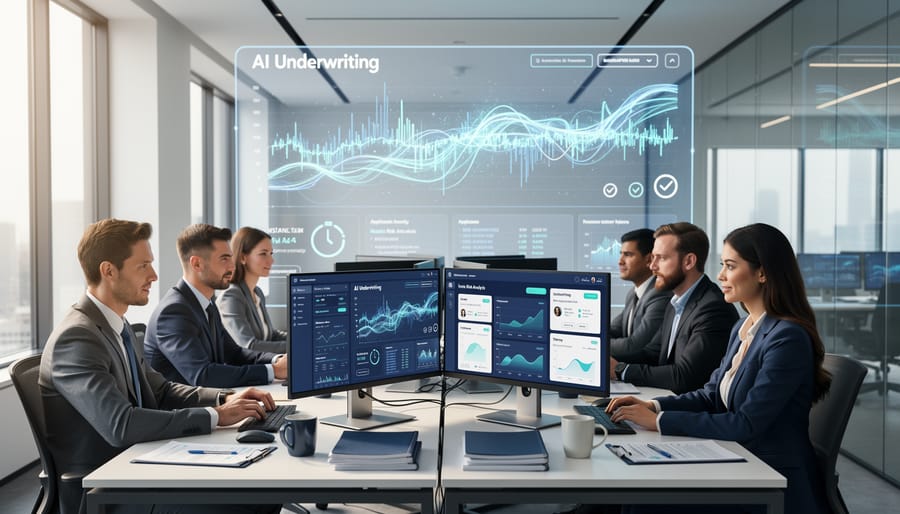
The AI Technology That’s Changing Everything
Machine Learning Models That Learn From Millions of Applications
Insurance companies feed their AI systems millions of past applications, creating digital libraries of experience. These machine learning frameworks study patterns in approved and denied applications, learning to spot connections that even experienced underwriters might miss.
Think of it like teaching a child to identify animals. Show them thousands of pictures, and they eventually recognize a dog regardless of breed or color. Similarly, AI models analyze vast datasets to understand risk profiles.
What exactly do these models examine? They process hundreds of data points simultaneously: applicant age, occupation, lifestyle habits, medical history, geographic location, and even social indicators. For instance, a life insurance model might discover that applicants who regularly participate in amateur marathons present different risk profiles than those who don’t exercise, adjusting premium calculations accordingly.
Real-world application shows impressive results. One major insurer trained their model on 10 million historical applications spanning two decades. The system learned to predict claim likelihood with 92% accuracy, identifying subtle risk factors like specific medication combinations or occupation-related stress patterns that traditional questionnaires overlooked. This continuous learning means the more applications processed, the smarter the system becomes at distinguishing between high-risk and low-risk applicants.
Natural Language Processing: Reading Documents Like a Human Expert
Natural Language Processing, or NLP, acts like a highly trained reader who can scan through mountains of paperwork in seconds. When an insurance application arrives, it typically includes medical records, bank statements, employment letters, and detailed forms—documents that traditionally required human underwriters to read line by line.
NLP technology transforms this process by automatically identifying and extracting key information from these documents. For example, when processing medical records, NLP can locate mentions of pre-existing conditions, prescribed medications, and recent diagnoses, even when they’re buried in doctor’s notes written in different formats. Similarly, it can pull income figures from financial statements and verify employment details from supporting documents.
The technology works by understanding context, not just keywords. If a medical record mentions “patient reports occasional headaches,” NLP recognizes this as different from “patient diagnosed with chronic migraines”—a distinction critical for accurate risk assessment. This intelligent reading capability means insurers can process applications faster while capturing information more consistently than manual review, reducing the chance that important details get overlooked in lengthy documents.
Predictive Analytics for Instant Risk Assessment
AI-powered predictive analytics transforms insurance underwriting by analyzing vast amounts of data in seconds rather than weeks. The system pulls information from diverse sources—medical records, driving history, credit scores, social media activity, and even wearable fitness devices—to create a comprehensive risk profile. Advanced algorithms identify patterns invisible to human underwriters, predicting claim probability with remarkable accuracy. For example, an auto insurance AI might detect that drivers who brake smoothly and maintain consistent speeds pose lower risks, automatically adjusting premiums accordingly. This is how machine learning is reshaping insurance, enabling instant decisions while ensuring premiums accurately reflect individual risk levels rather than broad demographic categories.
Real Companies Using AI Underwriting Right Now
While AI-powered underwriting might sound futuristic, several insurance companies are already reaping real benefits from this technology. Let’s look at how these early adopters are transforming their operations.
Lemonade, a digital-first insurance company, has become the poster child for automated underwriting. Their AI system, called Jim, can approve straightforward homeowners and renters insurance applications in as little as three seconds. Compare that to the industry average of several days or even weeks. The company reports that approximately 30% of their claims are handled entirely by AI without any human intervention. This lightning-fast processing hasn’t just impressed customers—it has slashed operational costs significantly, allowing Lemonade to offer competitive premiums while maintaining healthy margins.
Prudential Financial took a different approach with their life insurance products. Rather than replacing underwriters entirely, they implemented an AI system that analyzes medical records, prescription histories, and publicly available data to assess risk for policies up to $5 million. The results speak volumes: what once took 4 to 6 weeks now takes as little as 24 hours for qualified applicants. Prudential reports that about 60% of their applicants now receive instant decisions. The company also found that their AI system identified risk factors that human underwriters occasionally missed, actually improving their overall accuracy.
Munich Re, one of the world’s largest reinsurance companies, developed an AI platform called ALLFINANZ that helps insurers assess commercial property risks. The system analyzes satellite imagery, weather patterns, and local crime statistics to evaluate properties. Insurance companies using this platform report 40% faster processing times for commercial property applications and more consistent risk assessments across different underwriters.
These examples demonstrate that AI underwriting isn’t just theoretical—it delivers measurable improvements in speed, accuracy, and cost efficiency. The technology works particularly well for standard applications where risk factors are straightforward, freeing up human underwriters to focus on complex cases requiring nuanced judgment. As these success stories multiply, more insurance companies are investing in similar technologies to stay competitive.
What Automated Underwriting Means for You
For Insurance Buyers: From Weeks to Minutes
Remember when applying for insurance meant weeks of waiting, mountains of paperwork, and countless follow-up calls? Those days are rapidly disappearing. Today’s automated underwriting systems are transforming the customer experience in remarkable ways.
Instead of waiting two to three weeks for a decision, applicants now receive instant quotes and approval decisions in minutes. The process is simple: fill out a digital application, and AI systems immediately analyze your information against vast databases. Within moments, you have your answer.
The technology also enables truly personalized policies. Traditional underwriting often placed people into broad categories, but machine learning algorithms can evaluate your unique risk profile more precisely. This means fairer pricing—if you’re a healthy 35-year-old who exercises regularly, you’re no longer grouped with higher-risk individuals in the same age bracket.
The convenience extends beyond speed. Many insurers now offer entirely digital experiences, allowing you to complete applications from your smartphone at midnight if you choose. Some companies even integrate with wearable devices to offer dynamic pricing based on your actual lifestyle habits, rewarding healthy behaviors with lower premiums in real-time.

For Insurance Companies: Efficiency Meets Accuracy
For insurance companies, automating underwriting transforms operations in meaningful ways. The most immediate benefit is cost reduction—AI systems handle routine applications without human intervention, cutting processing costs by up to 70% in some cases. A single automated system can evaluate thousands of applications simultaneously, providing the scalability needed during peak seasons without hiring additional staff.
Consistency becomes another major advantage. While human underwriters might assess similar applications differently based on fatigue or personal judgment, AI applies the same criteria uniformly across every case. This standardization reduces errors and ensures fair treatment for all applicants.
The efficiency gains are remarkable. Insurance companies using automated underwriting report processing 10 to 20 times more applications with existing resources. This increased capacity means faster market response, improved customer acquisition, and the ability to handle growth without proportional increases in operational costs. Meanwhile, underwriters redirect their expertise toward complex, high-value cases that genuinely require human insight and decision-making.
For Underwriters: Becoming Strategic Advisors
AI systems now handle straightforward insurance applications automatically, processing standard cases in minutes rather than days. This shift allows human underwriters to evolve beyond data entry and routine assessment, focusing instead on complex scenarios that demand expert judgment—like evaluating unique business risks or navigating unusual medical histories. Think of it as transforming tech careers from repetitive tasks to strategic problem-solving. Underwriters become consultants who tackle edge cases, build relationships with brokers, and develop specialized expertise. For example, while AI approves a standard home insurance policy, the human expert analyzes coverage for a historic property with restoration features. This partnership maximizes efficiency while preserving the irreplaceable value of human insight.
The Challenges AI Underwriting Still Faces
Despite its promise, AI-powered underwriting faces several important hurdles that insurance companies must navigate carefully.
Data privacy stands at the forefront of these concerns. AI systems need vast amounts of personal information to make accurate decisions—everything from medical histories to driving records. When this data gets collected, stored, and analyzed, there’s always risk of breaches or misuse. Insurance companies are responding by implementing stronger encryption methods, anonymizing data where possible, and ensuring compliance with regulations like GDPR in Europe and CCPA in California. The challenge is balancing the need for comprehensive data with protecting customer privacy.
Algorithmic bias presents another significant challenge. If an AI system trains on historical data that contains human biases—perhaps past underwriters who unconsciously favored certain demographics—the AI will learn and perpetuate those same biases. For example, if historical data shows certain zip codes as high-risk simply because they correlate with particular ethnic groups, the AI might unfairly penalize applicants from those areas. Insurance companies are addressing this by conducting regular bias audits, diversifying their training data, and maintaining human oversight to catch discriminatory patterns before they affect real customers.
Regulatory compliance adds complexity too. Insurance is one of the most heavily regulated industries, and regulations vary dramatically between states and countries. AI systems must be explainable—regulators and customers alike have the right to understand why an application was denied. This requirement for transparency conflicts with some AI models that function as “black boxes,” making decisions through processes that even their creators struggle to explain fully.
Finally, there’s the question of human oversight. While AI excels at processing data and identifying patterns, it can miss nuances that experienced underwriters would catch. A temporary gap in employment might look risky to an algorithm but could have a perfectly reasonable explanation. That’s why most successful implementations use AI to assist rather than completely replace human underwriters, combining the efficiency of machines with human judgment and empathy.
Where This Technology Is Headed Next
The insurance underwriting landscape is poised for dramatic transformation over the next few years, driven by advances in AI technologies reshaping industries and the growing availability of real-time data sources.
One of the most significant developments on the horizon is the integration of data from wearable devices and Internet of Things (IoT) sensors. Insurance companies are already piloting programs that pull health metrics from smartwatches and fitness trackers to assess applicants in real-time. Instead of relying on annual checkups or self-reported health information, underwriters will soon access continuous streams of data about heart rate, activity levels, and sleep patterns. Similarly, home insurance carriers are beginning to use smart home devices that monitor everything from water leaks to security systems, allowing for more accurate risk assessment.
Hyper-personalization represents another major trend. Rather than placing applicants into broad risk categories, AI systems are moving toward creating truly individualized policies. These systems will consider hundreds of unique data points about each person, from driving habits tracked through telematics devices to lifestyle choices gleaned from social media and purchase histories. This means premiums that more precisely reflect individual risk rather than demographic averages.
Perhaps most transformative is the emergence of fully autonomous underwriting for standard cases. Major insurers are targeting systems that can approve straightforward applications within seconds, with zero human intervention. These platforms will handle routine decisions automatically while flagging only complex or unusual cases for human review. Early implementations suggest that 70-80 percent of applications could eventually flow through these autonomous systems, fundamentally changing how insurance companies allocate their workforce and serve customers.
The insurance industry stands at a pivotal moment. AI-powered underwriting automation isn’t just making existing processes faster—it’s fundamentally reimagining how insurers assess risk and serve customers. What once took weeks now happens in minutes, and what required mountains of paperwork now flows seamlessly through intelligent algorithms that can analyze hundreds of data points simultaneously.
This transformation brings remarkable opportunities: instant policy approvals for straightforward cases, more accurate risk assessment through comprehensive data analysis, and human underwriters freed to focus on complex situations requiring nuanced judgment. Companies implementing these systems are already seeing measurable improvements in efficiency and customer satisfaction.
Yet challenges remain. Questions about algorithmic fairness, data privacy, regulatory compliance, and the appropriate balance between automation and human oversight continue to evolve. The technology itself keeps advancing, presenting both solutions and new considerations.
The future of insurance underwriting isn’t about AI replacing human expertise—it’s about creating a powerful partnership. Machines excel at processing vast amounts of data quickly and consistently, while humans bring empathy, ethical reasoning, and the ability to handle exceptional circumstances. As this technology matures, we’re witnessing the emergence of a hybrid model where artificial intelligence and human intelligence work together, each amplifying the other’s strengths to create an underwriting process that’s faster, fairer, and more sophisticated than ever before.