

Imagine deploying an AI model that suddenly produces wildly inaccurate predictions, and you have no idea why. The training data looks fine at first glance, but somewhere in the pipeline from raw information to production model, something went wrong. Without a clear map of how your data moved, transformed, and evolved, you’re left guessing in the dark. This scenario plays out daily in organizations worldwide, costing time, money, and trust.
Data lineage tracking is your solution to this chaos. It creates a complete, visual record of your data’s journey from its original source through every transformation, cleaning step, and model training phase to its final use. Think of it as a GPS history for your data, showing not just where information came from, but every stop it made along the way and how it changed at each point.
For AI and machine learning projects, this tracking capability solves critical real-world problems. When your model’s accuracy drops unexpectedly, lineage tracking lets you trace back to pinpoint exactly which data source or preprocessing step introduced errors. When regulators ask how you used customer information in your AI system, you can provide documented proof of compliant handling. When a team member leaves and takes tribal knowledge with them, your lineage documentation preserves that understanding for everyone else.
The difference between projects that scale successfully and those that collapse under their own complexity often comes down to visibility. Data lineage tracking provides that visibility, transforming opaque data pipelines into transparent, manageable systems. Whether you’re building your first machine learning model or managing dozens in production, understanding where your data has been determines where your AI projects can go.
What Is Data Lineage Tracking?

The Three Components You Need to Know
Think of data lineage tracking as following a recipe from start to finish. Just like you’d want to know where your ingredients came from, how you mixed them, and what final dish you created, data lineage does the same for your information. Let’s break this down into three essential components that make tracking possible.
First, you have data origins, which answer the simple question: where did this data come from? In an AI project, your data might originate from customer databases, sensor readings, social media feeds, or uploaded files. Imagine training a recommendation system for an online store. Your origin data could include purchase histories from your sales database, product ratings from customer reviews, and browsing behavior from your website analytics. Knowing these sources helps you verify data quality and trace any issues back to their root.
Next come data transformations, the steps that change your data along its journey. This is where raw information gets cleaned, combined, filtered, or enriched. Using our online store example, you might remove duplicate entries, convert currencies to a standard format, or merge customer data from different systems. Each transformation is like a checkpoint in your data’s story.
Finally, data destinations show where your processed data ends up. This could be your machine learning model, a reporting dashboard, or a data warehouse. In our recommendation system, the destination might be the algorithm that suggests products to shoppers. Understanding destinations helps you see who relies on your data and what impact errors might have downstream.
How Data Lineage Fits Into AI Data Lifecycle Management

Data Collection and Ingestion
Data lineage tracking begins at the moment data first touches your system. Think of it like a passport that gets stamped every time you cross a border. When data enters your organization, lineage tools automatically record essential details: the original source (whether it’s a customer database, external API, or uploaded file), the exact timestamp of arrival, and the method of transfer used.
Modern lineage systems use metadata tagging to capture this information without disrupting data flow. For example, when your AI training dataset pulls customer reviews from three different e-commerce platforms, the lineage tracker notes each platform as a distinct source, logs when the extraction occurred, and documents any authentication methods used.
This initial capture is crucial because it establishes the foundation for everything that follows. If your machine learning model later produces unexpected results, you can trace back to see whether the issue stems from a particular data source or occurred during a specific time window. Many organizations implement automated connectors that integrate with their existing data pipelines, making this tracking seamless and requiring minimal manual intervention. The goal is transparency from the very first data point, creating a clear audit trail that serves both technical troubleshooting and compliance requirements.
Data Preparation and Transformation
Before your AI model can learn anything meaningful, raw data typically needs significant preparation. Data lineage tracking during this crucial phase creates a transparent record of every transformation your data undergoes—from its messy, unstructured original state to the polished dataset ready for training.
Think of it like tracking ingredients through a recipe. When a data scientist cleans a dataset by removing duplicate entries, fills in missing values, or normalizes numerical ranges, lineage systems capture these exact steps. If your model later performs poorly, you can trace back to see whether aggressive filtering removed important edge cases or if data normalization inadvertently distorted crucial patterns.
Labeling represents another critical transformation stage. When human annotators tag images as “cat” or “dog,” or mark customer reviews as positive or negative, lineage tracking records who labeled what, when, and using which guidelines. This becomes invaluable when investigating data quality issues or inconsistent model predictions.
Feature engineering transformations—like converting timestamps into day-of-week categories or combining multiple fields into composite features—also get documented. This comprehensive tracking ensures you can reproduce successful preprocessing pipelines, identify problematic transformations, and maintain consistency across model versions as your AI system evolves.
Model Training and Validation
Data lineage tracking becomes especially powerful during model training and validation, where it creates a complete map connecting your datasets to specific model versions and their performance outcomes. Think of it as a detailed training journal that records which data recipes produced which AI models and how well they performed.
When you train a machine learning model, data lineage automatically documents critical information: which dataset version you used, when the training occurred, what preprocessing steps were applied, and the resulting accuracy metrics. For example, if your customer recommendation model achieves 92% accuracy in January but drops to 85% in March, lineage tracking lets you trace backward to identify exactly what changed in the training data.
This connection between data quality and model performance is invaluable for troubleshooting. Perhaps that accuracy drop happened because a data collection sensor malfunctioned, introducing errors that your lineage system flagged. Or maybe a supplier changed their data format, creating inconsistencies that affected your model’s learning.
For teams collaborating on AI projects, this historical record prevents duplicate work and speeds up experimentation. Data scientists can quickly see which data combinations have already been tested, what parameters worked best, and why certain model versions were retired. When regulators ask how your fraud detection model makes decisions, you can confidently show the exact training data and validation results that shaped it.
Real Problems That Data Lineage Solves
When Your Model Suddenly Stops Working
Picture this: Your customer recommendation model has been running smoothly for months, delivering accurate predictions and happy users. Then one Monday morning, accuracy drops by 30%, and complaints flood in. What happened?
This is where data lineage tracking becomes your detective tool. Instead of frantically checking code or retraining models, you trace backward through your data’s journey. The lineage map reveals that a routine database update changed how customer age values were calculated, switching from “years since birth” to “months since birth” without anyone notifying the ML team.
Without data lineage tracking, this debugging process could take days of manual investigation, checking countless data sources and transformation steps. With it, you pinpoint the exact change in minutes by following your data’s documented path from source to model.
Data lineage tracking acts like a detailed journal of everything that touches your data: where it came from, how it was transformed, when changes occurred, and who made them. When problems arise, you simply follow the trail backward until you find where things went wrong, then implement fixes with confidence knowing the full impact of your changes.

Meeting Compliance and Audit Requirements
Data lineage tracking has become essential for meeting compliance and audit requirements in our increasingly regulated digital landscape. Think of it as creating a detailed paper trail for your data—something auditors and regulators increasingly demand.
Under GDPR, organizations must demonstrate exactly how personal data flows through their systems. For instance, if a customer in Europe requests to know how their information was used in your AI model’s decisions, data lineage tracking lets you show the complete journey: from initial collection through processing, transformation, and final use in predictions. Without this visibility, you risk substantial fines.
The emerging EU AI Act takes this further, requiring organizations to document training data sources and processing steps for high-risk AI systems. Imagine building a loan approval AI—you’ll need to prove which datasets trained your model and how they were transformed.
Beyond avoiding penalties, good lineage tracking simplifies audits dramatically. When auditors arrive, you can instantly generate reports showing data origins, transformations, and access logs. This transparency builds trust with regulators and customers alike, turning compliance from a burden into a competitive advantage that demonstrates your commitment to responsible AI practices.
Reproducing Your Best Results
Imagine you’ve trained a machine learning model that achieved exceptional accuracy—maybe it correctly predicted customer behavior with 95% precision. Now your team wants to build on that success, but here’s the challenge: can you recreate exactly what made it work?
This is where data lineage tracking becomes your scientific notebook. Just as researchers document their experiments to reproduce results, lineage tracking records every detail of your successful model runs. It captures which version of the training dataset you used, what preprocessing steps you applied, which features you engineered, and even the specific parameters that led to your breakthrough.
When a model performs surprisingly well, data lineage helps you understand why. You can trace back through the entire data pipeline to identify the winning combination. Perhaps a particular data cleaning technique removed noise more effectively, or maybe a specific subset of training data contained patterns that improved predictions.
For teams working on similar projects, this documentation is invaluable. Instead of starting from scratch or relying on someone’s memory, new team members can examine the lineage trail and understand the exact steps that produced excellent results. This knowledge transfer accelerates development and helps you consistently build high-performing models rather than stumbling upon success by accident.
Data Provenance: Understanding Where Your Data Really Comes From
Tracking Data Quality at the Source
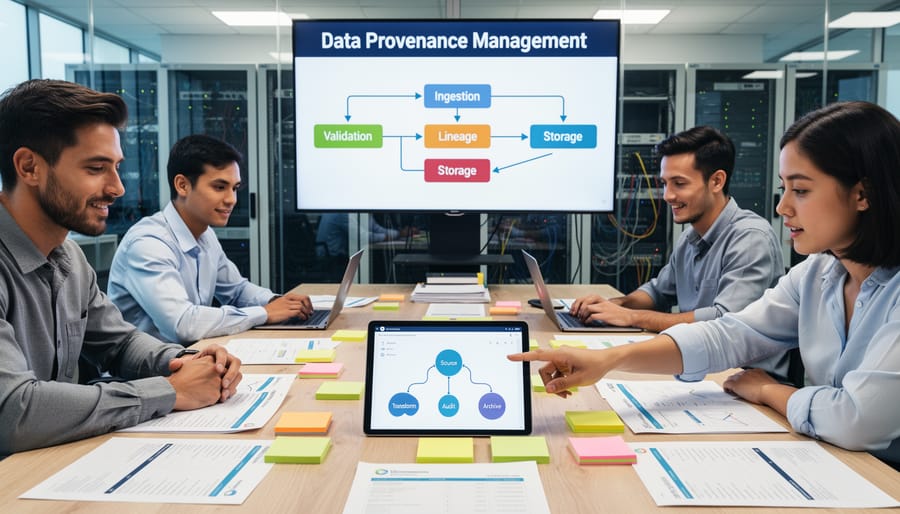
Tracking data quality at its origin point prevents problems from cascading through your entire AI pipeline. Consider a healthcare AI model trained to predict patient readmission rates. By implementing lineage tracking at the source, developers discovered that patient age data from one hospital system consistently showed everyone as exactly 65 years old due to a default field error. Without source tracking, this bias would have silently corrupted model predictions for months.
In another real-world scenario, a retail recommendation engine showed puzzling results until lineage tracking revealed that product price data from a legacy database hadn’t been updated in six months. The model was essentially recommending items based on outdated pricing, hurting sales conversions.
Source tracking also exposes systematic collection issues. A financial services company found through lineage analysis that transaction data from mobile apps included timestamps in different time zones, creating false patterns in fraud detection models. By catching these inconsistencies early through proper data governance and source monitoring, teams can fix problems before they compromise model accuracy. This proactive approach saves countless hours of debugging and prevents potentially costly model failures in production environments.
Getting Started: Practical Steps for Your First Lineage System
Start Small: What to Track First
When starting your data lineage journey, focus on three fundamental elements that deliver immediate value without drowning in complexity.
Begin with source tracking. Document where your data originates, whether it’s customer databases, sensor feeds, or external APIs. Think of this as creating a birth certificate for your data. For example, if you’re building a recommendation system, note that your training data comes from user purchase history spanning January 2023 to present.
Next, track transformations. Record the key changes your data undergoes before feeding it to your AI model. This includes cleaning steps like removing duplicates, normalizing values, or filtering outliers. You don’t need to log every tiny detail initially—just the major operations that significantly alter your data’s shape or content.
Finally, monitor model inputs. Keep a clear record of which processed datasets actually train or update your AI models, including version numbers and timestamps. This creates a direct line connecting your raw data to model predictions.
Start with these three elements using simple tools like spreadsheets or basic logging scripts. As you grow comfortable, you can expand to more sophisticated tracking systems. Remember, a simple lineage system you actually maintain beats a complex one you abandon after a week.
Tools That Make It Easier
Fortunately, you don’t need to build a data lineage system from scratch. Several tools can help you get started, whether you’re working on a personal project or managing enterprise-level data pipelines.
For open-source enthusiasts, Apache Atlas stands out as a comprehensive solution that integrates well with Hadoop ecosystems. It tracks data transformations and provides a searchable catalog of your data assets. If you’re working with modern data stacks, OpenLineage offers a standardized approach that works across different platforms and tools. Marquez, which implements OpenLineage, gives you a clean web interface to visualize how data flows through your systems.
On the commercial side, platforms like Collibra and Alation offer enterprise-grade features with user-friendly interfaces that make lineage tracking accessible to non-technical team members. These tools often include AI-powered discovery features that automatically map data relationships. Azure Purview and AWS Glue both provide cloud-native lineage tracking that integrates seamlessly if you’re already working within those ecosystems.
For smaller teams or those just starting out, tools like DBT (Data Build Tool) include built-in lineage documentation as part of their transformation workflows. This makes it incredibly easy to visualize how your SQL queries connect to create your final datasets.
When choosing a tool, consider your current infrastructure, team size, and budget. Open-source options work well for learning and smaller projects, while commercial platforms offer robust support and features for compliance-heavy industries like healthcare and finance.
Common Mistakes and How to Avoid Them
When teams first dive into data lineage tracking, they often stumble over a few common pitfalls. Let’s walk through these mistakes so you can sidestep them from the start.
One frequent error is tracking everything at once. Imagine trying to map every single data transformation in your entire organization on day one. It’s overwhelming and usually leads to abandoned projects. Instead, start small. Pick one critical AI model or data pipeline that’s causing headaches, implement lineage tracking there, and expand gradually. Think of it like learning to cook—you don’t tackle a five-course meal on your first attempt.
Another mistake is treating lineage tracking as a one-time setup. Data pipelines evolve constantly. New sources get added, transformations change, and team members modify code. If you document your lineage once and forget about it, you’ll soon have outdated maps that nobody trusts. The solution? Automate wherever possible. Modern lineage tools can capture changes automatically, much like how your phone’s GPS updates your route when you take a detour.
Many beginners also neglect the human element. They build sophisticated tracking systems but forget to train their team on why lineage matters and how to use it. Without buy-in, people work around the system rather than with it. Share real examples of problems lineage has solved, like quickly identifying why a model’s predictions suddenly shifted.
Finally, people sometimes implement lineage tracking without establishing proper data guardrails first. Before tracking where data goes, ensure you have basic quality checks and governance policies in place. Otherwise, you’re just efficiently documenting chaos.
Data lineage tracking isn’t just another technical checkbox for your AI projects—it’s the difference between building systems you can trust and running experiments you can only hope will work. Throughout this guide, we’ve seen how tracking your data’s journey addresses real challenges: from debugging mysterious model failures to ensuring compliance, from facilitating team collaboration to enabling confident decision-making.
The good news? You don’t need to overhaul your entire infrastructure overnight. Start small. Pick one AI project—perhaps one that’s caused you headaches recently—and implement basic lineage tracking for just the training data. Document where it came from, what transformations you applied, and which model version used it. You’ll be surprised how quickly this simple practice pays dividends when something goes wrong or when you need to explain your model’s behavior.
Think of data lineage as your AI project’s flight recorder. Just as aviation became safer when every flight’s data was meticulously tracked, your AI systems become more reliable, transparent, and maintainable when you know exactly what data touched them and how.
As artificial intelligence becomes increasingly woven into critical decisions—from healthcare diagnoses to financial approvals—the question isn’t whether you’ll implement data lineage tracking, but when. The organizations and practitioners who embrace it now are building the foundation for AI systems that don’t just perform well today, but remain trustworthy, explainable, and compliant tomorrow. The future of responsible AI depends on knowing where our data has been.