

Recognize that artificial intelligence isn’t magic—it’s mathematics in action. Every time Netflix recommends your next binge-worthy show or your phone unlocks with facial recognition, algorithms powered by linear algebra, calculus, and probability are working behind the scenes. Understanding these mathematical foundations for AI transforms you from a passive observer into someone who can actually build, improve, and innovate with these technologies.
Start with linear algebra to grasp how AI systems represent and manipulate data as vectors and matrices. When you see an image recognition system identifying a cat in a photo, it’s processing thousands of pixel values through matrix operations. Master calculus next to understand how AI models learn from mistakes—gradient descent, the backbone of neural network training, relies entirely on derivatives to find optimal solutions. Then tackle probability and statistics to work with uncertainty, because real-world AI must make decisions with incomplete information, from predicting stock prices to diagnosing diseases.
The challenge isn’t that AI requires impossibly advanced mathematics. The real barrier is knowing which mathematical concepts matter most and finding resources that explain them in the context of actual AI applications rather than abstract theory. Most traditional math courses weren’t designed with machine learning in mind, leaving learners to bridge the gaps themselves.
This disconnect creates unnecessary frustration. You don’t need a mathematics PhD to understand AI, but you do need the right learning path. The following guide cuts through the confusion, identifying exactly which mathematical concepts power modern AI systems and pointing you toward practical resources that connect theory directly to implementation.
The Math-AI Connection Nobody Talks About
Here’s a question most people won’t ask out loud: why does AI need math at all? After all, we interact with AI through natural conversations, images, and recommendations. There’s not a single equation in sight when ChatGPT writes you a poem or when Netflix suggests your next binge-worthy show.
The truth is, mathematics isn’t just connected to AI—it is the foundation upon which every AI system is built. Think of it this way: when you ask an AI to recognize a cat in a photo, that system is actually performing millions of mathematical calculations in milliseconds. It’s comparing pixel values, adjusting weights through calculus-based optimization, and using probability theory to confidently say “yes, that’s a cat” rather than “maybe, possibly, could be.”
Let’s break down a real-world example. When Spotify recommends songs you might love, it’s using linear algebra to represent your music preferences as vectors in multidimensional space. Your taste in indie rock, your occasional guilty-pleasure pop songs, and that one jazz album you played on repeat all become mathematical coordinates. The algorithm then calculates distances between these vectors to find patterns and similarities. Pure mathematics, invisible magic.
Here’s where misconceptions come in. Many aspiring AI practitioners freeze when they hear “you need math for AI,” imagining they need a PhD in mathematics to get started. The reality is more nuanced. You don’t need to be a mathematician, but you do need to understand the core concepts behind the algorithms you’re using.
For building and tweaking basic machine learning models, you’ll rely heavily on linear algebra for data manipulation, calculus for understanding how models learn and improve, and statistics for interpreting results and avoiding misleading conclusions. When your model performs poorly, mathematical literacy helps you diagnose whether it’s overfitting, whether your learning rate needs adjustment, or whether your data needs better preprocessing.
The good news? The math you need is learnable and purposeful. Unlike abstract math classes where you wondered “when will I ever use this,” AI math has immediate, visible applications. Every formula solves a real problem, every equation powers something tangible. That direct connection makes the learning journey significantly more rewarding than you might expect.
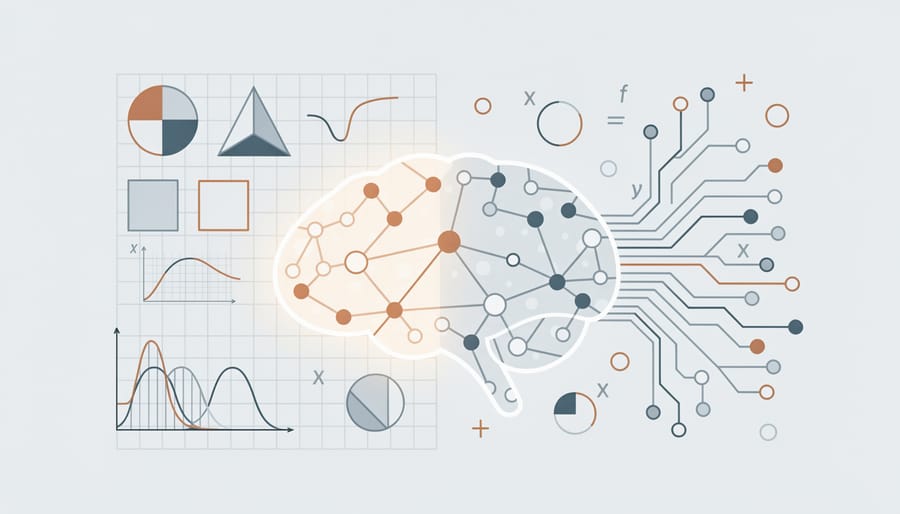
Core Mathematical Pillars You Actually Need
Linear Algebra: The Language of Data
If calculus helps AI learn over time, linear algebra is the language AI uses to organize and process data right now. At its core, linear algebra deals with vectors (ordered lists of numbers), matrices (rectangular grids of numbers), and the transformations we can perform on them.
Think of a digital photo. Each image is essentially a matrix where every pixel holds numerical values for color and brightness. When AI processes that image—perhaps to recognize a face or detect objects—it’s performing matrix operations. Convolutional neural networks, the powerhouse behind image recognition, apply filters (small matrices) that slide across image matrices to detect edges, textures, and patterns.
Vectors are equally fundamental. In natural language processing, words get converted into vectors called embeddings, where similar words end up closer together in mathematical space. The word “king” might be represented as [0.2, 0.7, 0.3], while “queen” gets a similar but distinct set of numbers.
Neural networks themselves rely heavily on matrix multiplication. When data flows through a network’s layers, each step involves multiplying input vectors by weight matrices and applying transformations. This is why graphics processing units (GPUs), originally designed for rendering graphics through matrix operations, became the preferred hardware for training AI models.
Understanding these concepts doesn’t require mastering every theorem. Grasping how matrices represent data and how transformations modify that data provides the foundation for understanding how AI actually works under the hood.

Calculus: Understanding How AI Learns
If linear algebra provides the structure and statistics the reasoning, calculus is the engine that powers AI learning. At its heart, calculus helps AI systems answer one crucial question: “How can I get better?”
Think of training an AI model like hiking down a foggy mountain while blindfolded. You can’t see the bottom, but you can feel the slope beneath your feet. Calculus, specifically derivatives, tells you which direction slopes downward most steeply. This concept, called gradient descent, is how AI models minimize errors and improve their predictions.
When an AI makes a mistake, backpropagation uses derivatives to trace that error backward through the network, calculating how much each parameter contributed to the problem. Imagine pulling on a puppet’s strings to adjust its movements—derivatives tell you exactly how hard to pull each string.
The gradient is simply a collection of derivatives pointing toward the steepest increase in error. AI does the opposite, following the negative gradient downhill toward better performance. This optimization process happens thousands or millions of times during training.
You don’t need to master complex calculus equations to understand AI fundamentals. Grasping the intuition—that derivatives measure rates of change and gradients point toward improvement—gives you insight into how neural networks transform from random guesses into powerful problem-solvers through iterative learning.

Probability and Statistics: Making Sense of Uncertainty
While machine learning models appear to make confident predictions, they’re actually navigating a world of uncertainty. This is where probability and statistics become essential tools in the AI toolkit.
Think of probability as the language AI uses to express confidence. When a spam filter flags an email, it’s not absolutely certain—it’s calculating probabilities based on patterns it has learned. These calculations rely on probability distributions, mathematical functions that describe how likely different outcomes are. For instance, the normal distribution (that familiar bell curve) helps models understand whether a data point is typical or an outlier.
Bayes’ theorem is particularly powerful in AI, allowing models to update their beliefs as new evidence arrives. When your phone’s autocorrect suggests words, it’s using Bayesian reasoning to combine what it knows about common word patterns with the specific context of what you’re typing right now.
Statistical inference helps us evaluate whether our models are actually working or just getting lucky. When researchers test a new AI system, they use statistical methods to determine if improvements are real or just random variation. Concepts like confidence intervals and hypothesis testing ensure that AI systems are reliable before deployment in critical applications like medical diagnosis or autonomous vehicles.
Understanding these statistical foundations helps you interpret model outputs more critically and recognize when AI predictions should be trusted versus questioned.
Discrete Math and Logic: The Foundation of Algorithms
While calculus and linear algebra often steal the spotlight, discrete mathematics quietly powers some of AI’s most critical algorithms. Think of discrete math as the toolkit for working with distinct, countable objects rather than continuous curves and surfaces.
Graph theory is perhaps the most visible example in action. Every time you use Google Maps to find the shortest route or see LinkedIn suggest connections, you’re witnessing graph algorithms at work. In AI, graph neural networks analyze social networks, molecular structures, and recommendation systems by treating data as nodes (points) and edges (connections between them). Pathfinding algorithms like Dijkstra’s algorithm, which originated in graph theory, help autonomous vehicles navigate city streets.
Combinatorics answers questions about counting and arrangement. When a machine learning model needs to explore different feature combinations or when a chess AI evaluates possible move sequences, combinatorial mathematics determines how many possibilities exist and which ones to prioritize. This becomes crucial in managing computational resources efficiently.
Computational complexity theory helps us understand which problems AI can realistically solve. It classifies problems by how much time and memory they require as they scale up. This explains why some AI tasks, like image recognition, have become remarkably efficient, while others, like perfectly predicting stock markets, remain computationally impractical. Understanding these limitations helps developers choose appropriate algorithms and set realistic expectations for AI systems.
Your Learning Path: From Zero to AI-Ready
Building your mathematical foundation for AI doesn’t have to take years of university courses. With focused effort and the right approach, you can develop the essential skills within 3-6 months. Here’s a realistic, structured learning path that takes you from mathematical beginner to AI-ready.
Month 1: Linear Algebra Fundamentals
Start with vectors and matrices, the building blocks of AI algorithms. Spend 30-45 minutes daily learning how to multiply matrices, understand dimensions, and grasp basic transformations. These concepts directly translate to how neural networks process data. By week four, you should comfortably manipulate matrices and understand how they represent data in machine learning models.
Your milestone: Successfully explain how a simple image (represented as a matrix of pixels) can be transformed using matrix operations.
Month 2: Calculus Essentials
Focus exclusively on derivatives and gradients, which power the learning process in AI models. You don’t need to master integration or complex calculus theorems. Instead, concentrate on understanding how functions change and how to find minimum points, which is exactly what happens when AI models “learn” from data.
Your milestone: Understand gradient descent conceptually and mathematically, recognizing it as the engine behind model training.
Month 3: Probability and Statistics
This month introduces you to how AI models make predictions under uncertainty. Learn probability distributions, expected values, and basic statistical concepts like mean and variance. These ideas explain why AI models output confidence scores rather than absolute answers.
Your milestone: Interpret a confusion matrix and understand precision, recall, and accuracy metrics used to evaluate AI performance.
Months 4-6: Integration and Practice
Now comes the exciting part where math meets real AI applications. Start implementing simple machine learning algorithms from scratch using Python. Begin with linear regression, then progress to logistic regression and basic neural networks. This hands-on practice cements your mathematical understanding by showing exactly where each concept applies.
Your milestone: Build a simple neural network that classifies images, understanding the mathematical operations at each layer.
Throughout this journey, dedicate one hour daily during weekdays and two hours on weekends. Use interactive platforms that provide immediate feedback, and don’t rush through concepts. Remember, depth beats speed. When you understand the mathematical foundations thoroughly, advanced AI concepts become surprisingly accessible rather than intimidatingly complex.
Top Learning Resources That Actually Work
Books That Break Down Complex Concepts
Finding the right book can transform your mathematical journey for AI from intimidating to illuminating. Here are carefully selected recommendations tailored to different learning stages.
For absolute beginners, “Math for Deep Learning” by Ronald T. Kneusel offers a gentle introduction that assumes no prior mathematical background. This book excels at using visual explanations and real-world examples to introduce core concepts like derivatives and matrices. It’s perfect if you’re starting from scratch and need confidence-building.
If you have some high school math but need a refresher, “Mathematics for Machine Learning” by Marc Peter Deisenroth provides comprehensive coverage while remaining accessible. What makes this valuable is its focus on intuition first, formulas second. The authors bridge the gap between pure mathematics and practical AI applications, showing you exactly why each concept matters. Best of all, it’s available free online.
For those with college-level math seeking to deepen their understanding, “Deep Learning” by Ian Goodfellow goes beyond basics into advanced probability and optimization theory. While more demanding, it’s the gold standard for understanding the mathematical foundations behind modern AI systems.
Looking for a broader perspective? Check out our guide to AI books for beginners that covers both mathematical and practical programming aspects.
Each of these books prioritizes clarity over complexity, making sophisticated mathematical ideas digestible for learners at every level.
Online Courses and Video Series
Learning math for AI has never been more accessible, thanks to interactive online courses designed specifically for visual learners and beginners. The key is choosing platforms that match your current skill level and learning preferences.
For absolute beginners, Khan Academy offers the gentlest introduction. Their free courses in linear algebra, calculus, and statistics start from ground zero, using intuitive explanations and practice problems. The platform’s AI tutor feature even personalizes your learning path based on your progress.
If you’re a visual thinker, 3Blue1Brown’s YouTube series is legendary in the AI community. Grant Sanderson transforms abstract concepts like neural networks and calculus into stunning animations that make you actually understand the “why” behind the formulas. His “Essence of Linear Algebra” and “Essence of Calculus” series are perfect companions to more formal courses.
For those with some math background ready to dive deeper, Coursera’s “Mathematics for Machine Learning” specialization bridges theory and application beautifully. You’ll learn exactly how linear algebra powers dimensionality reduction and how calculus optimizes your models, with real coding assignments.
MIT OpenCourseWare provides university-level rigor for free, ideal if you’re preparing for graduate studies or want comprehensive understanding. Their 18.06 Linear Algebra course is considered the gold standard.
Choose Khan Academy if you’re starting fresh, 3Blue1Brown for visual intuition, Coursera for applied learning with certificates, and MIT OCW for academic depth. Many successful AI practitioners mix multiple platforms, using each for its unique strengths.
Interactive Tools and Practice Platforms
Learning mathematical concepts for AI becomes much more engaging when you can apply them immediately. Rather than passively reading textbook chapters, interactive platforms let you see the direct connection between mathematical operations and AI behavior.
Brilliant.org stands out as an exceptional starting point for hands-on learning. Their interactive courses break down complex topics like linear algebra, calculus, and probability through visual puzzles and real-time feedback. You’ll manipulate matrices to understand neural network transformations or adjust probability distributions to see how they affect machine learning predictions. This immediate cause-and-effect relationship helps concepts stick far better than traditional study methods.
For those who prefer a coding-first approach, Jupyter Notebooks provide an ideal environment to experiment with math-based AI implementations. These interactive notebooks let you write Python code alongside explanatory text, making it easy to test mathematical formulas and instantly visualize their results. Platforms like Google Colab offer free access to Jupyter environments with pre-installed AI libraries, eliminating setup headaches.
Kaggle complements your learning by offering datasets and competitions where you can practice applying mathematical concepts to real problems. Their Learn section includes micro-courses on topics like data visualization and intro to machine learning, each taking just a few hours to complete.
Khan Academy remains invaluable for building foundational math skills through video lessons and practice exercises. Meanwhile, platforms like DataCamp and Codecademy provide structured paths that combine mathematical theory with practical coding exercises specifically designed for data science and AI applications.
The key advantage of these platforms is their learn-by-doing philosophy, transforming abstract mathematical concepts into tangible, visual experiences that prepare you for actual AI work.
Common Pitfalls and How to Avoid Them
Learning math for AI comes with its share of challenges, but recognizing these pitfalls early can save you months of frustration. Here are the most common stumbling blocks and how to navigate around them.
The first trap many learners fall into is attempting to master everything simultaneously. You might start with linear algebra on Monday, switch to calculus on Tuesday, and dive into probability by Wednesday. This scattered approach leaves you with superficial knowledge of everything and mastery of nothing. Instead, focus on one topic at a time for at least two to three weeks. For example, commit to understanding matrices and vector operations in linear algebra before moving to derivatives. This sequential learning builds a solid foundation rather than a shaky tower of half-understood concepts.
Another common mistake is getting lost in theoretical rabbit holes without connecting to practical applications. You might spend weeks memorizing formulas and proving theorems but never see how they relate to actual AI systems. The solution? Always pair theory with hands-on practice. When learning about gradient descent in calculus, immediately apply it to train a simple neural network, even if it’s just predicting house prices. This connection between abstract math and tangible results reinforces understanding and maintains motivation.
Motivation loss typically strikes around week three or four, especially when facing difficult topics like eigenvalues or probability distributions. Combat this by setting micro-goals and celebrating small wins. Rather than aiming to “learn calculus,” target specific achievements like “understand partial derivatives well enough to explain backpropagation.” Track your progress visibly, perhaps in a learning journal or checklist.
Finally, many learners study in isolation, which amplifies confusion and reduces accountability. Join online communities, find study partners, or participate in forums where you can ask questions and explain concepts to others. Teaching someone else what you’ve learned is one of the most powerful ways to solidify your own understanding and identify gaps in your knowledge.
Putting Math Into Practice With Real AI Projects
The best way to solidify your mathematical understanding is by applying it to actual AI projects. Theory becomes meaningful when you see how linear algebra transforms images, how calculus optimizes predictions, and how probability guides decision-making in real systems.
Start with a simple linear regression project. This classic exercise brings together algebra and basic calculus in a tangible way. You’ll work with data points, calculate slopes and intercepts, and watch as the algorithm minimizes error through gradient descent. The beauty of this project is that you can visualize exactly how the math works, seeing the line adjust itself to fit your data. Try predicting house prices based on square footage or estimating temperatures from historical data.
Next, build a basic image classifier using neural networks. This project illuminates how matrix multiplication powers modern AI. Each layer in your network performs linear transformations on input data, and you’ll see firsthand why understanding matrices matters. Start with the MNIST dataset of handwritten digits, where you’ll apply concepts like dot products and activation functions to recognize patterns. The moment your model correctly identifies a handwritten number, the connection between mathematical operations and AI capabilities becomes crystal clear.
For probability and statistics practice, create a spam email filter using Naive Bayes classification. This project demonstrates how probability theory enables machines to make educated guesses. You’ll calculate prior probabilities, likelihood ratios, and posterior probabilities, transforming abstract formulas into a working system that actually filters unwanted messages.
Consider exploring beginner-friendly AI projects that provide step-by-step guidance and pre-written code snippets. These resources help you focus on understanding the mathematical concepts rather than getting stuck on programming syntax.
As you progress, try a recommendation system project using collaborative filtering. This applies vector similarity and distance metrics, showing how geometry concepts help AI understand user preferences. Whether recommending movies or suggesting products, you’ll use cosine similarity and Euclidean distance to measure how alike different items or users are.
Remember, each project reinforces specific mathematical concepts while building your practical AI toolkit. Start small, celebrate your wins, and gradually tackle more complex applications as your confidence grows.
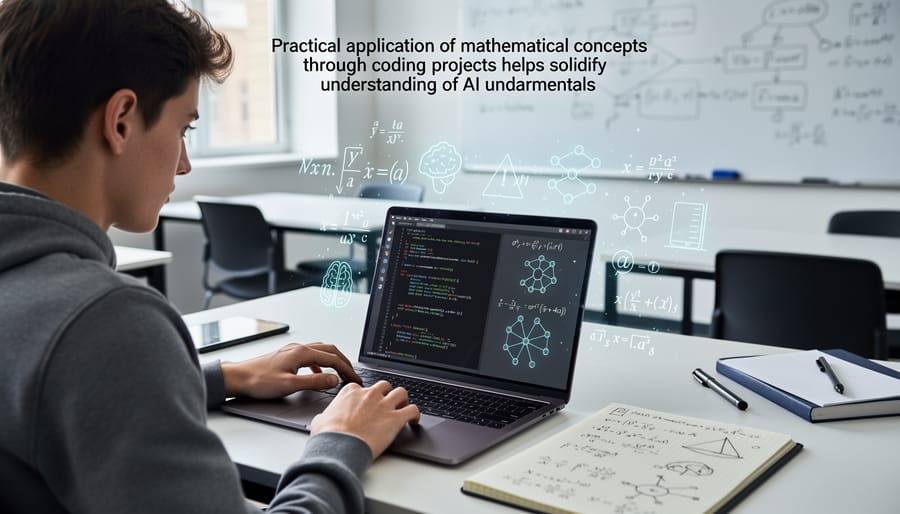
Building a strong mathematical foundation for AI doesn’t mean you need to become a mathematician overnight. Think of it as learning a new language—you start with essential phrases before writing poetry. The journey from mathematical novice to confident AI practitioner is entirely achievable when you break it down into manageable steps.
Throughout this guide, we’ve explored the core mathematical pillars supporting AI: linear algebra for understanding how machines process data, calculus for grasping how models learn and improve, probability for handling uncertainty, and statistics for making sense of results. We’ve also highlighted numerous resources, from interactive platforms like Khan Academy and 3Blue1Brown’s visual explanations to structured courses on Coursera and practical coding tutorials.
Here’s the most important takeaway: don’t try to master everything simultaneously. That’s a recipe for burnout and frustration. Instead, choose one area that resonates with your immediate goals. If you’re fascinated by neural networks, start with linear algebra and basic calculus. Planning to work with data analysis? Begin with probability and statistics. Each mathematical concept you understand opens new doors in your AI journey.
The resources are available, many of them free and designed specifically for self-learners. The AI field welcomes people from diverse backgrounds—what matters most is your curiosity and willingness to learn incrementally. Start small, stay consistent, and remember that every expert was once a beginner who decided to take that first step. Your AI journey begins with a single mathematical concept. Which one will you choose today?