
Machine learning models are getting smarter, but they’re also getting hungrier. Training a single large language model can take weeks on a standard computer and cost millions in electricity. Running AI applications on conventional processors is like trying to fill a swimming pool with a garden hose—technically possible, but painfully slow and inefficient.
Hardware acceleration changes this equation entirely. Instead of forcing your computer’s general-purpose CPU to handle billions of matrix calculations it wasn’t designed for, specialized hardware takes over these repetitive mathematical operations. Think of it as the difference between hand-washing dishes and using a dishwasher—both get the job done, but one is purpose-built for the task and dramatically faster.
The impact is staggering. What might take three weeks on a CPU can finish in three days on a GPU (Graphics Processing Unit), or mere hours on a TPU (Tensor Processing Unit). This isn’t just about convenience. Hardware acceleration has made previously impossible applications practical—real-time language translation, instant image recognition on your smartphone, and self-driving cars that process sensor data in milliseconds rather than minutes.
Today’s machine learning landscape offers several acceleration options, each with distinct strengths. GPUs excel at parallel processing and remain the most accessible choice for most developers. TPUs, designed specifically for neural networks, deliver even greater performance for certain workloads. Newer specialized chips like NPUs (Neural Processing Units) are bringing AI capabilities directly into laptops and mobile devices.
Understanding these hardware options isn’t just academic knowledge. Whether you’re a student choosing learning resources, a developer optimizing applications, or simply curious about how AI works so seamlessly in everyday technology, hardware acceleration is the fundamental breakthrough that transformed machine learning from laboratory research into the transformative force reshaping our world.
Why Your Regular Computer Struggles with Machine Learning
Imagine you’re hosting a dinner party and need to prepare a five-course meal. You could handle everything yourself, chopping vegetables, stirring sauces, and plating dishes one task at a time. But wouldn’t it be faster with a team of chefs working simultaneously? This scenario perfectly captures why your regular computer struggles with machine learning.
Traditional CPUs, the processors in most personal computers, work like that solo chef. They’re designed to handle tasks sequentially, executing instructions one after another at incredible speed. For everyday computing—browsing the web, writing documents, or running spreadsheets—this approach works brilliantly. CPUs excel at being versatile generalists, capable of handling diverse tasks with flexibility and precision.
However, machine learning operates fundamentally differently. Training a neural network involves performing millions or even billions of calculations, many of which could happen simultaneously. Think of it like processing a high-resolution image: each pixel might need similar calculations applied to it. A CPU would methodically work through these pixels in sequence, while specialized hardware could process thousands at once.
The mathematical operations that power neural networks are relatively simple but massively repetitive. They primarily involve matrix multiplications—essentially adding and multiplying long lists of numbers together. A CPU wasn’t designed with this specific workload in mind. It’s built to handle complex logic and decision-making across varied applications, not to perform the same mathematical operation thousands of times in parallel.
Consider the numbers: training a modern language model might require processing terabytes of data through trillions of calculations. On a standard CPU, this could take weeks or even months. The bottleneck isn’t just about raw speed; it’s about architectural mismatch. Your CPU spends valuable time fetching data from memory, decoding instructions, and managing tasks that could be streamlined for machine learning workloads.
This is where the concept of hardware acceleration enters the picture. Just as you wouldn’t use a butter knife to chop down a tree, using a general-purpose CPU for intensive machine learning tasks means working with a tool not optimized for the job. The solution lies in specialized hardware designed specifically to handle the parallel, repetitive calculations that neural networks demand—transforming that solo chef into an efficient kitchen brigade.
The Hardware Revolution: Specialized Chips Built for AI
GPUs: The First Game-Changer
In the early 2010s, researchers stumbled upon a revelation that would transform artificial intelligence forever. While CPUs were struggling to train neural networks in weeks or months, graphics cards designed for video games could accomplish the same tasks in days or even hours. This wasn’t planned—it was a happy accident born from necessity.
Graphics Processing Units were originally built to render the millions of pixels in your favorite video games simultaneously. Unlike CPUs with their handful of powerful cores designed for sequential tasks, GPUs pack thousands of smaller, simpler cores that excel at doing many calculations at once. This parallel architecture turned out to be perfect for machine learning, where training involves performing the same mathematical operations across massive datasets repeatedly.
Consider a practical example: training a standard image recognition model on a CPU might take two weeks. That same task on a modern GPU like the NVIDIA RTX 4090 could finish in under two days—roughly a 7x speedup. For researchers iterating through multiple experiments, this difference is game-changing.
The reason GPUs remain the workhorse of AI today is their versatility. They handle not just neural network training but also data preprocessing, simulations, and scientific computing. Major frameworks like TensorFlow and PyTorch were built with GPU acceleration in mind, making them accessible even to beginners.
Whether you’re a student running your first model or a startup building an AI product, GPUs offer the best balance of performance, cost, and flexibility—which explains why they’ve become synonymous with modern machine learning.
TPUs: Google’s Purpose-Built AI Engines
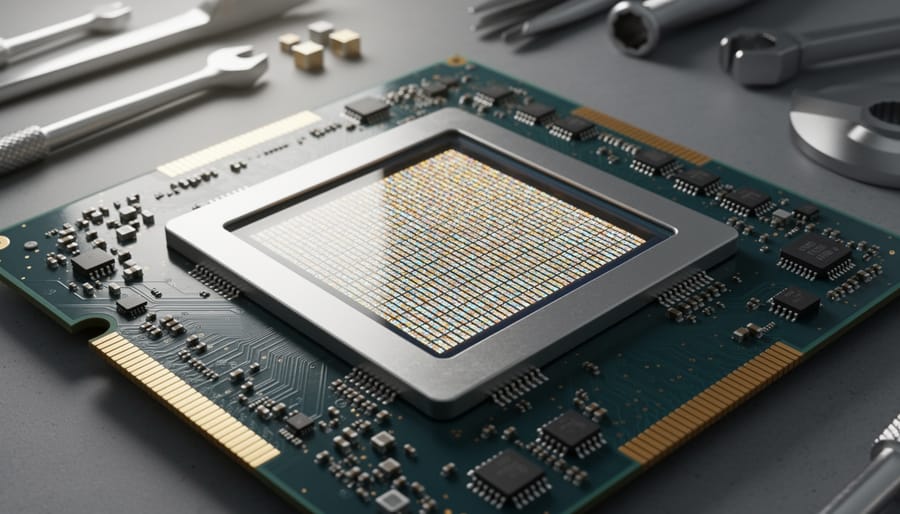
While GPUs excel at parallel processing, Google recognized that neural networks have unique computational patterns that could benefit from even more specialized hardware. Enter the Tensor Processing Unit, or TPU—a chip designed from the ground up exclusively for machine learning tasks.
Think of TPUs as the difference between a Swiss Army knife and a specialized surgical tool. GPUs are versatile and handle many tasks well, but TPUs do one thing extraordinarily well: matrix multiplication, the mathematical operation that forms the backbone of neural network computations. When your neural network processes images, understands language, or makes predictions, it’s essentially multiplying massive grids of numbers together billions of times. TPUs are engineered to perform these specific calculations with remarkable speed and efficiency.
The real advantage of TPUs lies in their energy efficiency. Google designed these chips to deliver maximum performance per watt of electricity consumed. In data centers running large-scale AI models, this translates to significant cost savings and reduced environmental impact. For instance, training a complex language model that might take weeks on traditional hardware can be completed in days using TPU clusters.
So when do TPUs outshine GPUs? They excel at training large neural networks with straightforward architectures, particularly in cloud environments where you’re running extended training sessions. Companies like Spotify use TPUs to power their music recommendation systems, processing millions of user preferences efficiently. However, if you’re experimenting with custom algorithms or need flexibility for varied workloads, GPUs might still be your best choice. TPUs are available primarily through Google Cloud Platform, making them ideal for organizations already invested in cloud-based AI development.
FPGAs and ASICs: The Specialized Specialists
While GPUs and TPUs dominate data centers, FPGAs (Field-Programmable Gate Arrays) and ASICs (Application-Specific Integrated Circuits) represent the hardware chameleons of machine learning acceleration. Think of them as custom-built tools rather than general-purpose power tools.
FPGAs are reprogrammable chips that can be configured after manufacturing to perform specific tasks. Imagine hardware that you can rewire like software, adapting its physical circuits to match your exact needs. Microsoft uses FPGAs in its Azure cloud services to accelerate search algorithms and network functions, demonstrating their versatility. They shine in edge computing scenarios where you need low power consumption and flexibility—like in autonomous drones that must process data locally without relying on cloud connectivity.
ASICs take specialization further. These chips are designed for one specific task and cannot be reprogrammed, but they excel at that single purpose with unmatched efficiency. Bitcoin mining rigs use ASICs because they perform one calculation type billions of times per second while consuming minimal power. Google’s TPUs are actually a type of ASIC optimized exclusively for tensor operations.
The trade-off is clear: FPGAs offer adaptability but cost more per unit, while ASICs deliver maximum performance and efficiency but require massive upfront investment. For companies deploying millions of devices—like smart cameras or industrial sensors—ASICs make economic sense. For research teams needing flexibility, FPGAs provide the perfect middle ground between general-purpose processors and fixed-function hardware.
NPUs: AI Acceleration in Your Pocket
Neural Processing Units have quietly revolutionized how we interact with our everyday devices. These specialized chips, now embedded in smartphones and laptops, bring AI capabilities directly into your pocket and onto your desk. Unlike cloud-based AI that sends your data to remote servers, NPUs process information locally on your device.
Think about how your phone recognizes your face to unlock, how it enhances photos in real-time, or how voice assistants respond even without internet. That’s your NPU at work. Apple’s Neural Engine, Qualcomm’s AI Engine, and similar processors handle these tasks efficiently while consuming minimal battery power.
The privacy benefits are substantial. When your device processes voice commands, facial recognition, or personal photos locally, that sensitive information never leaves your hands. Your data stays yours. NPUs also enable faster responses since there’s no waiting for cloud communication, and features work even in airplane mode.
From real-time language translation to computational photography that makes every shot look professional, NPUs democratize AI acceleration, making powerful machine learning accessible to billions of users worldwide without requiring specialized computing knowledge.

How Hardware Acceleration Actually Works
The secret behind hardware acceleration isn’t actually magic—it’s about doing many simple tasks simultaneously rather than tackling complex operations one at a time. Think of it like this: if you needed to paint 1,000 identical toy cars, would you hire one master painter to meticulously complete each car from start to finish, or would you set up an assembly line with 100 people who each paint one small part? Hardware accelerators choose the assembly line approach.
Traditional CPUs are like that master painter. They’re incredibly versatile and can handle virtually any task you throw at them, from playing music to running spreadsheets. They execute instructions sequentially, moving through operations with precision and flexibility. This works beautifully for general computing, but machine learning operates differently. Training a neural network requires performing the same mathematical operation—often simple multiplication and addition—millions or billions of times across vast datasets.
This is where parallel processing transforms everything. GPUs contain thousands of smaller, simpler cores compared to a CPU’s handful of powerful cores. When processing an image through a neural network, a GPU can simultaneously calculate outputs for hundreds of neurons at once, while a CPU would need to process them sequentially. Imagine calculating the brightness values for every pixel in a 1920×1080 image—that’s over 2 million calculations. A GPU divides this work across its many cores, completing in milliseconds what might take a CPU significantly longer.
Modern AI accelerators take this further with specialized components called tensor cores. These are purpose-built circuits designed specifically for the matrix multiplication operations that form the backbone of neural networks. Instead of breaking down a complex calculation into many small steps, tensor cores execute entire matrix operations as single instructions, dramatically accelerating the process.
However, raw computing power means nothing if your chip can’t access data quickly enough. This is where memory bandwidth becomes critical. Picture a chef with incredible knife skills but a tiny refrigerator door that only opens a crack—they’d spend more time retrieving ingredients than cooking. AI accelerators feature wide, fast memory pathways that can feed massive amounts of data to their processing cores simultaneously, ensuring those thousands of cores never sit idle waiting for information.
The data flow through these specialized chips follows a fundamentally different pattern than in traditional processors. Rather than shuttling data back and forth between memory and processor for each operation, accelerators keep data flowing through optimized pipelines, processing it in streams and minimizing wasteful transfers. This architectural difference, combined with parallel processing power, is what transforms days of training time into hours, making modern AI applications practically feasible.
Real-World Impact: From Training to Deployment
Training Speed Breakthroughs
The real-world impact of hardware acceleration becomes crystal clear when you look at actual training times. Consider GPT-3, one of the most well-known language models: training it on traditional CPUs would have taken years, but with specialized GPU clusters, it was completed in weeks. More recently, large language models that once required months of training now finish in days thanks to advanced accelerators.
Image recognition systems tell a similar story. ResNet-50, a popular computer vision model, originally took weeks to train on basic hardware. Today, using modern GPUs or TPUs, researchers can train the same model in under an hour. That’s not just faster—it’s transformational.
These speed gains create a compounding effect that changes how teams work. When training a model takes minutes instead of days, developers can experiment more freely. They can test different approaches, adjust parameters, and iterate rapidly. A data scientist might run ten experiments in an afternoon rather than waiting weeks for results from a single attempt. This acceleration doesn’t just save time; it fundamentally enables innovation, allowing researchers to explore ideas that would have been impractical when each test consumed days of computing resources.
Making Real-Time AI Possible
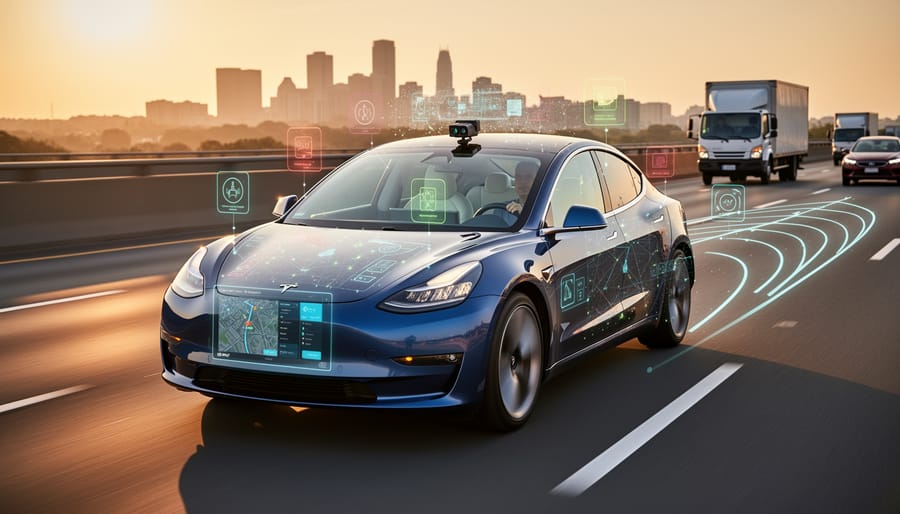
In the world we live in today, waiting even a few seconds for AI to respond can mean the difference between life and death. Consider an autonomous vehicle navigating a busy intersection. When a pedestrian suddenly steps onto the road, the car’s AI must detect the person, predict their movement, and apply the brakes in milliseconds. Without hardware acceleration, this split-second decision could take several seconds—far too slow to prevent an accident.
This is where acceleration transforms AI from impressive to indispensable. Real-time language translation apps now let travelers have natural conversations across language barriers, with words appearing on screen almost as quickly as they’re spoken. Video analysis systems can monitor dozens of security camera feeds simultaneously, identifying suspicious activity the moment it happens rather than reviewing footage hours later. Interactive AI assistants like voice-activated smart speakers understand and respond to your questions instantly, making the technology feel truly conversational rather than clunky and frustrating.
The magic happens because specialized hardware can process thousands of calculations in parallel, handling the massive computational demands of modern AI models without breaking a sweat. What once required powerful server farms can now happen on devices you carry in your pocket, making AI both faster and more accessible than ever before.
Energy Efficiency and Cost Savings
Specialized hardware isn’t just about speed—it’s also remarkably more energy-efficient and cost-effective than traditional computing solutions. Think of it like comparing a hybrid car to a gas-guzzler: specialized accelerators accomplish the same AI tasks while consuming significantly less power.
Here’s a striking comparison: training a large language model on CPUs might cost hundreds of thousands of dollars in electricity alone, while GPUs can reduce that by 70-80%, and custom ASICs can slash it even further. Google’s TPUs, for example, deliver up to 30 times better performance-per-watt compared to conventional processors.
For production deployments, these savings multiply rapidly. Consider a company running image recognition on millions of photos daily—the difference between processing each image for 10 cents versus 1 cent translates to thousands of dollars saved monthly.
The environmental impact matters too. Data centers already consume roughly 1% of global electricity, and AI workloads are growing exponentially. Specialized hardware helps keep this footprint manageable, making sustainable AI development possible at scale while keeping operational costs reasonable for businesses of all sizes.
Choosing the Right Hardware for Your AI Projects
Selecting the right hardware for your machine learning journey doesn’t have to drain your bank account or overwhelm you with choices. Think of it like buying your first car—you wouldn’t start with a Formula 1 race car when you’re just learning to drive. The same principle applies to ML hardware.
For absolute beginners exploring machine learning fundamentals, your existing laptop or desktop is often enough to get started. You can learn Python basics, understand algorithms, and work with small datasets using just your CPU. Platforms like Google Colab offer free access to GPUs, giving you a taste of acceleration without any upfront investment. This approach lets you experiment and determine if machine learning truly captures your interest before committing financially.
Once you’re working on actual AI project implementation with larger datasets or training your own models, you’ll need to evaluate your options more carefully. The choice between local hardware and cloud services depends on several factors: project frequency, dataset size, and budget constraints.
Cloud platforms with cloud-based acceleration make sense when you’re running occasional experiments or working with varied project types. You pay only for what you use, avoiding the hefty upfront costs of purchasing GPUs. Services like AWS, Google Cloud, and Microsoft Azure offer scalable resources that grow with your needs. This flexibility is particularly valuable for students and professionals still exploring different ML domains.
However, if you’re consistently training models or running extended experiments, local hardware becomes more cost-effective. A mid-range consumer GPU like NVIDIA’s RTX 4060 or 4070 provides excellent acceleration for most learning projects and personal work, costing between 300 to 600 dollars. These cards handle popular frameworks like TensorFlow and PyTorch efficiently, offering the immediate responsiveness that cloud services can’t always match.
Budget-conscious learners should consider used or previous-generation GPUs from reputable sellers. An older RTX 3060 still delivers substantial acceleration compared to CPU-only processing, often at half the price of current models.
The golden rule? Start small, learn continuously, and upgrade only when you consistently encounter genuine hardware limitations. Your learning journey matters more than having the fastest equipment from day one.
The Future of AI Hardware: What’s Coming Next
The landscape of machine learning hardware is about to get even more exciting. While today’s GPUs and TPUs have revolutionized what’s possible with AI, researchers are already building tomorrow’s technologies that could make current accelerators look like steam engines compared to rocket ships.
One of the most promising frontiers is photonic computing, which uses light instead of electricity to process information. Imagine your data traveling at, well, the speed of light through optical circuits. Companies like Lightmatter and Luminous Computing are developing chips that perform matrix multiplications using photons, potentially offering 100 times better energy efficiency than traditional electronic chips. This matters because as AI models grow larger, their energy consumption has become staggering—some training runs cost millions of dollars in electricity alone.
Neuromorphic chips take inspiration directly from your brain’s architecture. Unlike conventional processors that strictly separate memory and processing, these chips blur that boundary just like biological neurons do. Intel’s Loihi and IBM’s TrueNorth chips process information in spikes and pulses, mimicking how your neurons fire. They’re incredibly energy-efficient for certain tasks, consuming just milliwatts instead of hundreds of watts. Picture a security camera that can recognize faces while running on a tiny battery for months.
Then there’s quantum computing, though it’s the wild card in this deck. While quantum computers won’t replace classical accelerators for most machine learning tasks, they could revolutionize specific problems like optimization and molecular simulation. We’re still in the early experimental phase, but the potential is tantalizing.
Perhaps most importantly, these emerging AI technologies promise to democratize artificial intelligence further. As hardware becomes more efficient and affordable, running sophisticated AI models won’t require massive data centers. Small businesses, researchers in developing countries, and individual developers will gain access to capabilities once reserved for tech giants. The future of AI hardware isn’t just faster—it’s more accessible, sustainable, and revolutionary in ways we’re only beginning to imagine.
Hardware acceleration has fundamentally transformed artificial intelligence from an academic curiosity into the practical tool we interact with daily. Just a decade ago, training sophisticated AI models required months of computation and resources available only to elite research labs. Today, thanks to GPUs, TPUs, and specialized accelerators, developers can prototype ideas in hours and deploy intelligent systems that recognize faces, translate languages, and power autonomous vehicles in real-time.
This transformation isn’t just about speed—it’s about accessibility. What once seemed impossibly complex is now within reach for anyone willing to learn. You don’t need to purchase expensive hardware to start your journey. Cloud platforms offer pay-as-you-go access to accelerated computing, and many provide free tiers perfect for learning. Even your laptop’s modest GPU can run meaningful experiments with frameworks like TensorFlow and PyTorch.
The key is to start small and build progressively. Run a pre-trained model, experiment with transfer learning, then gradually tackle more ambitious projects. Each hands-on experience demystifies the technology and builds your intuition for how hardware and algorithms work together.
If you’re ready to dive deeper and develop practical AI skills systematically, the AI Systems and Hardware Acceleration learning roadmap provides a structured path forward. This isn’t just theory—it’s your guide to understanding and leveraging the technology reshaping our world. The future of AI isn’t just for specialists anymore; with the right resources and determination, it’s accessible to you.