

Financial institutions lose $32 billion annually to fraud, but artificial intelligence now catches suspicious transactions in milliseconds that human analysts might miss for days. AI systems in finance work by analyzing millions of data points simultaneously, identifying patterns that signal fraudulent activity, and flagging anomalies before significant damage occurs.
Consider what happens when someone steals your credit card information. Traditional fraud detection might notice unusual purchases after several transactions go through. AI-powered systems, however, compare each transaction against hundreds of variables instantly: your typical spending locations, purchase amounts, time patterns, device fingerprints, and even your typing speed. When something deviates from your established behavior, the system blocks the transaction and alerts you within seconds.
This technology isn’t limited to catching credit card thieves. Banks deploy AI to detect money laundering schemes that span multiple accounts and countries, insurance companies use it to identify false claims by cross-referencing medical records and accident reports, and investment firms employ it to spot insider trading patterns across massive datasets. JPMorgan Chase’s AI system, for example, reviews commercial loan agreements in seconds, a task that previously required 360,000 hours of lawyer time annually.
The mechanics behind these systems combine machine learning algorithms that improve with each transaction, natural language processing that reads and interprets financial documents, and neural networks that mimic human decision-making processes. These tools don’t replace human analysts but amplify their capabilities, handling routine pattern recognition while escalating complex cases that require human judgment.
Understanding how AI functions in fraud detection matters whether you’re protecting your personal finances, working in financial services, or simply curious about how technology safeguards your money in an increasingly digital economy.
Why Traditional Fraud Detection Methods Can’t Keep Up

The Speed Problem: When Milliseconds Matter
Picture this: You’re trying to buy concert tickets online, and your card gets declined. You call your bank, frustrated, only to hear that their system flagged your purchase as suspicious. By the time they verify it’s really you, the tickets are sold out. Sound familiar?
This happens because traditional fraud detection systems operate on rigid rules and batch processing, analyzing transactions hours or even days after they occur. When your bank’s system sees an unusual purchase, say a $200 ticket order from a new website, it simply blocks it and asks questions later.
The problem intensifies with the sheer volume of modern transactions. Financial institutions process millions of payments every minute, from credit card swipes to mobile wallet transfers. Legacy systems struggle to keep pace, leading to two painful outcomes: legitimate customers get blocked (false positives), or actual fraudsters slip through undetected (false negatives).
These delays aren’t just inconvenient; they’re costly. Studies show that false declines cost retailers billions annually in lost sales, while customers who experience them often switch banks entirely. Meanwhile, real fraud continues to evolve faster than rule-based systems can adapt, creating a security gap that grows wider each day.
The Pattern Problem: Fraud That Hides in Plain Sight
Traditional fraud detection systems work like security guards following a checklist: they flag transactions over a certain amount, purchases from suspicious locations, or unusual timing. But modern fraud doesn’t play by these obvious rules.
Consider a real scenario: A fraudster makes fifty small purchases across two months, each carefully staying below alert thresholds. No single transaction looks suspicious. The amounts vary naturally. The timing seems normal. A rule-based system sees fifty legitimate-looking transactions and waves them through.
This is the pattern problem. Sophisticated fraud operates in the gaps between rules, creating patterns that are invisible when you look at individual transactions but glaringly obvious when you see the complete picture. It’s like those magic eye images where the hidden shape only appears when you adjust your focus.
AI solves this by analyzing thousands of variables simultaneously across millions of transactions. It recognizes subtle patterns humans would miss: micro-variations in typing speed, unusual device fingerprints, or purchasing sequences that deviate slightly from genuine customer behavior. What looks like random noise to rule-based systems becomes a clear fraud signature to AI algorithms trained on vast datasets of both legitimate and fraudulent activity.
How AI Actually Detects Financial Fraud
Machine Learning: Teaching Computers to Spot Red Flags
Machine learning acts like a tireless detective, constantly learning from patterns to catch fraudsters in action. When it comes to spotting financial fraud, two main approaches power this detective work: supervised and unsupervised learning.
Think of supervised learning as teaching by example. Banks feed AI systems thousands of labeled transactions—this one’s legitimate, that one’s fraudulent. The system studies these examples, identifying patterns like unusual spending locations, transaction amounts, or timing. Once trained using various machine learning frameworks, it can predict whether new transactions look suspicious. For instance, if your credit card suddenly shows a $3,000 purchase in another country minutes after you bought coffee locally, the system flags it instantly.
Unsupervised learning takes a different approach—it’s the detective who spots oddities without being told what’s normal. This method analyzes transaction data to find unusual patterns automatically. Imagine your typical monthly spending hovers around $2,000, mostly at familiar stores. If transactions suddenly spike to $10,000 with multiple purchases at unfamiliar retailers, unsupervised algorithms notice this deviation and raise alerts.
Credit card companies combine both methods brilliantly. They use supervised learning to catch known fraud patterns while unsupervised learning discovers new, never-before-seen fraud techniques. This dual approach explains why your bank might text you within seconds when something seems off, potentially saving you from financial headaches before they happen.
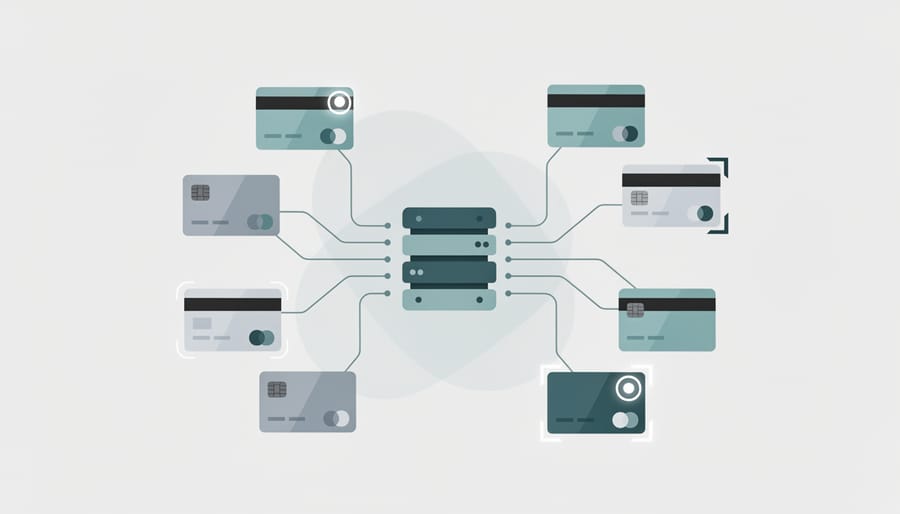
Neural Networks: The Pattern Recognition Powerhouse
Think of neural networks as pattern-spotting detectives with extraordinary memory. While a human fraud analyst might review hundreds of transactions and spot suspicious patterns, neural networks can examine millions of transactions simultaneously, identifying subtle connections that would be impossible for humans to detect.
Here’s how they work in practice: imagine your credit card gets used at a gas station in Texas at 3 PM, then an hour later someone tries to buy electronics in New York. A traditional rule-based system might miss this if it only checks individual transactions. But neural networks look at the bigger picture, considering your typical spending habits, travel patterns, device fingerprints, and hundreds of other data points all at once.
The real power lies in learning from experience. When a neural network analyzes a fraudulent transaction, it doesn’t just flag that specific pattern. It learns the underlying characteristics that make fraud, fraud. Maybe fraudsters tend to make small test purchases before large ones, or they prefer certain merchant types. The network picks up on these nuances across millions of examples.
Major banks use these systems to reduce false positives dramatically. Instead of blocking your card every time you travel, the network understands context. It knows the difference between you shopping while on vacation and a criminal halfway across the world using stolen credentials.
The development of explainable AI in fraud detection has made these systems even more valuable, allowing analysts to understand why specific transactions were flagged rather than relying on black-box decisions.
Behavioral Analytics: When AI Knows You Better Than You Know Yourself
Think of AI fraud detection systems as incredibly attentive personal assistants who know your financial habits inside and out. These systems don’t just watch for suspicious transactions; they build detailed behavioral profiles that capture your unique spending personality.
Here’s how it works: Every time you swipe your card at your neighborhood coffee shop at 7:30 AM or pay your utility bill on the first of the month, the AI takes note. Over time, it learns that you typically spend $50 on groceries on Tuesdays, rarely make purchases after midnight, and never shop internationally. This creates what experts call your “financial fingerprint,” a pattern as unique as your actual thumbprint.
The real magic happens when something doesn’t fit your pattern. Let’s say someone tries to buy a $2,000 laptop in another country at 3 AM. The AI instantly flags this because it violates multiple elements of your behavioral profile: unusual purchase amount, unfamiliar location, and strange timing. Banks can then freeze the transaction within seconds and send you an alert.
What makes this approach powerful is its ability to catch fraud that traditional rule-based systems miss. A $15 transaction at a gas station might seem harmless, but if you never visit gas stations because you don’t own a car, the AI spots this inconsistency immediately. It’s like having a financial guardian who notices when something’s off, even if the transaction amount appears normal.
Real-World Applications: AI Fraud Detection in Action
Credit Card Fraud: Stopping Thieves at the Point of Sale
Major credit card companies process millions of transactions every second, and AI credit card fraud detection systems work tirelessly behind the scenes to protect your money. Consider how Mastercard’s Decision Intelligence system analyzes every swipe, tap, or online purchase in milliseconds. When someone in New York suddenly tries to buy electronics in Bangkok minutes after using their card locally, the AI immediately flags this as suspicious based on impossible travel patterns.
Visa’s Advanced Authorization system provides an even more impressive example. It examines over 500 data points per transaction, including your typical spending habits, merchant location, device information, and time of day. In 2022 alone, it helped prevent over 25 billion dollars in fraud. The system learns what normal looks like for you specifically. If you regularly buy coffee for five dollars but suddenly there’s a two-thousand-dollar jewelry purchase, the AI catches it instantly and either declines the transaction or prompts additional verification. This real-time protection happens so fast that legitimate customers rarely notice the security working in the background.

Identity Theft and Account Takeovers
AI has become remarkably skilled at spotting identity thieves by analyzing patterns that genuine account holders typically follow. When you log into your banking app, AI systems instantly evaluate dozens of factors: your device type, location, typing speed, how you swipe through screens, and even the angle you hold your phone.
Consider how Chase Bank’s AI works in practice. If someone in Romania attempts to access your account at 3 AM while your phone remains in Los Angeles, the system immediately flags this inconsistency. But it goes deeper than geography. The AI notices behavioral quirks too. Perhaps you always check your savings account first, then transfers, then credit cards. An imposter likely won’t follow this exact sequence.
Bank of America takes this further with voice biometrics. When you call customer service, AI analyzes over 100 unique voice characteristics, from vocal pitch to speech rhythm. This creates a voiceprint that’s nearly impossible to fake.
These systems also connect with debit card scam prevention tools, creating multiple security layers. When something seems off, the AI might require additional verification steps, like answering security questions or confirming via text message. This happens seamlessly within seconds, protecting your account while you’re simply trying to check your balance.
Money Laundering and Complex Financial Crimes
Money laundering has evolved far beyond the stereotype of briefcases full of cash. Modern criminals move dirty money through hundreds of transactions across multiple countries, making it nearly impossible for human analysts to track every connection. This is where AI becomes a financial detective that never sleeps.
Think of traditional money laundering detection like trying to find a specific route on a map by examining one road at a time. AI, however, can view the entire map simultaneously, spotting unusual patterns across thousands of accounts and transactions. Machine learning algorithms analyze transaction networks, identifying suspicious behaviors like funds being split into smaller amounts (called “smurfing”), moved through shell companies, or following circular patterns where money eventually returns to its source.
For example, AI systems at major banks have uncovered schemes where criminals created dozens of seemingly unrelated accounts. While each individual transaction appeared normal, AI detected the hidden connections—same IP addresses, similar transaction timing patterns, and coordinated movements that suggested a single orchestrated operation.
These systems learn from historical cases, constantly improving their ability to spot new laundering techniques. They can flag transactions involving high-risk jurisdictions, unusual business relationships, or accounts that suddenly change their typical behavior patterns. What once took forensic accountants months to piece together, AI can now identify in hours, analyzing relationships between people, companies, and transactions that would be virtually invisible to human review alone.
The Technology Behind the Scenes
Natural Language Processing: Reading Between the Lines
Think of Natural Language Processing (NLP) as teaching computers to read like seasoned detectives. When you send an email to your bank or fill out a loan application, AI-powered NLP systems scan every word, looking for red flags that might slip past human reviewers.
Here’s how it works in practice: NLP algorithms analyze thousands of emails, customer communications, and transaction notes simultaneously, identifying suspicious patterns. For example, if someone claims their business sells “premium electronics” but their emails contain poor grammar, inconsistent business details, or language typically associated with scam operations, the system flags it for review.
Banks use NLP to examine insurance claims too. The technology can spot when multiple claims use suspiciously similar wording, suggesting coordinated fraud rings. It also catches subtle inconsistencies in stories that change across different documents.
What makes generative AI fraud detection particularly powerful is its ability to understand context and sentiment, not just keywords. The system learns what legitimate business communication looks like versus fabricated stories, becoming more accurate over time. While humans might review dozens of documents daily, NLP processes millions, catching needles in haystacks that would otherwise remain hidden.
Network Analysis: Following the Money Trail
Financial fraud rarely involves just one person working alone. Criminals often operate in sophisticated networks, moving money through multiple accounts to cover their tracks. This is where graph analytics comes into play—a powerful AI technique that maps relationships between accounts like a detective connecting clues on a crime board.
Think of it as creating a visual web. Each bank account becomes a dot, and every transaction between accounts creates a line connecting them. AI algorithms analyze these connections to spot unusual patterns. For example, if fifty different accounts suddenly start sending small amounts to one central account, then that account immediately transfers everything offshore, the AI flags this ring structure as suspicious.
Real-world impact? PayPal uses network analysis to identify fraud rings involving thousands of accounts. In one case, their system detected a money laundering operation where criminals created fake merchant accounts that appeared unrelated but were all linked through hidden connections—same IP addresses, similar transaction timing, and overlapping device fingerprints.
The beauty of this approach is speed. What might take human investigators months to piece together, AI can visualize and flag in seconds, helping financial institutions stop fraud rings before they disappear with the money.
Real-Time Processing: The Speed Advantage
Think about checking your bank account after lunch and seeing a transaction from halfway around the world. Without AI, that suspicious charge might only get flagged during an overnight batch review, giving fraudsters a 12-hour head start. Traditional systems analyzed transactions in batches, sometimes once or twice daily, creating dangerous windows of opportunity.
Modern AI changes this game completely. These systems evaluate every transaction the moment you swipe your card or click “pay.” Within milliseconds, the AI examines hundreds of factors: Is this your typical spending pattern? Does the location match your phone’s GPS? Is the purchase amount consistent with your history?
This real-time analysis means your bank can decline a fraudulent transaction before it completes, not send you an alert hours later asking if you recognize a charge. For example, if someone tries using your card details in Singapore while you’re shopping in Seattle, the AI instantly spots the geographical impossibility and blocks the transaction. The speed advantage isn’t just convenient; it’s the difference between preventing fraud and recovering from it.
The Challenges and Limitations

When AI Gets It Wrong: The False Positive Problem
We’ve all been there: your card gets declined at checkout, even though you have plenty of funds. You call your bank, frustrated, only to learn their fraud detection system flagged your legitimate purchase as suspicious. This is the false positive problem, and it happens more often than you’d think.
Here’s the challenge: AI fraud detection systems learn to spot unusual patterns, but sometimes your genuine behavior looks unusual. Booking a last-minute flight, shopping in a new city, or making an unusually large purchase can all trigger alerts. Banks estimate that for every real fraudster caught, several legitimate customers get inconvenienced.
The good news? The technology is getting smarter. Modern AI systems now consider context, learning your individual spending habits rather than just applying blanket rules. They analyze factors like your location history, typical purchase categories, and even the time of day you usually shop. Machine learning models continuously refine themselves, reducing false alarms while catching actual fraud.
Some banks now use real-time verification methods, sending you a quick text or app notification to confirm suspicious activity within seconds. This human-in-the-loop approach combines AI efficiency with your quick confirmation, dramatically improving accuracy while keeping you in control.
Privacy vs. Protection: Walking the Tightrope
Here’s the challenge: AI systems fighting fraud need access to your financial data to protect you, but that same data is incredibly sensitive. Think of it like giving a security guard the keys to your house—you want protection, but you’re also handing over significant access.
Financial institutions walk a daily tightrope between these competing needs. On one side, their AI systems analyze transaction patterns, location data, and spending habits to catch fraudsters. On the other, customers rightfully demand privacy and control over their personal information.
The solution lies in several smart strategies. Banks now use techniques like data anonymization, where identifying information gets stripped away before AI analysis begins. They’re also implementing “explainable AI” systems that can show customers exactly why a transaction was flagged, building trust through transparency.
Regulations like GDPR in Europe and CCPA in California have forced this balance, requiring companies to obtain clear consent and limit data collection to what’s strictly necessary. Many banks now offer customers granular controls—letting you choose how much monitoring you want in exchange for different levels of protection. It’s about empowering you to decide where your comfort zone lies between privacy and security.
What This Means for You
As a Consumer: What to Expect
When you swipe your credit card or log into your banking app, AI fraud protection is working silently in the background, analyzing your transaction in milliseconds. Here’s what’s happening behind the scenes and what you should know.
Your bank’s AI system maintains an invisible profile of your typical spending behavior. It knows you usually shop at grocery stores in your neighborhood on weekends and grab coffee every morning. When a transaction appears that doesn’t match your pattern, say a large electronics purchase in another country at 3 AM, the system flags it immediately. You might receive an instant text message asking you to verify the transaction, or your card could be temporarily blocked until you confirm it’s legitimate.
Most fraud detection happens without you noticing. The AI approves thousands of normal transactions while catching suspicious ones before damage occurs. However, you might occasionally experience a false alarm, like having your card declined while traveling. This happens because the AI prioritizes protecting your money over convenience.
To help your bank’s AI work better for you, notify them before traveling internationally and set up transaction alerts on your mobile app. These simple steps ensure you’re protected while minimizing disruptions to your daily life.
For Finance Professionals: Getting Started with AI
Ready to explore AI fraud detection in your workplace? Start by understanding your organization’s current fraud challenges. What patterns are you missing? Where do false alarms slow down your team? These questions will guide your AI journey.
Begin with education before implementation. Take online courses in machine learning basics and familiarize yourself with common AI fraud detection platforms like Feedzai, DataVisor, or SAS Fraud Management. Many offer free demos that let you see the technology in action without commitment.
Next, identify a pilot project. Choose a specific, manageable fraud problem rather than trying to solve everything at once. Perhaps focus on credit card transaction monitoring or account takeover detection. Small wins build confidence and demonstrate value to stakeholders.
Collaborate across departments. AI fraud detection works best when data scientists, fraud analysts, and compliance teams work together. Your human expertise in recognizing suspicious behavior patterns is invaluable for training AI systems effectively.
Finally, stay patient with the learning curve. AI systems require time to learn your specific fraud patterns and reduce false positives. Expect an adjustment period of several months where human oversight remains critical while the system refines its accuracy.
AI has fundamentally transformed how financial institutions detect and prevent fraud, turning what was once a reactive game of catch-up into a proactive defense system. We’ve seen how machine learning algorithms can spot suspicious patterns in milliseconds, how neural networks learn from millions of transactions to recognize the subtle signs of fraudulent activity, and how real-world applications at companies like PayPal and Mastercard are saving billions of dollars while protecting consumers like you and me.
But here’s the reality: this isn’t a problem that gets solved once and forgotten. Fraud detection has become an ongoing arms race. As AI systems get smarter, so do the fraudsters. They adapt their tactics, finding new vulnerabilities and creative workarounds. This means financial institutions must continuously update their AI models, feed them new data, and stay one step ahead of evolving threats.
Looking ahead, the future of AI in fraud detection is incredibly promising. We’re seeing emerging trends like federated learning, where institutions can collaborate on fraud detection without sharing sensitive customer data. Explainable AI is making these systems more transparent, helping fraud analysts understand why a transaction was flagged. And the integration of biometric authentication with AI is adding new layers of security that are both more secure and more convenient.
The key takeaway? AI isn’t just changing fraud detection, it’s revolutionizing it. Whether you’re a professional in finance, a student exploring AI applications, or simply someone who uses a credit card, understanding these systems helps you appreciate the invisible shield protecting your money every single day. Stay informed as this technology evolves, because the innovations happening today will shape how we all interact with money tomorrow.