
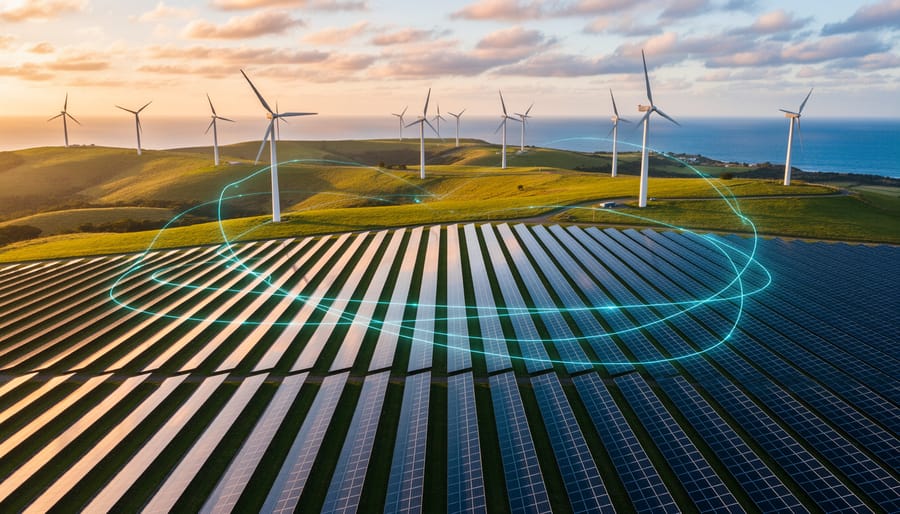
Climate change stands as humanity’s most pressing challenge, but artificial intelligence is emerging as one of our most powerful tools to fight it. While rising temperatures and extreme weather events dominate headlines, a quieter revolution is unfolding in research labs, data centers, and field stations worldwide where AI systems are transforming how we understand, predict, and respond to environmental threats.
The marriage of artificial intelligence and climate science isn’t just theoretical promise. Machine learning algorithms now predict weather patterns with unprecedented accuracy, satellite imaging powered by computer vision monitors deforestation in real-time, and neural networks optimize renewable energy grids to reduce our dependence on fossil fuels. These aren’t distant possibilities, they’re operational systems already making measurable impacts.
Consider this: traditional climate models once took weeks to process data and generate forecasts. Today, AI-enhanced systems analyze vast datasets from ocean sensors, atmospheric monitors, and satellite feeds in hours, identifying patterns invisible to human researchers. Deep learning models detect methane leaks from space, predict crop yields under changing conditions, and even design more efficient solar panels through generative algorithms.
This intersection of AI and environmental science represents more than technological innovation. It’s a fundamental shift in our capacity to understand complex Earth systems and respond before crises escalate. From Google’s data centers using AI to cut cooling energy by 40 percent to IBM’s flood prediction systems protecting vulnerable communities, practical applications are multiplying rapidly.
This article explores the concrete ways artificial intelligence is reshaping climate action. You’ll discover specific technologies already deployed, understand how they work in accessible terms, and learn what breakthroughs researchers anticipate next. No advanced technical knowledge required, just curiosity about how smart algorithms might help secure a livable planet.
Why Climate Scientists Are Racing to Harness AI
Climate scientists are dealing with a data problem of staggering proportions. Imagine trying to predict tomorrow’s weather by manually reviewing millions of temperature readings, satellite images, ocean current measurements, and atmospheric data points from around the globe. Now multiply that challenge by trying to forecast climate patterns decades into the future. It’s like attempting to complete a billion-piece jigsaw puzzle where the pieces are constantly changing shape.
Traditional climate models, while sophisticated, struggle with the sheer volume and complexity of Earth’s climate systems. These models divide the planet into grid squares and calculate how energy and matter move between them, but they can miss crucial details. For instance, clouds smaller than a grid square might be overlooked, yet they significantly impact how sunlight reflects back into space or traps heat near the surface.
This is where AI enters the picture as a game-changer. Think of AI as a pattern detective that never gets tired. While a human scientist might spend months identifying relationships between ocean temperatures and hurricane formation in limited datasets, machine learning algorithms can analyze decades of global data in hours, spotting subtle patterns that would otherwise remain hidden.
AI excels at exactly what climate science needs most: processing enormous amounts of messy, real-world data and finding meaningful connections. Machine learning models can simultaneously track thousands of variables, from jet stream movements to soil moisture levels, and understand how they interact in ways traditional equations struggle to capture.
The speed advantage is equally crucial. Climate change doesn’t wait for us to catch up with our analysis. AI can rapidly test thousands of scenarios, helping scientists understand which interventions might work best and how quickly we need to act. It’s like having a supercharged assistant that can run through countless “what if” questions while researchers focus on interpreting the results and making informed decisions.
This combination of pattern recognition, processing power, and speed makes AI not just helpful, but essential for tackling climate challenges at the pace and scale we desperately need.
Predicting Tomorrow’s Weather (And the Next Decade’s Climate)
Machine Learning Models That Outperform Traditional Forecasts
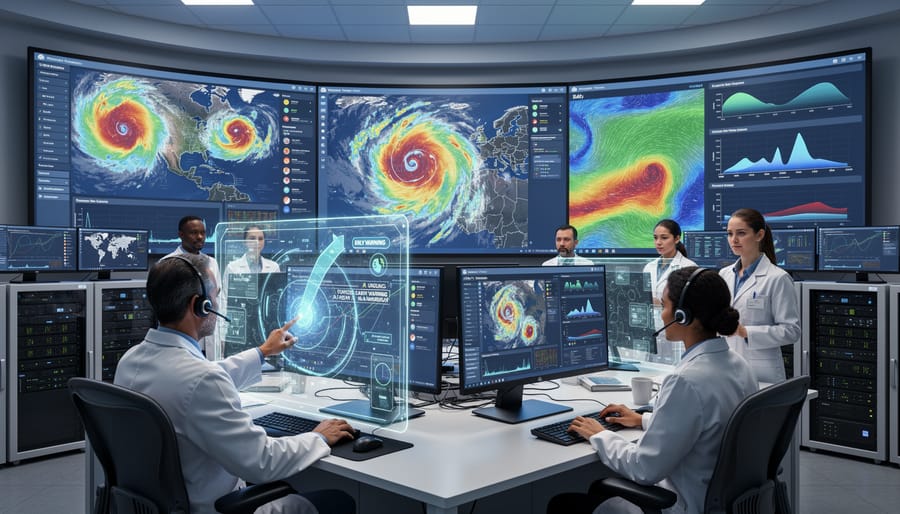
Traditional weather forecasting has relied on massive supercomputers crunching atmospheric data for hours, but a new generation of AI climate prediction models is changing the game entirely.
Google DeepMind’s GraphCast represents a breakthrough in this field. While conventional forecasting systems need hours of computation on energy-hungry supercomputers, GraphCast delivers 10-day weather predictions in under 60 seconds on a single machine. Even more impressive, it outperforms the European Centre for Medium-Range Weather Forecasts, the gold standard in weather prediction, on over 90% of test variables.
Here’s what makes this revolutionary: GraphCast learned weather patterns by studying four decades of historical data, teaching itself how weather systems evolve. Instead of solving complex physics equations step by step, it recognizes patterns across millions of atmospheric data points simultaneously.
The practical impact is enormous for early warning systems. In 2023, GraphCast accurately predicted Hurricane Lee’s landfall in Nova Scotia nine days in advance, three days earlier than traditional models. Those extra days mean more time for evacuations, emergency preparations, and potentially saving lives.
Microsoft’s Aurora and Nvidia’s FourCastNet are also pushing boundaries, with Aurora processing global forecasts five times faster than existing systems. These models can now predict extreme weather events like heat waves, floods, and tropical cyclones with unprecedented lead times, giving communities crucial extra hours or days to prepare and respond to climate-related disasters.
Understanding Climate Patterns We Couldn’t See Before
Climate data holds secrets that have eluded scientists for decades, hidden within billions of data points collected from satellites, weather stations, and ocean buoys. Traditional analysis methods simply couldn’t process the sheer volume or detect the subtle connections between seemingly unrelated variables. This is where AI changes everything.
Machine learning models can analyze thousands of climate variables simultaneously, discovering patterns invisible to human researchers. For example, AI systems examining decades of ocean temperature data, atmospheric pressure readings, and wind patterns recently identified previously unknown precursors to El Niño events. These AI discoveries revealed that certain combinations of subtle ocean temperature shifts in specific regions, occurring months before traditional indicators appear, can predict El Niño with remarkable accuracy.
The technology works by finding correlations across massive datasets that would take human analysts lifetimes to examine. Think of it like having a detective who can instantly review millions of case files to spot connections between tiny details that others missed. AI recently uncovered relationships between Arctic ice melt rates and extreme weather events in Europe, connections that conventional climate models overlooked because the signals were too weak or too complex.
This enhanced pattern recognition doesn’t just satisfy scientific curiosity. It translates directly into better predictions about droughts, hurricanes, and heatwaves, giving communities more time to prepare and potentially saving lives. The patterns were always there in the data, we just needed smarter tools to see them.
Tracking Environmental Changes From Space and Sea
Satellites That Never Sleep: AI-Powered Earth Monitoring
Every day, satellites orbiting Earth capture millions of images and data points about our planet’s surface. But here’s the challenge: a single satellite can generate terabytes of data in just one pass. Analyzing all this information manually would take teams of scientists decades to complete. This is where AI steps in as an invaluable assistant.
Machine learning algorithms now process satellite imagery automatically, identifying patterns and changes that signal environmental shifts. For example, these systems can scan vast stretches of the Amazon rainforest, detecting illegal logging activities within hours of occurrence. They compare new images against historical data, spotting where trees have disappeared and alerting authorities in near real-time.
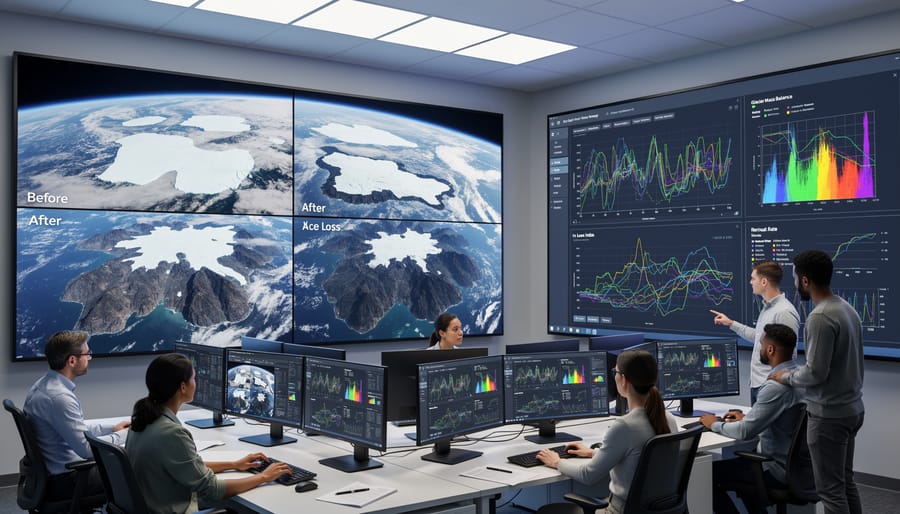
In the Arctic and Antarctic, AI monitors glacier retreat with unprecedented precision. The algorithms measure ice thickness, track melting rates, and identify acceleration patterns that help scientists predict sea level rise more accurately. What once required laborious manual measurements from research stations now happens continuously from space.
Urban sprawl, agricultural expansion, and wetland loss are also under AI’s watchful eye. These systems track how cities grow, where farmland replaces natural habitats, and which coastal areas face erosion. They create detailed maps showing land use changes over months or years, providing policymakers with concrete data to inform conservation decisions.
This 24/7 monitoring capability transforms our understanding of environmental change. Instead of waiting years for comprehensive reports, scientists now receive ongoing updates, enabling faster responses to emerging threats and better-informed climate action strategies.
Ocean Intelligence: Mapping What We Can’t See
Our oceans cover 70% of Earth’s surface, yet remain largely mysterious—we’ve mapped more of Mars than our own ocean floor. This knowledge gap makes it incredibly difficult to protect marine ecosystems from climate change. Fortunately, AI is changing that by helping scientists monitor vast ocean territories in ways humans simply couldn’t manage alone.
Take marine heatwaves, for example. These underwater heat events devastate coral reefs and disrupt entire food chains, but they’re notoriously hard to track across millions of square miles. AI systems now analyze satellite data and ocean sensors in real-time, identifying temperature anomalies and predicting where heatwaves will strike next. This gives marine biologists precious time to prepare monitoring efforts and helps fisheries anticipate impacts on fish populations.
Coral reefs face particular danger, with scientists estimating we could lose 90% of reefs by 2050. AI models trained on historical data can predict coral bleaching events weeks in advance by analyzing water temperature, light levels, and ocean currents. Some systems achieve accuracy rates above 85%, allowing conservationists to deploy targeted interventions like temporary shading structures or coral relocation efforts.
Perhaps most surprisingly, AI excels at catching ocean criminals. Illegal fishing costs the global economy billions annually and pushes species toward extinction. Machine learning algorithms now scan satellite imagery and vessel tracking data to identify suspicious patterns—ships turning off transponders in protected areas, vessels moving in ways that suggest unauthorized fishing, or boats meeting at sea to transfer illegal catches. These pattern recognition systems have already helped authorities crack down on illegal operations that human analysts might have missed in the overwhelming sea of data.
Accelerating Clean Energy and Carbon Solutions
Smarter Grids: Balancing Renewable Energy in Real-Time
One of renewable energy’s biggest challenges isn’t generating power—it’s predicting when that power will be available. Solar panels produce electricity only when the sun shines, and wind turbines need, well, wind. This unpredictability has traditionally made grid operators nervous about relying too heavily on renewables.
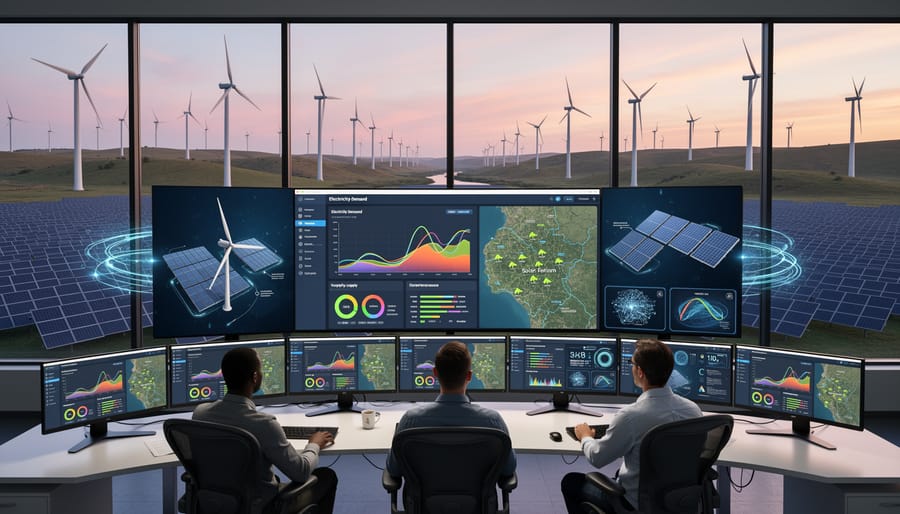
Enter AI-powered smart grids. These systems use machine learning algorithms to forecast renewable energy generation with remarkable accuracy. By analyzing weather patterns, historical data, and real-time conditions, AI can predict solar and wind output hours or even days in advance. One utility in Denmark, for example, uses AI to forecast wind power generation with 90% accuracy, allowing operators to plan accordingly and reduce reliance on fossil fuel backup plants.
But prediction is only half the story. AI also analyzes electricity demand patterns—learning when people typically use more power, how weather affects consumption, and even how holidays change usage. By matching predicted supply with anticipated demand, these intelligent systems automatically balance the grid in real-time, routing power where it’s needed and storing excess energy in batteries for later use.
The result? Less wasted energy, fewer blackouts, and greater confidence in renewable sources. In California, AI-managed grids have helped integrate massive amounts of solar power without compromising reliability. These smart systems are essentially teaching our electrical infrastructure to dance with the weather, transforming renewables from unpredictable add-ons into dependable power sources that can truly replace fossil fuels.
Finding Tomorrow’s Climate Solutions Faster
Imagine trying to find the perfect recipe by actually cooking millions of different combinations. It would take lifetimes. Yet that’s essentially what scientists have faced when searching for new materials to fight climate change. They needed better batteries to store renewable energy, more efficient solar panels to capture sunlight, and innovative materials to pull carbon dioxide from the air. Testing each possibility in a lab could take years.
This is where AI becomes a game-changer. Through AI-driven materials discovery, researchers can now simulate and test millions of material combinations virtually before ever stepping into a lab. Machine learning algorithms analyze how atoms and molecules interact, predicting which combinations will have the properties scientists need.
Take carbon capture technology. AI systems can screen thousands of potential catalysts—materials that speed up chemical reactions—to find ones that efficiently grab CO2 from the atmosphere or industrial exhaust. What might have taken a decade of lab work now happens in months, sometimes weeks.
The same approach applies to battery development. AI models evaluate countless chemical compositions to identify materials that store more energy, charge faster, and last longer. These breakthroughs are essential for electric vehicles and storing solar and wind energy for when the sun isn’t shining or the wind isn’t blowing.
For solar cells, AI helps discover new materials that convert more sunlight into electricity while costing less to manufacture. Some AI-identified compounds have already shown promise in early testing, potentially making solar power even more accessible.
The beauty of this approach is its efficiency. Instead of relying on trial and error or educated guesses, AI learns from existing scientific data and identifies patterns humans might miss, dramatically accelerating our path to climate solutions.

The Challenges AI Can’t Solve Alone
While AI offers powerful tools for fighting climate change, it’s not a silver bullet—and comes with its own set of complications that we need to address honestly.
First, there’s an ironic twist: AI itself has a carbon footprint. Training large AI models requires massive computational power, which translates to significant electricity consumption. These energy consumption challenges mean that some AI solutions might generate emissions even as they’re designed to reduce them elsewhere. A single large language model can produce as much carbon dioxide during training as five cars over their entire lifetimes. This doesn’t mean we shouldn’t use AI for climate solutions, but it does mean we need to be strategic about when and how we deploy it.
The quality of AI predictions depends entirely on the data fed into the system. Climate models need decades of accurate weather observations, satellite imagery, and sensor readings. In many parts of the world, particularly in developing nations most vulnerable to climate change, this data simply doesn’t exist or isn’t comprehensive enough. Garbage in, garbage out—as the saying goes. Without quality data, even the most sophisticated AI will produce unreliable results.
Human expertise remains irreplaceable. AI can identify patterns and make predictions, but it can’t understand the social, political, and economic contexts that shape climate policy. A computer might optimize an energy grid perfectly on paper, but it won’t understand community concerns, equity issues, or the cultural factors that influence whether people will actually adopt new technologies. Climate scientists, policymakers, and local communities must guide how AI tools are developed and deployed.
The ethical considerations run deeper too. There’s a real risk that over-reliance on AI could delay urgent action, as people wait for the perfect technological solution instead of making necessary changes now. Technology can support climate action, but it can’t replace the fundamental shifts in how we produce energy, consume resources, and organize our societies. AI is a tool in the toolbox—powerful when used wisely, but only one part of a much larger solution.
What’s on the Horizon for AI Climate Science
The future of AI in climate science is brimming with ambitious projects that sound like science fiction but are rapidly becoming reality. At the forefront are digital twins—virtual replicas of Earth’s entire climate system that can run countless what-if scenarios in minutes. The European Union’s Destination Earth initiative is building one of the most comprehensive digital twins yet, allowing scientists to simulate everything from local rainfall patterns to global ocean currents with unprecedented detail.
These digital twins aren’t just for scientists in lab coats. They’re being designed to help city planners visualize how their neighborhoods might flood in future storms or how urban green spaces could reduce heat islands. The technology makes climate projections tangible and actionable for decision-makers who need to act now.
Another exciting frontier is AI-powered climate adaptation strategies. While we’ve focused heavily on prediction, AI is now helping communities respond to climate impacts already happening. Machine learning models are optimizing water distribution in drought-prone regions, identifying which crops will thrive in changing conditions, and even predicting disease outbreaks linked to climate shifts.
Global collaboration is accelerating progress too. Initiatives like Climate Change AI bring together researchers, companies, and governments to tackle climate challenges no single entity could solve alone. These partnerships are creating open-source tools and datasets that make cutting-edge climate AI accessible to universities and organizations worldwide, not just tech giants.
For readers eager to engage with this field, the barriers to entry are lower than ever. Online platforms offer free courses in climate data analysis, while citizen science projects let anyone contribute to climate monitoring efforts using smartphone apps. Organizations like Climate Change AI regularly publish accessible reports on breakthrough applications, and many research teams share their models openly on platforms like GitHub.
The message is clear: AI climate science isn’t just the domain of specialists anymore. Whether you’re a student, developer, or simply someone passionate about solutions, there are meaningful ways to participate in this crucial work.
The intersection of AI and climate science represents one of the most promising frontiers in our response to environmental challenges. From predicting extreme weather events with unprecedented accuracy to optimizing renewable energy systems and monitoring deforestation in real-time, AI is already making tangible differences. However, it’s important to remember that artificial intelligence is a powerful tool, not a magic solution. It amplifies human expertise and helps us process information at scales we couldn’t manage alone, but it requires careful implementation, quality data, and continued refinement.
If you’re interested in following developments in this field, start by exploring platforms like Climate Change AI, which bridges the gap between AI researchers and climate scientists. For those wanting to contribute directly, consider developing skills in machine learning fundamentals, earth sciences, or data analysis. Even small contributions, like participating in citizen science projects that train climate models or supporting organizations working at this intersection, make a difference.
The path forward requires collaboration between technologists, climate scientists, policymakers, and communities affected by climate change. AI won’t solve the climate crisis on its own, but when combined with political will, sustainable practices, and collective action, it provides us with sharper insights and faster responses than ever before. The technology is here, continually improving, and increasingly accessible. What matters now is how we choose to apply it and who gets to benefit from these advancements as we work toward a more sustainable future.