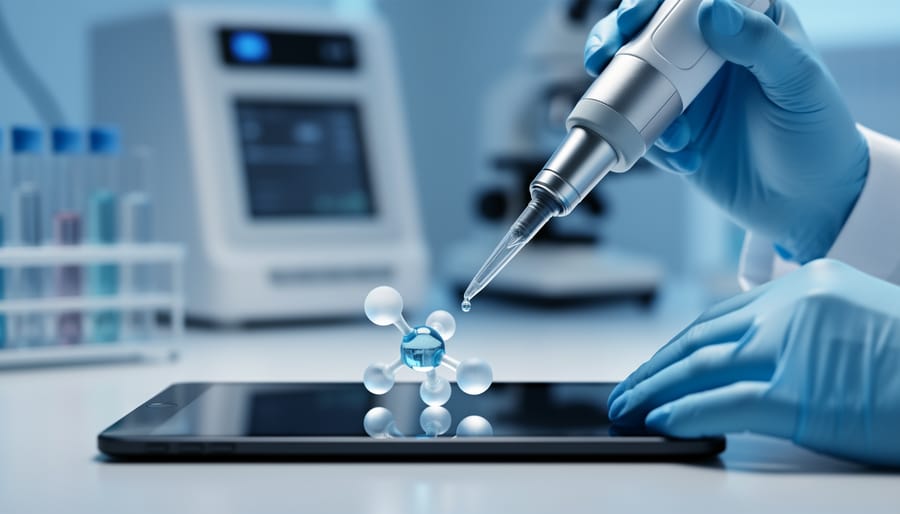
The pharmaceutical industry faces a sobering reality: developing a single drug takes approximately 10-15 years and costs upward of $2.6 billion, with a 90% failure rate. For every medicine that reaches patients, countless candidates fall short during testing, representing not just financial losses but delayed treatments for people who desperately need them. Generative AI is now challenging this paradigm by redesigning how we discover drugs from the ground up.
Think of generative AI as a highly trained molecular architect. Traditional drug discovery involves scientists manually testing millions of existing compounds to find one that might work against a disease target. Generative AI flips this approach: it learns the rules of molecular chemistry and biology from vast datasets, then designs entirely new molecules optimized for specific therapeutic goals. The technology doesn’t just search through what exists; it creates what could exist.
This isn’t science fiction playing out in distant laboratories. Companies like Insilico Medicine have used AI to design drug candidates now in human clinical trials, compressing what typically takes four years into under 18 months. Recursion Pharmaceuticals has generated insights from billions of cellular images to identify unexpected drug applications. These real-world results demonstrate that generative AI can meaningfully accelerate the journey from laboratory concept to potential patient treatment, though significant challenges around validation, safety testing, and regulatory approval remain before AI-designed drugs become commonplace in medicine.
The Old Way: Why Drug Discovery Takes Forever
Imagine searching for a single needle in a thousand haystacks, then spending fifteen years and nearly three billion dollars to prove you found the right one. That’s essentially how traditional drug discovery works today.
The conventional pipeline starts with target identification, where scientists pinpoint a specific protein or molecule involved in a disease. Then comes the screening phase, where researchers test millions of chemical compounds to find ones that interact with that target. Think of it like trying every key in a massive warehouse to find the few that might unlock a specific door.
Once promising candidates emerge, they enter preclinical testing with lab dishes and animal studies. The survivors then face three phases of human clinical trials, each progressively larger and more expensive. Phase I tests safety in a small group, Phase II examines effectiveness in a few hundred patients, and Phase III involves thousands of participants to confirm the drug actually works better than existing treatments.
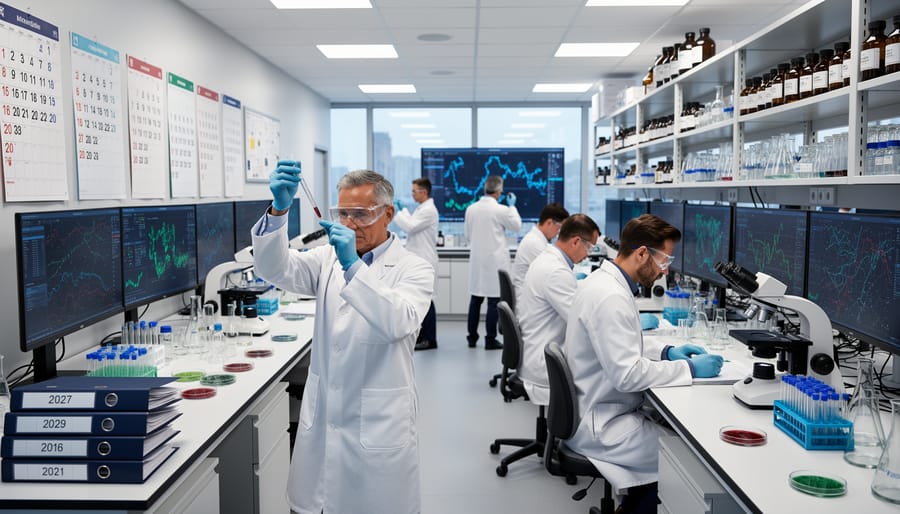
Here’s the sobering reality: this journey takes 10-15 years on average, and the failure rate is staggering. More than 90 percent of drug candidates that enter clinical trials never make it to pharmacy shelves. A compound might fail because it doesn’t work as expected, causes unexpected side effects, or simply can’t be manufactured reliably at scale.
The bottlenecks appear everywhere. Screening millions of molecules is painfully slow. Predicting how a drug will behave in the human body remains more art than science. And clinical trials, while essential for safety, represent massive gambles where years of work can evaporate with disappointing results.
For patients waiting for treatments for rare diseases or aggressive cancers, this timeline isn’t just frustrating—it’s potentially fatal. The pharmaceutical industry has long recognized these problems but lacked the tools to fundamentally reimagine the process. That’s where generative AI enters the picture, promising to compress timelines and improve success rates in ways previously impossible.
What Makes Generative AI Different
The Technology Behind the Magic
Several powerful AI techniques are revolutionizing how scientists discover new drugs, each bringing unique capabilities to the challenge.
Deep learning forms the foundation of this revolution. Think of it as teaching computers to recognize patterns the same way you learned to identify dogs. After seeing thousands of dog photos, you can spot a dog instantly. Similarly, deep learning systems analyze millions of molecular structures to predict which ones might work as medicines. They learn what successful drugs look like and can identify promising candidates from vast chemical libraries.
Generative adversarial networks, or GANs, work like a master artist and art critic working together. One AI creates new molecular structures (the artist), while another evaluates whether they look like viable drug candidates (the critic). Through this creative tension, GANs generate entirely new molecules that humans might never have imagined, potentially opening doors to breakthrough treatments.
Transformers, the technology behind ChatGPT, have found surprising applications in drug discovery. They treat molecular structures like sentences, understanding how different chemical “words” relate to each other. This helps predict how molecules will behave in the body and interact with disease targets.
Diffusion models represent the newest addition to the toolkit. Imagine watching a photograph gradually emerge from static noise. These models work similarly, starting with random chemical noise and progressively refining it into precise molecular structures with desired medicinal properties. Together, these technologies are transforming drug discovery from educated guesswork into intelligent design.
From Data to Drug Candidates
The journey from data to drug candidates follows a fascinating three-step workflow. First, AI systems learn from massive molecular databases containing millions of known chemical compounds, their structures, and biological activities. Think of it like teaching a student chemistry by showing them countless examples until they recognize patterns in what makes molecules effective.
Once trained, these AI models become molecular architects. Scientists input parameters like the target disease protein or desired properties (solubility, low toxicity), and the AI generates entirely new molecular structures that theoretically should work. Some systems create hundreds of candidates in hours, a process that traditionally took months.
The crucial third step is validation. Scientists don’t blindly trust AI suggestions. They test the most promising AI-generated molecules in lab experiments, checking if they actually bind to target proteins and produce desired effects. This combines computational screening with real laboratory work, including phenotypic drug discovery approaches that observe effects in living cells.
This iterative cycle continues, with AI learning from each round of testing results, gradually improving its molecular suggestions. The feedback loop accelerates discovery while human expertise remains essential for interpreting results and making final decisions.
Real Companies Making Real Drugs Right Now
Success Story: The First AI-Discovered Drug in Clinical Trials
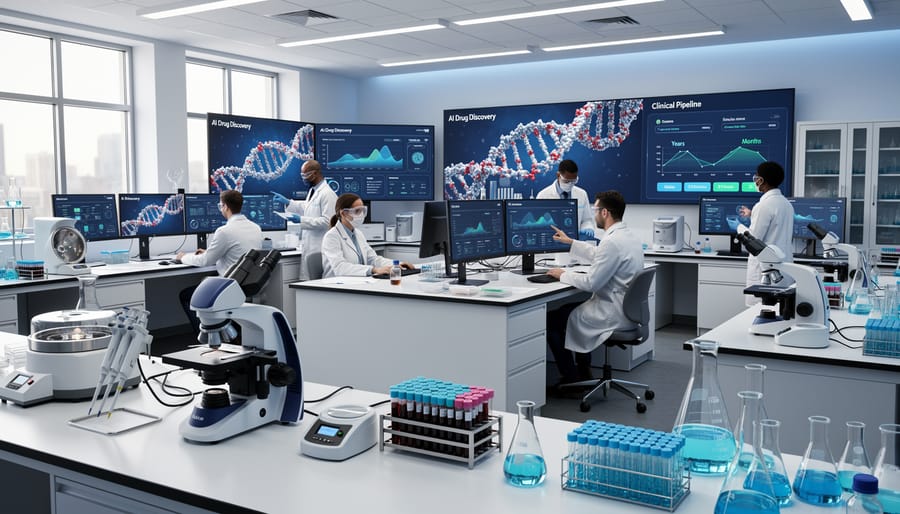
In 2019, Insilico Medicine, a Hong Kong-based AI company, set out to discover a new treatment for idiopathic pulmonary fibrosis, a devastating lung disease with limited treatment options. What typically takes pharmaceutical companies four to five years, Insilico accomplished in just 18 months, marking a pivotal moment in drug discovery history.
The process began with Insilico’s generative AI system analyzing massive datasets of biological information to identify a novel target protein involved in fibrosis. Think of it like having an exceptionally fast research assistant that can review millions of scientific papers and experiment results simultaneously. The AI then designed entirely new molecular structures that could interact with this target, generating approximately 30,000 potential drug candidates.
After the AI narrowed these down to the most promising options, Insilico’s scientists synthesized and tested fewer than 80 compounds in the laboratory. By late 2021, they had identified INS018_055, a small molecule that showed remarkable potential in preclinical studies.
The drug entered Phase I clinical trials in 2022 in both China and New Zealand, becoming one of the first AI-discovered drugs to reach human testing. Early results showed the compound was safe and well-tolerated in healthy volunteers. As of 2024, the drug has advanced to Phase II trials, where researchers are testing its effectiveness in actual patients with pulmonary fibrosis.
This breakthrough demonstrates that AI isn’t just theoretical anymore. It’s actively compressing timelines, reducing costs, and potentially bringing life-saving medications to patients years earlier than traditional methods would allow.
The Big Players and Their Platforms
The generative AI drug discovery landscape features several pioneering companies, each bringing distinct approaches to the challenge of accelerating pharmaceutical development.
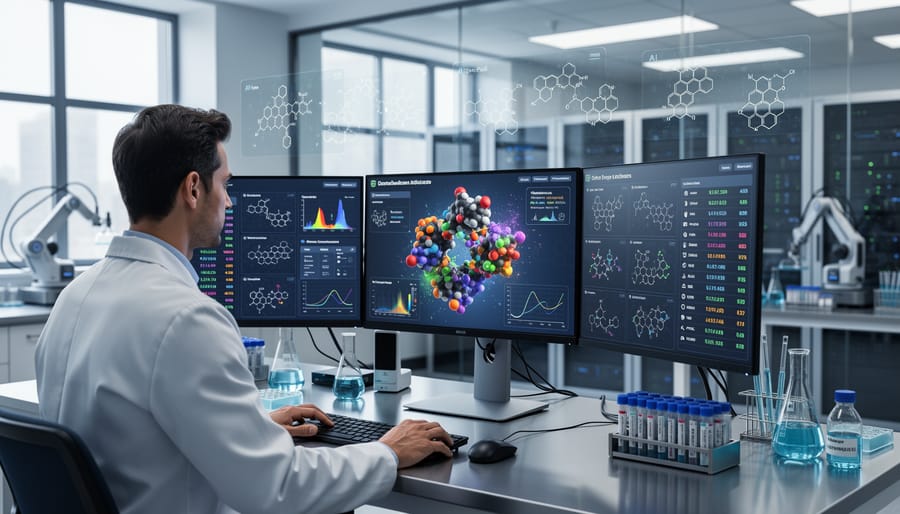
Recursion Pharmaceuticals stands out with its massive biological data generation system. The company operates one of the world’s largest wet labs, where robotic systems conduct millions of experiments, capturing images of how cells respond to different treatments. Their AI platform, trained on this enormous dataset of cellular images, can predict which drug candidates might work for specific diseases. Think of it as teaching a computer to recognize patterns in how diseases affect cells, then using that knowledge to suggest potential treatments.
Atomwise takes a different route, focusing on molecular structure. Their technology, called AtomNet, examines how drug molecules might fit with disease-causing proteins, similar to finding the right key for a lock. The company has screened over 3 trillion potential drug-protein combinations, helping researchers identify promising candidates in days rather than years. They’ve established partnerships with major pharmaceutical companies and research institutions to tackle diseases from Ebola to multiple sclerosis.
BenevolentAI combines multiple data sources into what they call a “knowledge graph,” connecting information from scientific literature, clinical trials, and genetic studies. Their platform reads and understands millions of research papers, identifying hidden connections between diseases and potential treatments that human researchers might miss. This approach led to the discovery of baricitinib as a potential COVID-19 treatment, which was subsequently approved for emergency use.
Insilico Medicine made headlines by designing a novel drug candidate for fibrosis in under 18 months, a process that traditionally takes four to five years, demonstrating the real-world speed advantages of generative AI approaches.
What Generative AI Can Actually Do Today
Designing Molecules from Scratch
Imagine an artist with an infinite canvas, but instead of painting landscapes, they’re sketching molecular structures. That’s essentially what generative AI does in drug discovery. These systems work like sophisticated molecular architects, learning the “grammar” of chemistry by studying millions of existing drug compounds.
Think of it as LEGO blocks with rules. Traditional drug discovery involves testing existing blocks one by one, hoping they fit together. Generative AI, however, learns which combinations work and why, then designs entirely new blocks from scratch that should theoretically snap together perfectly.
The AI models, often based on deep learning architectures, can generate thousands of novel molecular structures in hours. They’re given parameters like “must bind to this protein” or “needs to cross the blood-brain barrier,” and they produce candidates matching these criteria, much like an architect designing buildings that meet specific safety codes and aesthetic requirements.
What makes this revolutionary is specificity. Instead of randomly searching chemical space containing more possible molecules than atoms in the universe, AI navigates this vast territory intelligently, proposing structures with predetermined properties. It’s the difference between wandering aimlessly through a library versus having a guide who knows exactly where the relevant books are shelved.
Predicting How Drugs Will Behave
Before investing millions in synthesizing and testing a new drug candidate, wouldn’t it be valuable to know if it might cause liver damage or fail to reach its target? This is where generative AI becomes a game-changer, similar to predicting health outcomes in other medical applications.
AI models can analyze a drug molecule’s structure and predict how it will behave in the human body. By examining patterns from thousands of previous drug trials, these systems forecast potential toxicity levels, estimate effectiveness against disease targets, and identify likely side effects. Think of it as a virtual testing lab that runs simulations in hours rather than months.
This predictive capability dramatically reduces costs and time. Pharmaceutical companies can eliminate problematic candidates early, focusing resources only on promising molecules. For example, if AI flags a compound as potentially toxic to kidneys, researchers can modify or abandon it before expensive animal testing begins. One study found this approach can reduce preclinical development time by up to 50 percent, translating to millions in savings and faster paths to patients who need new treatments.
Optimizing Existing Drugs
Sometimes the best solution isn’t creating something entirely new, but improving what already works. Generative AI excels at this optimization game with existing drugs. Think of it like a sophisticated editing tool that suggests thousands of tiny molecular adjustments to make a good medication even better.
The AI analyzes a drug’s chemical structure and generates variations that might reduce side effects, improve absorption, or increase potency. For example, researchers have used AI to modify existing antibiotics to overcome bacterial resistance, essentially giving old drugs new life. The technology identified which parts of the molecule could be tweaked without losing effectiveness while adding desirable properties.
This approach is faster and cheaper than developing drugs from scratch because scientists start with proven compounds. AI can explore millions of structural modifications in days, predicting which changes will enhance safety profiles or allow lower dosages. Real-world applications include improving cancer therapies to target tumors more precisely while causing less damage to healthy tissue, demonstrating how AI transforms incremental improvements into significant patient benefits.
Repurposing Old Drugs for New Uses
Drug repurposing represents one of AI’s most practical applications in medicine today. Instead of developing entirely new molecules from scratch—a process taking over a decade—generative AI analyzes existing approved drugs to find unexpected therapeutic uses. The technology examines molecular structures, disease pathways, and vast medical databases to spot connections human researchers might miss.
A compelling success story involves baricitinib, an arthritis medication that AI systems identified as potentially effective against COVID-19. BenevolentAI’s algorithms analyzed how the drug might prevent the virus from entering cells, leading to emergency authorization for hospitalized patients. Similarly, AI helped researchers discover that metformin, commonly prescribed for diabetes, shows promise in treating certain cancers and age-related diseases.
The advantage is significant: repurposed drugs already have established safety profiles, cutting development time from 10-15 years to potentially 3-5 years. Companies like Exscientia and Atomwise regularly screen thousands of approved medications against new disease targets, uncovering possibilities that would take human teams years to investigate manually.
The Challenges Nobody Talks About
When AI Gets It Wrong
Despite the excitement, AI drug discovery isn’t foolproof. These systems sometimes generate molecules that look promising on paper but fail in real-world testing. Think of it like a recipe generator that creates combinations that sound delicious but taste terrible when actually cooked.
The biggest challenge is the “black box” problem. Imagine asking a friend for restaurant recommendations, and they give you a list but can’t explain why they chose those places. Similarly, AI models can suggest promising drug candidates without clearly explaining their reasoning. This makes scientists nervous because they need to understand why a molecule might work before investing millions in testing it.
Validation remains crucial. When AI suggests a new compound, human researchers must verify the predictions through laboratory experiments and clinical trials. A molecule that appears stable in a computer simulation might decompose quickly in the human body or cause unexpected side effects.
This is why pharmaceutical companies pair AI tools with experienced chemists and biologists. The technology accelerates the initial discovery phase, but human expertise guides the critical decisions about which candidates deserve further investigation. AI provides the shortcuts, but scientists still need to verify every turn along the way.
The Data Problem
Despite impressive advances, generative AI in drug discovery faces a fundamental challenge: data quality and quantity. Machine learning models are only as good as what they learn from, and pharmaceutical data remains surprisingly limited. Consider that humans have tested only a tiny fraction of possible molecular combinations, leaving AI models to predict outcomes in largely uncharted territory.
Training data often comes from published studies, which tend to showcase successful experiments rather than the countless failures that teach equally valuable lessons. This creates blind spots in AI predictions. Additionally, biological data is incredibly complex—a molecule might work beautifully in computer simulations but fail when it encounters the messy reality of living cells.
This is why AI can’t replace wet lab experiments entirely. Computer models might suggest a promising drug candidate in days, but scientists still need months of physical testing to verify it actually works, remains safe, and behaves as predicted in real biological systems. Think of AI as an incredibly smart assistant that narrows down millions of options to a handful worth testing—but human scientists must still roll up their sleeves and validate those predictions in the laboratory.
Regulatory Hurdles and Trust
Regulatory agencies like the FDA face a significant challenge: how do you evaluate a drug when AI played a key role in discovering it? Currently, regulators focus on the end product rather than the discovery method, which means AI-discovered drugs go through the same rigorous clinical trials as traditional ones. The first AI-designed drug molecule to enter human trials happened in 2020, and regulators are still developing frameworks to assess these technologies.
The trust issue runs deeper than regulatory approval, though. Doctors and patients need confidence in AI-generated medicines. Many healthcare professionals remain skeptical about “black box” AI systems where the decision-making process isn’t fully transparent. Building this trust requires pharmaceutical companies to demonstrate not just that their AI works, but how it works. Some companies are addressing this by publishing their methodologies and sharing data openly. The path forward involves collaboration between AI developers, drug makers, and regulators to establish clear standards that protect patient safety while encouraging innovation in this promising field.
What This Means for Patients and Healthcare
For patients waiting for treatments, generative AI in drug discovery represents something more meaningful than technological progress—it’s hope with a timeline. This technology is already shortening the journey from laboratory concept to available medication, which could mean life-changing treatments arriving years earlier than previously possible.
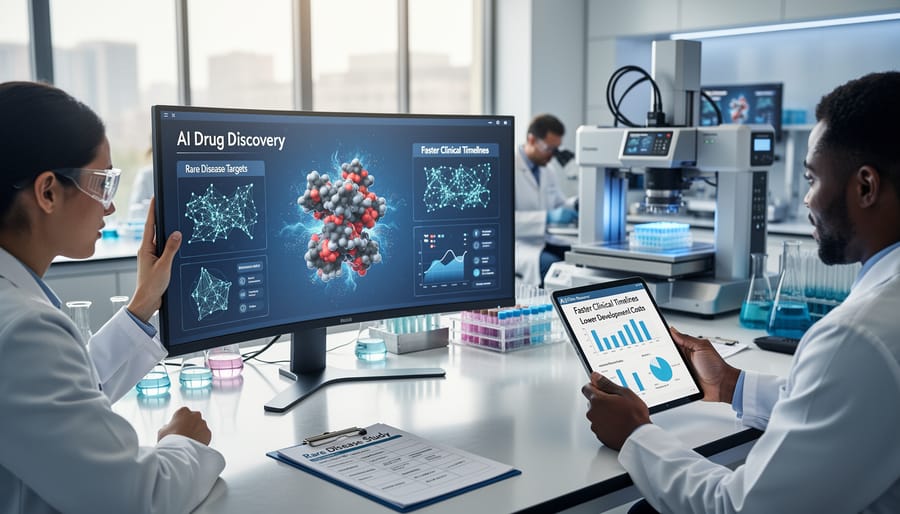
The most immediate impact appears in rare diseases, where small patient populations have traditionally made drug development financially unattractive. AI dramatically reduces initial research costs, making these “orphan diseases” viable targets for pharmaceutical companies. Families who were told no treatments existed for their child’s genetic condition may now see options emerge within their lifetimes rather than generations from now.
The personalized medicine revolution gains momentum through this technology too. Instead of the current “average patient” approach where medications work wonderfully for some people and poorly for others, AI can help identify drug candidates tailored to specific genetic profiles or disease variations. This means fewer trial-and-error medication switches and faster paths to what actually works for your specific body chemistry.
Cost reduction represents another tangible benefit, though it unfolds more gradually. Traditional drug development’s $2.6 billion price tag inevitably passes to patients through high medication costs. While AI won’t eliminate development expenses, cutting years from the timeline and reducing failed candidates means substantial savings that should eventually translate to more affordable treatments. This matters particularly for treating chronic diseases requiring lifelong medication.
Beyond individual medications, this AI healthcare revolution shifts pharmaceutical research capacity itself. When companies can explore more possibilities faster, they tackle diseases previously considered too complex or unprofitable. That expanding pipeline means better odds that whatever condition affects you or someone you love becomes a research priority rather than remaining overlooked.
These aren’t distant promises—the first AI-discovered drugs entering human trials today preview what becomes standard practice tomorrow.
We’re witnessing the opening chapter of what could be a fundamental transformation in how we discover medicines. Generative AI has moved from theoretical promise to producing actual drug candidates now advancing through clinical trials—a milestone that seemed distant just a few years ago. Companies like Insilico Medicine and Recursion Pharmaceuticals are demonstrating that AI-designed molecules can meet the rigorous standards required for human testing.
That said, it’s important to maintain perspective. We haven’t yet seen an AI-discovered drug reach patients, and the technology still requires significant human expertise to guide it. The true test will come in the next three to five years as current candidates progress through trials. Success rates, safety profiles, and actual time savings will become clearer.
What makes this moment exciting is the accelerating momentum. More pharmaceutical companies are investing in AI partnerships, computational tools are becoming more sophisticated, and the data infrastructure supporting these systems continues to improve. Watch for the first FDA approvals of AI-discovered drugs, expanded applications beyond small molecules into biologics and vaccines, and evidence of whether these methods truly reduce development timelines and costs. The potential to bring life-saving treatments to patients faster makes this a space worth following closely.