
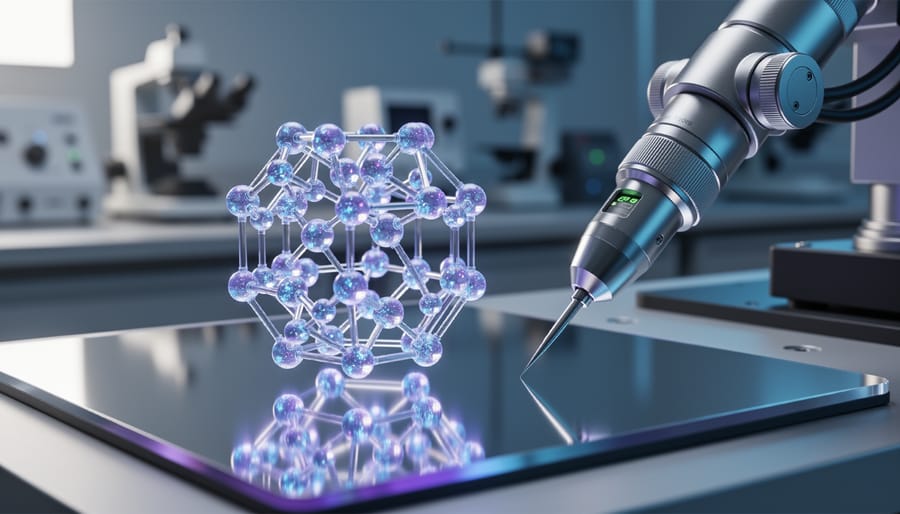
Imagine engineering materials atom by atom, creating substances with properties that don’t exist in nature—super-strong yet featherlight composites, self-healing coatings, or drug delivery systems that target cancer cells with pinpoint accuracy. This is nanotechnology materials science, where researchers manipulate matter at scales billionths of a meter to unlock revolutionary capabilities. The challenge? At the nanoscale, materials behave in unpredictable ways, and discovering the right atomic arrangements through traditional trial-and-error could take decades.
Artificial intelligence is transforming this landscape entirely. Machine learning algorithms now predict how atoms will interact before experiments begin, screening millions of potential material configurations in hours rather than years. Neural networks identify patterns in vast materials databases that human researchers would never notice, while generative AI designs entirely new nanomaterials optimized for specific applications. AI’s role in nanotechnology extends from computational modeling to autonomous laboratory systems that synthesize and test materials without human intervention.
This convergence is already producing breakthroughs: batteries that charge in minutes, water filters that remove contaminants molecule by molecule, and medical implants that communicate with your smartphone. Whether you’re curious about cutting-edge technology, exploring career opportunities, or simply wondering how AI is reshaping physical sciences, understanding this field reveals how digital intelligence is quite literally rebuilding our material world from the ground up.
Why Designing Nanomaterials Has Always Been Like Finding a Needle in a Haystack
Imagine walking into a library containing every possible book that could ever be written. Not just the books that exist today, but every combination of letters, words, and sentences that could theoretically form a book. Now imagine trying to find one specific book that solves a particular problem, and you’ll understand the challenge scientists face when designing nanomaterials.
At the nanoscale (we’re talking about structures between 1 and 100 nanometers, roughly 100,000 times smaller than a human hair), atoms can arrange themselves in virtually infinite configurations. Change just one atom’s position, swap one element for another, or adjust the temperature during creation, and you get an entirely different material with completely different properties. The number of possible combinations quickly spirals into the billions, even for relatively simple materials.
For decades, materials scientists have relied on trial-and-error experimentation. A researcher might hypothesize that combining certain elements in specific proportions could yield a material with desired properties, perhaps a more efficient battery electrode or a stronger, lighter aerospace component. They’d spend weeks or months synthesizing samples in the lab, then additional time testing and characterizing them. If the results were disappointing, they’d start over with a new hypothesis.
Think of it like trying to bake the perfect cake by randomly adjusting ingredients and oven temperatures, testing each attempt, taking detailed notes, and hoping to stumble upon the winning recipe. Except each “bake” takes months, costs thousands of dollars in equipment and materials, and requires specialized expertise.
This approach has given us remarkable innovations, from carbon nanotubes to quantum dots. However, it’s painfully slow and expensive. A single research project might explore only dozens or hundreds of material candidates over several years, leaving vast territories of possibility unexplored. Meanwhile, pressing challenges like climate change, energy storage, and medical treatments demand faster solutions. The traditional methods simply couldn’t keep pace with the urgency of modern problems, creating a bottleneck in materials innovation.
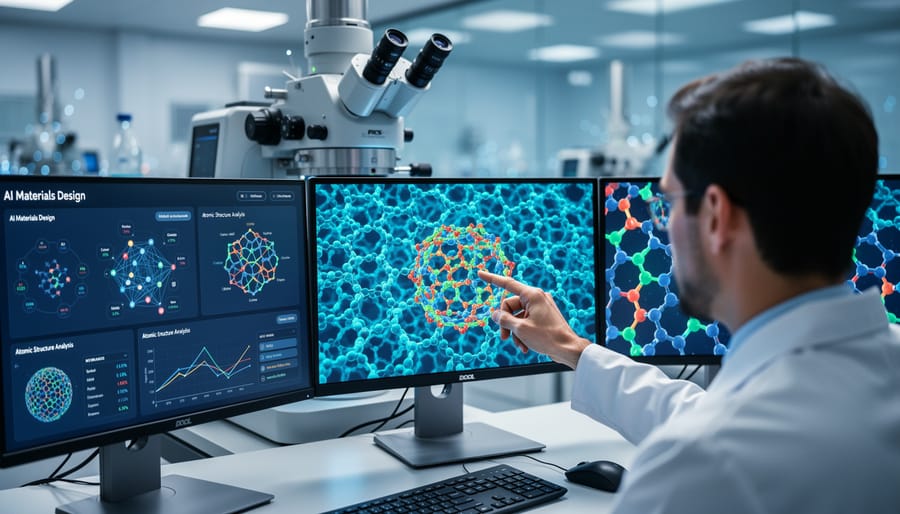
What Makes AI Perfect for Nanotechnology Materials Science
AI Can See Patterns Humans Miss
Imagine trying to find a needle in a haystack, except the haystack contains billions of needles and you’re looking for one with a specific molecular structure. That’s the challenge materials scientists face when searching for materials with desired properties. This is where machine learning becomes invaluable.
AI algorithms excel at detecting subtle correlations across massive datasets that human eyes simply cannot process. When analyzing nanomaterials, these systems examine thousands of variables simultaneously: atomic arrangements, bond angles, electron distributions, and crystalline structures. By processing data from millions of previous experiments and simulations, the algorithms identify which microscopic features correlate with specific properties like strength, conductivity, or chemical reactivity.
For example, a machine learning model might discover that materials with a particular type of surface roughness at the nanoscale consistently show enhanced catalytic activity, a connection that wasn’t obvious from traditional analysis. These hidden patterns emerge from examining countless data points across different temperature ranges, pressure conditions, and chemical compositions.
The real breakthrough happens when AI spots counterintuitive relationships: perhaps a slight imperfection in a crystal structure actually improves performance, contradicting conventional wisdom. Human researchers can then investigate why these patterns exist, leading to entirely new theoretical understanding of material behavior.
Predicting Properties Before Building
Imagine designing a revolutionary new material without ever stepping into a lab. That’s exactly what AI-powered prediction models make possible in nanotechnology. These sophisticated algorithms can forecast how a nanomaterial will behave before scientists synthesize even a single atom of it, essentially creating a virtual testing ground for new materials.
Here’s how it works: researchers feed AI models vast amounts of data about existing nanomaterials, including their atomic structures, chemical compositions, and observed properties like electrical conductivity, mechanical strength, or chemical reactivity. The AI learns patterns connecting structure to function, then applies this knowledge to predict properties of materials that exist only as digital designs.
For example, if scientists want to create a stronger, lighter material for aerospace applications, they can input various atomic arrangements into the model. The AI instantly predicts which configurations will deliver the desired strength-to-weight ratio without requiring months of laboratory experimentation. This approach has already accelerated the discovery of new battery materials, more efficient solar cells, and advanced medical sensors.
The time and cost savings are substantial. Traditional trial-and-error materials development can take years and consume significant resources. AI prediction models compress this timeline to weeks or even days, allowing researchers to focus their experimental efforts only on the most promising candidates.
Exploring Millions of Combinations in Hours
Imagine having to test every possible arrangement of LEGO blocks to find the strongest structure. With atoms, the possibilities multiply exponentially. Traditional laboratory experiments might test dozens of material combinations per year, but AI-powered computational methods can explore millions in mere hours.
This dramatic acceleration happens through advanced simulation techniques. AI algorithms rapidly calculate how different atoms interact when combined in various configurations, predicting properties like strength, conductivity, or heat resistance without physically creating each sample. Machine learning models, trained on existing materials data, can evaluate potential nanomaterial candidates and identify the most promising options for specific applications.
For example, when searching for better battery materials, AI systems can screen thousands of atomic compositions to find those with optimal lithium-ion conductivity. What would traditionally require years of painstaking laboratory work now takes days or weeks of computational exploration.
This speed advantage means researchers can test unconventional combinations they might never have considered, leading to unexpected discoveries. The AI doesn’t just work faster—it expands the creative possibilities by suggesting material configurations outside conventional thinking, opening new pathways to breakthrough nanomaterials for electronics, medicine, and energy storage.
Real Breakthroughs Happening Right Now
Batteries That Charge in Minutes
The daily frustration of waiting hours for your phone to charge could soon become a distant memory, thanks to AI-designed nanomaterials revolutionizing battery technology. Traditional lithium-ion batteries charge slowly because ions must navigate through dense electrode materials, but artificial intelligence is now engineering nanostructured electrodes that create superhighways for ion movement.
Machine learning algorithms analyze millions of possible nanoscale configurations to identify electrode designs with optimal porosity and surface area. These AI systems can predict how different nanoparticle arrangements affect charging speed, energy density, and battery lifespan before physical prototypes are ever built. One breakthrough involves silicon nanowires that AI optimized to accommodate the expansion and contraction during charging cycles, a problem that previously caused batteries to degrade quickly.
Real-world results are impressive: researchers using AI-designed graphene-based nanomaterials have achieved batteries that charge to 70% capacity in just five minutes. Companies are now developing electric vehicle batteries that could recharge as quickly as filling a gas tank. The AI doesn’t just speed up discovery; it identifies combinations of nanomaterials that humans might never consider, balancing competing factors like charging speed, capacity, safety, and cost in ways that push beyond conventional engineering limits.

Self-Cleaning Surfaces and Smart Coatings
Imagine a window that never needs cleaning or a hospital surface that kills bacteria on contact. AI is making these scenarios reality by designing nanocoatings with extraordinary properties. These ultra-thin layers, often just billionths of a meter thick, can transform ordinary materials into high-performance surfaces.
Machine learning algorithms analyze thousands of molecular combinations to identify nanostructures that create superhydrophobic surfaces, meaning water simply rolls off without leaving residue. This happens because AI can predict how tiny surface textures interact with water molecules, mimicking the natural water-repellent properties found on lotus leaves. Companies are already applying these coatings to smartphone screens and building exteriors.
Beyond water repellence, AI has discovered nanocoatings with antimicrobial properties that actively eliminate harmful microorganisms. By simulating how different nanoparticle arrangements interact with bacterial cell walls, researchers develop coatings for medical devices and food packaging that reduce infection risks without harsh chemicals.
Perhaps most exciting are adaptive coatings that respond to environmental changes. AI-designed materials can shift color with temperature variations, regulate heat absorption, or adjust transparency based on light conditions. These smart surfaces are finding applications in energy-efficient windows, temperature-regulating fabrics, and self-healing automotive paints that repair minor scratches automatically.

Targeted Cancer Treatment at the Molecular Level
Cancer treatment has long faced a critical challenge: how do you destroy cancer cells without harming healthy tissue? Artificial intelligence is now helping scientists solve this puzzle by designing specialized nanoparticles that act like smart missiles, delivering drugs precisely where they’re needed.
Think of these nanoparticles as tiny delivery vehicles, measuring just billionths of a meter across. What makes them special is their surface coating, which AI helps optimize to recognize specific proteins found only on cancer cells. It’s like giving each nanoparticle a unique key that fits only the locks on cancer cell doors.
Traditional drug development would require researchers to test thousands of nanoparticle designs through trial and error, a process taking years. AI dramatically accelerates this by analyzing vast datasets of molecular interactions, predicting which nanoparticle configurations will successfully bind to cancer cells while ignoring healthy ones. Machine learning algorithms can simulate how different shapes, sizes, and surface chemistries will behave in the human body before any physical testing begins.
Researchers at several institutions are already seeing promising results. AI-designed nanoparticles have successfully delivered chemotherapy drugs directly to tumor sites in laboratory studies, significantly reducing the devastating side effects patients typically experience. This precision approach means lower drug doses, less damage to healthy organs, and potentially better survival rates.
This breakthrough represents just one example of AI transforming medicine at the molecular level, opening new possibilities for treating diseases that were once considered nearly impossible to target effectively.
The AI Techniques Making This Possible
Machine Learning That Learns From Past Discoveries
Think of supervised learning as teaching a computer by showing it thousands of examples with answers already provided. In materials science, researchers have compiled massive databases containing information about nanomaterials: their atomic structures, chemical compositions, and measured properties like strength, conductivity, or how they react to heat.
Machine learning models study these existing datasets to identify hidden patterns. For example, by analyzing data from 50,000 known materials, an algorithm might learn that certain combinations of elements arranged in specific nanoscale structures tend to produce excellent electrical conductors. Once trained, these models can predict properties of materials that haven’t been synthesized yet, dramatically speeding up discovery.
This approach has already yielded practical results. Researchers at MIT used supervised learning to predict which nanomaterials would make the best battery electrodes, narrowing down thousands of candidates to a handful worth testing in the lab. Instead of spending years on trial-and-error experiments, scientists now get educated guesses about which new nanomaterials are worth pursuing. The model essentially learns from humanity’s collective materials science knowledge, then applies those lessons to unexplored possibilities.
Neural Networks That Think Like Materials Scientists
Imagine teaching a computer to think like an experienced materials scientist who can look at how atoms are arranged and predict how a material will behave. That’s exactly what deep learning approaches are accomplishing in nanotechnology today. These sophisticated neural networks learn from vast databases of atomic structures and their corresponding properties, discovering patterns that even human experts might miss.
For example, researchers at MIT developed a neural network that can predict whether a new nanomaterial will be stable or fall apart, simply by analyzing its atomic structure. The system trained on thousands of existing materials and learned to identify subtle relationships between atom positions, bond types, and resulting properties like strength, conductivity, or flexibility.
What makes these networks particularly powerful is their ability to handle complexity. A single nanoparticle might contain millions of atoms interacting in intricate ways. Traditional calculations would take weeks or months, but trained neural networks can evaluate new structures in seconds. This speed enables scientists to screen hundreds of potential materials quickly, identifying the most promising candidates for lab testing and dramatically accelerating the path from computer simulation to real-world application.
AI That Designs From Scratch
What if AI could dream up materials that have never existed before? That’s exactly what generative models are doing in nanotechnology. Unlike traditional approaches that tweak existing materials, these AI systems start with a blank canvas and design nanomaterials from scratch based on your wish list of properties.
Think of it like asking an architect to design your dream home by describing what you want—maybe exceptional strength, lightweight composition, and heat resistance—rather than just renovating an existing house. Generative models, including variational autoencoders and generative adversarial networks, learn the underlying patterns and rules of material structures from vast databases. They then use this knowledge to propose completely novel atomic arrangements and compositions.
For example, researchers have used these systems to generate new metal-organic frameworks for carbon capture and novel semiconductor structures for more efficient solar cells. The AI considers millions of possible atomic configurations in seconds, identifying candidates that meet specific performance criteria. This approach dramatically expands the realm of possibilities beyond what humans might imagine, potentially unlocking breakthrough materials for everything from drug delivery systems to quantum computing components. It’s moving materials science from discovery by chance to design by intention.
What This Means for Different Industries
The convergence of AI and nanotechnology materials science isn’t just reshaping laboratories. It’s quietly revolutionizing the products and services you interact with every day, across industries that touch nearly every aspect of modern life.
In electronics, AI-designed nanomaterials are making your devices faster, smaller, and more energy-efficient. Computer chips built with materials discovered through machine learning algorithms can process information at unprecedented speeds while consuming less power. This means your smartphone could soon last days instead of hours on a single charge, and data centers powering cloud services could reduce their massive energy footprint. Companies are already using AI to design next-generation semiconductors with nanoscale features that weren’t possible to engineer manually.
The healthcare sector is experiencing perhaps the most profound transformation. AI-optimized nanoparticles can now deliver cancer drugs directly to tumor cells while leaving healthy tissue untouched, reducing the brutal side effects of chemotherapy. Researchers have developed biosensors smaller than a grain of sand that can detect diseases like Alzheimer’s years before symptoms appear. These diagnostic tools, designed through thousands of AI-simulated experiments, could shift medicine from reactive treatment to proactive prevention. For patients, this translates to earlier interventions and better outcomes.
Energy production and storage are also benefiting dramatically. AI has accelerated the discovery of nanomaterials for solar panels that capture more sunlight and convert it more efficiently into electricity. Battery technologies using AI-designed nanostructured electrodes are enabling electric vehicles with longer ranges and faster charging times. One breakthrough material identified through machine learning can store three times more energy than conventional lithium-ion batteries, potentially solving one of clean energy’s biggest challenges.
Environmental protection efforts are gaining powerful new tools as well. Nanomaterials engineered with AI assistance can filter water more effectively, removing contaminants down to the molecular level. Some AI-discovered materials can even capture carbon dioxide directly from the atmosphere, offering potential solutions to climate change. Water treatment plants using these advanced filters can provide clean drinking water at a fraction of the current cost.
What makes these advances particularly exciting is their accessibility. As AI continues to accelerate materials discovery, the time from laboratory breakthrough to real-world product is shrinking dramatically, meaning these innovations will reach consumers faster than ever before.
The Challenges AI Still Faces at the Nanoscale
Despite the exciting progress, AI faces significant hurdles when working at the nanoscale, and understanding these limitations is crucial for setting realistic expectations.
The most fundamental challenge is data quality. Training effective AI models requires vast amounts of high-quality data, but nanomaterials research often produces inconsistent or incomplete datasets. Laboratory conditions vary between institutions, measurement techniques differ, and many promising materials have only been studied under limited circumstances. It’s like trying to learn a language when you only have scattered pages from different books—the AI struggles to find reliable patterns.
The gap between computational predictions and physical reality remains substantial. An AI model might predict that a particular nanostructure will exhibit amazing properties, but synthesizing that exact structure in a lab is another matter entirely. Computer simulations operate in idealized environments, while real-world materials contain impurities, defects, and unexpected interactions. This disconnect means that even the most sophisticated AI predictions require extensive experimental validation, which can be time-consuming and expensive.
Interpretability poses another significant obstacle. When an AI model suggests a novel nanomaterial design, researchers often cannot fully understand why the algorithm made that recommendation. This “black box” problem makes it difficult to trust AI predictions or learn from them to improve future research. It also raises AI ethics concerns, particularly regarding accountability when AI-designed materials fail or behave unexpectedly.
Perhaps most importantly, AI cannot replace human expertise—at least not yet. Materials scientists bring intuition, creativity, and decades of accumulated knowledge that machines cannot replicate. They understand the subtle nuances of synthesis processes, recognize when experimental results seem suspicious, and can make conceptual leaps that purely data-driven approaches might miss.
The most successful approach combines AI’s computational power with human insight, treating artificial intelligence as a powerful tool rather than a replacement for skilled researchers.
Where This Technology Is Heading Next
The future of nanotechnology materials science is rapidly shifting from human-directed experiments to intelligent, self-driving laboratories. Imagine walking into a research facility where robotic arms mix compounds, AI systems analyze results in real-time, and new materials are discovered while scientists sleep. This isn’t science fiction anymore. Autonomous labs are already emerging at leading research institutions, where machine learning algorithms control every aspect of nanomaterial synthesis, from selecting starting compounds to adjusting reaction conditions on the fly.
These smart labs learn from each experiment, building knowledge that speeds up discovery exponentially. When one synthesis fails, the AI immediately understands why and adjusts its approach, testing dozens of variations in the time it would take a human researcher to run a single trial. Early implementations have already accelerated discovery timelines by ten times or more.
The game-changer on the horizon is quantum computing integration, which promises to simulate nanomaterial behavior with unprecedented accuracy. Current computers struggle to model how atoms interact in complex nanomaterials, but quantum systems could crack these calculations in minutes rather than years.
We’re also seeing the emergence of fully automated materials discovery pipelines that connect AI prediction, robotic synthesis, and automated testing into one seamless workflow. Companies and universities are building these end-to-end systems that can go from identifying a promising material on a computer screen to holding a physical sample in your hand, all without human intervention.
The ultimate vision? A future where researchers simply describe the properties they need, perhaps a stronger, lighter material for spacecraft or a more efficient solar panel coating, and AI-driven labs deliver custom-designed nanomaterials within days.

The integration of artificial intelligence into nanotechnology materials science marks a profound transformation in how we discover and design materials. For centuries, materials development relied heavily on trial-and-error experimentation and the intuition of experienced scientists. A single promising material might take years or even decades to move from concept to practical application. Today, AI accelerates this timeline dramatically, sometimes compressing years of work into mere months or weeks through data-driven predictions and automated experimentation.
This shift goes beyond simple speed improvements. Machine learning algorithms can identify patterns and relationships in materials data that human researchers might never notice, opening entirely new avenues for innovation. AI systems can simultaneously consider thousands of variables, predict material properties before synthesis, and guide experiments toward the most promising candidates. This approach fundamentally changes the economics and feasibility of materials discovery, making it possible to tackle challenges that were previously too complex or time-consuming.
As this field evolves rapidly, staying informed becomes increasingly valuable whether you’re a student, technology enthusiast, or professional. Online courses in machine learning and materials science provide foundational knowledge, while platforms like arXiv and Materials Project offer free access to cutting-edge research. Following research labs at universities and organizations like the National Institute of Standards and Technology keeps you updated on breakthroughs. The convergence of AI and nanotechnology isn’t just reshaping laboratories; it’s redefining what’s possible in creating the advanced materials that will power future technologies.