

Every minute counts when a patient arrives at the hospital with a heart attack, stroke, or life-threatening injury. Acute care units are the specialized hospital departments designed to handle these critical situations, where medical teams work against the clock to stabilize patients and prevent permanent damage or death. These high-intensity environments include emergency departments, intensive care units, and trauma centers where speed, accuracy, and split-second decision-making can mean the difference between life and death.
Artificial intelligence is now transforming how these units operate. When a 62-year-old man arrived at a California hospital complaining of chest pain, an AI system analyzed his electrocardiogram in seconds and flagged a subtle pattern that indicated a major heart attack brewing, even before visible symptoms fully emerged. The cardiology team mobilized immediately, opening his blocked artery within the critical treatment window. Without AI’s pattern recognition capabilities, doctors might have sent him home with what appeared to be minor discomfort, potentially resulting in a fatal cardiac event hours later.
These AI applications are not science fiction. Hospitals worldwide are deploying machine learning algorithms that predict patient deterioration hours in advance, computer vision systems that detect internal bleeding in CT scans faster than human radiologists, and natural language processing tools that extract critical information from medical records in real time. The technology analyzes millions of data points simultaneously, something impossible for even the most experienced medical teams.
Understanding how AI functions in these pressure-cooker environments reveals both its remarkable potential to save lives and the important limitations that keep human expertise at the center of patient care. The future of emergency medicine lies in this powerful collaboration between artificial and human intelligence.
What Are Acute Care Units and Why They’re Critical
The Pressure Cooker Environment
Imagine a hospital emergency room at 2 AM. Ambulances arrive back-to-back, patients stream through the doors with symptoms ranging from chest pain to severe trauma, and medical staff must make life-or-death decisions with incomplete information. This is the reality of acute care units, where healthcare professionals operate under extraordinary pressure every single day.
What makes these environments uniquely challenging? First, there’s the relentless time pressure. When someone arrives with a suspected stroke or heart attack, every minute matters. Doctors often describe it as working with a ticking clock that never stops. Second, information overload becomes overwhelming. A single patient might generate vital signs, lab results, imaging scans, and medical history all at once, forcing clinicians to synthesize massive amounts of data while treating multiple patients simultaneously.
Third, split-second decisions carry enormous weight. Should this patient receive immediate surgery? Is that medication safe given their current condition? These aren’t questions you can ponder leisurely over coffee. And finally, the margin for error is razor-thin. Unlike many other settings where mistakes can be corrected, in acute care, one wrong call can have irreversible consequences.
Healthcare workers in these units perform remarkable feats daily, but they’re human. They get tired, they can miss subtle patterns, and they’re limited by how much information they can process at once. This is precisely why artificial intelligence is becoming such a promising partner in acute care settings.

Where AI Steps In: Real-World Applications That Save Lives
Predictive Analytics: Seeing the Crisis Before It Happens
Imagine a hospital system that can spot a life-threatening emergency hours before a patient shows obvious symptoms. This isn’t science fiction—it’s happening right now in acute care units equipped with predictive analytics technology.
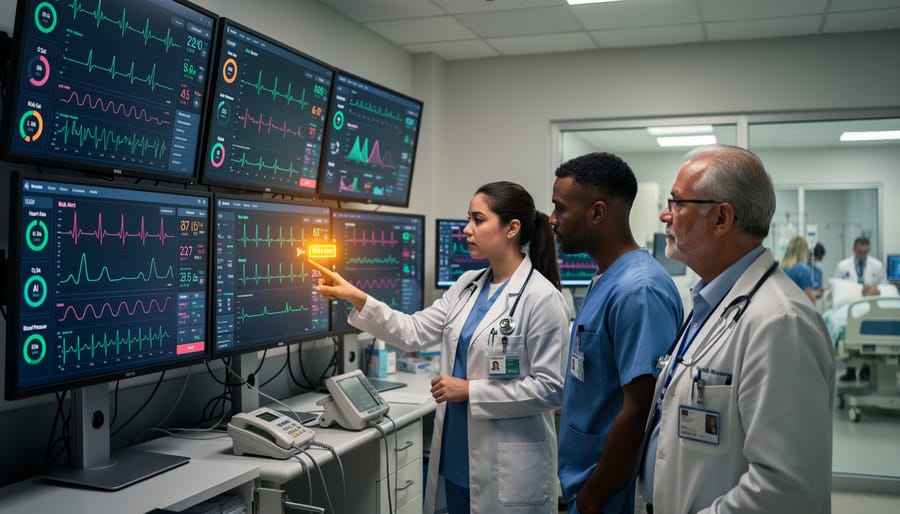
Predictive analytics uses artificial intelligence to continuously monitor patient data and identify subtle patterns that human eyes might miss. These AI systems analyze dozens of variables simultaneously: heart rate variability, respiratory patterns, blood pressure trends, lab results, and even medication responses. By comparing this data against thousands of previous patient cases, the technology can predict and prevent disease progression before crisis strikes.
Consider sepsis, a dangerous condition where the body’s response to infection spirals out of control. Without early intervention, sepsis can lead to organ failure and death within hours. Traditional monitoring might catch sepsis only when a patient’s temperature spikes or blood pressure drops dramatically—sometimes too late for optimal treatment. But AI-powered systems can detect sepsis risk up to 48 hours earlier by recognizing minute changes in vital signs and lab values that signal the body is beginning to struggle.
Johns Hopkins Hospital implemented such a system called Targeted Real-time Early Warning System. The AI continuously scans patient records and predicts health risks by calculating a deterioration score for each patient. When the system flagged a seemingly stable patient as high-risk, nurses discovered early signs of sepsis that standard protocols hadn’t caught. The patient received antibiotics hours earlier than they would have otherwise, likely preventing a critical emergency.
Similar systems now predict cardiac arrests, respiratory failure, and stroke risk. The key advantage is time—these algorithms give medical teams a crucial window to intervene when treatments are most effective, transforming reactive emergency care into proactive prevention.
Triage Optimization: Getting Patients to the Right Place Faster
It’s 2 a.m. on a Friday night, and the emergency department at Metropolitan Hospital is overwhelmed. A 45-year-old man with chest pain sits in the waiting room alongside a teenager with a sprained ankle, a child with flu symptoms, and an elderly woman experiencing dizziness. The single triage nurse faces an impossible task: quickly assess who needs immediate attention and who can safely wait, all while new patients continue streaming through the doors.
This scenario plays out thousands of times daily in emergency departments worldwide. Enter AI-powered triage systems that are transforming how hospitals prioritize care.
These intelligent systems work by analyzing multiple data points simultaneously. When patients first arrive, the AI processes their vital signs, chief complaints, medical history, and even subtle indicators like speech patterns or movement. Within seconds, it assigns a priority score that helps medical staff identify who needs immediate intervention. Think of it as a highly trained assistant that never gets tired or distracted, constantly monitoring and re-evaluating every patient in the queue.
At Cedars-Sinai Medical Center in Los Angeles, an AI triage tool reduced the time to identify critical patients by 30%. The system flagged a middle-aged woman presenting with vague symptoms as high-risk for sepsis, something that might have been missed during a rushed manual assessment. She received treatment within 20 minutes instead of potentially waiting hours.
The beauty of these systems lies in their ability to learn from outcomes. Every case teaches the algorithm to recognize patterns humans might miss, making triage more accurate over time. For patients experiencing true emergencies, those minutes saved can mean the difference between full recovery and permanent damage.
Clinical Decision Support: A Second Brain for Exhausted Doctors
Imagine a doctor in an acute care unit at 3 AM, treating their fifteenth patient of the shift. They’re exhausted, processing information about symptoms, medical history, and test results while the clock ticks. Now imagine that same doctor having an AI assistant quietly working alongside them, cross-referencing thousands of cases in milliseconds and flagging potential issues before they become critical.
This is clinical decision support (CDS), and it’s transforming how doctors make life-or-death decisions under pressure.
At its core, CDS systems function like a highly knowledgeable colleague who never sleeps and has memorized every medical journal ever written. These AI-powered tools analyze patient data in real-time, comparing it against vast medical databases containing millions of cases, research studies, and treatment outcomes. When a doctor enters a patient’s symptoms and test results, the system can suggest possible diagnoses they might not have immediately considered, especially for rare conditions that appear once in a career.
One of the most valuable features is drug interaction checking. A patient arrives taking five medications from different specialists. The emergency doctor prescribes a sixth. Within seconds, the CDS system alerts them that this new medication could dangerously interact with something already in the patient’s system. This automated safety net catches errors that human memory alone might miss during hectic shifts.
These systems also recommend evidence-based treatment protocols tailored to each patient’s unique situation. Unlike the straightforward monitoring involved in chronic disease management, acute care requires rapid-fire decisions. The AI doesn’t make decisions for doctors, but rather presents options ranked by likelihood and supported by the latest research, helping clinicians make more informed choices faster.
Think of CDS as a second brain that never gets tired, doesn’t suffer from cognitive overload, and continuously updates itself with new medical knowledge. It’s not replacing doctors but amplifying their expertise precisely when they need it most.
Image Analysis: Spotting What Human Eyes Might Miss
Picture this: It’s 2 AM in a busy emergency room, and a patient arrives with severe chest pain. A radiologist reviews the chest X-ray, but subtle signs of a collapsed lung hide in the shadows of the image. Now imagine an AI system analyzing that same scan in seconds, highlighting the tiny pneumothorax that could prove fatal if missed.
This scenario isn’t science fiction. AI-powered image analysis tools are already working alongside medical teams in acute care units worldwide, acting as a safety net that catches what human eyes might overlook during high-pressure moments.
These systems work by training on millions of medical images, learning to recognize patterns associated with everything from fractures and internal bleeding to early-stage tumors. When a new scan arrives, the AI examines it pixel by pixel, comparing what it sees against its vast database of learned patterns. Think of it like a radiologist who has reviewed every medical image ever taken, never gets tired, and can process information in the blink of an eye.
In one hospital in London, an AI tool analyzing CT scans for stroke patients reduced diagnosis time from an average of 90 minutes to just 18 minutes. For stroke victims, where every minute of delayed treatment destroys nearly two million brain cells, this speed difference can mean the difference between full recovery and permanent disability.
Similarly, AI systems have shown remarkable accuracy in detecting pulmonary embolisms (blood clots in the lungs) on CT scans, sometimes spotting clots that radiologists initially missed during busy shifts. The technology doesn’t replace human expertise but rather amplifies it, providing a second set of tireless digital eyes when stakes are highest.

The Technology Behind the Magic: How It Actually Works
Machine Learning Models in Action
Machine learning models in acute care units work much like a student learning from experience. Imagine teaching someone to recognize patterns by showing them hundreds of examples—that’s essentially how these algorithms learn from historical patient data.
The process begins with training data, which is the collection of past patient records that includes vital signs, lab results, treatments given, and outcomes achieved. Think of this as the algorithm’s textbook. The model studies thousands of cases, learning to identify patterns that humans might miss. For example, it might notice that patients with a specific combination of heart rate, blood pressure, and oxygen levels tend to deteriorate within the next few hours.
This process is called pattern recognition—the algorithm’s ability to spot meaningful connections in complex data. Just as you might recognize your friend’s face in a crowd by identifying familiar features, these models recognize risk patterns in patient data.
Once trained, the model can analyze new patients in real-time, comparing their current data against learned patterns to make predictions. This is where AI risk assessment becomes powerful in emergency settings.
The beauty of these systems lies in their continuous improvement. As they process more cases, they refine their predictions, becoming increasingly accurate at identifying which patients need immediate attention and which interventions work best for specific conditions.
Natural Language Processing in Medical Records
In acute care units, every second counts, and doctors often face an overwhelming challenge: sifting through hundreds of pages of patient records to find critical information. A patient’s medical history might be scattered across handwritten notes, discharge summaries, lab reports, and consultation records. This is where Natural Language Processing, or NLP, becomes a game-changer.
Think of NLP as a specialized reading assistant that can digest thousands of clinical notes in seconds. Unlike traditional computer systems that only understand structured data like checkboxes and dropdown menus, NLP-powered AI can read and understand the free-flowing text that doctors actually write. When an emergency room physician types “patient reports sharp chest pain radiating to left arm,” the AI doesn’t just see words. It recognizes patterns, identifies symptoms, and flags potential cardiac issues that demand immediate attention.
Here’s a real-world example: At a major hospital in Boston, an NLP system reviews incoming patient notes and automatically highlights previous allergic reactions, past surgeries, and medication conflicts. In one case, the system caught a dangerous drug interaction buried in a consultation note from three years earlier, something the attending physician might have missed while treating a critical trauma patient.
The technology works by training AI models on millions of medical documents, teaching them to recognize medical terminology, context, and relationships between symptoms and conditions. These systems can even interpret abbreviations and understand that “SOB” in medical notes means “shortness of breath,” not an insult. By extracting insights from this unstructured data ocean, NLP helps acute care teams make faster, more informed decisions when every minute matters.
The Human Element: Why Doctors Still Matter More Than Ever
As AI systems become more sophisticated in acute care settings, a common concern emerges: will machines eventually replace doctors and nurses? The reality is far more nuanced and actually quite reassuring.
Think of AI in acute care units like having an incredibly attentive assistant who never gets tired. When a patient’s vital signs start shifting in subtle ways, AI algorithms can flag these changes within seconds. However, it’s the emergency room physician who interprets what those changes mean in the context of that specific patient’s history, their medications, and the dozen other factors that make each case unique.
Consider a real scenario from a busy urban hospital. An AI system detected unusual patterns in an elderly patient’s ECG readings at 3 AM and sent an alert to the nursing station. The night nurse, drawing on years of experience, recognized that this particular patient had expressed chest discomfort hours earlier during a routine check. She connected these dots, something the AI couldn’t do, and immediately called for emergency intervention. The AI provided the data; the human provided the judgment that saved a life.
This is what healthcare experts call the augmentation model. Rather than replacing medical professionals, AI acts as a powerful support tool that handles data analysis at superhuman speeds while humans bring irreplaceable qualities to patient care: empathy, ethical reasoning, communication skills, and the ability to understand complex social and emotional contexts.
A patient experiencing a panic attack might show vital signs similar to someone having a cardiac event. AI can present both possibilities, but an experienced clinician can talk with the patient, notice behavioral cues, and make the critical distinction. They can hold a frightened person’s hand and explain what’s happening in a way that calms and reassures.
The future of acute care isn’t about choosing between humans or machines. It’s about combining AI’s computational power with human wisdom, creating a partnership where both elements make each other stronger and, most importantly, keep patients safer.

The Challenges We’re Still Solving
Data Privacy and Security Concerns
As AI systems in acute care units collect and analyze vast amounts of patient information, protecting this sensitive data becomes paramount. Every moment in emergency care generates data points: vital signs, medical histories, treatment responses, and diagnostic images. When machine learning algorithms process this information to make predictions or recommendations, healthcare facilities must ensure robust security measures are in place.
The challenge intensifies because acute care operates 24/7 under time pressure, where quick data access can mean the difference between life and death. This urgency sometimes conflicts with security protocols. Healthcare organizations must balance immediate accessibility for authorized personnel with ironclad protection against breaches.
Regulatory compliance adds another layer of complexity. In the United States, HIPAA regulations mandate strict guidelines for handling patient data, while Europe’s GDPR imposes additional requirements. When AI systems learn from patient data, organizations must ensure algorithms don’t inadvertently expose identifiable information or create new vulnerabilities.
Real-world concerns include ransomware attacks targeting hospital systems, unauthorized access to patient records, and data leaks during cloud-based AI processing. Healthcare facilities are now investing in encryption technologies, secure data anonymization techniques, and regular security audits. They’re also implementing clear protocols about who can access AI-generated insights and how long patient data remains in learning systems, ensuring innovation doesn’t compromise the trust patients place in their care providers.
Integration With Existing Hospital Systems
Integrating AI into acute care units isn’t as simple as installing new software. Most hospitals run on legacy systems—infrastructure built decades ago that wasn’t designed to communicate with modern AI platforms. Imagine trying to connect a smartphone to a 1990s fax machine, and you’ll understand the challenge.
These older systems store patient data in incompatible formats, making it difficult for AI algorithms to access the information they need in real-time. Electronic health records from different departments often can’t talk to each other, creating data silos that limit AI’s effectiveness. For example, an AI tool predicting patient deterioration needs seamless access to lab results, vital signs, and medication records simultaneously—but if these systems don’t integrate, the AI can’t function properly.
The costs present another hurdle. Hospitals must invest not only in AI technology but also in upgrading their existing infrastructure, training staff, and ensuring everything works together without disrupting patient care. One hospital found that implementing an AI sepsis detection system required eighteen months of integration work before it could go live.
Security concerns add another layer of complexity, as connecting systems creates more potential entry points for cyberattacks. Despite these obstacles, healthcare facilities are gradually finding solutions through phased implementations and working with vendors who specialize in healthcare integration.
Trust and Adoption Barriers
Despite AI’s promise, many medical professionals approach these technologies with healthy skepticism. Emergency physicians have spent years honing their clinical judgment, and trusting a machine with life-or-death decisions doesn’t come naturally. Some worry that over-reliance on AI might dull their diagnostic instincts or miss nuances that algorithms can’t detect.
The “black box” problem compounds these concerns. When an AI system flags a patient as high-risk, doctors often can’t see the reasoning behind that decision. This lack of transparency makes it difficult to validate the technology’s logic or catch potential errors.
Healthcare systems are addressing these barriers through several strategies. Rigorous validation studies now test AI tools across diverse patient populations before deployment. Training programs help staff understand both the capabilities and limitations of these systems. Importantly, developers are creating “explainable AI” that shows its reasoning process, allowing clinicians to verify recommendations against their expertise.
The key shift has been positioning AI as a supportive tool rather than a replacement. When doctors view these systems as tireless assistants that flag concerning patterns while leaving final decisions to human judgment, adoption increases. Real-world success stories from early adopters also help build confidence across the medical community.
What’s Coming Next: The Future of Emergency Care
The next wave of innovation in emergency medicine is already taking shape, and it promises to transform how we respond to medical crises. Picture ambulances equipped with AI systems that begin diagnosing patients during transport, alerting emergency rooms about incoming cases with preliminary treatment recommendations before the vehicle even arrives. This isn’t science fiction—several hospitals are piloting these smart ambulances today, shaving precious minutes off critical decision-making time.
One of the most exciting developments is autonomous monitoring systems that never blink or take breaks. These AI-powered watchdogs continuously analyze patient data from dozens of sensors simultaneously, detecting subtle warning signs that might slip past even experienced nurses during hectic shifts. When a patient’s condition begins to deteriorate, these systems can alert staff before visible symptoms appear, creating opportunities for intervention that simply didn’t exist before.
Personalized emergency protocols represent another frontier. Rather than applying one-size-fits-all treatment guidelines, emerging AI systems analyze a patient’s medical history, genetic markers, and current condition to suggest tailored interventions. A heart attack patient with diabetes and kidney disease, for example, would receive treatment recommendations specifically optimized for their unique combination of conditions, increasing effectiveness while reducing complications.
We’re also seeing the integration of AI across different AI in healthcare settings, creating networks where emergency departments, primary care facilities, and specialist centers share insights in real-time. This connected approach means that when you arrive at an acute care unit, the AI system already knows your medical history and can immediately suggest the most appropriate care pathway.
The ultimate vision? Emergency departments that combine human expertise with AI capabilities to deliver faster, more accurate, and increasingly personalized care—where technology handles the data-heavy analytical work while medical professionals focus on the human elements that require empathy, judgment, and experience.
The journey of AI in acute care units represents more than technological advancement—it’s a paradigm shift in how we approach emergency medicine. Picture a hospital floor where human expertise and artificial intelligence work side by side, each amplifying the other’s strengths. The doctor’s clinical judgment combines with AI’s pattern recognition, the nurse’s compassionate care enhanced by predictive alerts, and the entire team supported by systems that never tire or lose focus during those critical overnight hours.
We’re witnessing AI evolve from a promising concept into an indispensable partner. Systems that predict sepsis hours before traditional methods, algorithms that catch pneumonia on chest X-rays that human eyes might miss, and tools that help allocate scarce resources during emergencies—these aren’t futuristic fantasies. They’re saving lives today in hospitals around the world.
Yet this collaboration model requires us to remain realistic. AI doesn’t replace the experienced physician who notices subtle patient changes or the nurse who provides comfort during frightening moments. Technology handles the data deluge and pattern recognition, freeing healthcare professionals to focus on what humans do best: connecting, caring, and making nuanced decisions in complex situations.
The potential is staggering—countless lives saved, medical errors reduced, and healthcare teams supported in their mission. But there’s work ahead: refining algorithms, addressing biases, ensuring equitable access, and maintaining the human touch that defines compassionate care. As these challenges are met, we’re not just improving acute care units—we’re reimagining what emergency medicine can achieve.