

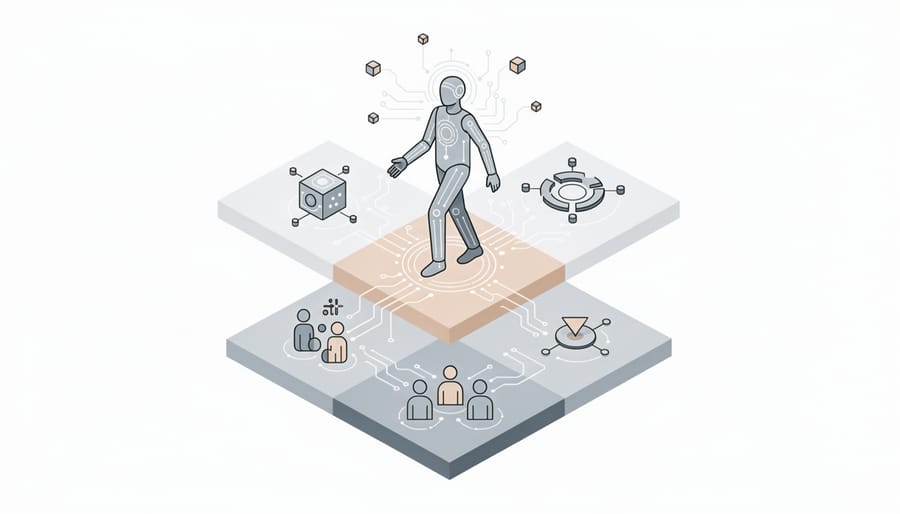
Leading AI teams requires mastering three distinct levels that transform capable technicians into visionary leaders. Whether you’re managing your first machine learning project or scaling an enterprise AI division, understanding how to operate effectively at the personal, team, and organizational level determines your impact.
The personal level demands technical credibility combined with emotional intelligence. You must code alongside your team while recognizing when a data scientist needs support versus space. This foundation of self-awareness and continuous learning establishes trust that purely theoretical management cannot achieve.
At the team level, your focus shifts to orchestrating diverse talents. AI projects uniquely require collaboration between data engineers, ML researchers, and domain experts who speak different technical languages. Success here means translating business objectives into clear technical milestones while protecting your team from scope creep that plagues AI initiatives.
The organizational level requires strategic thinking that bridges AI capabilities with business value. You champion ethical AI practices, secure resources for experimentation, and educate stakeholders who expect unrealistic magic from algorithms. This level separates leaders who deliver isolated models from those who build sustainable AI programs.
These levels are not sequential steps but interconnected capabilities you develop simultaneously. A junior team lead refining personal skills still influences organizational culture through their approach to responsible AI. A senior executive still needs technical awareness to make sound strategic decisions.
Mastering this framework transforms how you navigate the unique challenges of AI leadership, where technical complexity meets human collaboration and rapid innovation demands adaptive leadership strategies.
What Makes AI Leadership Different from Traditional Management
Leading AI teams isn’t quite like managing any other technology department. Imagine trying to navigate a ship where the ocean itself changes every few months—that’s what AI leadership feels like. While traditional management relies on established processes and predictable outcomes, AI leadership demands something fundamentally different.
The pace of change in artificial intelligence is staggering. A machine learning framework that’s cutting-edge today might be outdated in six months. Traditional managers can build expertise over years, but AI leaders must cultivate continuous learning as a core competency. This means staying current with emerging techniques like transformer models, reinforcement learning breakthroughs, and new ethical frameworks—all while guiding teams toward business objectives.
Then there’s the collaboration challenge. AI projects bring together data scientists, engineers, domain experts, ethicists, and business stakeholders—each speaking their own language. A data scientist might get excited about improving model accuracy by 2%, while a business leader wants to know how this translates to customer satisfaction or revenue. Bridging these worlds requires more than technical knowledge; it demands the ability to translate, mediate, and align diverse perspectives.
Ethical considerations add another layer of complexity. Unlike traditional software that either works or doesn’t, AI systems can work perfectly from a technical standpoint while causing real harm—amplifying biases, invading privacy, or making unfair decisions. AI leaders must weigh these implications alongside performance metrics, navigating questions that didn’t exist in conventional management playbooks.
The skills gap between technical teams and business stakeholders creates constant friction. Executives may have unrealistic expectations about what AI can deliver, while technical teams might pursue interesting problems that don’t align with business needs. Implementing proven management strategies helps, but AI leadership requires additional frameworks.
This is why the three levels of leadership model matters. AI leadership isn’t one-dimensional—it operates simultaneously at strategic, tactical, and operational levels, each requiring distinct skills and mindsets to navigate these unique challenges effectively.
The Three-Level Leadership Model Explained
The three-level leadership model provides a comprehensive framework for understanding how leaders operate at different scopes within AI organizations. Originally developed for traditional business contexts, this model adapts remarkably well to the unique challenges of AI implementation, where technical complexity meets organizational change.
At its foundation, the model recognizes that effective leadership and management operate across three distinct but interconnected levels: public leadership, private leadership, and personal leadership. Think of these levels as concentric circles, each expanding outward but remaining dependent on the strength of what lies beneath.
Public leadership represents your visible influence across the organization and beyond. In AI contexts, this means championing data-driven culture, communicating the vision for AI initiatives to stakeholders, and positioning your team’s work within the broader business strategy. This is where you shape perception and build organizational support for AI projects.
Private leadership focuses on your direct interactions with team members. Here, you’re coaching data scientists through difficult model challenges, facilitating collaboration between engineers and business analysts, and creating psychological safety for experimentation. This level is where trust gets built through one-on-one conversations and small-group dynamics.
Personal leadership forms the foundation. It’s your own learning journey, technical curiosity, and ethical grounding. Before you can guide others through the complexities of machine learning bias or responsible AI deployment, you must first develop these competencies yourself.
What makes this model powerful for AI leaders is its emphasis on integration. You cannot effectively advocate for AI transformation publicly if you haven’t invested in your private relationships with team members, and those relationships ring hollow without genuine personal development. Each level reinforces the others, creating a sustainable leadership approach that adapts as AI technologies evolve.
Level 1: Leading Yourself (Technical and Personal Mastery)
Staying Technically Relevant Without Burning Out
The reality is simple: you can’t master every new AI tool or framework that emerges weekly. Instead, successful AI leaders adopt a “T-shaped” knowledge approach—maintaining broad awareness across the AI landscape while preserving depth in strategic areas relevant to your organization’s goals.
Start by establishing a sustainable learning routine. Dedicate 30 minutes daily to scanning industry newsletters, following key researchers on social media, and reviewing abstract sections of significant papers. You don’t need to understand every implementation detail, just enough to ask informed questions and recognize opportunities.
Focus your deeper learning on areas that directly impact decision-making. If your team works with computer vision, understand the fundamental concepts and limitations rather than coding every model from scratch. Leverage your team’s expertise by scheduling regular “tech talks” where engineers explain new approaches they’re exploring—this builds culture while keeping you informed.
Create a personal advisory network of technical experts you can consult when evaluating new technologies. This trusted circle becomes your extended knowledge base, allowing you to make confident decisions without becoming a bottleneck.
Remember, your value as a leader isn’t knowing everything—it’s connecting technical possibilities with business outcomes and empowering your team to execute the details.
Building Your AI Ethics Compass
Leaders at every level face tough choices when implementing AI systems, and building a personal ethics compass helps navigate these murky waters. Think of this compass as your internal guidance system that activates when data, algorithms, and human impact collide.
Consider this real scenario: A hiring manager discovers their AI recruitment tool consistently filters out qualified candidates from certain neighborhoods. Should they trust the algorithm’s efficiency metrics or pause deployment? Leaders who’ve developed strong ethical AI frameworks ask critical questions first: Who gets harmed? What biases might be hidden in our training data? What happens if we wait versus act now?
Your ethics compass develops through three practices. First, establish your non-negotiables. These might include transparency with users, protection of vulnerable groups, or accountability for AI decisions. Write them down and revisit them regularly.
Second, create decision checkpoints. Before launching any AI feature, run through scenarios: What’s the worst outcome? Who lacks representation in our data? Can affected people challenge the AI’s decision? One product manager shared how this simple practice caught a facial recognition flaw that would have excluded users with disabilities.
Third, seek diverse perspectives. Your ethics compass strengthens when stress-tested by people with different backgrounds and experiences. Build a trusted network who’ll challenge your assumptions and reveal blind spots you cannot see alone. Remember, ethical AI leadership isn’t about having all the answers upfront, but rather developing the judgment to ask better questions when it matters most.
Level 2: Leading Your Team (People and Project Management)

Managing the Data Scientist-Engineer Dynamic
Leading interdisciplinary AI teams requires bridging two distinct mindsets: data scientists who prioritize experimentation and model accuracy, and engineers who focus on scalability and production reliability. This dynamic often creates friction when scientists build prototypes that engineers struggle to deploy.
Consider this common scenario: A data scientist develops a recommendation model using complex ensemble methods that achieves 95% accuracy. However, the engineering team discovers it takes 30 seconds to generate a single prediction, making it unusable in production. The scientist feels their work is undervalued, while engineers are frustrated by impractical solutions.
Effective leaders at the operational level can prevent this by establishing shared objectives early. Instead of measuring success solely by model performance, teams should define success metrics that include latency, resource usage, and maintainability. One practical technique is implementing joint design reviews where both groups evaluate proposed solutions together before significant development begins.
At the strategic level, leaders should invest in AI collaboration tools and shared platforms that enable both disciplines to understand each other’s constraints. Creating cross-functional pair programming sessions where data scientists and engineers work side-by-side helps build mutual understanding and results in solutions that are both accurate and deployable from the start.
Creating a Culture of Experimentation
In AI leadership, creating a culture where experimentation thrives requires balancing bold innovation with clear accountability. Think of it like a research lab meets a business environment—you need the freedom to explore, but also the discipline to learn from what doesn’t work.
Start by reframing failure as data collection. When an AI team at Spotify tested a recommendation algorithm that performed worse than their baseline, they didn’t scrap the project in silence. Instead, they documented what went wrong, shared insights across teams, and discovered valuable patterns about user behavior that informed future projects. This approach transforms setbacks into stepping stones.
Set up a “safe-to-fail” framework with clear boundaries. Define upfront what resources you can allocate to experimental projects—perhaps 20 percent of team time or a specific budget. Establish checkpoints to evaluate progress without prematurely killing promising ideas. At Google, the famous “20 percent time” policy led to Gmail and Google News, but it worked because there were structures supporting experimentation.
Celebrate learning milestones, not just victories. Hold monthly “experiment reviews” where teams present both successes and failures. Recognize individuals who took calculated risks, even when results fell short. One fintech company awards a “Best Failed Experiment” prize quarterly, highlighting what the team learned and how it influenced their strategy.
Remember, innovation isn’t about avoiding mistakes—it’s about making mistakes faster, learning quickly, and applying those lessons systematically. When leaders actively celebrate the learning process, teams become more willing to push boundaries and explore unconventional solutions.
Level 3: Leading the Organization (Strategic Vision and Change)

Translating AI Capabilities into Business Value
The real magic happens when leaders successfully translate what AI can do into what it means for the business. Think of it like being a bilingual interpreter—you need to speak both “tech” and “business” fluently.
Successful AI leaders frame technical achievements in business language. Instead of saying “we improved our model’s accuracy by 5%,” they say “we can now reduce customer churn by 15%, saving $2 million annually.” This reframing helps executives understand why they should invest in AI initiatives and gets teams excited about their impact.
Consider how Spotify’s AI leaders communicated their recommendation engine improvements. Rather than diving into collaborative filtering algorithms, they showcased user engagement metrics: listeners discovering 40% more new artists and session times increasing by 25%. These concrete outcomes made the technology’s value immediately clear to stakeholders.
Effective communication strategies include creating visual dashboards that track business KPIs alongside technical metrics, holding regular “translation sessions” where technical teams practice explaining their work in business terms, and developing case studies that connect specific AI capabilities to revenue growth or cost savings. The most successful leaders also establish shared vocabularies—simple terms that both technical and business teams understand—making collaboration smoother and decisions faster.
Leading AI Adoption Across Resistant Teams
Implementing AI tools across your organization often feels like pushing a boulder uphill, especially when team members fear job displacement or feel overwhelmed by new technology. Successfully navigating organizational change requires leaders to address these concerns head-on at all three leadership levels.
Start by acknowledging the elephant in the room. When introducing AI-powered customer service tools at a retail company, one manager organized informal coffee chats where employees could voice their worries without judgment. This simple act of listening revealed that resistance stemmed not from laziness, but from fear of becoming obsolete. Armed with this understanding, leadership reframed AI as a teammate rather than a replacement.
Create quick wins to build momentum. Instead of rolling out a comprehensive AI system all at once, pilot small projects where teams can experience immediate benefits. A marketing team hesitant about AI content tools became enthusiastic advocates after using AI to automate their weekly report generation, freeing up hours for creative work they actually enjoyed.
Invest in hands-on training that meets people where they are. Skip the technical deep-dives and focus on practical application. Show your sales team how AI can predict customer needs, then let them experiment in a safe environment. Celebrate early adopters and share their success stories across the organization.
Remember, resistance often signals a lack of clarity about personal value in an AI-enhanced workplace. Help your team members identify how AI amplifies their unique human skills rather than diminishes them.
How the Three Levels Work Together in Real AI Projects
Let’s look at how Sarah, an AI leader at a healthcare technology company, navigated all three leadership levels while launching a diagnostic AI system.
At the individual level, Sarah personally reviewed the model’s architecture every week. When her team struggled with bias in medical imaging data, she didn’t just delegate the problem. Instead, she rolled up her sleeves, examined the training datasets alongside her data scientists, and helped identify that their sample lacked diversity in skin tones. This hands-on involvement showed her technical credibility and built trust with her team.
Simultaneously, Sarah operated at the team level by fostering collaboration between her ML engineers and the medical professionals who would use the system. She organized weekly cross-functional sessions where doctors could explain their diagnostic workflow, helping engineers understand real-world constraints. When tensions arose between the speed-focused engineering team and the accuracy-focused medical advisors, Sarah facilitated conversations that led to establishing clear performance benchmarks everyone could support.
At the organizational level, Sarah championed the project to hospital administrators and the executive board. She translated technical achievements into business outcomes, explaining how the AI system would reduce diagnostic wait times by 40 percent and potentially save lives. She also secured resources for ongoing model monitoring and worked with legal teams to establish governance frameworks for responsible AI deployment.
The integration of all three levels proved essential. When Sarah briefly neglected the individual level during a busy quarter, she missed early warning signs that her team was cutting corners on data validation. This nearly derailed the project’s timeline when issues emerged later.
This example shows that effective AI leadership isn’t about choosing which level to focus on. It’s about maintaining awareness and activity across all three levels simultaneously, recognizing that each level supports and depends on the others for sustainable success.
Mastering AI leadership isn’t about choosing one level over another—it’s about developing the agility to operate effectively across all three. The most successful AI leaders are those who can zoom out to align initiatives with organizational strategy, coordinate seamlessly across teams and projects, and dive deep into technical details when needed. Think of it as having three different lenses that you switch between depending on what the situation demands.
Here’s how to start strengthening your leadership across all levels. First, honestly assess where you currently spend most of your time. Are you constantly in the technical weeds, potentially missing strategic opportunities? Or are you so focused on high-level strategy that you’ve lost touch with the implementation challenges your team faces daily? Most leaders naturally gravitate toward one or two levels based on their background and comfort zone.
Next, identify which level needs your immediate attention. If you’re a technical expert stepping into leadership, challenge yourself to spend 20% of your time on strategic thinking and cross-functional coordination. If you’re coming from a business background, dedicate time each week to understanding the technical foundations of your team’s work—not to micromanage, but to make more informed decisions.
Create a development plan that includes specific actions for each level. Attend strategy sessions, volunteer for cross-departmental projects, or schedule regular technical deep-dives with your team. Remember, leadership development is continuous. The AI field evolves rapidly, and your leadership approach must evolve with it. Start today by picking one action at each level and committing to it this month.