
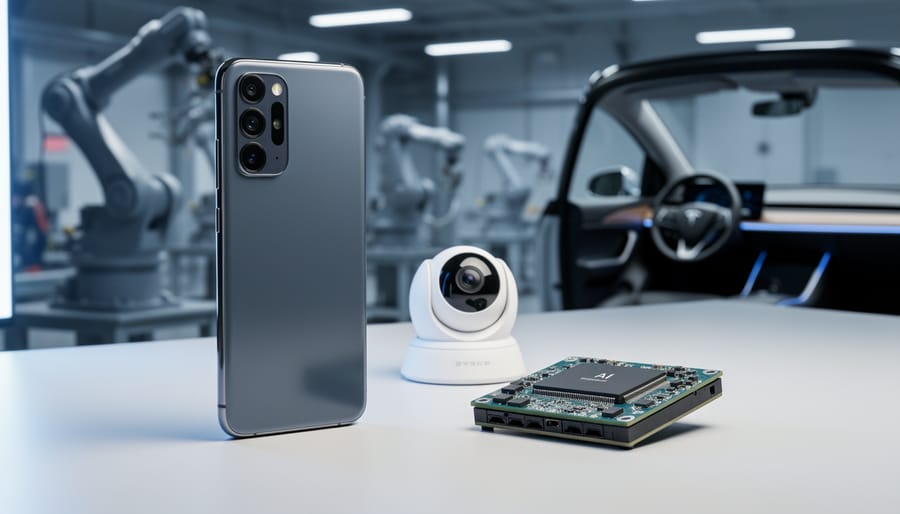
Edge AI is revolutionizing how devices process information by running artificial intelligence directly on smartphones, IoT sensors, and embedded systems rather than relying on distant cloud servers. Qualcomm stands at the forefront of this transformation, powering billions of edge devices worldwide with specialized processors that make real-time AI decisions possible without internet connectivity.
Consider your smartphone recognizing your face instantly to unlock, or a security camera detecting suspicious activity and alerting you within milliseconds. These scenarios rely on edge AI processors that analyze data locally, delivering faster responses, enhanced privacy, and reduced bandwidth costs. Qualcomm’s Neural Processing Units (NPUs) embedded in Snapdragon platforms enable developers to deploy sophisticated machine learning models that once required data center resources.
The practical implications extend far beyond consumer electronics. Manufacturing floors use Qualcomm-powered vision systems for quality control, autonomous vehicles process sensor data for split-second decisions, and healthcare devices analyze patient vitals in real-time. This distributed intelligence approach addresses critical limitations of cloud-dependent AI, including latency issues, privacy concerns, and connectivity requirements.
For developers and students exploring edge computing deployment, Qualcomm provides comprehensive toolkits that simplify the journey from concept to production. The technology democratizes AI by making powerful machine learning accessible on resource-constrained devices, opening opportunities for innovation across industries. Understanding how Qualcomm’s edge AI ecosystem works, from hardware capabilities to software optimization techniques, equips you to build the next generation of intelligent, responsive applications that operate seamlessly at the network’s edge.
What Makes Edge AI Different from Cloud AI
Think of AI processing like deciding where to prepare a meal. Cloud-based AI solutions are like ordering from a restaurant: you send your request elsewhere, wait for processing, and receive results back. Edge AI, on the other hand, is like cooking in your own kitchen—everything happens right where you are.
The fundamental difference lies in where the computing happens. Cloud AI sends data to distant servers over the internet for processing, while edge AI performs calculations directly on local devices like smartphones, cameras, or smart speakers. This shift in location creates three game-changing advantages.
Speed becomes dramatically faster with edge processing. When your phone recognizes your face to unlock, it doesn’t send your image to a server and wait for confirmation—that would take seconds. Instead, edge AI devices process everything locally in milliseconds. For applications like autonomous vehicles detecting pedestrians or augmented reality games responding to your movements, this instant response time isn’t just convenient—it’s essential.
Privacy receives a major boost because your data never leaves your device. When you use voice commands on your smartphone with edge AI, your conversations stay private rather than being transmitted to cloud servers. Your personal photos, health data, and daily interactions remain under your control.
Offline functionality means these devices work anywhere, anytime. Imagine using real-time language translation while hiking in remote mountains without cell service, or having your smart security camera continue identifying people during an internet outage. Edge AI makes this possible because it doesn’t depend on constant connectivity.
Qualcomm’s edge AI technology brings these advantages to everyday devices, transforming how we interact with technology by making AI faster, more private, and reliably available wherever we go.

Qualcomm’s Edge AI Technology Explained
The Neural Processing Engine
Think of your smartphone like a busy restaurant kitchen. You have general-purpose chefs (the CPU) who can cook anything, and specialized bakers (the GPU) who excel at making pastries. But what if you suddenly get hundreds of orders for complex molecular gastronomy dishes? You’d want a specialist trained specifically for that craft.
That’s exactly what Qualcomm’s Neural Processing Unit (NPU) does for artificial intelligence tasks. This dedicated chip component, often called the Neural Processing Engine, is purpose-built to handle the mathematical calculations that AI models require. While your phone’s regular processor could technically run AI operations, it would be slow and drain your battery quickly—like asking that general chef to prepare advanced AI recipes without proper training.
The NPU changes this equation dramatically. When you use face unlock on your phone, apply AI-powered filters to photos, or speak to a voice assistant, the NPU springs into action. It processes these AI workloads up to 15 times faster than a standard CPU while consuming significantly less power. This efficiency means your phone can run sophisticated AI features throughout the day without turning into a hot, battery-draining brick.
What makes this particularly important for edge AI is local processing. Instead of sending your data to distant cloud servers, the NPU handles everything right on your device. Your voice commands, photos, and personal information stay private and secure, while responses happen in milliseconds rather than seconds. This specialized worker ensures AI feels instant and seamless in your everyday life.
Snapdragon Platforms for Developers
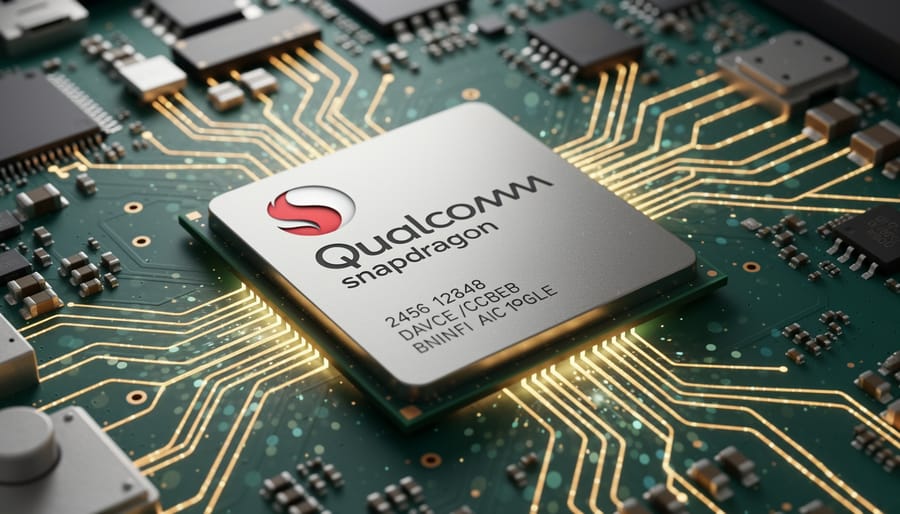
Qualcomm’s Snapdragon platforms represent a family of system-on-chip (SoC) solutions specifically engineered to bring artificial intelligence capabilities directly to devices at the edge. Think of these platforms as complete computing packages that combine processing power, AI acceleration, and connectivity features into a single chip, making them ideal for smartphones, laptops, IoT devices, and robotics.
What sets Snapdragon platforms apart is their heterogeneous computing approach. Rather than relying on a single processor type, they integrate multiple specialized components working together. The CPU handles general computing tasks, the GPU manages graphics and certain AI workloads, and the dedicated AI Engine (called the Hexagon processor) focuses exclusively on machine learning calculations. This division of labor means your device can run AI applications efficiently without draining battery life or overheating.
For developers, this translates to practical advantages. A Snapdragon-powered smartphone can process facial recognition locally in milliseconds, while a robot equipped with the same technology can navigate environments in real-time without constant cloud connectivity. The platforms support popular AI frameworks like TensorFlow and PyTorch, allowing developers to deploy existing models with minimal modifications.
Qualcomm regularly updates its Snapdragon lineup across different performance tiers. Entry-level chips power budget smartphones with basic AI features like photo enhancement, while flagship processors in the 8-series enable sophisticated applications such as real-time language translation and advanced computational photography. This range ensures developers can choose hardware matching their application requirements and target market, whether building consumer electronics or industrial IoT solutions.
The AI Hub and Development Tools
Qualcomm’s AI Hub serves as a central resource that makes edge AI development surprisingly accessible, even if you’re just getting started. Think of it as a comprehensive toolkit that removes many of the headaches developers typically face when trying to deploy AI models on actual devices.
The platform offers pre-optimized AI models that are ready to run on Qualcomm chips, meaning you don’t need to spend weeks tweaking your neural networks to work efficiently on mobile or IoT hardware. Instead of starting from scratch, developers can browse a library of models for common tasks like object detection, voice recognition, or image enhancement, then deploy them with minimal configuration.
What makes this particularly valuable is the ecosystem of development tools that accompany the AI Hub. These include software development kits, performance benchmarking tools, and detailed documentation written for real-world implementation. The goal is straightforward: reduce the time between having an AI idea and seeing it work on actual edge AI software.
For students and beginners, this democratizes access to sophisticated AI deployment without requiring deep expertise in hardware optimization or low-level programming.
Real-World Applications Running on Qualcomm Edge AI
Smartphones and Personal Devices
Your smartphone likely already uses Qualcomm’s edge AI technology, even if you haven’t noticed it working behind the scenes. Every time you take a stunning portrait photo with that dreamy blurred background, Qualcomm’s Snapdragon processors are running AI models directly on your device to identify faces, separate subjects from backgrounds, and adjust lighting in real time. This computational photography happens instantly because the AI processing occurs on the chip itself, not in the cloud.
Voice assistants like Google Assistant and Amazon Alexa also leverage Qualcomm’s AI Engine to understand your commands faster and more accurately. The technology enables features like wake word detection, which means your phone can listen for “Hey Google” without draining your battery, since specialized AI hardware handles this task efficiently.
Real-time translation is another impressive application. Apps can now translate conversations as they happen, converting speech to text, translating it, and even generating natural-sounding audio in another language—all processed locally on your device. This ensures privacy since your conversations never leave your phone, and it works even without an internet connection. These everyday conveniences demonstrate how edge AI has become integral to modern smartphone experiences, making devices smarter and more responsive to your needs.

Automotive and Transportation
The automotive industry represents one of the most exciting frontiers for Qualcomm’s edge AI technology. Modern vehicles are essentially computers on wheels, and Qualcomm’s Snapdragon Digital Chassis platforms bring sophisticated AI capabilities directly into cars without relying on constant cloud connectivity.
Consider autonomous driving features like lane-keeping assist or automatic emergency braking. These systems need to process camera and sensor data in milliseconds to keep passengers safe. Qualcomm’s edge AI processors analyze road conditions, detect pedestrians and obstacles, and make split-second decisions faster than any human driver could react. The on-device processing means there’s no dangerous delay waiting for cloud servers to respond.
Driver monitoring systems powered by Qualcomm chips use AI to track eye movements and head position, detecting drowsiness or distraction. When the system notices you’re nodding off during a long highway drive, it can alert you immediately or even activate safety features. This real-time analysis happens entirely within the vehicle, protecting your privacy since facial data never leaves the car.
In-vehicle intelligence extends beyond safety too. Voice assistants understand natural commands, climate systems learn your preferences, and infotainment systems adapt to passenger needs. All of this AI processing happens at the edge, creating smarter, safer, and more responsive vehicles.
IoT and Smart Home Devices
Your smart home is becoming smarter, thanks to Qualcomm’s edge AI technology working quietly behind the scenes. Instead of sending video footage or sensor data to the cloud for processing, devices equipped with Qualcomm chips can analyze information right where it’s captured—in your home.
Consider smart security cameras that can distinguish between a family member, a delivery person, and a potential intruder without uploading your video to remote servers. This on-device processing means faster alerts and enhanced privacy, since your footage stays local. Qualcomm’s AI processors enable these cameras to recognize faces, detect unusual activity, and even identify specific objects like packages or vehicles in real-time.
Smart doorbells benefit similarly, processing visitor identification instantly rather than experiencing cloud-related delays. Voice assistants embedded in home hubs can understand and respond to commands more quickly, while smart thermostats learn your patterns and adjust temperatures intelligently without constant internet connectivity.
The advantage extends to battery-powered devices too. Because Qualcomm’s AI chips are designed for power efficiency, wireless security sensors and cameras can operate longer between charges while still delivering sophisticated AI features like person detection and activity monitoring.
Getting Started: Tools for Deploying AI on Qualcomm Hardware
Prerequisites and Setup
Before diving into Qualcomm edge AI development, you’ll need a few foundational elements in place. Don’t worry if you’re just starting out—this technology is more accessible than you might think.
First, having basic programming knowledge will help you tremendously. Familiarity with Python is particularly valuable, as it’s the primary language used in AI development. If you’re comfortable writing simple scripts and understanding basic code structure, you’re already halfway there.
You’ll also benefit from understanding fundamental machine learning concepts. This doesn’t mean you need a PhD—just grasp what neural networks do and how models learn from data. Think of it like knowing how a car engine works before tuning one.
On the hardware side, you’ll need a device equipped with a Qualcomm Snapdragon processor that supports the Neural Processing Unit (NPU). Many modern smartphones and development boards fit this requirement. Qualcomm offers specific development kits if you’re serious about building applications.
Finally, ensure you have the Qualcomm Neural Processing SDK installed on your computer. This software toolkit provides everything needed to convert, optimize, and deploy AI models to Qualcomm hardware. The good news? Qualcomm provides comprehensive documentation and tutorials to guide you through the setup process, making your first steps surprisingly straightforward.
Development Workflow Overview
Deploying AI on Qualcomm edge devices follows a streamlined workflow that transforms your trained models into real-world applications. The journey begins with AI model training, where you develop your neural network using popular frameworks like TensorFlow or PyTorch on your development machine or cloud platform.
Once training is complete, the next step involves model optimization. This is where Qualcomm’s AI Engine Direct SDK comes into play, converting your model into a format optimized for Qualcomm’s Neural Processing Unit (NPU). The SDK automatically handles quantization, which reduces the model size while maintaining accuracy—think of it as compressing a high-resolution image without losing its essential details.
After optimization, you’ll use Qualcomm’s development tools to test your model’s performance on actual hardware or emulators. This validation phase ensures your AI runs efficiently on resource-constrained edge devices.
Finally, model deployment involves integrating your optimized model into your application, whether it’s a smartphone camera app, an IoT sensor, or an autonomous robot. Qualcomm provides APIs and libraries that simplify this integration, allowing your AI to run locally without constant internet connectivity.
Popular Frameworks and Integration
Qualcomm’s edge AI platform plays nicely with the most popular AI frameworks that developers already know and love. If you’ve built a model using TensorFlow or PyTorch, you can deploy it on Qualcomm hardware without starting from scratch. The company supports ONNX (Open Neural Network Exchange), which acts as a universal translator between different AI frameworks, making your models portable across platforms.
The magic happens through Qualcomm’s AI Engine Direct SDK, which converts your trained models into optimized versions that run efficiently on their Neural Processing Units. Think of it like translating a recipe into a format your specific oven understands best. For example, a TensorFlow model trained on cloud servers can be converted and compressed to run on a smartphone’s Snapdragon chip, maintaining accuracy while dramatically reducing power consumption. Qualcomm also provides the Neural Network SDK and Snapdragon Neural Processing Engine, offering developers flexibility in how they integrate AI capabilities into their edge applications.
Advantages and Limitations You Should Know
Like any technology, Qualcomm’s edge AI solutions come with distinct strengths and trade-offs worth understanding before diving in.
On the advantages side, Qualcomm excels at power efficiency. Their chips can run sophisticated AI models while sipping battery power rather than guzzling it, making them ideal for smartphones and IoT devices that need to last all day. Think of a phone that can process photos with AI enhancement without heating up in your pocket or draining by lunchtime.
Real-time processing represents another major win. Since computation happens on-device rather than traveling to distant cloud servers, you get nearly instant results. This matters tremendously for applications like augmented reality filters or voice commands where even a half-second delay feels sluggish.
Privacy benefits naturally follow from this local processing approach. Your photos, voice recordings, and biometric data stay on your device instead of transmitting across networks, reducing exposure to potential breaches or unauthorized access.
However, limitations exist too. Processing power, while impressive for mobile hardware, cannot match what massive cloud data centers offer. Training complex AI models from scratch remains impractical on edge devices, so you are typically running pre-trained models or doing limited fine-tuning.
Storage constraints also pose challenges. Edge devices have finite memory for storing large AI models, forcing developers to make strategic choices about which capabilities to include.
Cost considerations come into play as well. While Qualcomm chips are economically priced for consumer electronics, specialized development kits and testing equipment require upfront investment that hobbyists might find steep.
Finally, developers face a learning curve when optimizing models specifically for Qualcomm’s architecture, though the company provides extensive documentation and tools to smooth this journey.
Qualcomm’s edge AI technology represents a pivotal shift in how we’ll experience artificial intelligence in our daily lives. By processing data directly on devices rather than relying on distant cloud servers, Qualcomm is helping create a future where AI responds instantly, works anywhere, and respects your privacy. This matters because as AI becomes more integrated into everything from smartphones to smart cities, the ability to run these powerful algorithms locally becomes essential.
The real-world impact is already visible. Your smartphone’s camera instantly recognizes scenes and adjusts settings in milliseconds. Autonomous vehicles make split-second decisions that keep passengers safe. Medical devices analyze patient data in real-time without transmitting sensitive information. These aren’t distant possibilities but present-day applications powered by edge AI technology.
Looking ahead, we’re entering an era where edge AI will become ubiquitous. The convergence of 5G connectivity and on-device AI processing will unlock applications we’re only beginning to imagine, from augmented reality experiences that seamlessly blend with our environment to industrial robots that adapt to changing conditions without human intervention. Qualcomm’s continued investment in neural processing units and AI acceleration positions them at the forefront of this transformation.
Whether you’re a student exploring AI possibilities, a developer building the next generation of intelligent applications, or simply a technology enthusiast curious about where innovation is headed, understanding edge AI and Qualcomm’s role in its evolution is increasingly valuable. The future of AI isn’t just in massive data centers but in the devices we carry and the spaces we inhabit every day.