

AI models fail in production more often than most organizations realize—hallucinating incorrect information, producing biased outputs, or degrading in performance without warning. A healthcare AI might confidently misdiagnose a patient. A customer service chatbot could generate offensive responses. A recommendation engine might suddenly stop converting users. Without proper monitoring, these failures go undetected until significant damage occurs.
AI observability solves this critical gap by providing comprehensive visibility into how AI systems behave in real-world conditions. Unlike traditional software monitoring that tracks metrics like uptime and response times, AI observability examines the quality, accuracy, and reliability of model outputs themselves. It answers questions that keep ML teams awake at night: Is my model making accurate predictions? Are certain user groups receiving worse results? Has my training data drifted from production reality?
The stakes have never been higher. Organizations now deploy AI systems that make consequential decisions—approving loans, diagnosing diseases, routing emergency services. A single undetected failure can erode customer trust, trigger regulatory penalties, or cause real-world harm. Traditional monitoring tools cannot catch these AI-specific failures because they lack the intelligence to evaluate prediction quality, detect bias, or identify data drift.
This guide explains what AI observability actually means, why it represents a fundamental shift from conventional monitoring, and which tools can help you implement it effectively. Whether you’re deploying your first model or managing dozens in production, understanding observability transforms AI systems from black boxes into transparent, trustworthy assets.
What AI Observability Actually Means
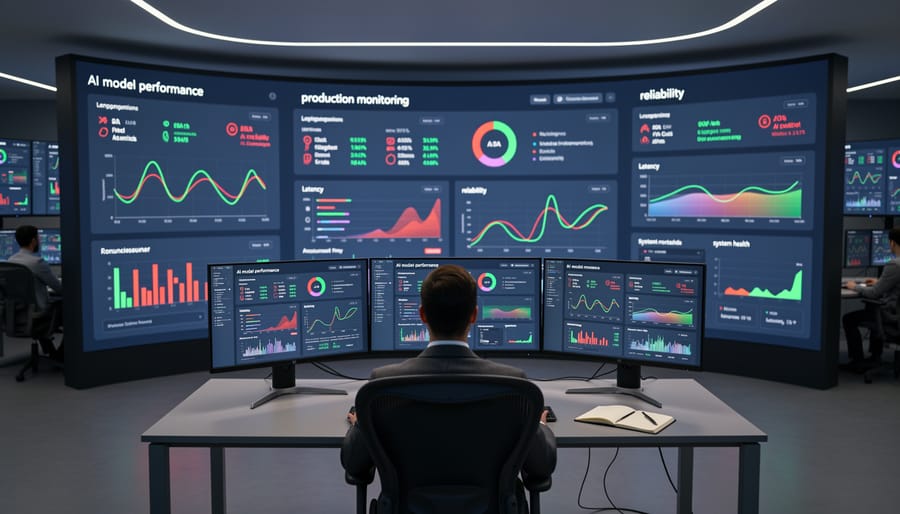
Beyond Traditional Monitoring
Traditional software monitoring focuses on tracking whether your application is up or down, how fast it responds, and if errors occur. These metrics work well because conventional software is deterministic—give it the same input, and you’ll get the same output every time. But AI models operate fundamentally differently, and that’s where traditional monitoring falls short.
Think about it this way: when you AI model training completes and you deploy your model, you’re not deploying a set of predictable rules. You’re deploying a system that makes probabilistic decisions based on patterns it learned from data. The same image might be classified slightly differently depending on lighting conditions, or a chatbot might generate varied responses to similar questions.
This probabilistic nature creates unique challenges. Your model might be technically “running” perfectly fine—no crashes, fast response times—yet producing increasingly inaccurate predictions because the real-world data has shifted from what it saw during training. A fraud detection model trained on pre-pandemic shopping patterns, for example, might struggle with the surge in online purchases that followed, flagging legitimate transactions as suspicious.
Additionally, AI models depend heavily on their input data quality and distribution. A single corrupted data field or an unexpected spike in null values can silently degrade performance without triggering any traditional alarms. This is why AI observability goes beyond uptime and latency, diving deep into model behavior, data quality, and prediction patterns to catch issues that conventional monitoring would miss entirely.
The Three Pillars of AI Observability
Think of AI observability as a three-legged stool. Remove any leg, and the entire system becomes unstable. These three pillars work together to give you complete visibility into how your AI systems are performing in the real world.
The first pillar is model performance tracking. This means continuously monitoring whether your AI model is making accurate predictions over time. Imagine a recommendation engine for an online bookstore. When first deployed, it might achieve 85% accuracy in suggesting books users actually purchase. But three months later, that accuracy drops to 65%. Performance tracking catches this decline immediately. You’re measuring metrics like precision, recall, and F1 scores, but more importantly, you’re watching for model drift—when your AI starts making worse predictions because the real world has changed in ways your training data didn’t anticipate.
The second pillar focuses on data quality monitoring. Your model is only as good as the data flowing through it. Picture a fraud detection system at a bank that suddenly starts receiving transaction data with missing timestamps or corrupted location information. Data quality monitoring acts as a gatekeeper, flagging anomalies like unexpected null values, data type mismatches, or statistical shifts in input distributions. One financial services company discovered through data monitoring that a integration error was feeding their model outdated customer information, causing thousands of false fraud alerts.
The third pillar encompasses system health metrics—the operational vitals of your AI infrastructure. This includes tracking response times, throughput, resource utilization, and error rates. When a healthcare diagnostic AI starts taking 30 seconds instead of 3 seconds to analyze medical images, system health monitoring raises the alarm before patients experience delays in their care.
The Hidden Problems AI Observability Solves
Data Drift: When Your Model Stops Making Sense
Imagine you built a model in 2019 to predict customer preferences based on shopping behavior. It worked brilliantly, achieving 90% accuracy. Fast forward to 2024, and suddenly that same model is making bizarre recommendations. What happened? Welcome to data drift.
Data drift occurs when the statistical properties of your input data change over time, causing your model’s performance to quietly deteriorate. Think of it like training for a marathon in summer, then running the actual race in winter wearing the same light gear. The fundamentals haven’t changed, but the conditions have shifted dramatically.
Here’s a real example: A retail company deployed a recommendation engine trained on pre-pandemic shopping data. When COVID-19 hit, customer behavior shifted dramatically. People stopped buying office clothes and started purchasing home workout equipment and baking supplies. The model, still expecting pre-pandemic patterns, kept suggesting briefcases to customers searching for yoga mats. Sales plummeted because nobody was monitoring how far the incoming data had drifted from the training data.
Data drift happens gradually and silently. Customer demographics shift, market trends evolve, seasonal patterns emerge, or external events like economic changes reshape behavior. Without proper monitoring, you won’t notice until users complain or revenue drops. This is precisely why AI observability matters. It helps you detect these shifts early, alerting you when your model’s view of the world no longer matches reality, so you can retrain or adjust before problems escalate.

Model Decay and Performance Degradation
Even the most sophisticated AI models don’t stay sharp forever. Think of it like a smartphone that worked perfectly when you bought it but starts glitching after a software update or struggles with new apps. AI models experience something similar called model decay or performance degradation.
This happens because the real world keeps changing while your model stays frozen in time. Imagine a recommendation engine trained on shopping patterns from 2019. It wouldn’t understand the massive shift to home fitness equipment and remote work tools that emerged during the pandemic. The gap between what the model learned and current reality grows wider, leading to irrelevant recommendations and frustrated users.
Model decay occurs for several reasons. Data drift happens when incoming data looks different from training data, like a fraud detection system suddenly facing new types of scams. Concept drift occurs when the relationship between inputs and outputs changes, such as customer preferences shifting due to economic conditions. Even subtle changes in how data is collected or processed can cause your once-accurate model to stumble. Without proper observability, these silent performance drops can go unnoticed for weeks or months, quietly eroding user trust and business value.
Bias and Fairness Issues
AI models can inadvertently learn and amplify biases hidden in training data, leading to unfair outcomes in real-world applications. Observability tools act as watchdogs, continuously monitoring model predictions for signs of bias across different demographic groups.
Consider a loan approval system that might favor certain applicants based on zip codes, unintentionally discriminating against specific communities. Observability platforms track prediction patterns across various customer segments, flagging disparities before they cause harm. For example, if a hiring algorithm screens out qualified candidates from certain backgrounds at higher rates, monitoring dashboards quickly surface these discrepancies.
These tools measure fairness metrics like demographic parity and equal opportunity, making invisible biases visible. By analyzing prediction distributions and error rates across protected attributes, teams can spot when models drift toward unfair behavior. This proactive approach to bias detection and fairness helps organizations course-correct quickly, ensuring AI systems serve all users equitably rather than perpetuating historical inequalities.
Essential Features of AI Observability Tools
Real-Time Performance Tracking
Once your AI model is deployed, continuous monitoring becomes essential to ensure it performs as expected. Think of it like a fitness tracker for your AI system—constantly checking vital signs to catch problems before they impact users.
Accuracy monitoring tracks whether your model’s predictions remain reliable over time. For example, a recommendation engine that initially achieved 90% accuracy might drift to 70% as user preferences evolve. By tracking this metric daily, you can identify when retraining becomes necessary, preventing customers from receiving irrelevant suggestions that hurt engagement.
Latency measures how quickly your model responds to requests. A fraud detection system must analyze transactions in milliseconds—if latency increases from 50ms to 500ms, legitimate purchases might get declined while customers wait, damaging their experience and your reputation.
Throughput indicates how many predictions your system handles per second. An image classification API processing 1,000 requests per second that suddenly drops to 200 signals potential infrastructure issues. During peak shopping seasons, this bottleneck could mean lost revenue as customers abandon slow-loading product pages.
These metrics work together like dashboard warning lights in your car. Monitoring them in real-time helps you maintain smooth operations and quickly address issues before they escalate into costly failures.
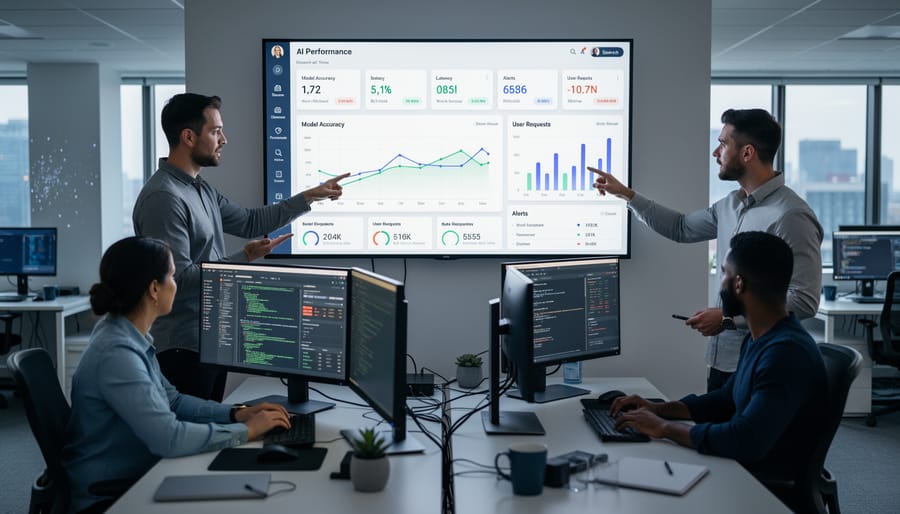
Automated Alerting and Anomaly Detection
Modern AI observability platforms act like sophisticated smoke detectors for your machine learning systems, catching problems before they escalate into full-blown fires. These tools continuously monitor your models and automatically send alerts when something unusual happens.
Imagine you’ve deployed a recommendation engine for an e-commerce site. An automated alerting system might notice that click-through rates suddenly dropped 30% overnight, even though the model itself appears to be running smoothly. The tool flags this anomaly immediately, allowing your team to investigate and discover that a recent inventory update inadvertently removed popular product categories from the recommendations.
In another scenario, a fraud detection model at a financial institution might start flagging 10 times more transactions than usual. The observability platform detects this spike in predictions and alerts the team. Investigation reveals that the input data distribution shifted due to a holiday shopping surge, requiring model recalibration to maintain accuracy.
These systems use statistical methods and machine learning techniques to establish baseline performance patterns. When metrics deviate significantly from these baselines, whether it’s prediction latency, data drift, or accuracy degradation, teams receive instant notifications through their preferred channels like Slack, email, or incident management tools, enabling rapid response and minimizing potential damage.
Explainability and Interpretability Features
Understanding why an AI model made a particular decision can feel like trying to read someone’s mind. This is where explainability and interpretability features become essential components of AI observability. These capabilities transform opaque “black box” models into transparent systems that teams can actually debug and trust.
Modern observability platforms incorporate model explainability tools that reveal the reasoning behind predictions. For instance, when a loan approval system denies an application, explainability features can show which factors carried the most weight—perhaps credit score, income level, or employment history. This transparency is crucial not just for debugging errors but also for building stakeholder confidence.
These tools typically provide feature importance rankings, showing which input variables influenced each prediction. Some platforms go further with visualization techniques that highlight exactly which parts of an image a computer vision model focused on or which words in a text most affected sentiment analysis results. For a customer service chatbot that suddenly starts giving incorrect answers, these insights help engineers quickly identify whether the problem stems from training data issues, feature drift, or model degradation—turning mysterious failures into actionable fixes.
Data Quality Monitoring
Data quality monitoring acts as your AI model’s health checker, constantly scanning incoming data for red flags. These tools automatically detect missing values, spot unusual outliers that don’t match expected patterns, and identify distribution shifts where new data looks significantly different from training data. For example, if your customer prediction model suddenly receives data with unexpected income ranges or missing age fields, monitoring alerts you before faulty predictions reach production. This proactive approach helps teams catch data issues early, preventing costly mistakes and maintaining model accuracy over time.
Popular AI Observability Tools You Should Know
Enterprise Solutions
For organizations running AI at scale, comprehensive enterprise platforms offer end-to-end observability solutions that integrate seamlessly with existing infrastructure. These platforms handle everything from model training to production deployment, making them ideal for teams managing multiple models across different environments.
AWS SageMaker Model Monitor stands out for teams already invested in the Amazon ecosystem. It automatically detects data drift and quality issues, sending alerts when your model’s performance deviates from baseline expectations. Think of it as your model’s health tracker, continuously checking vital signs like prediction accuracy and data distribution shifts.
Azure ML monitoring provides similar capabilities for Microsoft-oriented organizations, with particularly strong integration across Azure services. It excels at tracking model fairness and responsible AI metrics, helping teams ensure their models remain ethical as they scale.
Datadog AI Observability takes a different approach by treating AI models like any other application component. If your team already uses Datadog for infrastructure monitoring, this creates a unified view where you can see how your models interact with databases, APIs, and other services. This holistic perspective is invaluable when troubleshooting issues that span multiple systems, helping you quickly identify whether problems originate from your model, data pipeline, or supporting infrastructure.
Specialized AI Monitoring Platforms
When your AI models move from experimentation to production, dedicated monitoring platforms offer comprehensive solutions designed specifically for machine learning workflows. These specialized tools go beyond traditional software monitoring by tracking model-specific metrics like data drift, prediction quality, and feature behavior over time.
Arize AI stands out for its user-friendly interface and powerful drift detection capabilities. Imagine you’ve deployed a customer churn prediction model—Arize automatically alerts you when incoming customer data starts looking different from your training data, helping you catch problems before they impact business decisions. It excels at root cause analysis, showing you exactly which features are causing performance degradation.
WhyLabs takes a privacy-first approach by analyzing your data locally and only sending statistical profiles to the cloud. This makes it ideal for healthcare and financial services where data cannot leave your infrastructure. Their lightweight monitoring works seamlessly whether you’re running models on-premises or in the cloud.
Fiddler focuses on explainability alongside monitoring. It answers the question every stakeholder asks: “Why did the model make this decision?” For teams working in regulated industries or building customer-facing AI applications, Fiddler’s ability to explain individual predictions while monitoring overall performance proves invaluable.
Each platform offers free tiers or trials, making it easy to experiment and find the right fit for your specific needs.
Open-Source and Budget-Friendly Options
Getting started with AI observability doesn’t require a massive budget or complex enterprise software. Several open-source tools offer robust monitoring capabilities perfect for teams taking their first steps into production AI.
Evidently AI stands out as a beginner-friendly option, providing pre-built dashboards that track data drift and model performance without extensive configuration. Imagine launching your first recommendation system and immediately spotting when user behavior shifts—Evidently makes this straightforward with visual reports anyone on your team can understand.
MLflow has become the Swiss Army knife of machine learning lifecycle management. Beyond experiment tracking, it offers model registry features and basic monitoring capabilities. A small e-commerce startup, for instance, could use MLflow to compare different pricing models and monitor which performs best over time, all within a single platform.
For infrastructure monitoring, Prometheus paired with Grafana creates powerful visualization dashboards. While traditionally used for general application monitoring, these tools adapt well to AI systems, tracking API response times, resource usage, and prediction latencies.
These tools integrate smoothly with existing workflows and scale as your needs grow, making them ideal launchpads for your observability journey.
Getting Started with AI Observability
Step 1: Define What Success Looks Like
Before diving into tools and dashboards, pause and ask yourself: what does “working well” actually mean for your AI system? This clarity is essential because AI observability without direction is like having a sports car with no destination—impressive, but pointless.
Start by identifying your primary concern. Are you worried about your chatbot giving incorrect answers? Then accuracy metrics matter most. Running a recommendation engine? Focus on relevance scores and user engagement rates. For image classification models, you might track precision and recall.
Consider both technical and business metrics. Technical KPIs include model accuracy, latency (how fast predictions happen), and error rates. Business KPIs connect to real outcomes—customer satisfaction scores, conversion rates, or cost savings.
Here’s a practical example: an e-commerce company using AI for product recommendations might define success as maintaining 85% recommendation accuracy, keeping response times under 200 milliseconds, and achieving a 15% click-through rate. These specific targets create a measurable baseline.
Write down three to five critical metrics that align with your AI’s purpose. This focused list becomes your north star, guiding which observability features you’ll actually use rather than drowning in unnecessary data.
Step 2: Start Simple with Basic Monitoring
When you’re just starting with AI observability, resist the temptation to implement every monitoring capability at once. Instead, focus on two fundamental practices: logging your model’s predictions and tracking basic accuracy metrics.
Begin by recording what your model predicts alongside the actual outcomes when they become available. For example, if you’ve built a recommendation system, save each recommendation made and whether users clicked on it. This simple practice creates a historical record you can analyze later.
Next, set up basic accuracy monitoring. Calculate how often your model gets things right on a weekly or daily basis. You don’t need fancy dashboards yet—a simple spreadsheet or basic chart works perfectly fine at this stage.
Think of this as establishing your baseline. Just as you wouldn’t optimize a website without knowing your current traffic patterns, you can’t improve model deployment performance without understanding how it’s currently behaving. These foundational metrics will reveal whether your model maintains its accuracy over time or if something’s gradually going wrong.
Step 3: Build Alerting and Response Processes
Even the best monitoring setup is useless without clear alerts and response workflows. Think of it like having a smoke detector in your home—you need it to sound at the right time, not during every cooking session, and your family needs to know exactly what to do when it goes off.
Start by identifying what truly matters. Set alerts for critical issues like significant accuracy drops (say, more than 5% decline), dramatic increases in prediction latency, or unusual patterns in model confidence scores. A healthcare AI that suddenly shows low confidence in its diagnoses needs immediate attention, while minor fluctuations might just require logging.
Avoid alert fatigue by establishing thresholds that balance sensitivity with practicality. One data science team reduced their daily alerts from 47 to just 3 by fine-tuning their thresholds, allowing them to actually respond to real problems instead of dismissing notifications.
Create a clear response playbook. Define who gets notified first, what actions they should take, and when to escalate issues. For example, if your recommendation engine shows degraded performance, your workflow might include: check recent data quality, review model version, compare against baseline metrics, and roll back if necessary. Document these steps so any team member can respond effectively, even at 2 AM.
Real-World Success Stories
How an E-commerce Company Caught Pricing Errors Early
A mid-sized online retailer discovered their AI-powered recommendation engine was suggesting products at drastically reduced prices, sometimes below cost. The culprit? A pricing data pipeline that occasionally fed stale information to the model.
Their observability system caught the issue within hours through several key practices. First, they monitored prediction distributions, tracking the range of prices their model recommended. When prices dropped outside expected bounds, alerts fired immediately. Second, they implemented data drift detection, comparing incoming pricing data against historical patterns. This revealed that 15% of products had outdated prices during a flash sale event.
The team also tracked business metrics alongside model performance. When they noticed a sudden spike in recommendations for low-margin items, they connected it to the pricing anomaly. By correlating model outputs with upstream data quality checks, they pinpointed the exact moment the pipeline began delivering incorrect prices.
The fix took just two hours, preventing an estimated $50,000 in losses. This case demonstrates how observability transforms abstract model monitoring into concrete business protection, catching problems before customers notice them.
A Healthcare Startup’s Journey to Reliable AI
When MediScan, a healthcare startup, launched their AI-powered diagnostic tool to detect early-stage pneumonia from chest X-rays, they knew accuracy wasn’t enough. In healthcare, understanding why a model makes specific predictions is literally a matter of life and death.
Their observability journey began after a concerning incident: their model flagged several false positives during a beta test at a rural clinic. Without proper monitoring, they would have missed this pattern entirely. The team implemented an observability framework that tracked three critical areas.
First, they monitored prediction confidence scores for every diagnosis. When confidence dropped below 85%, the system automatically flagged cases for human review. Second, they tracked data drift by comparing incoming X-ray characteristics against their training dataset. This helped them discover that images from older equipment showed different contrast levels, affecting accuracy.
Third, they logged every prediction with detailed metadata, including equipment type, patient demographics, and radiologist feedback. This created an audit trail for regulatory compliance while helping improve the model over time.
Within six months, MediScan reduced false positives by 40% and gained FDA approval partly because they could demonstrate comprehensive monitoring and safety protocols. Their observability system transformed from a technical requirement into their competitive advantage, building trust with healthcare providers and patients alike.
As AI systems become increasingly embedded in everything from healthcare diagnostics to financial decision-making, observability isn’t just a nice-to-have feature—it’s essential infrastructure. The models you build today will need ongoing monitoring, debugging, and refinement as they encounter real-world data and edge cases you never anticipated during development.
Think of AI observability as your insurance policy against the unexpected. Just as you wouldn’t launch a web application without monitoring its uptime and performance, you shouldn’t deploy machine learning models without visibility into their behavior. The cost of blind spots—whether that’s biased predictions affecting real people, performance degradation going unnoticed, or compliance violations—far exceeds the investment in proper monitoring tools.
The good news? You don’t need to be an expert to get started. Begin small by implementing basic logging for your next project. Track your model’s predictions, monitor a few key performance metrics, and set up simple alerts for anomalies. As you grow more comfortable, you can expand into more sophisticated observability practices like feature drift detection and automated retraining pipelines.
The ML observability landscape is evolving rapidly, with new tools and best practices emerging regularly. Stay curious, experiment with different approaches, and learn from the broader community. Your future self—and the users depending on your AI systems—will thank you for building observability in from the start rather than scrambling to add it after problems arise.