

Selling your property quickly no longer means accepting undervalued offers or waiting weeks for traditional appraisals. Artificial intelligence is transforming property valuation, delivering accurate estimates in minutes rather than days. Platforms like propertysaviour.co.uk now leverage machine learning algorithms that analyze thousands of comparable sales, neighborhood trends, and property features simultaneously to generate precise valuations instantly.
This technology processes data far beyond human capacity. AI systems examine recent transactions within your area, assess current market conditions, evaluate property characteristics like square footage and condition, and adjust for seasonal fluctuations—all while accounting for micro-market trends that traditional appraisers might overlook. The result is a comprehensive valuation that helps you price competitively for rapid sale.
The speed advantage is undeniable. Where conventional valuations require scheduling appointments, waiting for appraisers, and processing reports over several days, AI-driven tools provide immediate results. You simply input your property details, and algorithms trained on millions of data points return a market-informed estimate within seconds. This acceleration is crucial when timing matters, whether you’re facing financial pressure, relocating for work, or capitalizing on favorable market conditions.
Understanding how these systems work empowers you to make informed decisions about pricing strategy and sale timing, ultimately positioning your property for the quickest possible transaction.
Why Traditional Property Valuations Slow Down Your Sale
When you list your property using traditional methods, the valuation process often becomes the first major roadblock. Most homeowners don’t realize that conventional appraisals can take anywhere from two to four weeks to complete, and that’s assuming everything goes smoothly.
The scheduling bottleneck begins immediately. Professional appraisers juggle multiple assignments, which means you’re waiting for an available slot on their calendar. Once scheduled, the appraiser needs physical access to your property, requiring you to coordinate times that work for both parties. If you’re managing tenants or living out of state, this simple step becomes even more complicated.
During the on-site visit, human assessors rely heavily on their personal experience and judgment. While expertise is valuable, it introduces an element of subjectivity. Two different appraisers might value the same property differently by tens of thousands of dollars, depending on which features they emphasize or how they interpret market conditions. This inconsistency creates uncertainty exactly when you need confidence to price competitively for a quick sale.
The comparable data analysis presents another limitation. Traditional appraisers typically examine a handful of recently sold properties in your neighborhood, usually between three and six comparables. This narrow sample size might miss important market patterns or fail to account for unique features that could justify a higher valuation. The manual nature of this research means deeper analysis simply isn’t practical within standard appraisal timeframes.
These delays translate directly into financial consequences. Every week your property sits unsold means continued mortgage payments, property taxes, insurance premiums, and maintenance costs. For someone relocating for a new job or managing financial pressures, these holding costs add up quickly. Meanwhile, market conditions shift. That motivated buyer from two weeks ago might have already purchased a competing property while you waited for your appraisal report. The opportunity cost of traditional valuations extends beyond money into missed connections with ready buyers.

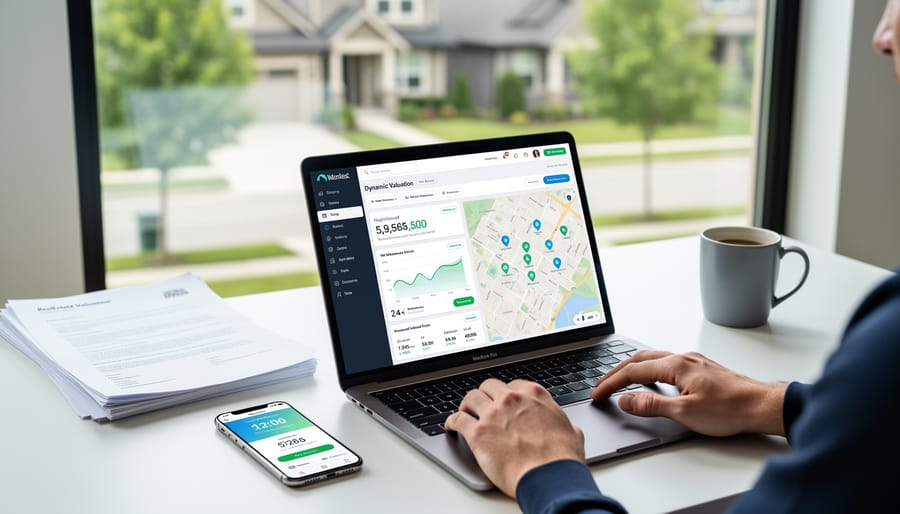
How AI Transforms Property Valuation Speed
Machine Learning Analyzes Thousands of Data Points Instantly
Think of machine learning in property valuation like having a seasoned real estate expert who’s memorized every home sale in your city for the past decade, can instantly recall neighborhood trends, and processes this information faster than you can blink. That’s essentially what happens when you use an AI-driven property valuation tool.
When you input your property details, machine learning frameworks immediately analyze thousands of data points simultaneously. The system examines your home’s physical characteristics like square footage, number of bedrooms, and recent renovations. It cross-references this with location factors including school ratings, crime statistics, proximity to amenities, and neighborhood desirability scores.
But here’s where it gets impressive: these algorithms don’t just look at current data. They process historical sales patterns, identify seasonal pricing trends, and detect emerging market shifts that human appraisers might miss. Imagine trying to manually compare your three-bedroom home against every similar property sold within five miles over the last five years while also accounting for interest rate changes and local economic conditions. It would take days or weeks. Machine learning does this in seconds.
The technology works like a highly sophisticated pattern-recognition system. It’s learned from millions of past transactions what makes properties valuable and can apply those lessons to your specific situation instantly. This speed transforms what traditionally took appraisers days of research and analysis into an immediate, data-backed valuation, giving sellers the quick answers they need to make fast decisions.
Real-Time Market Data Integration
Traditional property valuations can quickly become outdated, sometimes within days of being completed. AI-driven platforms solve this problem by functioning like a constantly updated pulse on the real estate market. These systems connect to multiple data streams simultaneously, pulling information from MLS (Multiple Listing Service) databases, public records, mortgage rate changes, and local economic indicators in real-time.
Think of it like a weather app for property values. Just as meteorological systems continuously monitor atmospheric conditions, AI valuation tools track market temperatures through fresh listings that appear each hour, sale transactions recorded at local registries, and shifting neighborhood trends. When a comparable property sells down the street, the AI platform incorporates that data immediately, adjusting your home’s valuation within minutes rather than weeks.
This continuous data integration proves particularly valuable during volatile market periods. For instance, if mortgage rates suddenly drop or a major employer announces relocations to your area, AI systems detect these economic indicators and recalibrate property values accordingly. The technology aggregates thousands of data points daily, from recent appraisals to current buyer demand metrics, ensuring your property’s estimated value reflects genuine market conditions at the exact moment you’re ready to sell.
Pattern Recognition Beyond Human Capability
AI algorithms excel at detecting connections invisible to the human eye. While traditional appraisers might focus on obvious factors like square footage and location, AI systems analyze hundreds of variables simultaneously to spot subtle patterns that influence property values.
Consider this real example: An AI valuation platform discovered that homes within 200 meters of coffee shops in urban neighborhoods sold 7% faster and at 3% higher prices than comparable properties just 300 meters away. Human appraisers would likely miss this micro-location nuance, but AI processes thousands of sales records to identify it.
Another fascinating pattern involves seasonal trends combined with school district changes. AI detected that family homes near recently upgraded schools experienced value increases six months before traditional market reports reflected the shift. Understanding AI and ML differences helps explain how machine learning improves its predictions over time by learning from these historical patterns.
The technology also recognizes unusual correlations, like how homes with specific architectural features perform differently across neighborhoods, or how proximity to public transportation impacts values differently depending on local demographics. These insights help sellers price properties accurately for quick sales, avoiding the costly mistakes of overpricing or leaving money on the table.
Real-World Applications: AI Valuation Tools You Can Use Today
Automated Valuation Models (AVMs) Explained
Automated Valuation Models, or AVMs, are computer programs that estimate how much your property is worth without requiring a human appraiser to physically visit. Think of them as sophisticated calculators that analyze millions of data points to generate an instant value for your home.
Here’s how they work: AVMs pull information from public records, recent home sales in your neighborhood, property characteristics like square footage and number of bedrooms, and market trends. Advanced algorithms then process this data to predict what your property would likely sell for in today’s market.
The most recognizable example is Zillow’s Zestimate, which evaluates over 100 million homes across the United States. When you search for an address on Zillow, you instantly see an estimated value that updates regularly as market conditions change. Similarly, Redfin Estimate uses machine learning to analyze recent sales and property details, claiming accuracy within 2% of the final sale price for homes on its platform.
Other platforms like Realtor.com and Chase Home Value Estimator offer their own versions, each using slightly different data sources and algorithms. Banks and mortgage lenders also employ proprietary AVMs to quickly assess collateral value when processing loan applications.
The beauty of AVMs lies in their speed and accessibility. What once required scheduling an appraiser and waiting days for a report now happens in seconds. However, these tools work best as starting points rather than definitive valuations, especially when you’re preparing for a quick sale and need reliable pricing guidance.
AI-Powered Cash Offer Platforms
Imagine selling your house in days rather than months, with a guaranteed cash offer in hand within 24 hours. This isn’t science fiction—it’s exactly what AI-powered cash offer platforms, commonly known as iBuyers, deliver to homeowners today.
Companies like Opendoor, Offerpad, and Zillow Offers have revolutionized home selling by deploying sophisticated AI systems that analyze your property instantly. Here’s how the process works: you submit basic information about your home through their website or app—details like square footage, number of bedrooms, and recent updates. Within moments, their AI algorithms spring into action.
These systems pull data from millions of recent sales, neighborhood trends, and even granular details like school ratings and local economic indicators. The AI then compares your property against similar homes, adjusting for unique features like renovations or lot size. Machine learning models, trained on years of transaction data, can predict your home’s market value with remarkable accuracy—often within a few percentage points.
The beauty of this technology lies in its speed and convenience. Traditional appraisals require scheduling, home visits, and waiting weeks for results. AI-powered platforms eliminate this friction entirely. You receive a preliminary offer almost immediately, followed by a formal cash offer after a brief home inspection to verify condition.
For sellers facing time pressure—whether relocating for work, managing an inherited property, or avoiding foreclosure—these platforms provide certainty and speed that traditional sales simply cannot match. The trade-off? These offers typically come in slightly below market value, compensating for the convenience and guaranteed sale.
The Accuracy Question: Can You Trust AI Valuations?
When you’re selling property quickly, the question “Can I trust this AI valuation?” naturally comes to mind. Let’s explore what the data tells us about AI accuracy in real estate.
Modern AI property valuation systems typically achieve accuracy rates between 85-96% when estimating values within 10% of the final sale price. That’s impressive, but it’s important to understand where these systems excel and where they sometimes stumble.
AI valuations work best for properties that fit established patterns. Think of a three-bedroom suburban home with standard features in an area with lots of recent sales data. The algorithms can analyze thousands of comparable sales, neighborhood trends, and market conditions in seconds, often producing highly reliable estimates. These systems continuously learn from new transactions, improving their predictions over time.
However, AI faces challenges with unique properties. A historic Victorian mansion, a home with extensive custom renovations, or a property in a rapidly changing neighborhood might throw off algorithmic predictions. The technology struggles when there’s insufficient comparable data or when subjective factors like architectural significance or emotional appeal significantly influence value.
Location matters tremendously for AI accuracy. Urban and suburban markets with high transaction volumes provide the data density these systems need. Rural areas or markets with few recent sales can produce less reliable estimates because the algorithms have limited information to analyze.
Think of AI valuation as your first checkpoint, not your final destination. For quick sales, it provides an excellent starting point that’s faster and often more objective than traditional methods. The technology removes emotional bias and processes vast amounts of market data that would take humans weeks to analyze. Companies developing these tools focus heavily on optimizing AI performance to deliver increasingly accurate results.
When should you seek human expertise? Consider a professional appraisal for properties with unique features, significant renovations, legal complications, or values exceeding typical ranges for your area. The smartest approach combines both: use AI for speed and data-driven insights, then validate with human expertise when circumstances warrant additional scrutiny.
This hybrid approach gives you the efficiency needed for quick sales while maintaining the reliability that protects your financial interests.
Maximizing Your Fast Sale Using AI Valuation Insights
Once you’ve received your AI valuation, the real opportunity lies in using that data strategically. Think of AI insights as your competitive advantage in a time-sensitive market. Here’s how to make the most of them.
Start by comparing your AI valuation across multiple platforms. If three different AI tools suggest your property is worth between $425,000 and $445,000, you’ve identified a reliable range. This consensus gives you confidence when setting your asking price. Price just below the upper range to attract serious buyers while leaving minimal negotiation room.
Next, examine the detailed breakdown that AI-powered analytics provide. Most platforms show which features add or subtract value from your property. Perhaps your renovated kitchen adds $15,000, but outdated bathrooms reduce value by $8,000. This granular information reveals exactly where quick improvements yield the highest return. One seller discovered her property’s main value detractor was curb appeal, so she invested $500 in landscaping and increased offers by $12,000.
Use AI trend predictions to time your listing. Many tools forecast whether your local market will rise or fall in coming months. If AI predicts a 3% decline over the next quarter, listing immediately makes financial sense.
Finally, leverage AI data in negotiations. When buyers question your price, present objective AI analysis rather than emotional justifications. Saying “comparable sales data and predictive algorithms support this valuation” carries more weight than “I think it’s worth this much.”
Remember, AI provides the intelligence, but you control the strategy. Combine machine precision with human judgment to navigate your quick sale confidently and profitably.

What’s Next: The Future of AI in Property Sales
The property market is evolving rapidly, and AI technology is just getting started. As we’ve seen with AI transforming industries across the board, several exciting developments are reshaping how we’ll buy and sell homes in the coming years.
Virtual property tours powered by AI are becoming increasingly sophisticated. Imagine walking through a potential home from your couch while an AI assistant provides real-time pricing insights based on the specific features you’re viewing. These systems can instantly adjust valuations as you explore different rooms, noting premium finishes or areas needing renovation.
Blockchain integration is another game-changer on the horizon. This technology promises to make property transactions faster and more transparent by creating secure, immutable records of ownership and valuation history. When combined with AI pricing models, blockchain could reduce closing times from weeks to mere days.
Perhaps most intriguing is the emergence of predictive analytics for optimal selling times. Advanced AI models now analyze market cycles, seasonal trends, and economic indicators to suggest the best week or even the best day to list your property. Early adopters of these tools report selling up to 15% faster than traditional timelines.
As these technologies mature and become more accessible, the gap between listing a property and closing the deal will continue to shrink, making quick sales not just possible but the new standard.
AI-driven property valuation has fundamentally transformed how quickly sellers can enter the market. By eliminating weeks of waiting for traditional appraisals, these tools provide instant insights that compress the entire sales timeline. Whether you’re facing a job relocation, managing financial pressures, or simply wanting to capitalize on market conditions, having an accurate valuation within minutes rather than weeks changes everything.
The technology empowers you with information that was once exclusively available through lengthy professional processes. You can make confident pricing decisions, compare offers against real data, and move forward with sales negotiations immediately. This democratization of property intelligence levels the playing field for everyday sellers.
However, understanding when to rely on AI valuations versus seeking traditional appraisals remains essential. For straightforward residential properties in data-rich markets, AI tools excel. For unique properties, complex situations, or final lending requirements, professional appraisals still play a vital role.
As you explore these innovative tools, approach them as powerful starting points in your quick-sale journey. Test multiple platforms, understand their methodologies, and use the speed advantage they provide to make informed decisions faster than ever before.