

Commercial real estate professionals waste countless hours crafting property descriptions, responding to inquiries, and managing listings across multiple platforms. Artificial intelligence is transforming this landscape by automating repetitive tasks and dramatically improving how properties reach potential tenants and buyers.
AI-powered tools now generate compelling listing descriptions in seconds by analyzing property features, market data, and successful past listings. These systems identify the most attractive selling points for each property type, whether warehouse space, retail locations, or office buildings, and craft language that resonates with specific buyer segments. The technology moves beyond simple templates to create unique, persuasive content that highlights what makes each property distinctive.
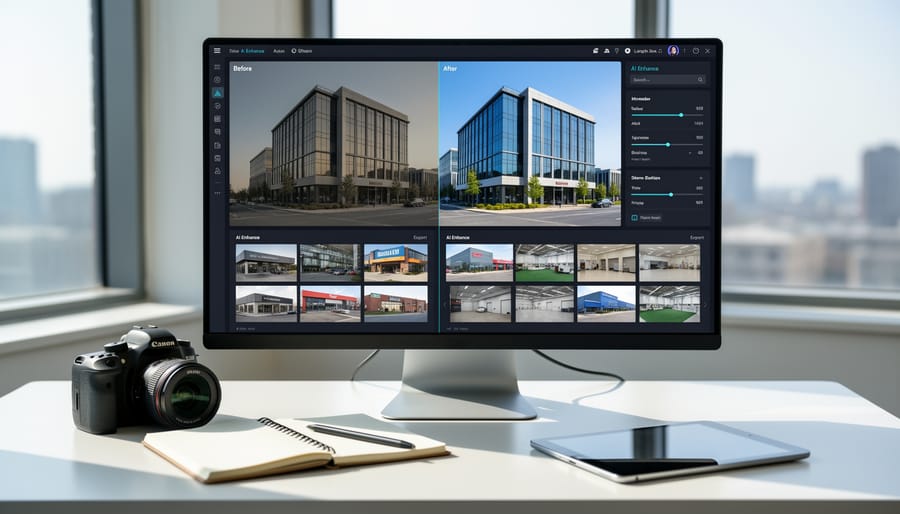
Image recognition algorithms automatically enhance property photos by adjusting lighting, removing unwanted objects, and even suggesting optimal camera angles for virtual tours. Some platforms use AI to generate floor plans from photos or create virtual staging that shows potential uses for empty spaces. This visual enhancement happens instantly, eliminating the need for expensive professional editing services.
Predictive analytics help brokers price properties more accurately by analyzing comparable sales, market trends, neighborhood development patterns, and economic indicators. Machine learning models process thousands of data points to recommend pricing strategies that maximize both speed to lease and final value. These insights prove particularly valuable in dynamic markets where traditional valuation methods lag behind rapid changes.
Chatbots handle initial tenant inquiries 24/7, answering common questions about square footage, amenities, lease terms, and availability. This immediate response capability captures leads that would otherwise slip away during off-hours. For those marketing offices to rent or industrial properties, AI matching algorithms connect listings with qualified prospects by understanding requirements beyond simple keyword searches, considering factors like growth plans, industry needs, and location preferences.
The Problem with Traditional Commercial Listing Creation
Creating commercial real estate listings the traditional way is like trying to fill a swimming pool with a teaspoon—it gets the job done eventually, but at what cost? Most commercial real estate professionals spend countless hours manually entering property details into listing platforms, often juggling spreadsheets, photos, and notes scattered across different systems.
The first major headache is human error. When you’re typing square footage, zoning classifications, and amenity lists by hand for the twentieth property that week, mistakes slip through. A misplaced decimal point could list a 10,000 square foot warehouse as 100,000, or crucial details like loading dock specifications might get overlooked entirely. These errors don’t just waste time—they damage credibility and can derail serious buyer interest.
Consistency presents another challenge. Different team members describe properties in wildly different ways. One broker might emphasize “premium finishes and modern infrastructure,” while another calls the same building “updated facilities.” This inconsistency confuses potential buyers and weakens your brand’s professional image. Without standardized templates or guidance, every listing becomes a unique writing exercise rather than a strategic marketing tool.
Then there’s the sheer repetitiveness of the work. Describing similar properties requires reformulating essentially the same information repeatedly. Industrial warehouses share common features, yet each description must be crafted from scratch. This repetitive work drains productivity and prevents professionals from focusing on relationship-building and deal-making—the activities that actually generate revenue.
Highlighting what makes each property special becomes difficult when you’re rushing through listings. That perfect corner location or recently upgraded HVAC system might not get the attention it deserves in the description. Similar to how AI property valuation has transformed pricing accuracy, traditional listing creation struggles to capture and emphasize unique selling points effectively.
Finally, keeping listings updated across multiple platforms—your website, commercial real estate portals, social media, and email campaigns—becomes a coordination nightmare. Change one detail, and you’re stuck updating it everywhere manually, hoping you haven’t missed a platform.


What AI Actually Does for Commercial Real Estate Listings
Automated Property Description Generation
Imagine typing “15,000 sq ft, 3rd floor, downtown, parking included” and instantly receiving a polished description like: “Experience premium workspace in this expansive 15,000-square-foot suite, perfectly positioned on the third floor of a distinguished downtown tower. Floor-to-ceiling windows flood the open floor plan with natural light, while included parking privileges add exceptional value for your team and clients.”
This transformation happens through natural language processing (NLP), a branch of AI that understands and generates human language. When you input basic property specifications into an AI-powered system, the technology analyzes the data points and draws from thousands of successful commercial listings to craft descriptions that highlight selling points and appeal to potential tenants or buyers.
Here’s how it works in practice: The AI recognizes that “downtown” location is a premium feature worth emphasizing. It understands that “15,000 sq ft” suits mid-sized companies and frames it as “expansive workspace.” The system automatically adds context about natural light, accessibility, and value propositions that basic specs lack.
The real advantage emerges when handling multiple listings simultaneously. A property manager with twenty vacant units can generate customized, professional descriptions in minutes rather than hours. Each description maintains consistency in quality while highlighting unique features specific to that property. The AI adapts tone based on property type, automatically using more sophisticated language for Class A office towers versus practical terminology for industrial warehouses, ensuring your marketing speaks directly to the right audience.
Smart Data Extraction and Organization
Imagine manually typing property details from dozens of PDF documents, extracting information from old spreadsheets, and describing features visible in hundreds of photos. This tedious reality consumed hours of valuable time for commercial real estate professionals until AI-powered data extraction changed the game.
Modern AI systems can read through lease agreements, property reports, and historical listings to automatically identify crucial information like square footage, zoning classifications, parking availability, and tenant improvement allowances. These AI tools streamline workflows by recognizing patterns in documents, even when formats vary significantly between properties.
Computer vision technology takes this further by analyzing property photographs. AI can identify features like exposed ceilings, loading docks, conference rooms, or kitchen facilities without human annotation. For example, when you upload fifty images of a warehouse property, the system automatically tags photos showing high ceilings, concrete floors, or truck access points, organizing them into relevant categories.
The system also learns from your previous listings. If you typically highlight proximity to highways for industrial properties, the AI recognizes this pattern and automatically calculates distances to major transportation routes for new listings. It pulls comparable property data, identifies market trends, and even suggests pricing ranges based on similar properties in your database.
This intelligent extraction creates comprehensive property profiles in minutes rather than hours, ensuring consistency across your portfolio while freeing your team to focus on client relationships and deal-making rather than data entry.
Intelligent Property Matching and Recommendations
Finding the perfect commercial property traditionally involves sifting through countless listings, comparing spreadsheets, and relying heavily on broker intuition. AI-powered intelligent matching systems are transforming this process by learning what buyers and tenants actually need, then surfacing only the most relevant opportunities.
These systems work by analyzing two key data streams. First, they examine buyer or tenant preferences including location requirements, square footage needs, budget constraints, parking availability, and specific amenities like loading docks or conference facilities. Second, they process detailed property characteristics from each listing including physical attributes, lease terms, and neighborhood features. Using machine learning frameworks, the algorithm identifies patterns between successful matches and applies these insights to future recommendations.
Consider a growing tech company searching for office space. Instead of reviewing hundreds of properties, the AI recognizes their pattern: proximity to public transit, open floor plans, high-speed internet infrastructure, and flexibility for expansion. The system automatically prioritizes listings matching these criteria while filtering out traditional corporate spaces that don’t align with their culture.
The benefits extend beyond convenience. By analyzing interaction data like which listings users view longest, which features they compare, and which properties they schedule tours for, the system continuously improves its accuracy. This means brokers receive higher-quality leads from genuinely interested parties rather than casual browsers, dramatically improving conversion rates and reducing time wasted on mismatched prospects.
Real-World Applications: AI Tools Making an Impact Today
Automated Listing Syndication
Imagine uploading your commercial property listing once and watching it appear perfectly formatted across CoStar, LoopNet, your company website, and multiple real estate portals—all without manual copy-pasting or reformatting. That’s the power of AI-driven listing syndication.
Through automated data pipelines, AI systems analyze each platform’s unique requirements and automatically adjust your listing accordingly. For example, CoStar might require specific property classification codes, while LoopNet emphasizes high-resolution images in particular dimensions, and your website needs SEO-optimized descriptions.
Here’s how it works in practice: When you input a new 50,000-square-foot warehouse listing, the AI instantly creates platform-specific versions. It generates CoStar’s detailed comp fields, formats LoopNet’s abbreviated property highlights, and crafts keyword-rich content for your website—all from your single data entry.
The system continuously monitors each platform’s formatting updates and API changes, ensuring your listings remain compliant without requiring your team to track technical specifications. This consistency eliminates embarrassing formatting errors and ensures potential tenants see professional, accurate information regardless of where they discover your property.
Photo Analysis and Enhancement
Picture this: you’ve just photographed a stunning office building, but your listing has 50 images and you’re unsure which ones will grab attention first. AI-powered photo analysis tools solve this challenge by automatically scanning your images and identifying key features like modern lobbies, parking facilities, or conference rooms. These systems use computer vision, a technology that enables machines to “see” and understand images just like humans do, to tag each photo with relevant attributes.
Beyond organization, AI tools can determine the optimal sequence for your photos by analyzing which images generate the most engagement from potential tenants. For example, the system might discover that exterior shots with good lighting perform better as lead images than interior views.
Image enhancement capabilities take this further by automatically adjusting brightness, contrast, and color balance to make spaces appear more inviting. Some advanced platforms can even remove temporary objects like construction equipment or enhance dull skies to showcase properties in their best light. These improvements happen in seconds rather than hours of manual editing, allowing brokers to publish professional-quality listings faster while maintaining consistency across their entire portfolio.
Pricing Intelligence
Setting the right price for commercial real estate can feel like guesswork, but AI transforms this challenge into a data-driven strategy. Instead of relying solely on intuition or outdated comparisons, AI systems analyze massive datasets to recommend pricing that maximizes both competitiveness and profitability.
At its core, AI pricing intelligence works by examining comparable properties in your area. Think of it as having a research assistant who instantly reviews hundreds of similar listings, noting their square footage, location, amenities, and recent transaction prices. The AI identifies patterns that human analysis might miss, such as how specific features like loading docks or parking ratios affect pricing in different submarkets.
But AI goes beyond simple comparables. These systems incorporate real-time market trends, tracking shifts in supply and demand across different property types. For example, if warehouse spaces in a particular district are seeing increased interest due to e-commerce growth, the AI adjusts pricing recommendations accordingly. It can also factor in seasonal variations, economic indicators, and even planned infrastructure developments that might impact future property values.
Location data adds another layer of sophistication. AI analyzes proximity to transportation hubs, demographic shifts in surrounding areas, and foot traffic patterns to determine location premiums. A retail space near a newly opened transit station, for instance, might warrant higher pricing than historical data alone would suggest.
The result is dynamic pricing recommendations that adapt to market conditions, helping property owners avoid the costly mistakes of overpricing (leading to extended vacancies) or underpricing (leaving money on the table). This data-backed approach gives commercial real estate professionals confidence in their pricing decisions.
Getting Started: Implementing AI for Your Listings
Choosing the Right AI Tool for Your Needs
Selecting the right AI tool requires careful evaluation of your specific needs and workflow. Start by identifying your pain points: Are you spending hours writing property descriptions? Struggling with photo quality? Need faster market analysis? Your biggest challenge should guide your tool selection.
When evaluating vendors, ask these essential questions: How does the AI handle your specific property types? A tool trained primarily on residential listings may struggle with industrial warehouses or retail spaces. Request demos using your actual properties to see real results. Also inquire about data security and privacy measures, especially if you’re uploading sensitive client information or pre-market listings.
Look for tools that integrate seamlessly with your existing systems. The best AI solution should work with your property management software, CRM, and listing platforms rather than creating another disconnected workflow. Check whether the tool offers API access or native integrations with platforms you already use daily.
Consider the learning curve and support available. Some platforms offer intuitive interfaces that your team can master in hours, while others require extensive training. Read user reviews from other commercial real estate professionals to understand real-world experiences beyond the marketing materials.
Finally, start small. Many vendors offer free trials or tiered pricing that lets you test features before committing to enterprise-level plans. Use this opportunity to measure actual time savings and quality improvements with a handful of listings before rolling out company-wide.
Integration with Existing Systems
Modern AI listing tools are designed to work alongside your existing technology stack rather than replace it entirely. Most platforms offer pre-built integrations with popular CRM systems like Salesforce and HubSpot, property management software such as Yardi and AppFolio, and major listing platforms including LoopNet and CoStar.
During implementation, expect a phased rollout spanning two to six weeks, depending on your system complexity. The process typically begins with API connections that allow data to flow seamlessly between platforms. For example, when your property management system updates a vacancy status, the AI tool can automatically refresh listings across multiple channels without manual intervention.
Many providers offer what’s called a “sandbox environment” where you can test the integration safely before going live. This lets your team experiment with features and identify any compatibility issues early on.
The good news? Most implementations don’t require extensive technical expertise from your end. Vendors usually provide dedicated support teams who handle the heavy lifting of connecting systems. Your main responsibility involves mapping data fields, like ensuring your CRM’s “square footage” field matches the AI tool’s corresponding input.
One practical tip: Start by integrating one or two core systems first, validate they’re working properly, then expand to additional platforms. This measured approach minimizes disruption to your daily operations.
Training Your Team (It’s Easier Than You Think)
Getting your team comfortable with AI doesn’t require a months-long training program. Start with a simple 30-minute demonstration showing how the tool works with a real listing from your portfolio. Let team members experiment hands-on during the first week, treating AI as a drafting assistant rather than a replacement for their expertise.
The key is addressing concerns upfront. Many brokers worry AI will make their skills obsolete, but emphasize how it handles tedious tasks while they focus on client relationships and deal-making. Consider designating one tech-savvy team member as your AI champion who can troubleshoot questions and share success stories.
Most teams reach comfortable proficiency within two weeks of daily use. Create a feedback loop where staff can suggest improvements to your AI workflow. When brokers see they’re creating better listings in half the time, resistance typically transforms into enthusiasm. Remember, you’re not changing what makes great real estate professionals valuable—you’re just giving them better tools to showcase properties.

What to Watch Out For: Limitations and Best Practices
When to Override AI Suggestions
While AI offers powerful insights for commercial real estate listings, your professional judgment remains invaluable in specific situations. Think of AI as a skilled assistant rather than a replacement for your expertise.
Override AI suggestions when dealing with unique or high-value properties that require nuanced positioning. For example, if AI recommends standard office language for a historic building with character features, your knowledge of buyer preferences should prevail. You understand the emotional appeal that algorithms might miss.
Local market dynamics often require human intervention. AI might not recognize that a property near a recently announced corporate headquarters deserves premium positioning, or that neighborhood improvements haven’t yet reflected in the data. Your boots-on-the-ground intelligence captures these emerging trends before AI models catch up.
Pay special attention when AI-generated descriptions sound generic or miss critical selling points. If the system overlooks a property’s proximity to major transportation hubs or recent renovations, manually enhance the content. Similarly, review AI pricing recommendations against current deal flow and buyer sentiment you’re experiencing firsthand.
Quality control matters most when targeting specific buyer profiles. AI might optimize for broad appeal, but you know whether a particular industrial space suits manufacturing better than logistics based on ceiling heights and loading dock configurations that algorithms might underweight.
Data Privacy and Accuracy Concerns
While AI streamlines commercial real estate listings, it introduces critical privacy and accuracy considerations that property professionals must address. Commercial property data often contains sensitive financial information, tenant details, and proprietary pricing strategies that require careful handling under regulations like GDPR and CCPA.
One major concern is AI’s tendency to generate plausible-sounding but incorrect information, known as hallucinations. Imagine an AI listing system that fabricates square footage or misrepresents zoning classifications—such errors could lead to legal disputes and damaged client relationships. Always verify AI-generated content against original property documentation before publishing.
Data security becomes paramount when feeding confidential lease agreements and financial projections into AI systems. Establish clear protocols about what information gets processed by AI tools, ensuring cloud-based platforms encrypt data both in transit and at rest. Many AI implementation challenges stem from inadequate security measures during deployment.
Create a human-in-the-loop workflow where experienced agents review all AI outputs for factual accuracy and compliance. This practice protects your firm from misrepresentation claims while maintaining the efficiency gains AI provides. Regular audits of AI-generated listings help identify patterns of errors before they impact your business reputation.
AI isn’t here to replace commercial real estate professionals—it’s here to make them more effective. Think of it as a highly skilled assistant that handles the time-consuming tasks, freeing you to focus on what you do best: building relationships, negotiating deals, and providing expert guidance to clients.
The commercial real estate landscape is evolving rapidly, and early adopters of AI technology are already seeing significant competitive advantages. They’re listing properties faster, reaching more qualified prospects, and closing deals while their competitors are still writing descriptions manually. The gap between those who embrace these tools and those who don’t will only widen as AI capabilities continue to advance.
If you’re feeling overwhelmed by the possibilities, remember that you don’t need to transform your entire operation overnight. Start small. Choose one or two AI features that address your most pressing pain points—perhaps automated description writing or predictive pricing analysis. Test them on a handful of listings, measure the results, and gradually expand from there. Many platforms offer free trials or tiered pricing that lets you experiment without major financial commitment.
Looking ahead, AI in commercial property listings will become increasingly sophisticated. We’re moving toward systems that can predict market trends with remarkable accuracy, create immersive virtual experiences, and match properties with buyers before they even hit the market. The professionals who start building their AI literacy today will be best positioned to leverage these innovations tomorrow.