

Artificial intelligence pricing tools generated $843 million in revenue during 2023, with companies implementing dynamic pricing seeing profit margins increase by 5-10% on average. But these headline numbers mask a more complex reality: while retail giants like Amazon credit AI pricing systems with billions in additional revenue, 40% of small to mid-sized businesses report breaking even or losing money on their AI investments within the first two years.
The profitability question isn’t whether AI pricing works in theory, it’s whether it works for your specific situation. A grocery chain with thin margins and high inventory turnover faces entirely different economics than a software company selling digital products. The former might see returns within months, while the latter could struggle to justify the implementation costs.
This disparity exists because AI profitability hinges on three concrete factors: the volume of pricing decisions you make daily, your current pricing inefficiencies, and your organizational readiness to act on algorithmic recommendations. A hospitality business adjusting thousands of room rates hourly has fundamentally different ROI potential than a B2B manufacturer with quarterly contract negotiations.
The evidence reveals a clear pattern. Companies processing high transaction volumes in competitive markets show measurable returns within 6-18 months. Those with complex, relationship-based pricing or limited data infrastructure often face 3-5 year payback periods, if they achieve positive returns at all.
What follows is a data-driven examination of actual financial outcomes across industries, transparent cost breakdowns including hidden expenses most vendors won’t mention, documented failure cases that reveal common pitfalls, and a practical framework for calculating whether AI pricing makes financial sense for your business model.
What AI-Driven Pricing Actually Does (And Why It Matters)
Think about the last time you booked a flight or called a ride-share. You probably noticed that prices seemed to change every time you checked. That’s AI-driven pricing at work, and it’s one of the most profitable applications of artificial intelligence today.
At its core, AI-driven pricing uses machine learning algorithms to automatically adjust prices based on real-time market conditions. Instead of setting a fixed price and hoping for the best, these systems constantly analyze dozens of factors: current demand, competitor pricing, time of day, weather conditions, customer browsing behavior, historical sales patterns, and even local events that might affect demand.
Here’s a simple example: When you open a ride-sharing app on a rainy Friday evening, the AI instantly processes thousands of data points. It knows that rides are in high demand, drivers are scarce, and people are willing to pay more to stay dry. Within milliseconds, it calculates the optimal price that maximizes revenue while still attracting enough customers. This is called dynamic pricing, and it happens automatically without any human intervention.
Airlines have mastered this approach for decades, but modern AI has made it far more sophisticated. Today’s systems don’t just react to supply and demand; they predict future trends. By analyzing patterns from AI-powered business analytics, these algorithms can forecast when a customer is most likely to buy, what price point will convert browsers into buyers, and even identify which customers are willing to pay premium prices.
The beauty of these systems is their ability to learn and improve continuously. Every transaction feeds new data back into the model, making future predictions more accurate. What once required teams of analysts working with spreadsheets now happens automatically, processing millions of pricing decisions per day with increasing precision.

The Real Numbers: Profitability Across Different Industries
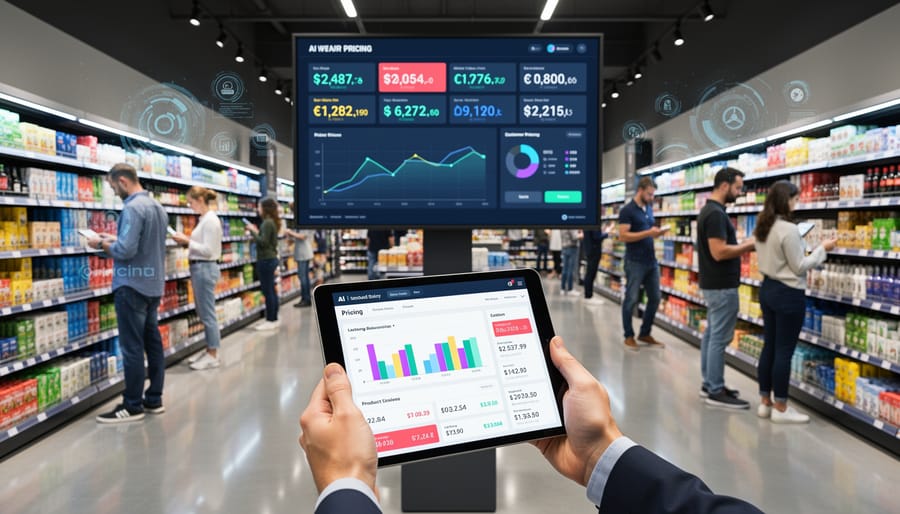
Retail and E-commerce Success Stories
Major retailers are proving that AI investments deliver measurable returns. Amazon’s AI-powered recommendation engine generates an estimated 35% of total revenue, translating to billions in additional sales annually. This success stems from sophisticated customer behavior analysis that personalizes shopping experiences in real-time.
Walmart implemented AI-driven inventory management and dynamic pricing across its stores, resulting in a 10-15% reduction in excess inventory costs and improved profit margins by 2-3 percentage points. Their system adjusts prices for over 500 million products based on demand patterns, competitor pricing, and local market conditions.
Smaller businesses are seeing impressive gains too. Shopify merchants using AI-powered pricing tools report average conversion rate increases of 20-30%. One mid-sized fashion retailer increased revenue by 23% within six months after implementing AI recommendations, while reducing promotional discounting by 18%.
Sephora’s AI chatbot and personalized product recommendations drove a 11% increase in average order value and boosted customer retention rates by 150%. The beauty retailer achieved ROI within eight months of deployment.
Even traditional brick-and-mortar stores benefit. Target’s AI price optimization system helped increase same-store sales by 3.4% while maintaining competitive pricing. The technology analyzes millions of data points daily to find the sweet spot between volume and margin, proving that AI profitability extends beyond pure e-commerce players to hybrid retail models.
Hospitality and Travel Industry Results
The hospitality and travel sector has emerged as one of AI’s most profitable proving grounds, with companies reporting measurable financial gains within months of implementation. Major hotel chains using AI-powered dynamic pricing have seen revenue per available room (RevPAR) increase by 10-15% on average, according to industry reports from leading hospitality groups.
Marriott International, for example, implemented AI algorithms across its properties and reported optimizing room rates in real-time based on demand patterns, local events, and competitor pricing. The result was improved occupancy rates during traditionally slow periods while maximizing revenue during peak seasons. Similar success stories have emerged from Hilton and Accor, which reported double-digit percentage improvements in overall revenue management efficiency.
Airlines have experienced even more dramatic returns. Delta Air Lines publicly shared that their AI pricing system processes over 30 million fare changes daily, resulting in hundreds of millions in additional annual revenue. The technology analyzes booking patterns, remaining seat inventory, and historical data to adjust prices multiple times per day.
Booking platforms like Expedia and Booking.com leverage AI to personalize pricing and recommendations for individual users, increasing conversion rates by 20-30%. These platforms demonstrate that AI profitability extends beyond just setting prices – it encompasses predicting customer behavior, reducing abandoned bookings, and identifying upselling opportunities that human analysts might miss.

B2B and Manufacturing Outcomes
Industrial and manufacturing companies have discovered that AI pricing delivers particularly impressive returns, especially when dealing with complex product catalogs and varied customer relationships. Unlike consumer-facing businesses with standardized prices, B2B companies often manage thousands of SKUs with customer-specific contracts, making manual pricing optimization nearly impossible.
Consider a mid-sized industrial parts manufacturer that implemented AI-driven contract optimization. By analyzing historical purchasing patterns, production costs, and customer loyalty metrics, their system identified that they were underpricing certain specialty components by an average of 12% for long-term clients. The AI recommended tailored pricing adjustments that increased margins while maintaining competitiveness. The result? A 7% revenue increase within six months without losing a single major account.
Another manufacturing firm used AI to optimize their quote-generation process. Previously, sales teams spent hours manually calculating prices for custom orders, often leaving money on the table to ensure deal closure. The AI system analyzed win rates, competitor pricing intelligence, and production capacity to suggest optimal pricing for each quote. This reduced quote preparation time by 60% while improving deal profitability by 9%.
The most striking outcome involves dynamic pricing for raw materials and components. One distributor reported that AI-powered pricing adjustments based on real-time supply chain data generated an additional $2.3 million in annual profit—a 340% ROI on their AI investment within the first year.
Small Business vs. Enterprise: Does Size Matter?
AI profitability isn’t reserved exclusively for corporate giants. While Fortune 500 companies like Amazon have famously generated billions through dynamic pricing algorithms, smaller businesses are seeing meaningful returns at their scale too. The key difference lies in expectations and implementation approach.
Enterprise companies typically invest $500,000 to several million in custom AI pricing solutions, but they’re optimizing across thousands of products and massive transaction volumes. A 2-3% margin improvement translates to tens of millions in additional profit. Small businesses, conversely, can access subscription-based AI pricing tools for $100-$500 monthly. A local e-commerce store with $500,000 in annual revenue might only gain $10,000-$15,000 yearly from AI optimization, but that’s still a solid 2,000-3,000% ROI on their software investment.
The profitability sweet spot depends on your volume and complexity. Businesses with 50+ SKUs, fluctuating demand patterns, or competitive markets tend to see faster payback regardless of size. Solo entrepreneurs selling three products probably won’t justify the investment, while a regional retailer managing seasonal inventory across multiple locations could see returns within months.
The Hidden Costs Nobody Talks About
When companies first explore AI profitability, they often focus on the exciting potential returns while glossing over the substantial expenses that can quietly drain budgets. Let’s pull back the curtain on what implementing AI really costs.
The sticker price is just the beginning. While AI software platforms might advertise monthly subscription fees ranging from $500 to $50,000 depending on scale, AI implementation costs extend far beyond licensing. A mid-sized retailer implementing dynamic pricing, for example, might budget $30,000 annually for software but find themselves spending triple that amount when all factors are considered.
Data infrastructure presents one of the biggest hidden expenses. AI systems are hungry for quality data, and most companies discover their existing data isn’t ready for prime time. You’ll need robust storage solutions, data cleaning tools, and often entirely new databases. One e-commerce company shared that they spent six months and $150,000 just organizing and standardizing their product data before their AI pricing tool could even begin learning patterns.
Integration headaches compound these costs. Your shiny new AI system needs to communicate with your existing tech stack, which means custom development work, API connections, and countless hours of testing. Payment processors, inventory management systems, customer relationship management platforms, they all need to play nicely together. Budget at least 20-30% of your software costs for integration alone.
Then there’s the human factor. AI doesn’t run itself. You’ll need data scientists to fine-tune algorithms, analysts to interpret results, and IT professionals to maintain systems. Even if you outsource these roles, expect to pay premium rates. A single experienced data scientist commands salaries exceeding $120,000 annually in most markets.
Ongoing maintenance adds another layer. Algorithms need regular updates as market conditions shift, models require retraining with fresh data, and systems demand continuous monitoring to prevent costly errors. That pricing algorithm that worked brilliantly last quarter might start making questionable decisions if not properly maintained.
The sobering reality? Many companies underestimate total costs by 50-70% in their initial projections, which can transform a potentially profitable AI initiative into a financial burden that takes years to recover from.
When AI Pricing Backfires: Cautionary Tales
Not every AI pricing experiment ends in profit. Understanding where others stumbled can save your business from costly mistakes.
Consider the infamous case of Bruce Springsteen concert tickets in 2022. Ticketmaster’s dynamic pricing algorithm pushed some seats to over $5,000, sparking massive public outrage. Fans accused the company of price gouging, and the controversy generated weeks of negative press. The backlash was so severe that it contributed to congressional hearings about ticketing practices. While the system technically maximized short-term revenue, it damaged brand reputation and customer trust in ways that likely offset any financial gains.
Uber faced similar pushback with its surge pricing during emergencies. When Hurricane Sandy hit New York in 2012, prices skyrocketed at the exact moment people needed rides most. The company quickly learned that algorithmic optimization without ethical guardrails creates public relations nightmares. They’ve since implemented surge pricing caps during declared emergencies, showing that sometimes limiting AI recommendations is the profitable long-term choice.
In retail, a major grocery chain tested dynamic pricing in 2019 that adjusted shelf prices throughout the day based on demand patterns. Customers noticed bread costing more at 5 PM than noon and felt manipulated. The pilot program was quietly discontinued after just three months when customer satisfaction scores plummeted and social media backlash intensified.
The common thread in these failures? Companies prioritized algorithmic efficiency over human perception. The lesson isn’t that AI pricing doesn’t work, but that it requires careful implementation with clear boundaries.
Before deploying AI pricing, ask yourself: Will customers view changes as fair? Are there ethical limits to price variation? What safeguards prevent the algorithm from making tone-deaf decisions during sensitive situations?
Sometimes the most profitable decision is knowing when not to let AI set the price. Building customer trust often generates more long-term value than squeezing every dollar from each transaction.
Breaking Down the Payback Period: How Long Until Profit?
Understanding when AI pricing investments break even is crucial for planning your budget and expectations. Based on real-world implementations, most companies see initial returns within 6 to 18 months, though this timeline varies significantly based on several key factors.
Retail companies typically experience the fastest payback periods. For example, a mid-sized e-commerce business implementing dynamic pricing saw profitability within 8 months, thanks to immediate revenue increases of 12-15%. The automation replaced manual pricing adjustments for over 50,000 products, generating savings from day one.
In contrast, manufacturing companies often face longer timelines of 15-24 months. A chemical manufacturer reported their AI pricing system took 18 months to break even, primarily because they needed to build robust historical datasets and integrate multiple legacy systems before seeing meaningful results.
Several factors determine how quickly you’ll reach profitability. Data quality stands out as the most influential variable. Companies meeting data quality requirements from the start typically shave 3-6 months off their payback period. Poor data quality, however, extends timelines as teams spend additional months cleaning and preparing information.
Market volatility also plays a role. Industries with frequent price changes, like travel or hospitality, see faster returns because AI can respond to fluctuations hundreds of times daily. Stable markets with infrequent pricing updates may take longer to demonstrate clear advantages.
Your implementation approach matters too. Cloud-based solutions with pre-built models often deliver faster results than custom-built systems. One hotel chain using a ready-made solution reached profitability in just 5 months, while a competitor building from scratch needed 14 months despite similar business sizes.
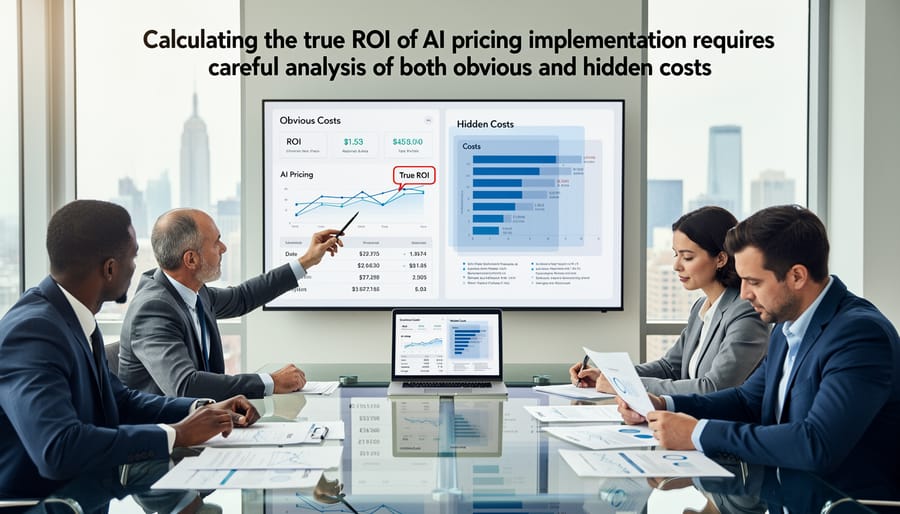
Is AI Pricing Profitable for YOUR Business?
Before diving into AI-driven pricing, you need to determine whether it makes financial sense for your specific business. Not every company will see the same returns, and understanding your readiness can save you from costly missteps.
Let’s walk through a practical framework to assess your AI pricing profitability potential.
Start by examining your price sensitivity. Does a small price change significantly impact your sales volume? Businesses with high price elasticity—think e-commerce, travel, or hospitality—often see the biggest wins from AI pricing. If your customers shop around and compare prices frequently, dynamic pricing can capture more revenue. However, if you operate in a market where customers expect fixed prices or perceive frequent changes negatively, AI pricing might damage trust more than boost profits.
Next, consider your competitive landscape. Are you competing in a crowded market where competitors adjust prices regularly? AI pricing tools excel when they can respond to market movements in real-time. Companies in stable markets with minimal price competition may not need sophisticated algorithms to maintain profitability.
Product complexity matters too. Do you sell thousands of SKUs or just a handful? AI pricing becomes increasingly valuable as your catalog grows. Managing prices manually for 10,000 products is nearly impossible, but pricing ten premium products might not justify the investment in AI infrastructure.
Here’s a critical self-assessment question: Do you have sufficient data? AI pricing requires historical sales data, competitor pricing information, and ideally customer behavior patterns. If you’re a startup or new market entrant with limited data, you’ll struggle to train effective models. Successful organizational AI adoption depends on data quality and quantity.
Finally, evaluate your technical capacity. Can your team implement and monitor AI systems? Do you have the budget for either in-house development or third-party solutions? Remember that AI pricing isn’t set-and-forget technology—it requires ongoing monitoring and refinement.
If you answered yes to most of these considerations, AI pricing likely offers strong profit potential for your business.