

Artificial intelligence stands at an inflection point in 2024, transforming from experimental technology into essential infrastructure that reshapes how we work, create, and solve problems. The conversation has shifted dramatically beyond “Will AI change our world?” to “How do we navigate the changes already underway?”
Generative AI tools now produce human-quality text, images, and code in seconds, making creative and analytical capabilities accessible to millions who previously lacked technical expertise. Meanwhile, AI agents are evolving from simple chatbots into autonomous systems that complete multi-step tasks, book appointments, and manage workflows with minimal human oversight.
The enterprise world races to implement AI while grappling with critical questions about data privacy, algorithmic bias, and workforce transformation. Regulations like the EU AI Act are establishing guardrails, forcing organizations to balance innovation with responsibility. At the same time, breakthroughs in multimodal AI allow systems to seamlessly process text, images, audio, and video together, opening possibilities we’re only beginning to explore.
Understanding these developments isn’t optional anymore. Whether you’re a student planning your career, a professional adapting to new tools, or an enthusiast tracking technological progress, knowing which AI topics matter and why they matter determines your ability to participate in this transformation. The following topics represent the conversations dominating boardrooms, research labs, and policy discussions worldwide, explained without the jargon that typically obscures their real-world significance.
Generative AI: Beyond ChatGPT’s Hype
Multimodal AI Models Taking Center Stage
Imagine asking a question and receiving an answer that combines text, relevant images, and even video clips—all generated by a single AI system. This is the power of multimodal AI models, which represent a significant leap forward in how machines understand and communicate with us.
Unlike traditional AI systems that specialized in one data type, multimodal models can simultaneously process and generate text, images, audio, and video. Think of them as fluent in multiple “languages” of data. For example, you could show one of these systems a photo of your refrigerator contents and ask what recipe you could make, and it would analyze the image while providing a written recipe and even verbal cooking instructions.
This technology is transforming everyday experiences. Customer service chatbots now understand screenshots of error messages alongside your written description. Educational platforms can generate personalized learning materials that combine explanatory text with custom diagrams and video demonstrations. In healthcare, doctors can input patient scans, medical histories, and symptoms into systems that provide comprehensive diagnostic insights.
For businesses, the implications are substantial. Marketing teams can create cohesive campaigns across multiple formats from a single prompt. Product designers can describe concepts verbally and receive visual prototypes instantly. The efficiency gains come from eliminating the need to switch between different specialized tools.
Major tech companies have already deployed multimodal capabilities in their flagship AI products, making this technology accessible to millions of users. As these systems continue improving, we’re moving toward a future where interacting with AI feels as natural as conversing with another person—regardless of whether you’re typing, speaking, or sharing visual information.

The Race for AI Model Efficiency
The AI industry is experiencing a fascinating pivot. While tech giants spent years building ever-larger models requiring enormous computing resources, a counter-movement is gaining momentum: the push toward smaller, more efficient AI that can run right on your smartphone or laptop.
This shift addresses a practical problem. Cloud-based AI models like ChatGPT require massive data centers with thousands of specialized processors, consuming tremendous energy and incurring substantial costs with each query. For everyday users, this means depending on internet connectivity, waiting for server responses, and raising privacy concerns when sensitive data leaves your device.
Enter edge AI, the practice of running artificial intelligence directly on local devices. Companies like Apple, Google, and Microsoft are now developing compact models that deliver impressive performance without cloud dependency. Apple’s recent iPhone features, for example, can process photos, transcribe speech, and provide smart suggestions entirely on-device.
The benefits extend beyond convenience. Local AI processing means faster responses since data doesn’t travel to distant servers and back. It enhances privacy by keeping personal information on your device. It reduces costs for companies that would otherwise pay billions for cloud infrastructure.
This democratization of AI technology is particularly exciting for developers in regions with limited internet infrastructure and for applications requiring real-time decision-making, like autonomous vehicles or medical devices. The race isn’t just about making AI bigger anymore; it’s about making it smarter, leaner, and accessible to everyone, everywhere.
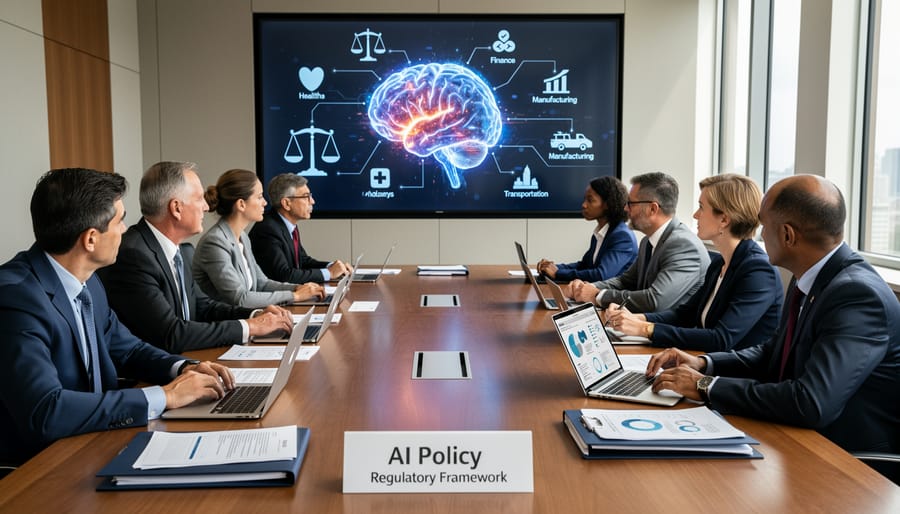
AI Regulation and Ethics: The Rules Are Being Written Now
What AI Regulations Mean for Developers and Businesses
Governments worldwide are racing to create guardrails for AI, and these new regulations will reshape how developers build and businesses deploy artificial intelligence systems. Think of it like the early days of data privacy laws, but moving much faster and with higher stakes.
In the European Union, the AI Act categorizes systems by risk level. High-risk applications like facial recognition in public spaces or AI used in hiring decisions face strict requirements including transparency reports, human oversight, and regular audits. For developers, this means building documentation and testing protocols into your workflow from day one, not as an afterthought. Companies deploying these systems must maintain detailed records showing how their AI makes decisions.
The United States is taking a sector-specific approach. Financial institutions using AI for credit decisions must comply with fair lending laws, while healthcare AI falls under HIPAA requirements. California’s emerging regulations mirror aspects of the EU framework, creating a patchwork that businesses operating nationwide must navigate carefully.
For practical impact, consider a startup building a resume screening tool. Under new regulations, you’ll need to prove your algorithm doesn’t discriminate based on protected characteristics, provide explanations for why candidates are rejected, and allow human review of decisions. This affects development timelines, costs, and architectural choices.
The key takeaway? Compliance isn’t optional anymore. Businesses should conduct AI impact assessments before deployment, invest in explainable AI techniques, and establish clear human oversight processes. Developers need to prioritize transparency and documentation alongside performance metrics. Those who adapt early will gain competitive advantages as regulations tighten further.
AI Agents: Your Future Digital Workforce
Artificial intelligence is making a remarkable leap from being a helpful assistant to becoming a proactive team member. We’re witnessing the rise of AI agents, sophisticated systems that can plan, make decisions, and execute multi-step tasks with minimal human oversight. Unlike traditional AI tools that simply respond to your commands, these agents can understand a goal and figure out how to achieve it independently.
Think of it this way: yesterday’s AI was like a calculator that waited for you to press buttons. Today’s AI agents are more like having an intern who can take an assignment, research the best approach, and deliver results without constant supervision.
In customer service, AI agents are revolutionizing how businesses handle support. Companies like Klarna have deployed agents that manage entire customer conversations from start to finish, resolving issues, processing refunds, and even detecting fraudulent activity. These systems don’t just answer questions from a script; they understand context, access relevant information across multiple databases, and make judgment calls about the best solution.
Research teams are using AI agents to accelerate discovery. AutoGPT and similar platforms can conduct literature reviews, synthesize findings from hundreds of papers, and identify research gaps that humans might miss. One pharmaceutical company recently used AI agents to analyze chemical compounds, reducing their drug discovery timeline from months to weeks.
Business automation is perhaps seeing the most dramatic transformation. AI agents now handle invoice processing, schedule complex meetings across time zones, monitor project deadlines, and even draft preliminary reports. A marketing agency might deploy an agent that tracks campaign performance, identifies underperforming ads, adjusts budgets, and generates weekly summaries for the team.
The key difference is autonomy. These agents don’t need step-by-step instructions. Give them an objective, and they’ll determine the necessary steps, adapt when obstacles arise, and learn from outcomes to improve future performance.
The Open Source AI Revolution
Community-Driven Innovation vs. Corporate Control
The AI landscape today reflects a fascinating push-and-pull between tech giants and grassroots developers. While companies like OpenAI, Google, and Microsoft invest billions in proprietary AI systems, a vibrant open-source community continues to democratize access to powerful AI tools.
This tension isn’t purely competitive. Many companies release open-source versions of their work, recognizing that community innovation can accelerate progress for everyone. Meta’s LLaMA models exemplify this approach, providing researchers and developers with foundation models they can customize and improve. Similarly, Hugging Face has become the GitHub of AI, hosting thousands of models and datasets that anyone can use or modify.
Open-source projects like Stable Diffusion disrupted the image generation space by offering capabilities previously locked behind corporate APIs. The project spawned countless applications and modifications, proving that community-driven innovation could match corporate offerings. Tools built on open machine learning frameworks like PyTorch and TensorFlow enable developers worldwide to create sophisticated AI applications without massive budgets.
However, concerns persist about corporate control. When companies develop AI behind closed doors, users have limited insight into training data, biases, or decision-making processes. Open-source alternatives provide transparency but often lack the computational resources for cutting-edge performance.
The future likely involves hybrid approaches where corporations and communities collaborate. OpenAI’s partnership with Microsoft, while controversial, funds research that sometimes benefits the broader community. Meanwhile, initiatives like EleutherAI demonstrate that coordinated volunteer efforts can produce genuinely competitive models, ensuring that AI innovation remains accessible to all.
AI in Scientific Discovery and Healthcare
Imagine waiting years for a drug that could save your life, only to learn it’s still in early testing phases. This frustrating reality is rapidly changing thanks to artificial intelligence, which is compressing decades of scientific research into mere months.
In 2020, DeepMind’s AlphaFold solved a problem that had stumped scientists for 50 years: predicting how proteins fold into their 3D shapes. This breakthrough matters because understanding protein structures is essential for developing new medicines. What once took researchers months or years now happens in hours, accelerating drug development for diseases like Alzheimer’s and cancer.
Drug discovery has similarly transformed. Traditional pharmaceutical development costs billions and takes 10-15 years from lab to patient. AI systems now analyze millions of molecular combinations in days, identifying promising drug candidates with unprecedented speed. During the COVID-19 pandemic, AI helped researchers screen existing drugs for repurposing, significantly speeding up treatment options.
The AI healthcare innovations extend directly into doctor’s offices and hospitals. AI-powered diagnostic tools now detect diseases like diabetic retinopathy and certain cancers from medical images with accuracy matching or exceeding human specialists. In one notable case, an AI system identified breast cancer from mammograms 13% more accurately than radiologists, potentially saving countless lives through earlier detection.
Personalized medicine represents perhaps the most exciting frontier. Rather than the one-size-fits-all approach, AI analyzes your genetic makeup, lifestyle, and medical history to recommend treatments tailored specifically to you. Cancer patients, for instance, now receive therapy recommendations based on their tumor’s unique genetic profile, dramatically improving treatment success rates.
These advances aren’t science fiction—they’re happening now, reshaping how we discover medicines, diagnose diseases, and treat patients. The result? Faster cures, earlier detection, and healthcare that actually fits each individual’s needs.

The Infrastructure Challenge: Computing Power and Energy
Behind every AI breakthrough lies a massive infrastructure challenge that’s reshaping data centers worldwide. Training a single large language model can consume as much electricity as hundreds of homes use in a year, raising urgent questions about AI’s environmental impact as the technology scales.
The demand for specialized computing hardware has skyrocketed. Graphics Processing Units (GPUs) and Tensor Processing Units (TPUs), chips designed to handle AI’s parallel processing needs, are now in such high demand that tech companies compete fiercely to secure supply. A single high-end GPU cluster for training advanced AI models can cost millions of dollars and require extensive cooling systems to prevent overheating.
This creates a dual challenge: the financial barrier to entry for AI development grows steeper, and the environmental cost becomes harder to ignore. Some researchers estimate that AI’s energy consumption could rival that of entire countries within the next decade if current trends continue.
However, innovation is meeting this challenge head-on. Companies are developing more efficient AI chips that deliver better performance per watt. Google’s latest TPU designs, for example, offer significantly improved energy efficiency compared to earlier generations. Techniques like model compression, which creates smaller versions of AI systems without sacrificing much accuracy, are gaining traction.
Meanwhile, researchers are exploring quantum computing and neuromorphic chips that mimic the human brain’s energy-efficient processing. Some data centers now run on renewable energy, while others use AI itself to optimize cooling systems and reduce waste. These solutions represent crucial steps toward making AI innovation sustainable for the long term.
AI Job Market: What’s Actually Happening
The reality of AI’s impact on jobs is far more nuanced than either the dystopian or utopian predictions suggest. Yes, AI is automating certain tasks, but it’s simultaneously creating entirely new roles and transforming existing ones in unexpected ways.
Here’s what’s actually happening: AI isn’t replacing entire jobs wholesale. Instead, it’s reshaping specific tasks within those jobs. A graphic designer now uses AI tools to generate initial concepts faster, allowing more time for strategic creative work. Customer service representatives leverage AI chatbots for routine queries while focusing on complex, emotionally demanding interactions. The key insight? Jobs requiring uniquely human skills like creative problem-solving, emotional intelligence, and complex decision-making remain largely AI-resistant.
The AI job market trends reveal a significant demand for hybrid skills. Companies aren’t just hiring AI specialists anymore. They need marketing professionals who understand AI tools, healthcare workers who can interpret AI-assisted diagnostics, and financial analysts who can work alongside predictive algorithms. This creates opportunities for professionals willing to upskill rather than completely retrain.
Three skill categories are proving invaluable: First, AI literacy, understanding what AI can and cannot do helps you identify automation opportunities in your field. Second, prompt engineering, the ability to effectively communicate with AI systems is becoming as fundamental as using spreadsheets. Third, human-centric skills like critical thinking, creativity, and interpersonal communication are increasingly valuable because they’re difficult to automate.
For professionals adapting to this landscape, the strategy is clear: embrace AI as a collaborative tool rather than viewing it as competition. Experiment with AI tools relevant to your industry, take online courses to build foundational understanding, and focus on developing skills that complement rather than compete with AI capabilities. The professionals thriving in this transition aren’t the ones fighting AI, they’re the ones learning to dance with it.

The AI landscape is evolving faster than ever, but staying informed doesn’t have to feel overwhelming. Whether you’re a student exploring career options, a professional adapting to new tools, or simply someone curious about technology’s direction, understanding these hot topics gives you a genuine advantage in almost any field you can imagine.
Start small and build from there. Pick one area that resonates with your interests or work, whether that’s generative AI, ethical considerations, or practical applications in your industry. Follow a couple of reputable tech news sources, join online communities discussing AI developments, or experiment with accessible AI tools to gain hands-on experience. The key is consistency over intensity—spending just fifteen minutes a week reading about AI advances will keep you surprisingly well-informed.
Remember, you don’t need to become an AI expert overnight. The goal is developing a working understanding of how these technologies are reshaping our world. As AI continues integrating into healthcare, education, business, and creative fields, your awareness of these trends becomes increasingly valuable. Think of it as learning a new language for the modern world—one conversation, one article, one experiment at a time. The future of AI isn’t just being built by engineers and researchers; it’s being shaped by informed individuals who understand its potential and participate in meaningful discussions about its direction.