

Picture a farm where crops thrive with minimal synthetic fertilizers, where natural pest control replaces chemical sprays, and where soil health improves year after year—all while maintaining profitable yields. This isn’t a romantic return to pre-industrial farming. It’s Low-Input Sustainable Agriculture (LISA), and artificial intelligence is transforming it from an idealistic concept into an economically viable reality for farmers worldwide.
LISA represents a fundamental shift in how we grow food. Instead of depending heavily on expensive chemical inputs, it works with natural ecosystems through practices like crop rotation, cover cropping, and integrated pest management. The challenge has always been complexity: managing diverse crops, timing interventions perfectly, and making countless micro-decisions that industrial monoculture simplifies through heavy chemical use.
Enter AI. Machine learning algorithms now analyze satellite imagery to detect crop stress before it’s visible to the human eye. Computer vision systems distinguish weeds from crops with 98% accuracy, enabling targeted intervention instead of blanket herbicide application. Predictive models forecast pest outbreaks days in advance by processing weather data, historical patterns, and real-time field sensors. What once required decades of farming intuition now happens through smartphone apps processing millions of data points instantly.
This technology democratizes sustainable farming. Small-scale farmers in developing nations use AI-powered advisors to optimize their limited resources. Mid-sized operations reduce input costs by 30-40% while maintaining yields. Large agricultural enterprises meet sustainability commitments without sacrificing profitability.
The convergence of LISA principles with AI capabilities isn’t just changing individual farms—it’s reshaping our entire food system toward environmental resilience and economic sustainability. The future of agriculture is both ancient and cutting-edge, combining time-tested ecological wisdom with computational power that makes sustainability scalable.
What Is Low-Input Sustainable Agriculture?
Low-Input Sustainable Agriculture (LISA) represents a farming approach that works with nature rather than against it. At its heart, LISA focuses on growing healthy crops while minimizing dependence on synthetic chemicals, reducing soil disruption, and maintaining farm profitability over the long term.
Think of LISA as a smarter way to farm. Instead of relying heavily on chemical fertilizers and pesticides, farmers using this method embrace four core principles. First, they dramatically reduce or eliminate synthetic inputs by using natural alternatives like compost and manure. Second, they practice minimal tillage, leaving soil structure intact to preserve beneficial microorganisms and prevent erosion. Third, they rotate different crops seasonally to naturally replenish soil nutrients and break pest cycles. Finally, they manage pests through biological controls like introducing helpful insects or planting companion crops that repel harmful ones.
Consider Green Valley Farm, a 15-acre family operation in Vermont. Owner Maria Santos transitioned to LISA five years ago after struggling with rising chemical costs and depleting soil quality. She now rotates tomatoes, beans, and cover crops across her fields. Instead of tilling deeply, she uses a no-till drill that minimally disturbs the soil. For pest control, she plants marigolds between vegetable rows and introduces ladybugs to control aphids naturally. Her input costs dropped by 40 percent while yields remained stable.
What makes LISA particularly exciting today is how AI-powered sustainable practices are making these methods more accessible and precise than ever before. Where farmers once relied purely on experience and observation, modern tools now help them make data-driven decisions about when to plant, how to manage water, and where pest problems might emerge before they become visible to the naked eye.
This combination of traditional wisdom and technological innovation is transforming what sustainable farming can achieve.
The Traditional Challenges of Going Low-Input
For decades, farmers interested in low-input sustainable agriculture have faced a consistent reality: reducing chemical inputs sounds wonderful in theory but proves incredibly challenging in practice.
Consider Maria, a third-generation farmer in Iowa who tried transitioning to LISA methods five years ago. Within weeks, she found herself spending three times longer in her fields than before. Where chemical herbicides once cleared weeds in a single application, she now needed to monitor crop rows daily, identify dozens of weed species, and time mechanical interventions precisely. Miss the window by 48 hours, and those weeds could reduce her yield by 30 percent.
This labor intensity represents just one hurdle. LISA demands an encyclopedic knowledge base that takes years to develop. Farmers must understand soil microbiology, recognize hundreds of beneficial and harmful insects, predict weather patterns, know companion planting techniques, and make split-second decisions based on constantly changing field conditions. Unlike conventional agriculture’s standardized playbook, sustainable methods require customization for each field’s unique ecosystem.
The stakes feel impossibly high. A conventional farmer can apply synthetic fertilizer and reliably predict outcomes. A LISA farmer using cover crops, crop rotation, and natural pest management faces far more variables. Will this year’s winter rye provide enough nitrogen? Will beneficial predator insects arrive before aphids destroy the crop? These uncertainties translate directly to income volatility that many farmers simply cannot afford.
Perhaps most frustratingly, the knowledge exists scattered across agricultural extension offices, research papers, and experienced farmers’ minds, but accessing and applying it in real-time remains nearly impossible. When a farmer notices unusual leaf discoloration on Tuesday morning, she needs answers within hours, not after consulting multiple experts or researching pest databases.
This complexity has kept LISA largely confined to small-scale operations and prevented the widespread adoption our food system desperately needs.
How AI Changes the Game for Low-Input Farming
Low-input sustainable agriculture faces a fundamental puzzle: how do you grow more food while using fewer resources? Traditional farming relies heavily on synthetic fertilizers, pesticides, and intensive irrigation—inputs that are expensive and environmentally damaging. LISA aims to reduce these dependencies, but doing so requires incredibly precise decision-making. You need to know exactly when to plant, how much water each crop section needs, which pests are emerging, and where soil nutrients are depleting.
This is where artificial intelligence becomes a game-changer. AI systems can analyze data from weather stations, satellite imagery, soil sensors, and historical crop performance all at once—something no human could do manually. Instead of applying fertilizer uniformly across entire fields, AI algorithms identify specific zones that need nutrients, reducing waste by up to 30%. Rather than spraying pesticides preventively, computer vision systems spot individual pests or diseased plants, enabling targeted treatment.
The beauty of AI revolutionizing sustainable farming is that it replaces expensive chemical inputs with intelligent information. A farmer doesn’t need more equipment or more chemicals—they need better decisions. Machine learning models predict optimal planting windows based on weather patterns, forecast yields to prevent overproduction, and even recommend crop rotations that naturally restore soil health.
This shift from resource-intensive to knowledge-intensive farming makes sustainability economically viable. Small-scale farmers can access AI tools through smartphones, democratizing technology once reserved for industrial operations. The result is farming that produces comparable yields while significantly reducing environmental impact and operational costs.
Smart Precision Agriculture: Doing More With Less
AI-Powered Soil Health Monitoring
Healthy soil is the foundation of sustainable farming, but traditionally, farmers could only guess at what their fields needed. Today, machine learning algorithms are transforming this guesswork into precise science. Smart sensors buried in the soil continuously measure moisture levels, nutrient content, pH balance, and microbial activity. These devices transmit data to AI systems that analyze patterns and predict exactly what the soil needs, when it needs it.
The technology works by comparing real-time soil readings against vast databases of agricultural outcomes. The AI identifies which natural amendments like compost, cover crops, or crop rotation will boost soil health most effectively. This means farmers can maintain fertile land while dramatically cutting chemical fertilizer use, sometimes by 40% or more.
Take Sarah Chen, a third-generation farmer in Iowa who installed soil sensors across her 300-acre corn and soybean operation. The AI system revealed that portions of her fields had sufficient nitrogen from previous cover crops, eliminating unnecessary fertilizer applications in those zones. In other areas, the system recommended specific compost applications timed to microbial activity peaks. Within two growing seasons, Sarah reduced her fertilizer costs by $12,000 annually while increasing yields by 8%. The system even alerted her to developing compaction issues before they became visible, allowing early intervention.
This precision approach makes sustainable farming economically attractive, proving that technology and nature can work together profitably.

Computer Vision for Targeted Pest Management
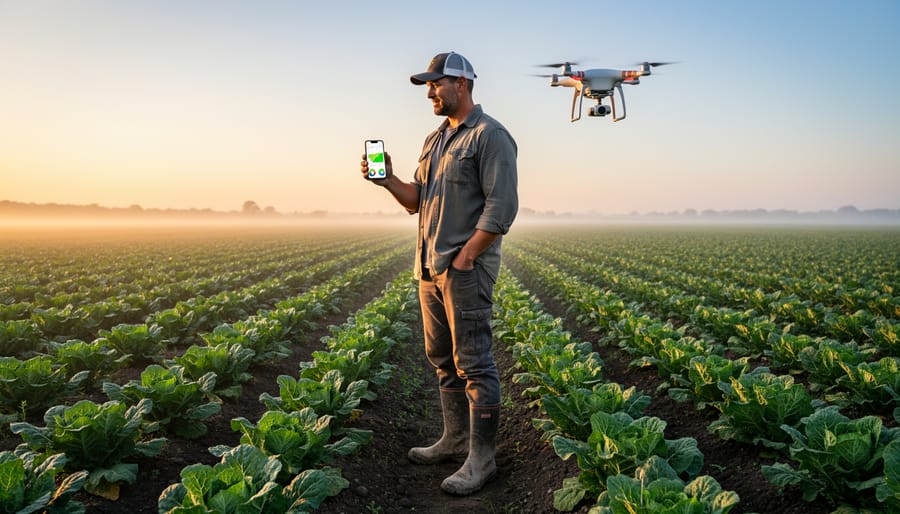
Imagine a tomato farmer in Spain who used to spray pesticides across his entire 50-acre farm every two weeks, just to be safe. Today, he flies a camera-equipped drone over his fields instead. The drone’s AI system analyzes thousands of images in real-time, identifying the exact location of aphid colonies on specific plants. Instead of blanket spraying, he now treats only the affected areas, reducing his pesticide use by 80 percent.
This is computer vision at work in agriculture. AI-powered cameras mounted on drones or ground robots capture detailed images of crops and use machine learning algorithms to detect early signs of pest inffestation or disease. The technology works by training neural networks on thousands of images showing healthy versus unhealthy plants. Once trained, these systems can spot problems invisible to the human eye, like discoloration patterns indicating fungal infection days before symptoms become obvious.
The practical benefits are remarkable. A strawberry grower in California uses ground-based camera systems that continuously monitor her fields. When the AI detects spider mites on a few plants, she receives an alert on her smartphone with the precise GPS coordinates. She treats only those plants, saving money on chemicals while protecting beneficial insects elsewhere in her field.
This targeted approach transforms pest management from a preventive guessing game into a precise, responsive practice, making sustainable farming economically viable for operations of all sizes.
Predictive Analytics for Crop Rotation Planning
Imagine knowing exactly which crop to plant next season to keep your soil healthy without adding expensive fertilizers. That’s what predictive analytics makes possible for farmers today.
AI models work like weather forecasters for soil health, but instead of predicting rain, they predict which crops will naturally restore nutrients. These systems digest massive datasets including decades of harvest records, soil composition measurements, weather patterns, and plant biology. The AI identifies patterns humans might miss—like how planting legumes after corn replenishes nitrogen levels, or how deep-rooted crops following shallow ones prevent nutrient depletion at different soil depths.
Here’s a real-world example: A farmer in Iowa traditionally rotated corn and soybeans every two years. An AI system analyzed his farm’s 15-year history plus regional data from thousands of farms. It suggested adding oats and red clover into a four-year rotation. The result? Soil nitrogen increased by 40 percent naturally, reducing fertilizer costs by $85 per acre while yields remained stable.
The tangible benefits extend beyond cost savings. Farmers using AI-guided rotation see improved soil structure, reduced pest pressures (since crop-specific insects lose their food source between seasons), and better water retention. One California vineyard reduced irrigation needs by 25 percent after following AI recommendations that incorporated cover crops between growing seasons.
These systems democratize knowledge that previously required generations of farming experience, making sustainable practices accessible to new farmers entering agriculture.
AI Tools Making LISA Accessible to Everyday Farmers
Mobile Apps Powered by Machine Learning
The smartphone in your pocket is becoming one of the most powerful tools for sustainable farming. Today’s mobile apps harness machine learning to help farmers make smarter decisions with minimal resources, bringing sophisticated agricultural technology to anyone with a basic smartphone.
One standout example is Plantix, a free app that’s helped over 20 million farmers worldwide. Simply snap a photo of an unhealthy plant leaf, and its AI instantly identifies diseases, nutrient deficiencies, and pest problems across more than 90 crops. The app then suggests treatment options, often recommending organic or low-input solutions first. What makes this remarkable is that the machine learning model improves with every photo submitted, becoming more accurate for local conditions.
For weather prediction, apps like FarmLogs and Cropio combine satellite imagery with machine learning algorithms to deliver hyperlocal forecasts. These tools help farmers time their planting, irrigation, and harvesting to maximize yields while minimizing water and fertilizer use. The AI learns regional weather patterns and can predict frost risks or optimal planting windows with surprising accuracy.
Agrostar and FarmBot offer personalized farming advice by analyzing your specific soil conditions, crop types, and local climate. Their AI assistants answer questions in real-time, essentially putting an agricultural expert in your pocket. These apps are designed for accessibility, working even on older smartphones and in areas with limited internet connectivity.
What unites these applications is their focus on doing more with less, empowering farmers to adopt sustainable practices without expensive equipment or extensive training.

Affordable Sensor Networks and IoT Devices
One of the biggest barriers to adopting advanced farming technology has traditionally been cost. High-end monitoring systems can run into thousands of dollars, putting them out of reach for small-scale farmers. This is where affordable sensor networks are changing the game.
Today’s low-cost IoT (Internet of Things) devices can monitor everything from soil moisture and temperature to nutrient levels and ambient humidity, often for less than the price of a smartphone. These compact sensors communicate wirelessly with AI platforms, creating a real-time picture of field conditions without requiring expensive infrastructure or satellite connections.
Here’s how it works in practice: A farmer might place several solar-powered sensors throughout their fields. These devices continuously collect data and transmit it to a central AI system via low-power networks or even basic cellular connections. The AI analyzes patterns, detects anomalies, and sends alerts directly to the farmer’s phone when action is needed, like irrigation in a particularly dry section or pest activity in a specific area.
The beauty of this approach is its scalability. A farmer can start with just a few sensors in problem areas and expand gradually. Companies like FarmBeats from Microsoft have demonstrated that even repurposed, consumer-grade sensors can provide valuable agricultural insights when paired with intelligent software.
This democratization of technology means data-driven farming is no longer exclusive to industrial operations. Small farms can now make informed decisions based on actual field conditions rather than guesswork, reducing waste while improving yields.
Real Success Stories: Farmers Already Winning With AI-Powered LISA
The numbers tell a powerful story. Across three continents, farmers are discovering that combining AI technology with low-input methods isn’t just environmentally friendly—it’s profitable.
Take the Martinez family farm in California’s Central Valley. After decades of conventional farming, they partnered with an AI platform in 2022 to transition 200 acres to low-input methods. Within eighteen months, their synthetic fertilizer costs dropped 65 percent while corn yields remained stable at 180 bushels per acre. How? The AI system analyzed soil sensors, weather patterns, and plant health imagery to determine exactly when and where nutrients were needed. Instead of blanket applications, they now apply targeted organic amendments. Their soil organic matter increased from 2.1 percent to 3.4 percent, and their operating margin improved by $47,000 annually. These real farm success stories demonstrate the practical benefits of merging technology with sustainable practices.
Halfway around the world in Kenya, smallholder farmer Grace Mwangi manages five acres of mixed vegetables. She uses a mobile AI app that costs less than $3 monthly. The system sends her text messages about optimal planting times, predicts pest outbreaks, and recommends natural control methods. Since adopting the technology in 2023, Grace reduced her pesticide expenses by 80 percent while increasing her tomato yields by 35 percent. The AI helped her implement companion planting strategies and identified the precise moisture levels her crops needed, cutting water use by half.
In Iowa, the Thompson Farm represents large-scale implementation. Their 1,200-acre operation uses AI-driven precision equipment that plants cover crops in precise patterns between cash crop rows. The system calculates the perfect seed density to suppress weeds naturally without competing for nutrients. After three seasons, they’ve cut herbicide use by 70 percent, reduced tillage passes from five to two annually, and maintained soybean yields within 3 percent of their conventional baseline. Their fuel costs dropped $18 per acre, and soil erosion decreased measurably.
These farmers share a common insight: AI doesn’t replace agricultural knowledge—it amplifies it, making sustainable practices economically viable at any scale.

The Barriers That Still Exist (And How They’re Being Solved)
While AI-powered sustainable agriculture holds tremendous promise, several real-world barriers still prevent widespread adoption, particularly among small-scale farmers who could benefit most.
The connectivity challenge stands out as perhaps the most fundamental obstacle. Many rural farming communities lack reliable high-speed internet, making it difficult to use cloud-based AI platforms that analyze data in real-time. A farmer in rural Iowa might have the best soil sensors available, but without consistent connectivity, the insights remain locked away. However, innovators are responding with edge computing solutions that process data locally on devices, syncing with cloud systems only when connection becomes available. Companies like FarmLogs now offer offline modes that collect data throughout the day and upload when connectivity returns.
Cost remains another significant hurdle. While prices have dropped dramatically, quality sensors, drones, and AI subscriptions still represent substantial upfront investments for farmers operating on thin margins. The solution is emerging through cooperative purchasing programs and equipment-sharing initiatives, where multiple farmers pool resources to access technology. Some tech providers now offer pay-as-you-grow models, where farmers pay only during harvest seasons or based on actual yields improved.
The learning curve shouldn’t be underestimated either. Farmers comfortable with traditional methods may find AI platforms intimidating initially. Extension programs and agricultural universities are bridging this gap through hands-on workshops and mentorship programs that pair tech-savvy younger farmers with experienced growers.
Data privacy concerns also loom large. Farmers worry about who owns their field data and how it might be used by corporations. Blockchain-based solutions and farmer-controlled data cooperatives are emerging to give growers sovereignty over their information while still benefiting from collective insights.
These challenges are real, but the agricultural technology community is actively addressing each one. The progress happening today suggests these barriers will continue diminishing, making sustainable farming technology increasingly accessible to everyone who needs it.
What This Means for the Future of Farming
The future of farming is being rewritten by artificial intelligence, and we’re only seeing the beginning. As sustainable agriculture technology continues to evolve, we can expect increasingly sophisticated AI models that predict not just individual crop needs, but entire ecosystem interactions across seasons and years.
Climate integration represents the next frontier. Imagine AI systems that combine real-time weather data, historical climate patterns, and soil conditions to guide farmers through increasingly unpredictable growing seasons. These tools will help small-scale farmers adapt to climate change by suggesting resilient crop varieties and optimal planting windows that traditional methods might miss.
Perhaps most exciting is the rise of collaborative farming networks. Picture a system where farmers share anonymized data from their fields, creating a collective intelligence that benefits everyone. A breakthrough discovery on one farm—like a natural pest deterrent or water-saving technique—could be instantly validated and shared across thousands of operations worldwide through AI analysis.
This democratization of agricultural knowledge means a smallholder farmer in rural India could access the same decision-making power as a large commercial operation in Iowa. Low-cost sensors paired with smartphone apps are already making this possible, and as technology costs continue dropping, the barrier to entry keeps shrinking.
The result? A future where sustainable farming isn’t a luxury reserved for those with resources, but a standard approach accessible to anyone with a mobile device. AI won’t replace farmers’ expertise—it will amplify it, helping them feed more people while protecting the land for generations to come.
The convergence of artificial intelligence and low-input sustainable agriculture represents more than just technological progress—it marks a fundamental shift in how we approach food production. What once seemed like an idealistic trade-off between environmental responsibility and economic practicality is becoming increasingly achievable. AI-powered tools are transforming sustainable farming from a niche practice into a scalable, profitable model that works for operations of all sizes.
The real breakthrough lies in accessibility. Small-scale farmers in developing regions can now access crop monitoring through smartphone apps, while large commercial operations deploy sophisticated sensor networks and predictive analytics. This democratization of technology means sustainable practices are no longer reserved for those with deep pockets or extensive technical expertise.
Looking ahead, the possibilities are genuinely exciting. As machine learning algorithms continue improving and hardware costs decline, we’ll see even more innovative applications emerge. Imagine precision irrigation systems that predict water needs days in advance, or pest management tools that identify threats before they become visible to the human eye.
If you’re intrigued by this intersection of technology and sustainability, consider exploring how these innovations might apply to your region’s specific challenges. Whether you’re a student contemplating career paths, a developer interested in agricultural tech, or simply someone passionate about sustainable solutions, there’s a role to play in this evolving field. The future of farming isn’t just about feeding more people—it’s about doing so intelligently, sustainably, and profitably, with AI as an essential partner in that mission.