
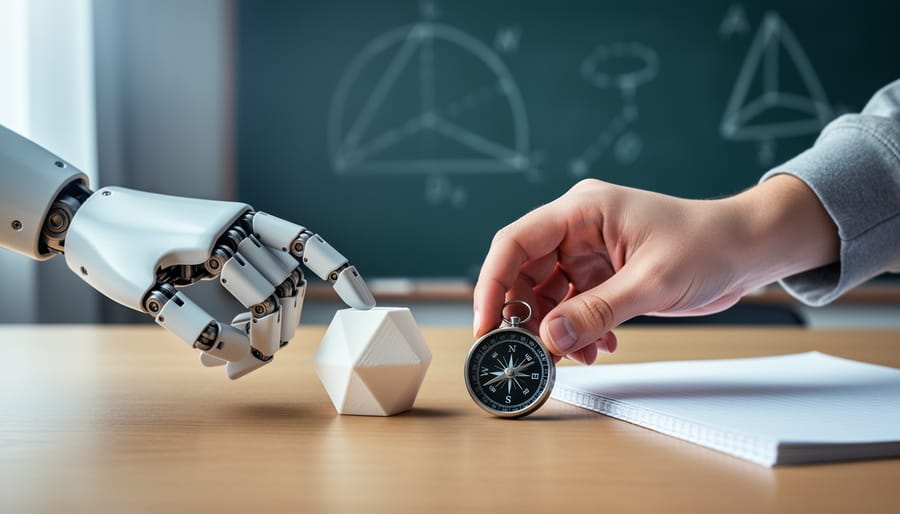
Picture a mathematical problem so challenging that only the world’s brightest teenage minds can solve it after years of rigorous training. Now imagine artificial intelligence attempting the same feat. This is the frontier where the International Mathematical Olympiad meets machine learning, and the results are reshaping our understanding of what AI can truly achieve.
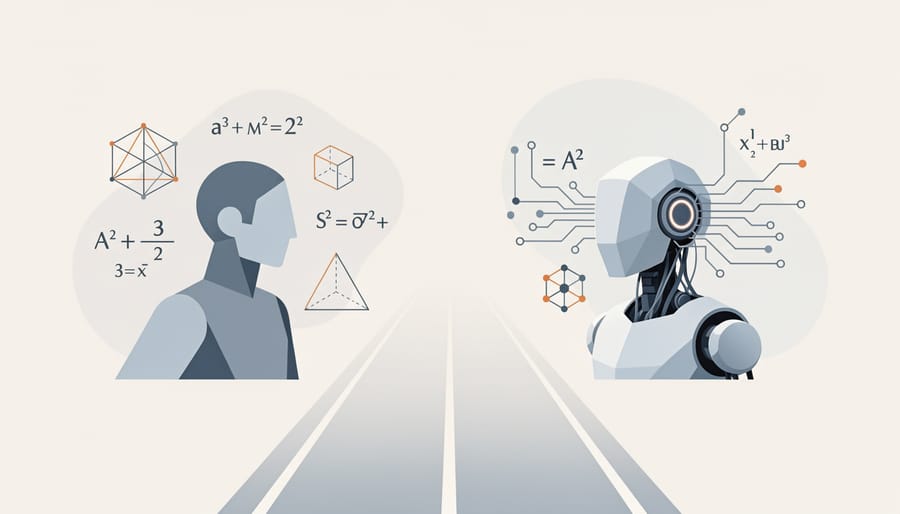
The AI Math Olympiad represents a pivotal benchmark in artificial intelligence development. Unlike chess or Go, where computers have already surpassed human champions, olympiad-level mathematics demands creative reasoning, abstract thinking, and the ability to construct elegant proofs from scratch. These problems require more than computational power—they need genuine mathematical insight, making them one of AI’s most formidable challenges.
Recent breakthroughs have been remarkable. In 2024, Google DeepMind’s AlphaGeometry solved geometry problems at a level approaching International Mathematical Olympiad medalists, while other systems have begun tackling algebra and number theory challenges. Yet despite this progress, AI still struggles with the intuitive leaps and creative problem-solving that human mathematicians employ naturally. Current systems can verify proofs and assist with specific problem types, but generating original solutions to novel problems remains largely beyond their reach.
Why does this matter beyond academic curiosity? Success in AI mathematics has profound implications. The mathematical foundations for AI development could revolutionize scientific research, automate theorem proving in critical systems, and accelerate discoveries in physics, engineering, and computer science itself. Companies and research institutions worldwide are investing heavily because olympiad-level reasoning represents a crucial step toward more general artificial intelligence.
For enthusiasts and professionals alike, understanding this intersection of mathematics and AI opens doors to one of technology’s most exciting frontiers. Whether you’re curious about AI capabilities, passionate about mathematics, or exploring career opportunities in machine learning, the AI Math Olympiad offers a compelling lens through which to view the future of intelligent systems.
What Makes Math Olympiad Problems So Brutally Hard for AI?
The Gap Between Calculation and Creative Reasoning
Modern AI systems can perform calculations at breathtaking speeds—multiplying thousand-digit numbers in milliseconds or solving complex equations instantly. Yet when faced with Math Olympiad problems, they often stumble not because the math is computationally intensive, but because it requires creative insight.
Consider a classic problem: proving that the square root of 2 is irrational. A human mathematician might experience an “aha moment”—imagining what would happen if we assume the opposite and following that thread to a logical contradiction. This proof by contradiction requires no complex calculations, just a clever conceptual leap. AI systems, despite their computational power, struggle to generate this kind of elegant reasoning from scratch.
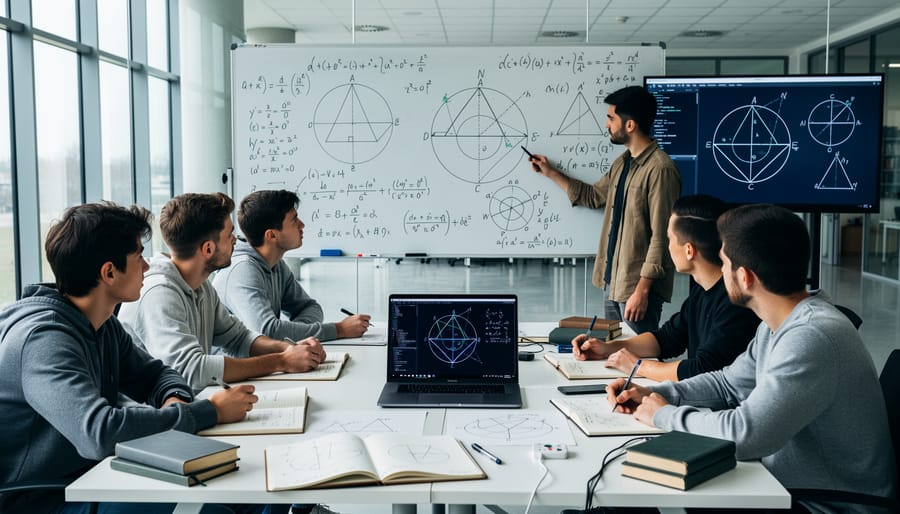
In the 2024 AI Math Olympiad competitions, we saw this gap clearly. AI models could rapidly verify solutions and perform algebraic manipulations, but when problems required inventing a novel construction or recognizing a hidden pattern, performance dropped dramatically. For instance, geometry problems often demand visualizing auxiliary lines that unlock a solution—something humans do intuitively by recognizing structural similarities to past problems.
The challenge isn’t processing power. An AI can evaluate millions of potential approaches per second, yet this brute-force exploration often misses the single creative insight that makes a problem trivial. It’s like having a supercomputer search every key on a keyring when a human would simply recognize which key fits the lock by its shape. This fundamental difference reveals why mathematical reasoning remains one of AI’s most fascinating frontiers.
Real Examples: Problems That Stumped AI
To understand AI’s current limitations, let’s examine actual olympiad problems that have challenged even advanced systems.
Consider this geometry puzzle from the International Mathematical Olympiad: “Given a triangle ABC, prove that the angle bisectors meet at a single point.” While this seems straightforward to humans who can visualize the concept, AI struggles because it requires spatial reasoning combined with abstract proof construction. Machines can’t “see” geometric relationships the way we do—they work with numerical coordinates and algebraic representations, making intuitive geometric insights difficult to replicate.
Another stumper involves number theory: “Prove that there are infinitely many prime numbers of the form 4n+3.” This problem requires creative mathematical thinking and the ability to construct an elegant proof by contradiction. AI systems excel at pattern recognition but struggle to generate the kind of novel reasoning strategies that mathematicians develop through years of practice. The machine needs to understand not just that something is true, but why it must be true—a fundamentally different cognitive challenge.
Perhaps most telling is this combinatorics problem: “In how many ways can you arrange chess pieces on a board such that no two pieces attack each other, considering multiple piece types?” The difficulty lies in combining constraint satisfaction with strategic search through enormous possibility spaces. While AI can brute-force smaller versions, scaling up requires the kind of creative problem decomposition that human mathematicians naturally employ.
These examples reveal that today’s AI lacks the flexible reasoning, visual intuition, and creative proof strategies that make human mathematical thinking so powerful.
The Major Players: Who’s Racing to Solve AI Math Olympiad
AlphaGeometry and DeepMind’s Breakthrough
In early 2024, DeepMind’s breakthrough system AlphaGeometry made headlines by solving 25 out of 30 geometry problems from past International Mathematical Olympiad competitions. To put this in perspective, the average human gold medalist solves about 25.9 problems, meaning AlphaGeometry performed near the level of the world’s best young mathematicians.
What makes AlphaGeometry special? Unlike traditional AI systems that rely purely on pattern recognition, it combines two complementary approaches. First, a neural language model generates creative intuitions about possible solution paths, similar to how human mathematicians develop hunches. Second, a symbolic engine rigorously verifies these ideas using formal logic, ensuring mathematical correctness. Think of it as pairing human-like creativity with computer-perfect precision.
The system works by training on millions of synthetic geometry problems, learning to recognize patterns and relationships between shapes, angles, and lines. When faced with a new problem, it explores multiple solution strategies simultaneously, much like a chess engine evaluating different moves.
However, significant limitations remain. AlphaGeometry only handles geometry problems, representing a narrow slice of mathematical reasoning. It struggles with algebra, number theory, and combinatorics, which require different problem-solving approaches. The system also cannot explain its reasoning in human-understandable terms, making it difficult for students to learn from its solutions. Additionally, it requires extensive computational resources, limiting practical accessibility for everyday educational use.
The IMO Grand Challenge: The $5 Million Question
In 2019, a bold challenge was thrown down to the artificial intelligence community: create an AI system capable of winning a gold medal at the International Mathematical Olympiad. The IMO Grand Challenge isn’t just another competition with a trophy at stake. It comes with a $5 million prize and represents what many consider the Mount Everest of AI mathematical reasoning.
The competition’s goals are straightforward yet extraordinarily difficult. An AI system must solve IMO problems at a level that would earn a gold medal if it were a human competitor. But here’s the catch: the AI needs to process problems presented as natural language or images, just like human contestants receive them, and produce solutions with complete mathematical proofs that judges can verify.
Why does this matter so much? Current AI systems, even the most advanced ones, struggle with the creative reasoning and multi-step logical thinking that IMO problems demand. These aren’t simple calculations or pattern-matching exercises. They require genuine mathematical insight, the ability to devise novel strategies, and construct rigorous proofs from scratch.
The timeline initially projected potential success by 2025, though organizers acknowledged this might be optimistic. Winning would represent a revolutionary breakthrough for several reasons. First, it would demonstrate that AI can perform abstract reasoning at expert human levels. Second, the techniques developed could transform how AI approaches complex problem-solving in fields like scientific research, engineering design, and strategic planning. Finally, it would show that machines can genuinely understand and manipulate mathematical concepts, not just memorize patterns from training data.
The challenge remains open, pushing researchers worldwide to develop AI systems that think more like mathematicians and less like calculators.
Why This Matters Beyond Math Competitions
From Proofs to Practical AI
When AI systems master olympiad-level mathematics, they’re not just solving abstract puzzles—they’re developing reasoning capabilities that transform real-world industries. Think of mathematical reasoning as a mental gym that strengthens AI’s ability to tackle complex problems across diverse fields.
In drug discovery, AI systems with advanced mathematical reasoning can model molecular interactions, predict protein folding patterns, and identify promising compounds faster than traditional methods. DeepMind’s AlphaFold, for instance, leveraged geometric and mathematical principles to solve protein structure prediction, a breakthrough that earned scientific recognition worldwide.
Engineering benefits equally. AI that understands mathematical relationships can optimize bridge designs for maximum strength with minimum materials, predict structural failures before they occur, or design more efficient aircraft wings by solving complex fluid dynamics equations.
Even everyday applications improve. When your smartphone’s AI assistant plans the fastest route through traffic, it’s solving optimization problems similar to those found in mathematical competitions—just applied to navigation data instead of pure numbers.
The key insight is this: mathematical olympiad problems teach AI to break down complex challenges into logical steps, recognize patterns, and verify solutions—skills that translate directly to diagnosing diseases, predicting climate patterns, or designing sustainable energy systems. As these systems grow more capable, they become invaluable partners in solving humanity’s most pressing challenges, making theoretical mathematical prowess remarkably practical.
The Path to Artificial General Intelligence
Think of the International Mathematical Olympiad as a stress test for AI intelligence. While today’s AI systems can excel at specific tasks like playing chess or recommending movies, solving olympiad-level mathematics requires something far more sophisticated: the ability to reason abstractly, apply creative problem-solving, and combine multiple mathematical concepts in novel ways.
This is why researchers view olympiad mathematics as a crucial stepping stone toward Artificial General Intelligence, or AGI. Unlike narrow AI that masters one domain, AGI would possess human-like flexibility to understand, learn, and apply knowledge across different fields. Mathematical olympiads demand exactly these capabilities. A single problem might require geometry, algebra, and number theory, plus the intuition to know which approach will work.
When AlphaGeometry solved 25 out of 30 olympiad geometry problems in 2024, it wasn’t just about getting answers right. The breakthrough demonstrated AI’s growing capacity for multi-step reasoning and creative proof construction. Each olympiad problem an AI solves represents progress toward systems that can truly think, not just calculate. For the AI community, these competitions serve as measurable milestones on the long road to machines that reason like humans.
Learning Resources: Build Your Own Math Foundation for AI
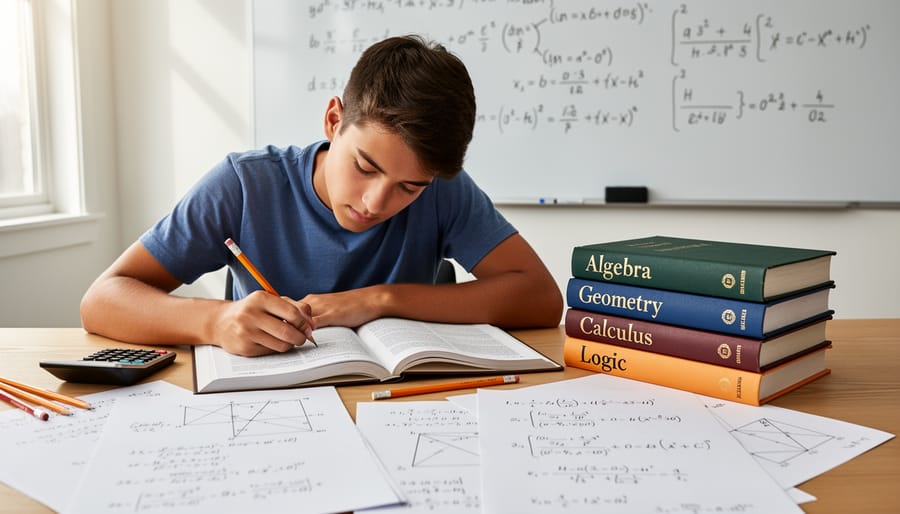
Starting Points for Beginners
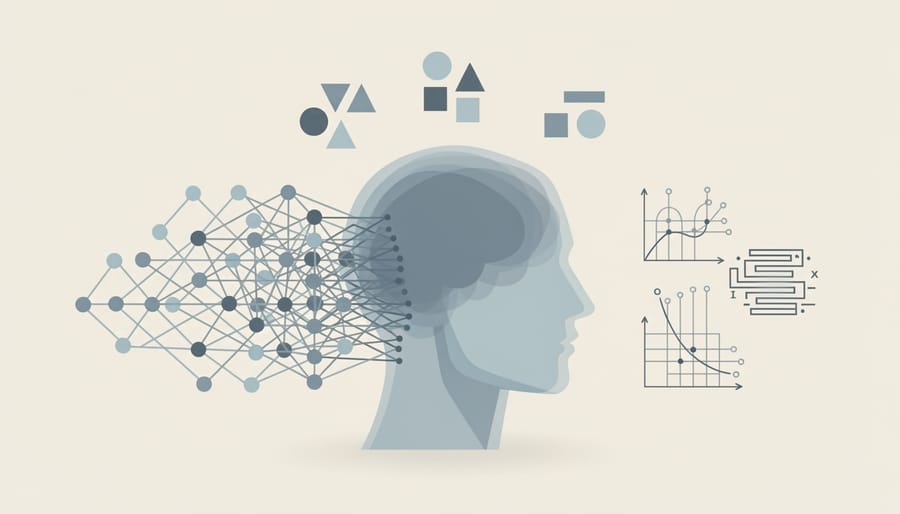
Building a strong mathematical foundation is your first step toward understanding AI systems that tackle Olympiad-level problems. Let’s explore the best resources to get you started on this journey.
For linear algebra, Gilbert Strang’s “Introduction to Linear Algebra” remains the gold standard. This book breaks down matrices, vectors, and transformations with crystal-clear explanations. Pair it with his free MIT OpenCourseWare lectures for a complete learning experience. Khan Academy also offers an excellent linear algebra course that starts from absolute basics.
Calculus foundations come alive through “Calculus Made Easy” by Silvanus Thompson, a century-old gem that still outshines many modern textbooks in accessibility. For a more contemporary approach, try 3Blue1Brown’s “Essence of Calculus” video series on YouTube, which uses stunning visualizations to explain derivatives and integrals.
Discrete mathematics, crucial for understanding algorithms and logic, is well-covered in Kenneth Rosen’s “Discrete Mathematics and Its Applications.” This field includes graph theory, combinatorics, and probability—all essential for AI development.
For integrated learning, interactive online courses on platforms like Coursera and edX offer structured pathways. Andrew Ng’s “Mathematics for Machine Learning” specialization on Coursera combines all three areas specifically for AI applications. Meanwhile, Brilliant.org provides engaging, problem-based learning that mirrors the Olympiad style while teaching foundational concepts.
Start with whichever area feels most approachable, then gradually expand your knowledge base.
Intermediate Resources: Problem-Solving Techniques
Developing olympiad-level problem-solving skills requires dedicated practice and the right resources. Art of Problem Solving (AoPS) stands out as the gold standard, offering comprehensive courses, forums, and their renowned Alcumos platform where you can tackle problems ranging from beginner to olympiad difficulty. Their community actively discusses creative approaches to challenging problems, making it invaluable for learning different problem-solving strategies.
For hands-on practice, platforms like Brilliant.org provide interactive lessons that break down complex mathematical concepts into digestible challenges. You’ll find courses specifically designed to build intuition around topics frequently appearing in olympiads, from number theory to combinatorics.
The International Mathematical Olympiad’s official website archives past competition problems with solutions, giving you authentic practice material. Meanwhile, the Mathematics Stack Exchange community offers a space to ask questions and explore elegant solutions explained by experienced mathematicians.
Consider joining online study groups through platforms like Discord or Reddit’s r/learnmath community, where enthusiasts share problem-solving sessions and motivation. These communities often organize virtual problem-solving marathons, mimicking the collaborative learning environment that strengthens mathematical reasoning.
For structured learning paths, MIT OpenCourseWare offers free university-level mathematics courses with problem sets that develop the rigorous thinking needed for olympiad challenges. Pair these resources with consistent daily practice, and you’ll build the problem-solving muscles that both human competitors and AI systems need to excel.
Advanced: Contributing to AI Math Research
For those ready to dive deeper, the AI math research community offers exciting opportunities to contribute. The International Mathematical Olympiad Grand Challenge archive maintains datasets of past problems, providing benchmarks for testing new approaches. Open-source projects like DeepMind’s FunSearch and Meta’s MathConverse repositories on GitHub allow developers to experiment with mathematical reasoning frameworks and contribute improvements.
Academic conferences such as NeurIPS and ICML regularly feature workshops dedicated to mathematical reasoning in AI, where researchers share breakthrough methodologies. The arXiv preprint server hosts cutting-edge papers on topics like theorem proving and symbolic mathematics—searching for terms like “neural theorem proving” or “mathematical reasoning transformers” reveals the field’s frontier.
Competition platforms including Kaggle occasionally host math-focused AI challenges, while the IMO Grand Challenge community continues tracking progress toward human-level performance. For structured learning before diving into research, explore curated learning resources that build foundational knowledge.
Online communities like the Machine Learning subreddit and Discord servers dedicated to AI research provide spaces to discuss ideas, find collaborators, and stay updated on recent developments. Contributing can start small—even documenting your experiments with existing models helps the broader community understand what approaches work best for mathematical problem-solving.
Getting Started: Your First Steps
Ready to dive into the fascinating world of AI math olympiads? Here’s how to start, no matter your background.
If you’re a student curious about AI’s mathematical capabilities, begin by exploring actual olympiad problems. Visit the International Mathematical Olympiad archive to see the challenges AI systems tackle. Try solving a few problems yourself, then watch how AI approaches them differently. This hands-on comparison reveals both the power and limitations of current systems. Free platforms like AlphaGeometry’s demonstrations showcase AI problem-solving in action, making abstract concepts tangible.
For developers and programmers, the journey starts with understanding the architecture behind mathematical AI. Familiarize yourself with transformer models and theorem provers by reading accessible research summaries from DeepMind and OpenAI. You don’t need a PhD to grasp the basics. Start small: experiment with existing AI math tools like Lean or Coq, which teach computers to verify mathematical proofs. These platforms offer interactive tutorials that bridge the gap between traditional programming and mathematical reasoning.
Machine learning enthusiasts should focus on the training datasets and benchmarks. Explore repositories like MATH (a dataset of 12,500 competition problems) or miniF2F, which contains formalized olympiad-level challenges. Understanding how AI systems learn from these datasets illuminates the broader field of AI reasoning.
Regardless of your path, join online communities discussing AI mathematics on platforms like Discord, Reddit’s machine learning forums, or specialized AI research groups. These spaces offer real-time discussions, resource sharing, and collaborative learning opportunities. Set a simple goal: spend 30 minutes weekly engaging with one AI math problem or research paper summary. Consistent small steps build profound understanding over time.
The AI Math Olympiad represents far more than a competitive benchmark. It’s a window into the evolving landscape of machine intelligence, revealing both the remarkable strides AI has made in mathematical reasoning and the profound challenges that still lie ahead. While today’s AI systems can solve certain olympiad problems with impressive speed, the inconsistency in their performance highlights a crucial gap between pattern recognition and genuine mathematical understanding.
For those captivated by this frontier, the learning resources we’ve explored offer pathways to deepen your understanding of both mathematics and the AI systems attempting to master it. Whether you’re a student curious about machine learning, a professional expanding your skillset, or simply an enthusiast fascinated by AI’s capabilities, engaging with these materials will provide valuable insights into how artificial intelligence approaches complex reasoning.
As you explore this fascinating intersection of mathematics and AI, consider these questions: Will future AI systems develop truly creative mathematical intuition, or will they remain sophisticated pattern matchers? How might AI mathematical reasoning transform fields from scientific research to education? And perhaps most intriguingly, what can AI’s struggles with mathematical creativity teach us about the nature of human intelligence itself?
The journey to understanding AI’s mathematical capabilities is ongoing, and you’re now equipped with the knowledge and resources to follow along. The frontier of machine intelligence awaits those curious enough to explore it, and the questions we ask today will shape the innovations of tomorrow.