
Your brain runs on roughly 20 watts of power—about the same energy as a dim light bulb—yet it processes information faster and more efficiently than the world’s most powerful supercomputers. Traditional computer chips, by contrast, gulp down megawatts of electricity to perform tasks your brain handles effortlessly, like recognizing a friend’s face in a crowd or catching a ball mid-flight.
Neuromorphic computing chips aim to close this staggering gap by mimicking how biological brains actually work. Instead of shuttling data back and forth between separate memory and processing units like conventional chips, these brain-inspired processors integrate both functions directly into their architecture. They communicate using electrical spikes similar to neurons, process information in parallel rather than sequentially, and learn from experience rather than following rigid programmed instructions.
This fundamental shift matters because artificial intelligence has hit a wall. Training large language models now costs millions of dollars in electricity. Autonomous vehicles struggle with real-time decision-making because their chips can’t keep up. Robotics researchers watch their creations drain batteries in minutes attempting tasks toddlers master naturally.
Neuromorphic chips promise to shatter these limitations. Early prototypes already demonstrate 100 times better energy efficiency than traditional processors for specific AI tasks. Major tech companies and research labs worldwide are racing to perfect this technology, recognizing it as potentially transformative for everything from smartphones that understand context without cloud connections to medical devices that detect seizures before they happen.
The revolution isn’t coming from faster transistors or more cores. It’s coming from rethinking how we build computers from the ground up, using nature’s three-billion-year head start as our blueprint.
What Makes Neuromorphic Computing Different from Traditional AI Chips
The Brain-Inspired Architecture
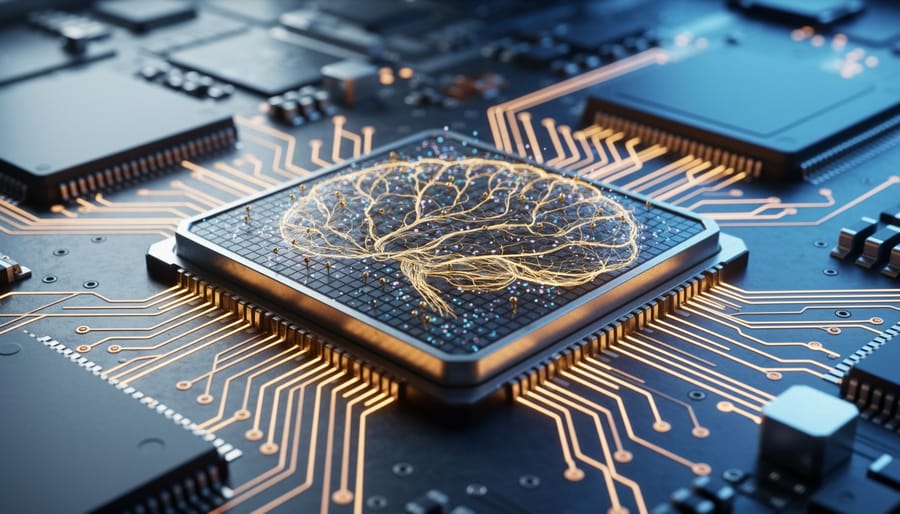
Imagine your brain as a bustling city where billions of neurons constantly communicate through electrical signals. Neuromorphic chips attempt to recreate this remarkable architecture in silicon, moving away from the traditional computing approach that processes information step-by-step.
In your brain, neurons are specialized cells that receive signals from thousands of neighbors, process this information, and decide whether to “fire” their own signal forward. Synapses, the tiny gaps between neurons, act as adjustable connection points that strengthen or weaken based on how often they’re used—this is essentially how you learn and remember.
Neuromorphic chips mimic this structure using artificial neurons and synapses. Each artificial neuron is a tiny circuit that accumulates incoming electrical signals. When the combined input crosses a certain threshold, the neuron fires, just like its biological counterpart. These artificial synapses are electronic components with adjustable resistance, controlling how strongly one neuron influences another.
Here’s where it gets interesting: unlike traditional neural networks that simulate brain-like connections through software running on conventional processors, neuromorphic chips physically embody these connections in hardware. Think of it as the difference between reading sheet music versus having an orchestra perform it live.
The connections between artificial neurons form vast networks—some chips contain millions of neurons and billions of synapses. Intel’s Loihi 2 chip, for example, packs 128,000 neurons and 128 million synapses onto a single piece of silicon smaller than your thumbnail. These networks process information in parallel, with multiple signals traveling simultaneously through different pathways, just as your brain processes sights, sounds, and thoughts all at once without getting overwhelmed.
Energy Efficiency That Changes Everything
The power efficiency of neuromorphic chips isn’t just impressive on paper—it represents a fundamental shift in how we think about computing energy consumption. Traditional processors might consume several watts to perform AI tasks, but neuromorphic chips can accomplish similar workloads using mere milliwatts. That’s a difference measured in thousands.
To put this in perspective, imagine your smartphone running advanced AI applications for days instead of hours on a single charge. Intel’s Loihi chip, for example, can solve certain optimization problems while consuming 1,000 times less energy than conventional processors. This isn’t about incremental improvement—it’s transformational.
The secret lies in how these chips process information. Unlike traditional systems that constantly shuttle data between memory and processors, neuromorphic chips integrate these functions directly into their architecture, mimicking how our brains work. Neurons in your brain only fire when needed, consuming energy selectively rather than continuously. Neuromorphic chips replicate this principle through event-driven processing, activating only when specific inputs occur.
Consider real-world implications: sensors monitoring environmental conditions could operate for years on tiny batteries, autonomous drones could fly longer missions, and wearable health devices could provide continuous monitoring without daily charging. For edge computing applications where power sources are limited, this efficiency doesn’t just improve performance—it makes previously impossible applications viable.
How Hardware-Software Co-Design Creates Smarter Chips
Why Traditional Chip Design Doesn’t Work for Brain-Like Computing
For decades, computer chip designers followed a familiar path: build powerful hardware, then let software engineers figure out how to use it. This approach worked brilliantly for traditional computing tasks like spreadsheets, video streaming, and web browsing. However, when it comes to mimicking how the brain processes information, this hardware-first strategy hits a wall.
Think of it like building a car engine before deciding whether you need a race car or a delivery truck. Traditional processors excel at sequential calculations, performing millions of math operations in rapid succession. But the brain doesn’t work this way. Your neurons fire simultaneously, processing visual information, sounds, memories, and emotions all at once through billions of parallel connections.
When researchers try to simulate brain-like processes on conventional chips, they encounter serious roadblocks. A standard processor might need to execute thousands of individual instructions just to simulate a single biological neuron’s behavior. This creates a massive energy drain. For example, training a large neural network on traditional hardware can consume as much electricity as several homes use in a year.
The fundamental mismatch gets worse at scale. The human brain contains roughly 86 billion neurons with trillions of connections, yet runs on just 20 watts of power—about the same as a dim lightbulb. Meanwhile, supercomputers attempting to simulate even a fraction of that brain activity require megawatts of power and warehouse-sized cooling systems. This stark difference reveals why designing the hardware first, then forcing brain-like algorithms to adapt, simply cannot achieve true neuromorphic efficiency.
The Co-Design Approach in Action
Unlike traditional chip development where hardware engineers build processors first and software developers adapt later, neuromorphic computing flips this script entirely. Researchers now work in tandem, shaping brain-inspired algorithms and physical chip architectures as complementary pieces of the same puzzle.
Consider Intel’s Loihi project, where neuroscientists, computer scientists, and hardware engineers share the same workspace. When developing algorithms for robotic navigation, the team discovered that certain spiking patterns required specific voltage characteristics. Rather than forcing the algorithm to work with existing hardware, they redesigned both simultaneously. The chip gained adjustable voltage regulators while the algorithm evolved to leverage this flexibility, resulting in 100x better energy efficiency than initially projected.
At IBM’s research labs, a similar dance unfolds with their TrueNorth chip. Teams developing object recognition algorithms communicate daily with circuit designers. When software researchers found that mimicking the visual cortex’s layered structure improved accuracy, hardware engineers immediately prototyped new interconnect designs to physically mirror those neural pathways. This back-and-forth iteration cycle, repeated dozens of times, produces chips that feel less like generic processors and more like purpose-built neural tissue.
This collaborative approach accelerates innovation dramatically. What once took years of sequential development now happens in months through continuous feedback loops between algorithm performance and hardware capabilities.
Real Neuromorphic Chips You Should Know About
Intel’s Loihi: The Research Powerhouse
Intel’s Loihi chip represents one of the most significant research efforts in neuromorphic computing today. First released in 2017, with its second generation Loihi 2 arriving in 2021, this specialized processor mimics how biological neurons communicate through electrical spikes. Think of it as Intel’s experimental playground for brain-inspired computing, designed specifically to help researchers explore what’s possible when we step away from traditional computing architectures.
What makes Loihi special? The chip contains 128,000 artificial neurons that can be connected in flexible patterns, much like synapses in your brain. Unlike conventional processors that execute instructions sequentially, Loihi’s neurons fire asynchronously, meaning they only consume power when actively processing information. This event-driven approach can reduce energy consumption by up to 1,000 times compared to traditional CPUs for certain tasks.
Researchers worldwide are using Loihi to tackle problems that stumped conventional computers. At the University of California, scientists trained Loihi to recognize hazardous chemicals by smell, processing odor patterns ten times faster than traditional methods. Others have demonstrated real-time gesture recognition and obstacle avoidance for robotics applications. One particularly fascinating project taught Loihi to solve optimization puzzles that typically require significant computational resources, completing them in microseconds while sipping minimal power.
Intel doesn’t sell Loihi commercially. Instead, they provide it through their Neuromorphic Research Community, a network of over 200 academic and government institutions. This open research approach accelerates discovery, helping scientists understand how brain-inspired computing could revolutionize everything from autonomous vehicles to smart sensors in the Internet of Things.
IBM’s TrueNorth: Pattern Recognition Master
IBM’s TrueNorth chip represents a fundamentally different approach to computing, mimicking the brain’s structure with 1 million programmable neurons and 256 million synapses packed onto a postage-stamp-sized processor. Unlike traditional chips that process information sequentially, TrueNorth processes data in parallel, just like your brain handles multiple sensory inputs simultaneously.
What makes TrueNorth exceptional is its energy efficiency. The chip consumes just 70 milliwatts of power—about the same as a hearing aid battery—while performing complex pattern recognition tasks. This efficiency comes from its event-driven architecture, meaning neurons only activate when needed, similar to how your brain doesn’t fire every neuron constantly.
TrueNorth excels at real-time pattern recognition problems. For example, the U.S. Air Force has tested TrueNorth for analyzing aerial surveillance footage, where the chip can identify objects and track movement patterns while using minimal power. This matters tremendously for drones and remote sensors with limited battery capacity.
In commercial applications, TrueNorth has demonstrated impressive results in gesture recognition, speech processing, and visual pattern detection. One compelling demonstration involved the chip recognizing people, bicycles, cars, and trucks in real-time video with 85 percent accuracy while consuming dramatically less power than conventional processors running similar tasks.
The trade-off? TrueNorth isn’t designed for general computing or precise mathematical calculations. Instead, it shines in applications requiring fast, approximate pattern matching where energy efficiency matters more than perfect accuracy.
Emerging Players and Academic Innovations
Beyond the major industry players, a vibrant ecosystem of universities and startups is pushing neuromorphic computing in exciting new directions. These emerging players often experiment with radical approaches that challenge conventional thinking.
At Stanford University, researchers developed the Neurogrid system, which simulates one million neurons using just five watts of power—about what your smartphone uses during a call. The secret lies in its analog circuitry that mimics biological neurons more directly than digital approaches. Think of it like using a water wheel instead of calculating water flow mathematically; sometimes the physical approach is simply more efficient.
BrainChip, an Australian startup, has commercialized the Akida chip, which combines spiking neural networks with practical applications like object detection and cybersecurity. What makes Akida noteworthy is its ability to learn on-device without sending data to the cloud, addressing privacy concerns in real-world scenarios like smart surveillance cameras.
At the University of Manchester, the SpiNNaker2 project represents one of the largest neuromorphic systems ever built, capable of simulating billions of neurons in real-time. Researchers use it not just for AI applications but to understand how biological brains work—essentially creating a testbed for neuroscience theories.
Startups like Rain Neuromorphics are exploring memristors, components that can both store data and process it in the same location, much like synapses in your brain. This eliminates the energy-hungry back-and-forth between memory and processors that traditional chips require.
These diverse approaches showcase that neuromorphic computing isn’t a single technology but a frontier with multiple promising paths forward, each offering unique advantages for different applications.
Where Neuromorphic Chips Excel (And Where They Don’t)
Perfect Tasks for Brain-Inspired Chips
Neuromorphic chips excel at tasks that mirror how our brains work naturally. Rather than crunching through massive calculations sequentially, these chips shine when processing information continuously, recognizing patterns instantly, and making quick decisions with minimal power consumption.
Edge computing represents one of the most promising applications. Consider a smart security camera that needs to distinguish between a person, a pet, or swaying tree branches. Traditional chips would send video to a cloud server for analysis, creating delays and privacy concerns. A neuromorphic chip processes this information locally in real-time, recognizing patterns instantly while consuming just milliwatts of power. Intel’s Loihi chip demonstrated this capability by identifying hand gestures with 100 times better energy efficiency than conventional processors.
Robotics offers another perfect match. Robots need to navigate unpredictable environments, adjusting instantly to obstacles and changing conditions—much like how our brains coordinate movement. IBM’s TrueNorth chip has powered experimental robots that react to their surroundings with brain-like reflexes, making split-second decisions without draining batteries.
Sensor processing represents a natural fit too. Imagine a factory with thousands of vibration sensors monitoring equipment health. Neuromorphic chips can process these continuous data streams simultaneously, detecting unusual patterns that signal potential failures before they happen. They handle this constant vigilance while drawing minimal power, unlike traditional processors that would overheat or require frequent recharging.
Pattern recognition tasks—from speech recognition to anomaly detection—also benefit enormously. These chips can spot complex patterns in noisy data almost instantaneously, making them ideal for applications like early disease detection in medical imaging or real-time translation devices that fit in earbuds.
Current Challenges and Limitations
Despite their enormous potential, neuromorphic computing chips face several significant hurdles before they can become mainstream technology. Understanding these challenges helps paint a realistic picture of where we stand today.
The most pressing issue is programming complexity. Traditional computers follow straightforward, step-by-step instructions that programmers have refined over decades. Neuromorphic chips, however, work fundamentally differently. They process information through interconnected artificial neurons that communicate via spikes—brief electrical pulses similar to biological brain signals. Writing software for this architecture is like learning an entirely new language. Developers can’t simply adapt existing code; they must rethink algorithms from the ground up. Imagine trying to give directions to someone who doesn’t understand left or right, only patterns and rhythms—that’s the programming challenge engineers face.
This difficulty connects directly to the limited software ecosystem. While traditional computing benefits from millions of ready-made programs and frameworks, neuromorphic computing has relatively few tools available. Universities and research labs are developing programming frameworks like Intel’s Lava or IBM’s PyNN, but these remain in early stages compared to mature platforms like Python or TensorFlow. This scarcity creates a chicken-and-egg problem: without easy-to-use software, fewer developers experiment with the technology, and without developers, the software ecosystem grows slowly.
Manufacturing presents another substantial obstacle. Creating neuromorphic chips requires extremely precise fabrication processes. Unlike mass-produced conventional processors, neuromorphic architectures often need custom designs for specific applications, making them expensive to produce. These AI implementation challenges mean that scaling production while maintaining affordability remains difficult. Additionally, testing and validation take considerably longer since conventional testing methods don’t fully apply to brain-inspired architectures. Each chip might respond slightly differently, requiring individual calibration—a time-consuming process that drives up costs and limits widespread adoption.
Real-World Applications Already Using Neuromorphic Computing

Smart Cameras and Vision Systems
Neuromorphic vision sensors are transforming how machines see and interpret the world around them. Unlike traditional cameras that capture every pixel at fixed intervals, these smart sensors work more like your eye—only responding when something in the scene actually changes.
In security applications, neuromorphic cameras excel at detecting unusual movement patterns in real-time. These systems can monitor airport terminals or parking lots for hours without draining processing power, instantly alerting security personnel when they detect suspicious behavior. The chips respond in microseconds rather than the milliseconds traditional systems require.
The automotive industry has embraced this technology for advanced driver assistance systems. Neuromorphic vision sensors can track multiple moving objects simultaneously—pedestrians, cyclists, other vehicles—while using dramatically less power than conventional cameras. This efficiency proves crucial for electric vehicles where every watt counts toward driving range.
Industrial robotics represents another breakthrough area. Factory robots equipped with neuromorphic vision can identify defects on fast-moving assembly lines, adapting to varying lighting conditions without reprogramming. A smartphone manufacturer in Asia recently implemented these sensors, reducing defect rates by 40 percent while cutting quality control costs. These practical applications demonstrate how brain-inspired hardware is moving from research labs into everyday technology that makes our world safer and more efficient.
Robotics and Autonomous Systems
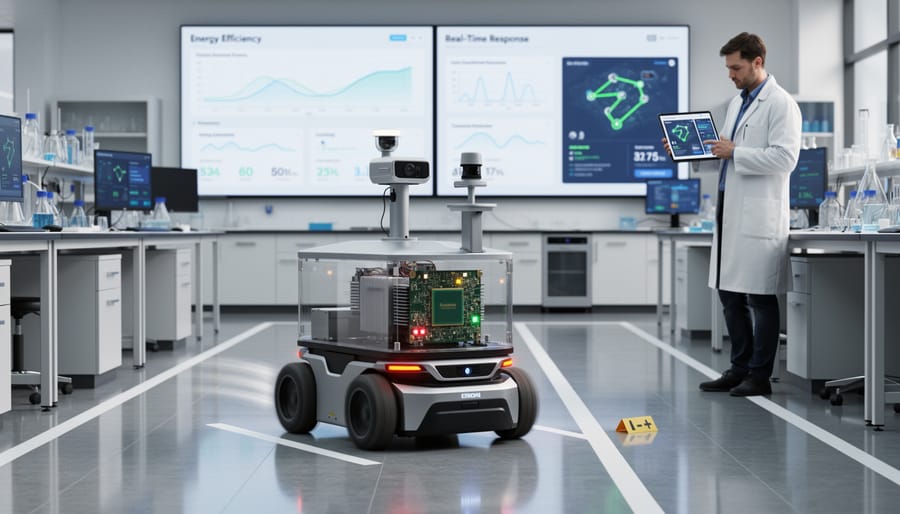
Imagine a robot navigating a busy warehouse, dodging obstacles and adjusting its path in milliseconds—all while consuming less power than a smartphone. This is the promise of neuromorphic chips in robotics applications, where brain-inspired computing transforms how machines perceive and respond to their environment.
Traditional robots process information through sequential calculations, creating delays between sensing and action. Neuromorphic chips change this by processing sensory data in parallel, mimicking how our brains instantly react to stimuli. This means robots can make split-second decisions locally, without waiting for cloud-based processing.
Consider autonomous drones equipped with neuromorphic vision sensors. These drones can track moving objects and navigate through complex environments while running on battery power for hours longer than conventional systems. The Intel Loihi chip, for instance, has enabled research robots to learn navigation patterns using 75 times less energy than traditional processors.
In manufacturing, neuromorphic-powered robotic arms adapt to unexpected changes on assembly lines—like a shifted part or new object—by learning from each interaction rather than requiring complete reprogramming. This adaptive intelligence makes robots more practical for dynamic real-world environments where conditions constantly change.
Edge AI and IoT Devices
Neuromorphic chips are transforming the world of smart devices, where battery life can make or break user experience. Unlike traditional processors that drain power even during simple tasks, these brain-inspired chips sip energy while continuously processing sensor data. Think of your smartphone’s camera that instantly recognizes faces, or smart home cameras that distinguish between your pet and an intruder—these applications benefit enormously from neuromorphic technology.
Smart home devices represent a perfect use case. A security camera equipped with neuromorphic chips can analyze video feeds locally, detecting unusual movements or recognizing familiar faces without sending data to the cloud. This approach not only protects privacy but dramatically reduces energy consumption. Similarly, wearable health monitors can track heart rhythms and detect anomalies for days without recharging, thanks to the efficient event-driven processing that mimics how our neurons fire only when needed. Industrial IoT sensors monitoring machinery vibrations or temperature changes can operate for months on tiny batteries, continuously learning normal patterns and flagging irregularities instantly.
What This Means for the Future of AI
The Path to Widespread Adoption
The journey to mainstream neuromorphic computing won’t happen overnight, but the roadmap is becoming clearer. Industry experts predict we’ll see significant commercial deployments between 2025 and 2030, with widespread adoption likely in the 2030s.
Currently, we’re in the early adoption phase. Companies like Intel and IBM are testing their neuromorphic chips in controlled environments—think research labs and pilot programs. The next milestone involves proving these chips can outperform traditional processors in specific tasks like pattern recognition and real-time sensor processing.
Several factors will influence how quickly neuromorphic computing catches on. First, software development tools need to become more user-friendly. Right now, programming these brain-inspired chips requires specialized knowledge that most developers don’t have. Second, manufacturing costs must decrease through economies of scale. Third, the technology needs clear success stories that demonstrate undeniable advantages over existing solutions.
The competition matters too. While quantum computing advances grab headlines, neuromorphic chips offer a more practical near-term solution for many AI applications because they work at room temperature and consume far less power.
Expect to see neuromorphic processors first appearing in edge devices, autonomous vehicles, and industrial sensors before they reach consumer electronics. The path forward depends on continued research funding, industry collaboration, and proving real-world value beyond laboratory demonstrations.
How This Could Change Your Daily Tech
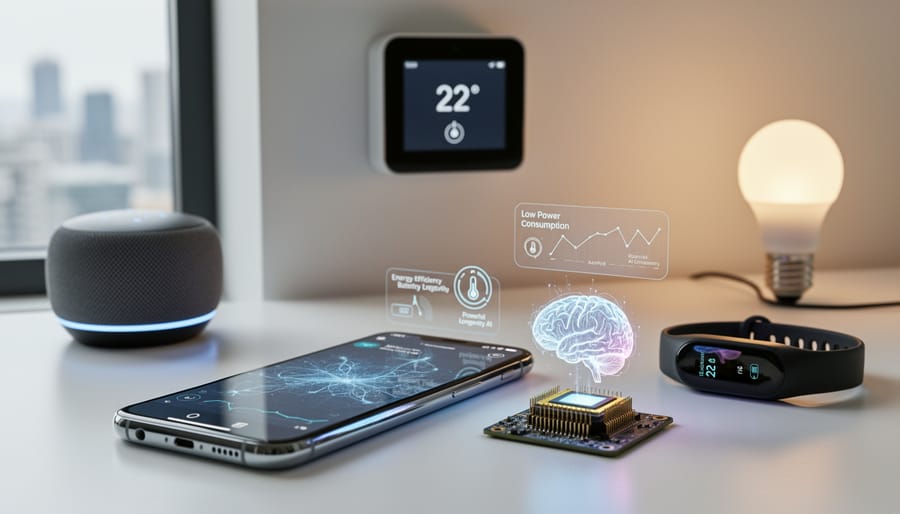
Imagine your smartphone battery lasting an entire week instead of barely making it through the day. Neuromorphic chips could make this a reality by processing information much more efficiently than traditional processors. Your phone’s voice assistant would understand context and nuance better, responding to your requests without sending data to distant servers, keeping your conversations genuinely private.
Wearable devices stand to benefit enormously too. Fitness trackers equipped with neuromorphic chips could analyze your movement patterns in real-time, detecting potential health issues like irregular heartbeats or early signs of fatigue before they become serious. These devices would learn your unique patterns without draining their tiny batteries in hours.
Smart homes would become truly intelligent rather than just connected. Your thermostat wouldn’t just follow a schedule—it would anticipate your preferences based on subtle environmental cues and your daily routines. Security cameras could distinguish between a family member, a delivery person, and a genuine threat without constantly streaming footage to the cloud.
Even your laptop could benefit, with neuromorphic co-processors handling background tasks like noise cancellation during video calls or real-time language translation, all while using a fraction of the power current AI features demand.
Neuromorphic computing chips represent more than just another incremental improvement in processor design—they signal a fundamental shift in how we approach artificial intelligence hardware. By mimicking the brain’s elegant efficiency, these chips promise to unlock AI capabilities that consume less power, respond faster, and potentially bring sophisticated intelligence to devices we carry in our pockets or wear on our wrists.
For you as someone exploring the AI landscape, understanding neuromorphic computing matters because it addresses real limitations holding back today’s AI systems. While current AI achievements are impressive, they often require massive data centers and energy consumption that simply won’t scale to billions of edge devices. Neuromorphic chips offer a practical pathway forward, already demonstrating success in applications from robotics to medical diagnostics.
The co-design approach we’ve explored—where hardware and algorithms evolve together—isn’t just technical detail. It represents a philosophical shift toward building AI systems that work with nature’s proven designs rather than against them. As these technologies mature over the coming years, they’ll increasingly shape the AI tools and experiences you encounter daily.
Keep exploring emerging AI hardware innovations beyond neuromorphic computing. Technologies like quantum processors, optical computing, and advanced accelerators are all part of the exciting evolution reshaping artificial intelligence. The more you understand these foundational technologies, the better equipped you’ll be to participate in and benefit from the AI revolution unfolding around us.