
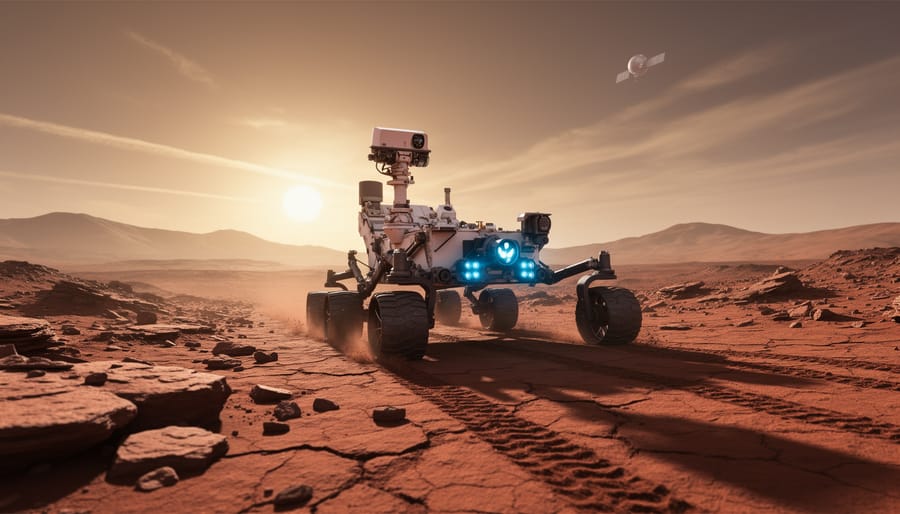
The vast darkness of space has always challenged human exploration—distances too great, environments too hostile, and data too complex for human minds alone to process. Enter artificial intelligence, the transformative force now reshaping how we navigate, analyze, and understand the cosmos. From autonomous rovers making split-second decisions on Martian terrain to algorithms detecting Earth-like planets in distant star systems, AI has evolved from a supporting tool to an indispensable partner in our quest beyond Earth.
AI-powered space missions are already delivering breakthroughs that seemed impossible just decades ago. Machine learning systems now process astronomical data millions of times faster than human researchers, identifying patterns in cosmic radiation, predicting satellite trajectories, and even searching for signs of extraterrestrial intelligence. NASA’s Perseverance rover uses AI to navigate Mars independently, selecting rock samples worth studying without waiting for instructions from Earth—a game-changer when communication delays span up to 22 minutes each way.
The partnership between human ingenuity and artificial intelligence is unlocking mysteries once confined to science fiction. As we venture deeper into space, AI becomes not just helpful but essential, handling tasks ranging from real-time spacecraft adjustments to analyzing decades of telescope data in hours. This article explores how AI is revolutionizing space exploration today and what unprecedented discoveries await tomorrow.
Why Space Missions Need AI More Than Ever
The Communication Problem
Imagine sending a text message to a friend on Mars. You hit send, then wait. And wait. Depending on where Earth and Mars are in their orbits, your message would take anywhere from 4 to 24 minutes to arrive. Now imagine waiting another 4 to 24 minutes for their response. That’s nearly an hour for a simple back-and-forth conversation.
This communication delay isn’t just inconvenient—it’s a fundamental challenge for space exploration. When NASA’s Perseverance rover encounters an unexpected obstacle or needs to make a time-sensitive decision, it can’t phone home for instructions. By the time mission control receives the distress signal and sends back a response, the critical moment has passed.
This is where artificial intelligence becomes essential. Spacecraft equipped with AI can analyze their surroundings, identify hazards, plan routes, and make decisions in real-time without waiting for human input. Think of it as giving rovers and satellites their own problem-solving abilities—a kind of digital autonomy that lets them act independently when every second counts. Without AI, space missions would move at a glacial pace, with rovers sitting idle for hours between each careful movement, waiting for Earth-based instructions that take forever to arrive.
Data Overload in the Cosmos
Modern space telescopes and satellites are creating an unprecedented flood of information. The James Webb Space Telescope, for example, captures approximately 57 gigabytes of data every single day as it peers into the deepest corners of our universe. That might not sound overwhelming until you consider this happens daily, and Webb is just one instrument among thousands orbiting Earth or observing from space.
Ground-based observatories add to this digital deluge. The Vera Rubin Observatory, once fully operational, will generate about 20 terabytes of data each night by photographing the entire visible sky every few days. Within its first year alone, it will collect more astronomical data than all previous telescopes combined throughout human history.
This creates an impossible challenge: no team of human astronomers could possibly review millions of images to identify interesting phenomena like distant supernovae, new asteroids, or gravitational wave sources. We’re essentially drowning in cosmic information.
This is precisely where artificial intelligence becomes essential. AI excels at processing vast datasets, identifying patterns humans would miss, and flagging discoveries that warrant closer examination. Without machine learning algorithms working around the clock, most of this invaluable space data would remain unexamined, representing countless missed opportunities for breakthrough discoveries.
AI-Powered Rovers: Thinking Machines on Other Worlds
AutoNav and Terrain Recognition
Imagine driving a car on Mars from 140 million miles away, where every command takes up to 20 minutes to arrive. That’s the challenge facing rover operators, which is why autonomous navigation has become essential for productive exploration.
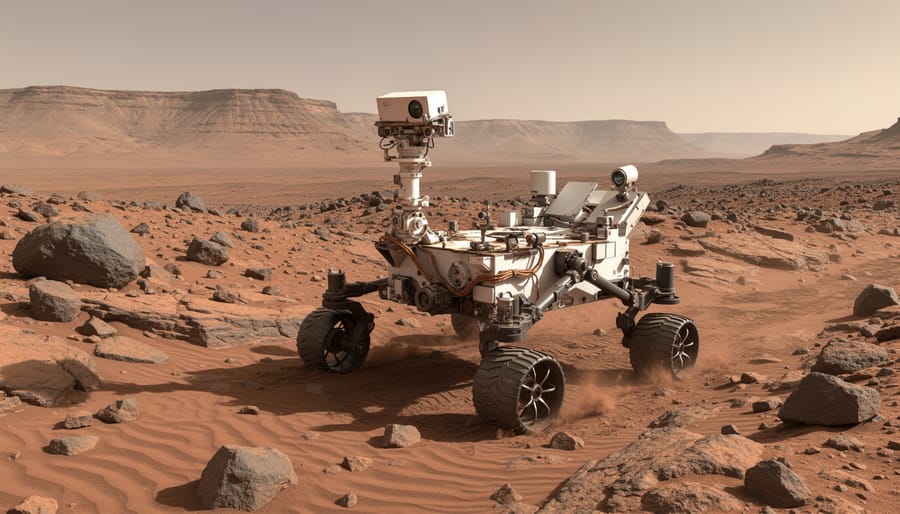
Machine learning has transformed how rovers traverse alien landscapes. Instead of waiting for human instructions for every move, modern rovers like Perseverance use computer vision algorithms to identify obstacles, assess terrain hazards, and plot safe routes independently. The system analyzes images from multiple cameras, recognizing dangerous features like large rocks, steep slopes, and sandy patches that could trap the rover.
Perseverance represents a quantum leap in autonomy. Its AutoNav system processes 3D maps of surrounding terrain in real-time, making navigation decisions about five times faster than its predecessor, Curiosity. While Curiosity could travel roughly 100 meters per Martian day with constant human oversight, Perseverance covers up to 200 meters with minimal intervention. The rover evaluates potential paths, calculates risk scores for different routes, and chooses the safest trajectory without waiting for Earth-based approval.
This enhanced autonomy means scientists spend less time planning each drive and more time conducting experiments. The technology learns from experience too, improving its hazard recognition as it encounters new terrain types. For future missions to distant moons or asteroids where communication delays stretch even longer, this self-reliance will prove indispensable, enabling spacecraft to explore efficiently while humans focus on the bigger scientific picture.
Smart Science Selection
Imagine a Mars rover rolling across the red planet’s surface, surrounded by thousands of rocks. Which ones deserve closer inspection? This is where AI becomes the rover’s intelligent assistant. NASA’s AEGIS system, which stands for Autonomous Exploration for Gathering Increased Science, acts like a smart field geologist that never gets tired.
AEGIS uses computer vision and machine learning to analyze images captured by rover cameras, identifying rocks with unusual shapes, textures, or compositions that scientists back on Earth would find interesting. Instead of waiting hours for instructions from mission control, the rover can make decisions on the spot, zapping promising rocks with its laser spectrometer to analyze their chemical makeup.
This autonomous decision-making has transformed how we explore other worlds. The Curiosity rover, equipped with AEGIS, has independently selected and analyzed thousands of targets since 2016. The system learns to recognize scientifically valuable features like layered sediments, mineral veins, or unusual color variations that might indicate past water activity.
The result? More science gets done in less time, and rovers can capitalize on fleeting opportunities when lighting conditions are perfect for observation, maximizing every precious moment of their mission.
Self-Diagnosis and Survival
Space rovers face extreme temperatures, radiation, and dust storms millions of miles from any repair shop. That’s where AI becomes their personal doctor. NASA’s Perseverance rover uses machine learning algorithms that constantly monitor its own health, checking everything from wheel wear to instrument performance. These systems analyze patterns in sensor data to predict when components might fail before they actually do.
Think of it like your smartphone warning you about battery health, but with much higher stakes. When AI detects potential issues, it automatically adjusts the rover’s operations. If solar panels are collecting less energy due to dust accumulation, the system prioritizes critical tasks and postpones less urgent activities. The Curiosity rover has successfully used these adaptive strategies to survive over a decade on Mars, far exceeding its original mission timeline.
This self-reliance is essential because communication delays with Earth can reach 20 minutes each way, making real-time troubleshooting impossible. AI enables rovers to make smart decisions independently, extending mission life and maximizing scientific discoveries in these unforgiving environments.
Finding New Worlds: AI as the Ultimate Planet Hunter
Sorting Through Stellar Data
When astronomers point telescopes at the night sky, they collect massive amounts of data from thousands of stars simultaneously. Each star produces a light curve—a graph showing how its brightness changes over time. Hidden within these patterns are tiny dips in brightness that might indicate a planet passing in front of its star, a phenomenon called a transit. But here’s the challenge: manually analyzing this data would take human researchers centuries.
This is where machine learning algorithms become invaluable. Neural networks can examine light curves from thousands of stars in parallel, identifying subtle patterns that suggest planetary transits. These AI systems learn to distinguish between actual planets and false positives caused by instrument noise, stellar activity, or background interference.
The results have been remarkable. In 2017, researchers from Google and the University of Texas trained a neural network on data from NASA’s Kepler Space Telescope. The AI discovered two previously overlooked exoplanets orbiting the star Kepler-90, making it the first star system known to have eight planets—matching our own solar system. More recently, AI analysis of TESS (Transiting Exoplanet Survey Satellite) data has identified numerous planetary candidates that traditional methods missed.
These discoveries demonstrate how AI doesn’t just speed up research—it finds planets that would otherwise remain hidden in the noise, expanding our understanding of planetary systems throughout the galaxy.

Identifying Habitable Candidates
Once AI identifies planets in the habitable zone, the real detective work begins. Machine learning algorithms analyze light passing through exoplanet atmospheres during transit, breaking down the spectral signatures to identify chemical compositions. This process, called spectroscopy, traditionally required months of manual analysis. AI now accomplishes it in hours, scanning for biosignatures like oxygen, methane, and water vapor that might indicate life.
NASA’s James Webb Space Telescope generates massive datasets from distant worlds, and AI systems sort through this information to flag promising candidates. For example, the algorithm helped confirm TRAPPIST-1e, a rocky planet 40 light-years away with conditions potentially suitable for liquid water. Similarly, AI contributed to identifying K2-18b, a super-Earth where researchers detected water vapor in its atmosphere.
These algorithms don’t just look for individual elements. They evaluate combinations of factors including planet size, orbital distance, stellar radiation levels, and atmospheric pressure. The AI weighs these variables simultaneously, creating habitability scores that help scientists prioritize which worlds deserve deeper investigation. This rapid screening means researchers can focus their limited telescope time on the most Earth-like candidates, dramatically accelerating our search for worlds that might harbor life beyond our solar system.
Mission Control’s AI Co-Pilots
Optimizing Flight Paths and Fuel
Every spacecraft journey is like solving a massive cosmic puzzle—one where fuel is precious and timing is everything. AI has become the master puzzle-solver, calculating flight paths that would take human engineers weeks or even months to figure out.
Take NASA’s Mars missions as a real-world example. AI systems now calculate gravity assist maneuvers, where spacecraft use a planet’s gravitational pull like a cosmic slingshot to gain speed without burning extra fuel. The European Space Agency’s BepiColombo mission to Mercury relies on AI to navigate nine planetary flybys over seven years—a trajectory so complex that traditional methods would struggle to optimize it efficiently.
NASA’s Deep Space Network also uses machine learning to manage communication schedules with dozens of spacecraft simultaneously. The AI predicts optimal transmission windows and adjusts antenna positioning, reducing fuel consumption by ensuring spacecraft don’t waste energy repositioning for communications.
Perhaps most impressively, ESA’s advanced mission analysis tools use AI to generate thousands of potential flight path scenarios in hours, comparing fuel requirements, travel time, and mission risks. For a Mars sample return mission, this technology identified routes that could save up to 20% in fuel costs—translating to millions of dollars in savings and enabling longer, more ambitious missions with the same resources.
Satellite Swarm Coordination
Imagine trying to choreograph a dance with thousands of performers, each moving at 17,000 miles per hour while circling the planet. That’s essentially what AI does when managing satellite constellations like Starlink, which comprises thousands of satellites working in harmony.
Traditional satellite management relied on ground controllers manually adjusting each satellite’s position and function. With mega-constellations, this approach simply doesn’t scale. AI now handles the intricate task of coordinating complex systems, ensuring satellites maintain proper spacing, avoid collisions, and optimize their operations without constant human intervention.
For communication networks, AI algorithms continuously decide which satellites should relay data to minimize latency and maximize bandwidth. When you’re streaming video via satellite internet, AI is routing your connection through multiple satellites in real-time, predicting their positions and switching seamlessly between them as they orbit overhead.
Earth observation constellations use AI to coordinate imaging schedules. Instead of duplicating efforts, the system intelligently assigns which satellites photograph which areas, automatically prioritizing regions affected by natural disasters or requested by users. The AI considers cloud cover predictions, satellite positions, and mission priorities to create optimal imaging plans.
Space traffic management has become critical as orbital congestion grows. AI systems track thousands of objects, predict potential collisions days in advance, and autonomously adjust satellite trajectories when necessary. This collision avoidance happens faster than human operators could respond, preventing catastrophic chain reactions of space debris that could threaten our access to orbit for generations.

The Search for Extraterrestrial Intelligence Gets Smarter
For decades, scientists at the Search for Extraterrestrial Intelligence (SETI) have been listening to the cosmos, hoping to catch a whisper from distant civilizations. The challenge? Radio telescopes capture enormous amounts of data every single day, including millions of signals from satellites, cell phones, and other human-made sources. Finding a genuine alien transmission in this cosmic haystack has been like searching for a specific grain of sand on a beach.
Enter machine learning, which is revolutionizing how we hunt for ET.
Traditional SETI methods relied on pre-programmed rules to flag interesting signals, but these systems often missed unusual patterns or got overwhelmed by false positives. Modern AI algorithms can now analyze radio telescope data in real-time, learning to distinguish between terrestrial interference and potentially interesting cosmic signals with remarkable accuracy.
At the Breakthrough Listen project, researchers have deployed machine learning models that examine millions of frequency channels simultaneously. These algorithms don’t just follow rigid rules; they learn what Earth-based interference looks like by studying patterns in the data. One system successfully identified eight new signals of interest that human researchers had previously overlooked in archived observations.
The technology works by recognizing subtle characteristics in radio waves. Signals from Earth typically drift in frequency due to our planet’s rotation and the transmitter’s location. Signals from space would drift differently, reflecting the relative motion between Earth and their source. Machine learning excels at catching these nuanced differences that might slip past traditional filters.
Perhaps most exciting, AI systems can now process data from multiple telescopes simultaneously, cross-referencing observations to rule out local interference almost instantly. This means researchers spend less time chasing false leads and more time investigating genuinely mysterious signals. While we haven’t found alien civilizations yet, we’re listening smarter than ever before.
What’s Coming: Future AI Missions Already in Development
Autonomous Lunar and Martian Bases
Living on the Moon or Mars sounds like science fiction, but AI is making it possible sooner than you might think. As NASA’s Artemis program prepares to return humans to the lunar surface and space agencies plan for Mars colonization, artificial intelligence will serve as the invisible infrastructure manager keeping astronauts alive.
Think of AI as the ultimate multitasker for space habitats. These systems will continuously monitor life support equipment, adjusting oxygen levels, temperature, and air pressure without waiting for commands from Earth. Since communication delays between Mars and Earth can reach 20 minutes, astronauts need systems that respond instantly to emergencies like air leaks or equipment failures.
AI will also revolutionize construction in space. Autonomous robots equipped with machine learning algorithms can 3D-print habitat structures using local materials like lunar regolith or Martian soil. These robots learn from each task, improving their techniques and adapting to unexpected challenges like uneven terrain or material inconsistencies.
Energy management represents another critical role. AI systems will optimize solar panel positioning, battery charging cycles, and power distribution across habitat modules, ensuring nothing vital loses power during dust storms on Mars or the Moon’s two-week-long nights.
This level of autonomy doesn’t eliminate human oversight entirely, but it reduces the cognitive burden on astronauts, letting them focus on exploration and scientific research rather than constant system monitoring.

AI-Driven Deep Space Probes
The next generation of space probes heading to distant moons and planets will venture into territory so extreme and unfamiliar that human controllers simply can’t react fast enough. Consider Europa, Jupiter’s icy moon, where a probe must navigate through radiation fields strong enough to fry electronics while analyzing subsurface oceans for signs of life. Or Titan, Saturn’s largest moon, where a lander needs to distinguish between rocks and ice formations in a methane-rich atmosphere humans have never directly studied.
These missions demand AI systems that can make split-second decisions independently. When you’re 800 million miles from Earth, a simple “should I drill here?” question takes hours for a signal to reach mission control and return. Advanced AI will analyze terrain in real-time, identify scientifically valuable sites, adjust instrument settings based on unexpected discoveries, and even rewrite its own mission priorities if it encounters something extraordinary.
Future probes will use machine learning models trained on Earth to recognize geological features, chemical signatures, and potential biosignatures, then adapt those models as they encounter alien environments that challenge our assumptions. This isn’t just automation—it’s giving our robotic explorers the judgment to pursue groundbreaking discoveries we haven’t even imagined yet.
The Challenges We Still Need to Solve
While AI opens exciting possibilities for space exploration, significant challenges remain before autonomous systems can operate reliably in the harsh environment beyond Earth.
One of the most pressing concerns is radiation. Space is flooded with cosmic rays and solar particles that can wreak havoc on electronic systems. Unlike humans who can take shelter during solar storms, AI hardware must withstand constant bombardment. A single high-energy particle can flip bits in computer memory, potentially causing an AI system to make catastrophic decisions. Engineers are developing radiation-hardened chips, but these often lag years behind their commercial counterparts in processing power, creating a frustrating trade-off between durability and capability.
The need for explainable AI presents another major hurdle. When an autonomous spacecraft makes a critical decision—like selecting a landing site or adjusting its trajectory—mission controllers need to understand why. Current deep learning systems often function as “black boxes,” producing accurate results without clear reasoning paths. In space, where correcting mistakes might be impossible, this opacity is unacceptable. Researchers are working on AI systems that can articulate their decision-making process, but progress is slow.
Training data limitations also pose problems. AI systems learn from examples, but how do you train a rover to navigate terrain it has never encountered? Earth-based simulations help, but they cannot capture every possible scenario. Mars might present geological formations unlike anything in our training datasets, leaving AI systems uncertain when they most need confidence.
Finally, there are complex AI governance challenges and ethical questions. Should an autonomous probe be allowed to make irreversible decisions without human oversight? What happens if AI systems discover potential signs of life—can we trust them to handle such momentous findings appropriately? As we grant machines greater autonomy in space, we must carefully consider the boundaries of their authority and ensure human values remain central to exploration decisions.
What once belonged firmly in the realm of science fiction has become an indispensable reality. AI has transformed from a futuristic dream into the backbone of modern space exploration, working tirelessly behind the scenes on Mars rovers, aboard the International Space Station, and within mission control centers across the globe. These intelligent systems are making split-second decisions millions of miles from Earth, identifying potentially habitable worlds among billions of stars, and solving problems that would take human teams months to crack.
Yet despite these remarkable achievements, we’re only scratching the surface of what’s possible. The AI technologies deployed in space today represent the earliest versions of what will become increasingly sophisticated tools. As machine learning algorithms grow more advanced and our computational capabilities expand, we’ll see AI taking on even greater responsibilities in the cosmos. Future missions will rely on autonomous systems that can adapt to entirely unforeseen challenges, collaborate with human astronauts in ways we’re only beginning to imagine, and push the boundaries of exploration far beyond our current reach.
For your generation, this convergence of artificial intelligence and space exploration carries profound implications. The technologies being developed and refined right now may well be the ones that enable humanity to establish permanent settlements on Mars, mine asteroids for resources, or venture to the outer reaches of our solar system. You might witness the moment when we truly become a multi-planetary species, with AI serving as the essential partner that makes it all possible.