

Cloud breaches cost companies an average of $4.45 million per incident in 2023, yet most organizations struggle to monitor their expanding cloud environments effectively. Traditional security tools simply cannot keep pace with the volume of threats targeting cloud infrastructure, creating dangerous blind spots that attackers eagerly exploit.
Artificial intelligence is fundamentally changing this equation. By processing millions of security events per second and identifying patterns invisible to human analysts, AI-powered systems detect threats in real-time, automatically respond to attacks, and predict vulnerabilities before exploitation occurs. This technology represents the difference between reacting to breaches after damage is done and preventing them entirely.
The convergence of AI and cloud security addresses three critical challenges facing modern organizations. First, the sheer scale problem: cloud environments generate exponential amounts of security data that overwhelm traditional monitoring approaches. Second, the speed problem: cyberattacks now unfold in milliseconds, requiring automated responses faster than any security team can coordinate. Third, the sophistication problem: threat actors increasingly use AI themselves, making machine-speed defense not just advantageous but essential.
Whether you are a security professional evaluating next-generation tools, a business leader responsible for protecting sensitive data, or someone exploring careers in cybersecurity, understanding how AI enhances cloud security has become fundamental knowledge. This technology is not future speculation but present reality, already protecting millions of cloud workloads across industries.
This article demystifies how AI strengthens cloud security, explores practical applications across different use cases, examines the infrastructure making this possible, and provides actionable guidance for leveraging these capabilities regardless of your technical background or organizational role.
The Cloud Security Challenge Nobody Talks About

Why Traditional Security Tools Fall Short in the Cloud
Traditional security tools were built for a different era—one where IT infrastructure was predictable, perimeters were clearly defined, and threats followed recognizable patterns. Think of them as security guards with a rulebook: they check for known threats at the gate and follow predetermined protocols. While this worked well for on-premise data centers, cloud environments have completely rewritten the rules.
The cloud introduces unprecedented complexity. Resources spin up and down in seconds, applications communicate across distributed networks, and your infrastructure might span multiple providers and geographic regions. A single organization could have thousands of active workloads running simultaneously, each creating new potential vulnerabilities. Traditional security tools simply weren’t designed to monitor this level of dynamism.
Rule-based systems face a critical limitation: they only recognize what they’ve been programmed to detect. If a threat doesn’t match an existing signature or rule, it slips through unnoticed. Modern cyberattackers exploit this weakness by constantly evolving their tactics. They use techniques like polymorphic malware that changes its code with each iteration, or they execute “living off the land” attacks that use legitimate system tools in malicious ways—behaviors that appear normal to rule-based systems.
Manual security management becomes impossible at cloud scale. Security teams would need to write and update thousands of rules daily to keep pace with new threats and infrastructure changes. By the time humans identify a pattern and create a rule, attackers have often moved on to new methods. This reactive approach leaves organizations perpetually one step behind, making it clear that a more intelligent, adaptive solution is necessary.
The Data Overload Problem
Imagine a security team monitoring a mid-sized company’s cloud infrastructure. Every second, their systems generate thousands of log entries: user logins, data transfers, configuration changes, and potential security events. By the end of a single day, they’re staring at millions of data points. This is the data overload problem that plagues modern cloud security.
Traditional security tools weren’t designed for this scale. They generate so many alerts that security analysts spend their days drowning in notifications, most of which turn out to be false positives. Studies show that security teams can receive over 10,000 alerts daily, yet they can only investigate a fraction of them. It’s like trying to spot a specific grain of sand on an entire beach.
The consequences are serious. While analysts waste time chasing false alarms, real threats slip through unnoticed. A 2023 survey found that 70% of security professionals admit missing critical alerts due to alert fatigue. Attackers exploit this chaos, hiding their malicious activities within the noise of legitimate traffic. When every system is crying wolf, how do you spot the actual predator?
How AI Changes the Game for Cloud Security

Threat Detection That Actually Learns
Traditional security tools work from fixed rules—like a guard checking everyone against a printed list of known troublemakers. But what happens when threats don’t match that list? That’s where machine learning models transform cloud security by actually learning what “normal” looks like in your environment.
Here’s how it works in practice: Imagine your cloud infrastructure as a busy office building. AI systems observe everything—when employees arrive, which doors they use, typical meeting patterns. Over time, the system builds a detailed picture of normal behavior. When something unusual happens, it notices immediately.
For example, if a database administrator typically accesses customer records during business hours from New York, the system recognizes this pattern. But when that same account suddenly downloads massive amounts of data at 3 AM from Romania, red flags go up instantly. The AI didn’t need a pre-programmed rule about Romanian access—it simply recognized the deviation from established patterns.
These cloud AI platforms continuously refine their understanding, adapting as your business evolves. They distinguish between genuine threats and harmless changes, like when your marketing team legitimately increases data access during a campaign launch.
This learning capability catches sophisticated attacks that traditional systems miss—the slow data exfiltration, the gradually escalating privileges, the subtle insider threats that unfold over weeks rather than minutes.
Automated Response: Your 24/7 Security Guard
Imagine having a security guard who never sleeps, never takes breaks, and can respond to threats in milliseconds. That’s exactly what AI-powered automated response systems bring to cloud security. These intelligent systems don’t just detect threats—they take immediate action to neutralize them before damage occurs.
When a traditional security system spots a suspicious login attempt from an unusual location, it might send an alert to your IT team. But what if that alert comes at 3 AM, or during a holiday weekend? An AI-powered automated response system handles it instantly. The moment it detects the anomalous login, it can automatically trigger a multi-step response workflow: temporarily lock the account, require additional authentication, alert the security team, and isolate any potentially compromised resources—all within seconds.
Here’s a practical example: suppose malware starts spreading across your cloud infrastructure. An AI system can immediately quarantine infected virtual machines, block the malware’s command-and-control communications, create backup snapshots of clean systems, and begin analyzing the attack pattern to prevent future incidents. All of this happens faster than any human team could coordinate.
These automated workflows can also scale effortlessly. Whether you’re dealing with one threat or a coordinated attack involving thousands of attempts, the AI responds with the same speed and precision. This 24/7 vigilance means your cloud environment stays protected even when your human team is offline, turning potential disasters into minor incidents that are resolved before you even know they happened.
Predictive Security: Stopping Threats Before They Happen
Imagine if your home security system could predict a break-in before it happened. That’s essentially what predictive security does in cloud environments, using AI to spot threats on the horizon rather than just responding to alarms.
At its core, predictive security works by analyzing massive amounts of historical data to identify patterns that signal danger. Think of it like a weather forecast for cyberattacks. AI systems examine billions of data points, including login patterns, network traffic, user behavior, and system configurations, to detect anomalies that humans might miss. When the system notices something unusual, like a user suddenly accessing sensitive files at odd hours or a surge in data transfers to unfamiliar locations, it flags these as potential threats before any damage occurs.
Real-world applications demonstrate this power impressively. Major financial institutions now use predictive AI to identify compromised credentials before hackers can exploit them. The system learns what normal employee behavior looks like and immediately alerts security teams when accounts deviate from established patterns. Similarly, healthcare organizations employ these tools to predict ransomware attacks by recognizing the early-stage reconnaissance activities that hackers perform weeks before launching their assault.
E-commerce platforms have particularly benefited from this technology. By analyzing shopping patterns and transaction histories, AI can predict and prevent fraud attempts during high-traffic events like Black Friday, protecting both businesses and customers simultaneously. The technology doesn’t just react to threats; it anticipates them, giving security teams precious time to strengthen defenses and neutralize dangers before they materialize.
Real-World Applications You’re Already Using
Email Security and Phishing Detection
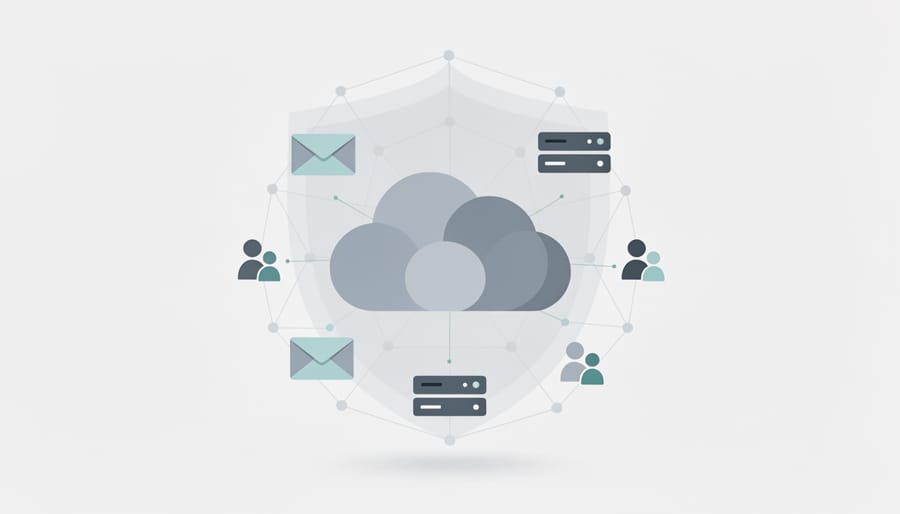
Email remains one of the most vulnerable entry points for cyberattacks, but AI is transforming how cloud-based email services defend against threats. Think of AI as a vigilant guardian that reads between the lines of every message flowing through your inbox.
Traditional email filters relied on simple rules—blocking known malicious addresses or flagging obvious spam. Today’s AI systems go much deeper. They analyze the language patterns in emails, looking for subtle signs of social engineering. For example, if an email claims to be from your bank but uses unusual phrasing or creates artificial urgency (“Click now or your account will be closed!”), AI flags it as suspicious.
Machine learning models examine sender behavior, email headers, and embedded links in real-time. They compare incoming messages against millions of known phishing examples, detecting sophisticated attacks like CEO fraud, where criminals impersonate executives to trick employees into transferring money.
What makes this particularly powerful in cloud environments is the shared intelligence. When AI identifies a new phishing technique targeting one organization, that knowledge protects all users across the cloud platform. The system continuously learns from every attempted attack, becoming smarter and more effective at catching threats before they reach your inbox—all happening invisibly in the background while you focus on your work.
Identity and Access Management
One of AI’s most powerful contributions to cloud security lies in protecting who gets access to what. Think of Identity and Access Management (IAM) as the digital bouncer for your cloud environment, and AI makes this bouncer incredibly smart.
Traditional security systems rely on simple rules: does this person have the right password? Are they logging in from an approved location? But AI takes this much further by learning what normal behavior looks like for each user. For example, if Sarah from marketing typically logs in from New York between 9 AM and 6 PM and accesses only customer relationship management tools, AI will notice immediately if her account suddenly tries to access sensitive financial databases at 3 AM from another country.
This behavioral analysis happens continuously in the background, creating unique profiles for every user. When AI detects anomalies like unusual download patterns, repeated failed access attempts, or privilege escalation attempts, it can automatically trigger alerts or even temporarily freeze suspicious accounts before damage occurs.
Real-world applications are already protecting millions of users. Major cloud platforms use AI to detect credential stuffing attacks, where hackers test stolen passwords across multiple accounts, and account takeovers that human security teams might miss for hours or days. By understanding the subtle patterns of legitimate versus malicious behavior, AI acts as an always-vigilant guardian, catching threats that slip past traditional authentication measures.
Cloud Storage Protection
Cloud storage has become the digital filing cabinet for businesses worldwide, but it also presents new vulnerabilities. AI acts as a vigilant guardian for your cloud-stored data, constantly monitoring for unusual behavior that might signal a security threat. Think of it as having a security camera that not only records but actually understands what it’s watching.
When AI monitors cloud storage, it learns normal patterns of file access and usage. For example, if an employee typically accesses 20 files per day during business hours, but suddenly 10,000 files are being downloaded at 3 AM, AI flags this as suspicious activity. This could indicate a compromised account or insider threat attempting data exfiltration, which is the unauthorized transfer of data outside the organization.
AI also excels at detecting misconfigurations, which are often the weakest link in cloud security. These might include accidentally public storage buckets or overly permissive access settings. Rather than waiting for manual audits, AI continuously scans your cloud environment and alerts administrators to potential exposures before attackers can exploit them, protecting sensitive information from falling into the wrong hands.
The Infrastructure Behind AI-Powered Cloud Security

Data Collection and Processing Pipelines
Think of security data flowing through AI systems like water moving through a city’s purification system. Raw security data—logs, user activities, network traffic—is collected from multiple cloud sources, much like water gathered from various inlets. This data first enters collection points where it’s standardized and cleaned, removing duplicates and irrelevant information.
Next, the data processing pipelines transform this information into formats AI models can understand. Imagine translating different languages into one common tongue. Security events are labeled (normal or suspicious), patterns are extracted, and relationships between data points are identified.
The processed data then feeds into AI models for training, similar to how a student learns from textbooks. Historical security incidents teach the system what threats look like, while normal activity patterns help it understand baseline behavior. This continuous learning cycle happens in real-time, with new data constantly updating the models’ knowledge.
Storage systems maintain both raw and processed data, creating a repository that improves model accuracy over time. The entire pipeline operates automatically, handling millions of security events daily without human intervention.
Model Training and Deployment
Training security AI models begins with feeding them massive amounts of threat data from past cyber attacks, malware signatures, and normal user behavior patterns. Think of it like teaching a guard dog to recognize intruders by showing it thousands of examples of both friendly visitors and potential threats. Security teams collect this data from various sources, including historical security logs, threat intelligence feeds, and simulated attack scenarios.
The AI model learns to spot patterns that humans might miss. For example, it discovers that legitimate users typically access files during business hours from specific locations, while attackers often show unusual login patterns or rapid data access across multiple accounts.
Once trained, these models are deployed across cloud infrastructure through a process called containerization, which packages the AI into portable units that can run anywhere in the cloud. This allows the same security model to protect multiple cloud services simultaneously, whether monitoring databases, applications, or network traffic.
The deployment isn’t a one-time event. These models continuously learn from new threats they encounter, updating their detection capabilities in real-time. When the AI identifies suspicious activity, it immediately alerts security teams or automatically triggers protective measures like blocking suspicious IP addresses or isolating compromised accounts.
Integration with Cloud Platforms
Modern AI security tools seamlessly integrate with major cloud providers through native APIs and dedicated security services. On AWS, tools like Amazon GuardDuty use machine learning to analyze billions of events across your cloud environment, detecting threats automatically without manual configuration. Similarly, Microsoft Azure offers Azure Security Center with built-in AI capabilities that provide continuous security assessments and intelligent threat detection across hybrid cloud workloads.
Google Cloud Platform takes advantage of its AI expertise through Chronicle and Security Command Center, which analyze security telemetry at massive scale. These platforms share a common approach: they plug directly into your existing cloud infrastructure, requiring minimal setup. Think of it like installing a smart security system in your home—once connected, it starts learning your normal patterns immediately.
The practical advantage is centralized visibility. Instead of juggling multiple security dashboards, you get unified threat detection across compute instances, storage buckets, databases, and network traffic. Most providers offer free tiers or trials, making it easy to test AI-powered security features before committing to enterprise-level protection.
What This Means for You (Whether You’re a User or Developer)
For Everyday Users
If you store photos on Google Photos, documents on Dropbox, or files on iCloud, AI is already working behind the scenes to protect your data. Cloud providers now use AI algorithms to detect suspicious login attempts, like someone accessing your account from an unusual location or device. This means you might receive security alerts that feel surprisingly smart—because they are.
What should you do? First, enable two-factor authentication on all cloud accounts. AI security works best when combined with strong user practices. Second, pay attention to those security notifications. If your cloud provider alerts you about unusual activity, don’t dismiss it—AI has likely identified a genuine threat pattern.
Also, be mindful of what you upload. While AI scans for malware and threats, you remain responsible for not sharing sensitive passwords or financial information in unencrypted files. Think of AI as a vigilant security guard for your cloud storage, but one that works most effectively when you follow basic safety protocols yourself.
For Aspiring AI/ML Professionals
Breaking into AI-powered cloud security offers exciting opportunities for those ready to blend technical expertise with creative problem-solving. Start by building a strong foundation in both cloud platforms like AWS, Azure, or Google Cloud, and machine learning fundamentals through online courses and certifications. Focus on understanding how AI models detect threats, analyze patterns, and automate security responses in real-world scenarios.
Develop hands-on experience by working with security datasets, practicing threat detection projects, and experimenting with open-source security tools. Learning Python for security automation and gaining familiarity with frameworks like TensorFlow or PyTorch will prove invaluable. Consider pursuing certifications in cloud security alongside AI specializations to demonstrate your dual expertise.
AI security professionals are increasingly in demand as organizations prioritize protecting their cloud infrastructure. Entry points include roles like security analyst, cloud security engineer, or machine learning engineer with security focus. Join online communities, attend cybersecurity conferences, and contribute to security projects on platforms like GitHub to build your network and showcase your capabilities to potential employers in this growing field.
For Organizations Moving to the Cloud
For organizations making the cloud transition, AI-powered security acts as an intelligent safety net during a vulnerable period. Think of it like having a security expert who never sleeps, continuously monitoring your cloud environment from day one. Traditional security tools often struggle with the dynamic nature of cloud infrastructure, where resources scale up and down automatically. AI excels here by learning your organization’s normal patterns and instantly flagging unusual activities, whether that’s unauthorized access attempts or suspicious data transfers.
The benefits are tangible. AI reduces the manual workload on IT teams by automatically detecting and responding to threats, allowing your staff to focus on strategic initiatives rather than sifting through countless security alerts. It also provides visibility across multi-cloud environments, ensuring nothing falls through the cracks as you migrate applications and data. For businesses concerned about compliance, AI tools can continuously monitor configurations and alert you to potential violations before they become costly problems.
The integration of artificial intelligence into cloud security represents more than just a technological upgrade—it’s a fundamental shift in how we protect digital assets. As we’ve explored throughout this discussion, AI brings unprecedented capabilities to threat detection, response automation, and predictive defense mechanisms. Yet it’s essential to remember that we’re witnessing an evolution in progress, not a completed revolution.
Think of AI-powered cloud security like a learning companion that grows more capable with each passing day. Every threat it encounters, every pattern it analyzes, and every attack it helps prevent contributes to a collective intelligence that benefits the entire security ecosystem. The systems protecting your data today are significantly more sophisticated than those from just a year ago, and tomorrow’s solutions will be even more advanced.
For technology enthusiasts and professionals considering this space, now is an exciting time to engage. The skills you develop today in understanding AI security frameworks will become increasingly valuable as organizations of all sizes recognize the necessity of these technologies. Students exploring career paths should note that the intersection of AI and cloud security offers diverse opportunities, from developing new algorithms to implementing security solutions across industries.
Looking ahead, we can anticipate several emerging trends: quantum-resistant security measures powered by AI, more sophisticated behavioral analytics that can detect insider threats with greater accuracy, and self-healing systems that automatically patch vulnerabilities before exploitation occurs. The next frontier also includes federated learning approaches that allow security systems to improve without compromising data privacy.
Stay curious, keep learning, and remember that in the rapidly evolving landscape of cloud security, continuous education isn’t optional—it’s essential. The future of digital protection is being written now, and understanding AI’s role puts you at the forefront of that transformation.