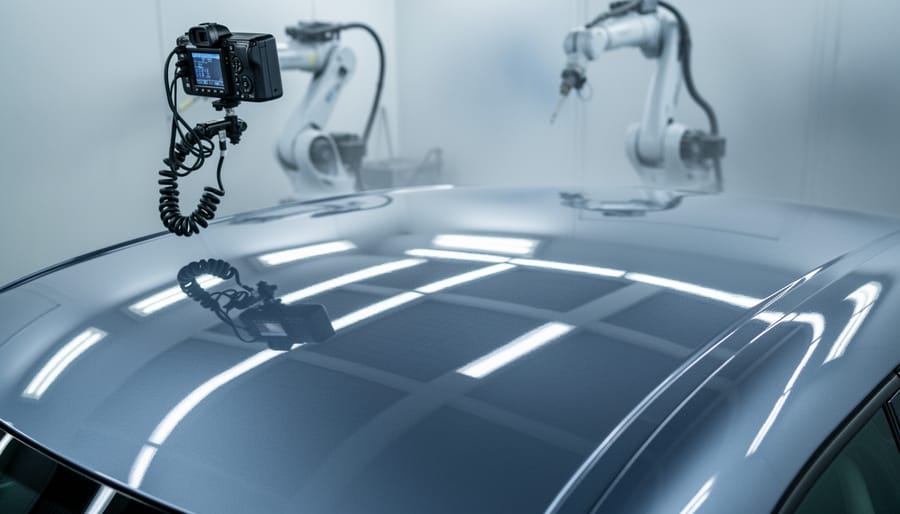
AI data validation transforms coating quality inspection by automatically detecting defects like orange peel, runs, and color mismatches at speeds up to 100 times faster than manual review, with accuracy rates exceeding 98% when properly trained. The system works by feeding camera images of painted surfaces through a trained neural network that has learned to distinguish acceptable finish from defective work, then flagging anomalies for human review or automatic rejection.
Quality control managers face a persistent challenge: traditional visual inspection relies heavily on human judgment, which varies between inspectors and deteriorates over long shifts. A single missed defect in automotive refinishing can cost thousands in rework and damage customer trust. AI validation addresses this by providing consistent, repeatable assessment across every part inspected.
The implementation process requires three core components: high-resolution imaging hardware to capture surface details, labeled training datasets showing both good and defective coatings, and validation protocols that confirm the AI’s decisions match expert judgment. Before deploying any system, you need to elicit AI requirements specific to your coating environment, including the defect types you encounter most, lighting conditions in your facility, and throughput expectations.
Modern systems excel at catching subtle issues that escape quick visual scans. A clearcoat application might look acceptable under standard lighting but reveal micro-defects under polarized inspection captured by calibrated cameras. The AI model learns these patterns from thousands of examples, building detection capabilities that rival experienced technicians.
Success depends on careful dataset preparation and ongoing model refinement. Facilities achieving the highest accuracy rates continually feed edge cases back into training, ensuring the system adapts to new products and application methods. Industries ranging from automotive manufacturing to specialized applications like ceramic coating in Brisbane workshops are adopting these validation systems to maintain consistent quality standards while reducing inspection time and costs.
What You’ll Need: Tools and Materials for AI-Powered Paint Inspection
Hardware Components
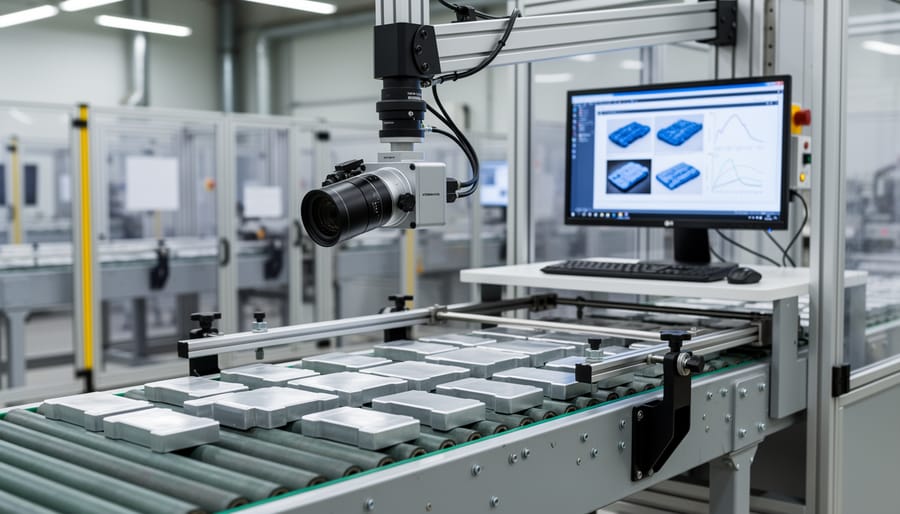
Industrial-grade cameras form the foundation of your AI inspection system. You’ll need high-resolution cameras capable of capturing fine surface details, aim for at least 5-megapixel sensors with global shutter technology to eliminate motion blur on moving production lines. Many automotive facilities use cameras with 12-20 megapixel resolution to detect micro-defects in clear coat finishes.
Specialized lighting dramatically impacts detection accuracy. LED ring lights or dome illuminators provide consistent, diffuse lighting that reveals surface imperfections without creating harsh reflections. For metallic and pearl coatings, consider cross-polarized lighting setups that highlight orange peel texture and flow patterns invisible under standard illumination.
Thermal sensors add another detection layer. Infrared cameras can identify uneven coating thickness and curing irregularities that visual inspection misses, particularly important for multi-layer paint systems.
Sturdy industrial mounts keep your equipment stable in harsh spray booth environments. Look for IP65-rated enclosures that protect cameras from overspray and cleaning chemicals. Adjustable mounting arms let you position cameras at optimal angles, typically 30-45 degrees from perpendicular, to capture reflective surface defects effectively.
Budget between $3,000-$15,000 per inspection station depending on resolution requirements and environmental protection needs.
Software and AI Frameworks
Modern coating inspection demands purpose-built software stacks that combine computer vision with real-time validation. For 2026 automotive applications, you’ll need three core components working together.
First, select a computer vision platform. TensorFlow and PyTorch remain industry standards, offering pre-trained models you can fine-tune for paint defect detection. These ML frameworks support convolutional neural networks optimized for visual inspection tasks. OpenCV provides essential image preprocessing tools, edge detection, color space conversion, and noise reduction critical for analyzing coating surfaces under variable lighting.
Next, choose validation middleware that bridges your AI model to inspection hardware. Libraries like ONNX Runtime enable fast inference on edge devices, processing camera feeds without cloud latency. Look for frameworks supporting real-time anomaly detection, allowing immediate flagging of coating defects as parts move through production.
Finally, implement quality management integration software. Platforms like Cognex VisionPro or custom Python scripts can log inspection results, trigger alerts for out-of-spec conditions, and maintain audit trails. Many 2026 solutions offer REST APIs for connecting to existing manufacturing execution systems, ensuring your AI validation data flows seamlessly into broader quality control workflows.
Data Collection Requirements
Building a reliable AI validation system requires diverse, high-quality training data that represents real-world coating scenarios. You’ll need thousands of images across three primary categories: defect samples (orange peel, runs, sags, dirt contamination, fisheyes, and color mismatches), baseline quality images showing acceptable coating finishes, and edge cases that challenge the model’s decision boundaries.
Each image must be consistently annotated using standardized defect classification schemes. Create detailed labels that specify defect type, severity level, location coordinates, and affected surface area. Capture images under controlled lighting conditions that match your production environment, maintaining consistent camera angles and distances.
Include examples from different paint types (basecoat, clearcoat, primer), colors (metallics present unique challenges), and substrate materials. Your dataset should reflect seasonal variations, different application equipment, and multiple operators to ensure the AI generalizes well across real production conditions rather than memorizing specific patterns.
Critical Safety and Quality Warnings Before You Begin
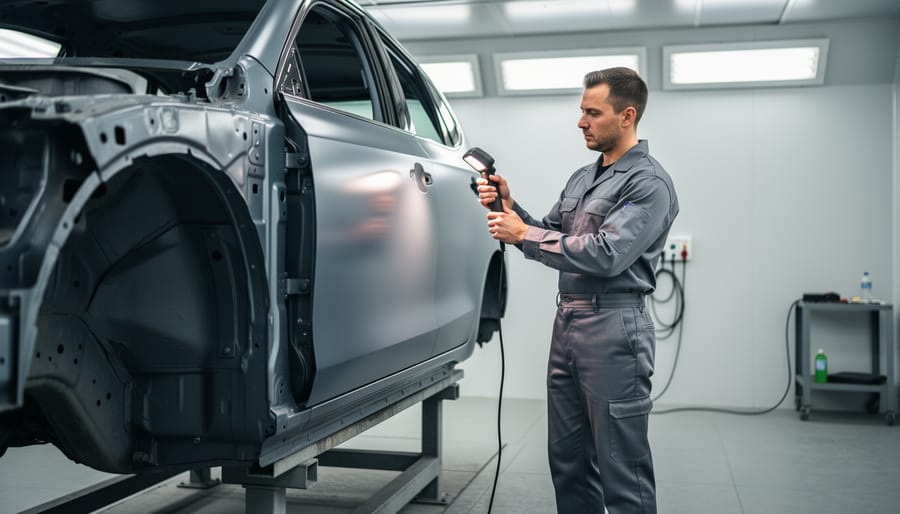
Understanding False Positives and False Negatives
In coating quality inspection, false positives occur when your AI system flags a perfectly acceptable finish as defective, while false negatives happen when it misses actual problems like orange peel texture or paint runs. Both errors carry real costs in an automotive aftermarket environment.
False positives waste time and materials. Your team might sand down and recoat a panel that was already within spec, burning labor hours and extending customer wait times. Worse, if your system consistently over-flags, inspectors may start ignoring its warnings altogether, defeating the entire purpose of automation.
False negatives are potentially more damaging. A missed defect that reaches the customer can trigger warranty claims, negative reviews, and lost business. If your AI fails to catch a dust contamination issue before delivery, you’re facing expensive rework and a damaged reputation.
The key is understanding your acceptable error threshold before deployment. Most automotive coating facilities target 95% or higher accuracy in validation testing, but you’ll need to weight false negatives more heavily than false positives. It’s better to have your system cautiously flag borderline cases for human review than to release substandard work to customers.
Regulatory and Compliance Considerations
Implementing AI validation for automotive coating inspection requires navigating a complex landscape of industry standards and regulatory frameworks. In 2026, automotive facilities must comply with ISO 9001 quality management standards, which mandate documented inspection procedures and traceability throughout the production process. Your AI system needs audit trails that demonstrate when inspections occurred, what criteria were applied, and how decisions were made about coating acceptance or rejection.
If you’re collecting or processing any data that could identify individual workers, vehicles, or customers, GDPR data privacy regulations apply in Europe, while similar state-level laws govern operations in California and other US jurisdictions. This means implementing data minimization practices, only capturing what’s necessary for quality inspection, and establishing retention policies that automatically delete outdated images and sensor data.
Beyond privacy, automotive coating inspection systems must often meet industry-specific certifications. OEM suppliers typically need IATF 16949 compliance, which requires statistical process control and validated measurement systems. Your AI validation approach must demonstrate measurement system analysis, showing that the technology can reliably detect defects with acceptable repeatability and reproducibility. Document everything: model training procedures, validation test results, and ongoing performance monitoring. Regulators and auditors will expect evidence that your AI system maintains consistent accuracy over time, not just at initial deployment.
Step-by-Step: Building Your AI Data Validation System
Step 1: Collect and Prepare Your Training Data
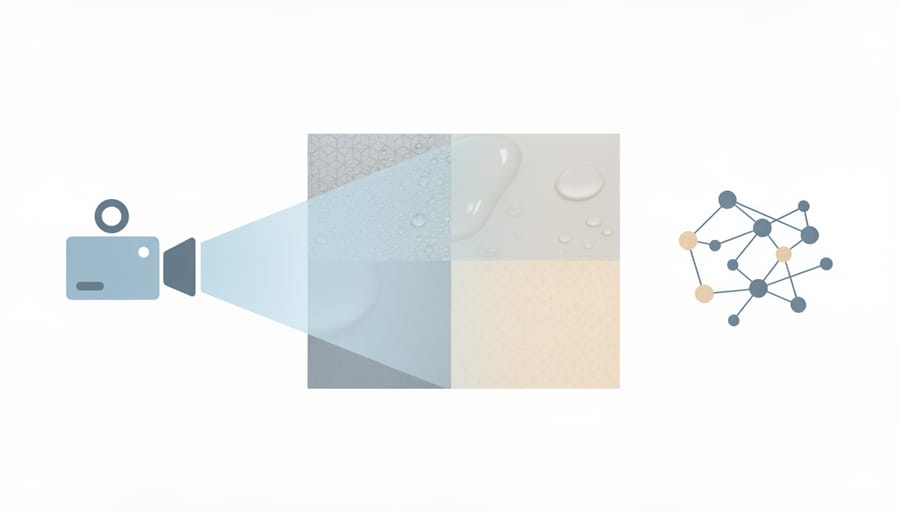
Start by capturing high-quality images of both defective and acceptable coating finishes across your entire production range. You’ll need at least 500-1000 images per defect category to train a reliable model. Focus on the four most common automotive paint defects: orange peel (textured surface irregularities), runs and sags (excessive material flow), dust contamination (foreign particles trapped in the coating), and color mismatch. Photograph each defect type under consistent lighting conditions, maintaining the same camera angles and distances you’ll use during actual inspections.
Document your acceptable quality standards with equal rigor. Capture images of coatings that meet your specifications, representing the range of acceptable variation in gloss, texture, and color. This baseline dataset teaches the AI what “good” looks like, which is just as critical as identifying defects.
Next, annotate every image with precise labels. Draw bounding boxes around defect areas, tag the defect type, and rate severity on a consistent scale (minor, moderate, severe). This annotation work determines your model’s accuracy, experienced teams fix data first rather than endlessly adjusting algorithms later. Include metadata like coating type, substrate material, and environmental conditions during application.
Organize your dataset into training (70%), validation (20%), and testing (10%) subsets before moving forward. This separation ensures you can measure real-world performance accurately.
Step 2: Select and Configure Your AI Model
Choosing the right AI model determines how accurately your system identifies coating defects. For automotive paint inspection, start with a pre-trained convolutional neural network (CNN) as your foundation. ResNet-50 and EfficientNet are proven choices in 2026 because they balance accuracy with processing speed, critical when inspecting multiple parts per hour.
If you need to pinpoint exact defect locations (like identifying where a run or sag occurs on a panel), use object detection models instead. YOLO (You Only Look Once) v8 or Faster R-CNN excel at drawing bounding boxes around specific problem areas. YOLO runs faster, making it suitable for real-time inspection lines, while Faster R-CNN offers slightly better precision for subtle defects like slight orange peel texture.
Configure your chosen model by setting the input image resolution. Higher resolution (1024×1024 pixels or above) captures fine coating details but requires more processing power. Most automotive applications perform well at 640×640 pixels, which detects runs, dust contamination, and color mismatches without overwhelming your hardware.
Next, establish your training environment. Cloud platforms like Google Colab Pro or AWS SageMaker provide GPU access without upfront hardware costs. For on-premises setups, you’ll need a workstation with at least an NVIDIA RTX 4070 GPU and 32GB RAM to handle model training efficiently. Install TensorFlow or PyTorch as your machine learning framework, both support the models mentioned and offer extensive coating inspection tutorials.
Step 3: Train Your Validation Model
Start by loading your labeled coating defect dataset into your chosen AI framework. Split the data into three groups: 70% for training, 15% for validation, and 15% for testing. This separation prevents your model from simply memorizing examples rather than learning to identify actual defect patterns.
Configure your initial hyperparameters before training begins. Set a conservative learning rate (typically 0.001 for coating inspection models) to ensure stable convergence. Choose batch sizes between 16 and 32 images, depending on your GPU memory capacity. Plan for at least 50 training epochs, though you’ll likely need more for automotive paint scenarios.
Launch the training process and monitor key metrics closely. Watch the validation accuracy after each epoch, it should steadily improve without wild fluctuations. If validation loss stops decreasing while training loss continues dropping, you’re overfitting. Address this by adding data augmentation (rotating images, adjusting brightness) or implementing dropout layers in your neural network.
Pay special attention to confusion matrices showing which defect types the model misidentifies. If it confuses orange peel with dust contamination, you’ll need more labeled examples highlighting the distinctive texture differences between these defects.
Expect to retrain multiple times. Adjust learning rates, modify network architecture depth, or add more examples of problematic defect categories. Track each iteration’s performance metrics to identify improvements and guide your refinement decisions.
Step 4: Implement Real-Time Data Validation Protocols
Real-time data validation protocols act as your AI system’s quality gatekeeper, catching corrupted inputs before they generate unreliable predictions. Think of these automated checks as pre-flight inspections that run continuously during production, verifying that every image and sensor reading meets the standards your model expects.
Start by configuring image quality thresholds directly in your capture pipeline. Set minimum resolution requirements (typically 1920×1080 or higher for coating inspection), acceptable focus scores using Laplacian variance calculations, and exposure limits that flag over- or underexposed images. Most modern inspection cameras support these checks through their SDK, automatically rejecting frames that fall outside your parameters before they reach the AI model.
Lighting consistency requires active monitoring since variations directly impact defect detection accuracy. Install photometric sensors near your imaging stations to measure illumination levels in real-time. When readings drift beyond ±5% of your calibrated baseline, common when bulbs age or ambient conditions change, trigger automatic alerts. Some systems pause inspection entirely until lighting returns to spec, preventing a cascade of false readings.
Sensor calibration checks should run at scheduled intervals throughout each shift. Create a validation routine that compares current sensor outputs against known reference standards, like a certified color calibration target for cameras or distance verification blocks for laser profilers. Log these calibration results with timestamps to maintain traceability for quality audits.
Implement data completeness checks that verify all required sensor inputs are present for each inspection cycle. Missing data from even one camera angle can cause the AI to miss critical defects on curved automotive panels. Configure your system to flag incomplete data sets immediately rather than attempting predictions with partial information.
Step 5: Integrate with Your Coating Quality Control Workflow
Connecting your trained AI model to your shop floor requires careful planning of data pathways and decision workflows. Start by identifying your current inspection checkpoints, typically after flash-off, between base and clear coats, and at final quality gates. Your AI system needs to slot into these existing stages without disrupting production rhythm.
Configure API endpoints that allow your AI validation software to receive images from inspection cameras in real time. Most modern quality management systems support REST APIs or MQTT protocols for this integration. Set up automated triggers so that when a part reaches an inspection station, cameras capture images and send them directly to your AI model for analysis. The system should return a pass/fail decision within two to three seconds to maintain production flow.
Link AI predictions to your production tracking database so each vehicle or component carries a digital inspection record. This creates an audit trail showing which parts were flagged, what defects the AI detected, and whether human inspectors agreed with the assessment. Use this data to master MLOps practices like model versioning and performance tracking across your coating operations.
Configure alert thresholds that match your quality standards. For critical defects like runs or contamination, set the system to immediately halt the line and notify supervisors. For minor issues like slight orange peel, route parts to a secondary inspection queue where human experts make final calls. Build dashboard views that display real-time defect rates, model confidence scores, and inspection throughput so quality managers can spot trends before they become systemic problems.
Test the integration during off-shift hours first, running your AI system in parallel with human inspectors to verify that data flows correctly and decisions align with your established quality criteria.
Testing Your System: Verification and Next Steps
Running Initial Validation Tests
Start with a controlled test set of coating samples where defects are already documented and verified by experienced inspectors. Run at least 100 samples through your AI system, including clear examples of orange peel, runs, sags, and dust contamination alongside perfect finishes. Compare the AI’s classifications against the ground truth data.
Calculate your model’s precision (how many flagged defects are real) and recall (how many actual defects it catches). For automotive coating inspection, aim for minimum 95% precision to avoid excessive false alarms and at least 90% recall to catch critical quality issues. Document where the system struggles, common weak spots include edge cases like minor texture variations or unusual lighting conditions.
Conduct side-by-side testing with human inspectors on fresh samples they haven’t pre-classified. Track agreement rates and investigate any significant discrepancies. If your AI marks defects that inspectors miss, or vice versa, review those cases carefully to understand whether the model needs retraining or if inspector guidance needs updating. Establish clear thresholds for acceptable performance before moving to live production testing.
Continuous Monitoring and Model Refinement
Once your AI validation system is live, its accuracy won’t stay constant without active management. Coating defects evolve as suppliers change paint formulations, environmental conditions shift, or new application techniques emerge. You need structured monitoring to catch performance drift before it impacts quality decisions.
Set up a weekly review process where inspectors flag AI predictions that seem questionable. Track these disputed cases in a log with timestamps, defect types, and final human judgments. If your false negative rate climbs above 5% or false positives exceed 10% for any specific defect category, trigger a model review. These thresholds signal that your AI is drifting from real-world conditions.
Plan quarterly retraining sessions using the flagged cases plus fresh examples from recent production runs. Focus on defect types where the model struggles most, perhaps metallic finishes or complex color-shift paints introduced in 2026. Feed this new data into your training pipeline and validate improvements before deploying the updated model.
Automate what you can: configure alerts when prediction confidence scores drop below historical averages, or when inspection times increase unexpectedly. These early warnings let you intervene before customers notice quality issues slipping through your system.
Scaling and Optimization Strategies
Once your pilot system proves reliable, expand gradually to maintain quality control. Start by replicating the proven configuration at one additional inspection station before scaling to your entire facility. This staged approach lets you catch integration issues early and train operators incrementally rather than overwhelming your team.
When adding new coating types, metallics, clear coats, or specialty finishes, treat each as a mini-project. Collect 200-300 defect samples per coating type and retrain your model using transfer learning from your existing base model. This approach requires far less data than building from scratch while maintaining accuracy across different paint chemistries.
For additional quality parameters like gloss uniformity or film thickness, consider separate specialized models rather than one monolithic system. Dedicated models for specific defect types typically outperform general-purpose validators and are easier to troubleshoot when performance drifts.
Monitor inference speed as you scale. If processing times exceed your production line cycle, upgrade to GPU-accelerated hardware or implement edge computing at each station. Batch processing multiple images simultaneously can improve throughput by 40-60% compared to sequential validation.
Establish quarterly retraining cycles using production data to keep models current with evolving defect patterns and coating formulations.
Common Questions About AI Data Validation in Paint Inspection
Understanding the practicalities of AI-powered coating inspection can help you make informed decisions about implementation. Here are answers to the most common concerns we hear from automotive aftermarket professionals considering this technology.
How accurate is AI compared to human inspection?
Well-trained AI systems typically achieve 92-98% accuracy for common coating defects, matching or exceeding human inspector performance while maintaining consistent standards across all shifts. However, AI excels at detecting repetitive defects but may initially struggle with novel or unusual coating issues that experienced inspectors recognize intuitively.
What’s the typical timeline for implementation?
Most automotive shops complete a functional pilot system in 8-12 weeks, including data collection, model training, and initial testing. Full production deployment with integration into existing workflows usually takes 3-6 months depending on the complexity of your coating processes and IT infrastructure.
Can AI validation work with our existing inspection equipment?
Many current industrial cameras and lighting systems can be repurposed for AI inspection, though you’ll likely need to add standardized mounting, adjust illumination angles, and potentially upgrade to higher-resolution sensors. The AI software layer integrates with most modern quality management systems through APIs or database connections.
What does implementation actually cost?
Entry-level systems for single inspection stations start around $15,000-$30,000 for hardware and software licenses, while enterprise deployments covering multiple bays with custom integration can reach $100,000-$250,000. Ongoing costs include cloud computing (if used), software maintenance, and periodic model retraining, typically 15-20% of initial investment annually.
Beyond these core questions, integration challenges often center on getting clean, consistent data from your production environment. Variations in ambient lighting, part positioning, and coating application techniques can affect AI performance, so standardizing your data collection process is critical. Start by documenting your current quality control workflows and identifying where AI validation will add the most value, whether that’s catching subtle defects human inspectors miss or speeding up high-volume inspection tasks. The technology works best as an augmentation tool rather than a complete replacement for skilled quality control staff.
Implementing AI data validation for coating quality inspection transforms how automotive aftermarket shops maintain paint quality standards. By automating the detection of defects like orange peel, runs, and dust contamination, you’ll achieve consistency that human inspectors simply can’t match across hundreds of vehicles. The numbers speak for themselves: shops using AI validation systems report up to 40% reductions in rework and significantly fewer warranty claims related to coating defects.
Beyond the operational gains, your customers benefit from more reliable quality. Every vehicle leaves your facility meeting the same exacting standards, eliminating the variability that comes with inspector fatigue or subjective judgment calls. That consistency builds trust and drives repeat business in a competitive aftermarket landscape.
The key to success is starting small. Launch a pilot program at a single inspection station with one coating type. Collect real-world performance data for 30 to 60 days, refine your model based on actual defects you encounter, and demonstrate value before expanding. This measured approach lets you address integration challenges, train your team on the new workflow, and build confidence in the system’s recommendations without disrupting your entire operation.
As you scale, you’ll develop expertise in model refinement and data quality management that becomes a competitive advantage. The initial effort pays forward: each new application of the system benefits from your accumulated knowledge and validated processes, making expansion progressively easier and more effective.