

Master linear algebra fundamentals through Khan Academy’s free course before touching any machine learning framework—understanding matrices, vectors, and eigenvalues will transform cryptic neural network equations into logical building blocks you can actually manipulate. Start with 3Blue1Brown’s “Essence of Linear Algebra” video series to visualize what these operations actually do to data, then immediately apply those concepts in a Jupyter notebook using NumPy arrays.
Build your calculus foundation by focusing exclusively on derivatives, partial derivatives, and gradients—these three concepts power 90% of AI optimization algorithms. Skip the advanced integration techniques your college professor loved; instead, work through fast.ai’s practical deep learning course which teaches backpropagation through hands-on coding, letting you see gradient descent update weights in real-time rather than drowning in abstract proofs.
Tackle probability and statistics through Allen Downey’s “Think Stats” which uses Python code examples instead of dry formulas. Understanding probability distributions, Bayes’ theorem, and expected values will clarify why AI models make certain predictions and help you diagnose when they’re confidently wrong.
The mathematical barrier to AI feels insurmountable when you’re staring at research papers filled with Greek symbols, but the reality is more forgiving. You don’t need a mathematics PhD—you need strategic learning that connects theory to the actual code running your models. Most beginners waste months on comprehensive textbooks covering topics they’ll never use, when targeted resources focused on AI-relevant mathematics would get them building functional models within weeks. This guide provides that focused roadmap, organizing resources by your current skill level and showing exactly which mathematical concepts matter most for practical AI development.
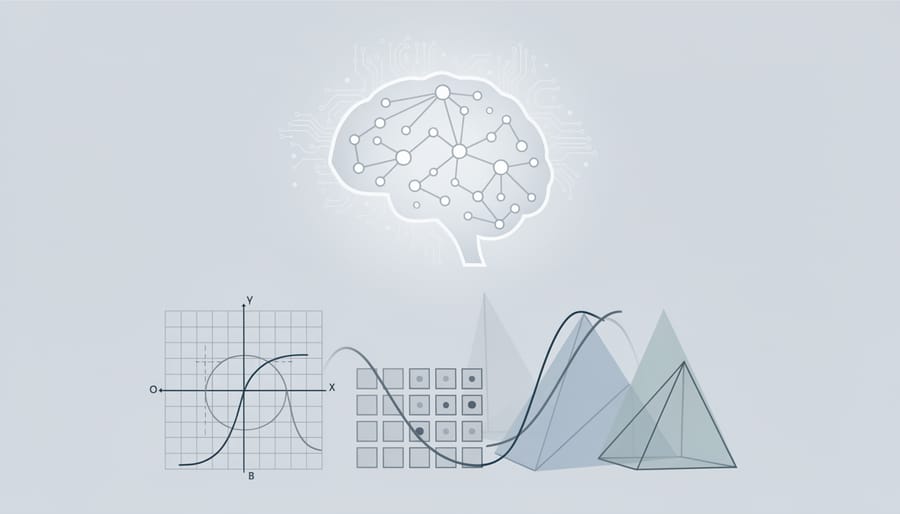
Why Mathematics Powers Everything in AI
The Core Math Domains You’ll Actually Use
Let’s demystify the mathematical foundation beneath AI by looking at the four core domains that power everything from chatbots to self-driving cars. Think of these as the different tools in your AI toolkit, each serving a specific purpose.
Linear algebra is the language that teaches machines to see and understand patterns. When you upload a photo to Instagram and it automatically recognizes your friend’s face, that’s linear algebra at work. Images become grids of numbers called matrices, and AI systems manipulate these matrices to detect edges, shapes, and eventually faces. Machine learning models also use vectors and matrices to store and process information, making this the most frequently used mathematical area in AI. The good news? You don’t need to master every theorem. Focus on understanding matrices, vectors, and basic operations like multiplication and transformation.
Calculus helps AI systems learn from their mistakes. Imagine teaching a robot to throw a basketball. Each time it misses, calculus allows the system to calculate exactly how to adjust the throw angle and force for the next attempt. This process, called gradient descent, uses derivatives to find the optimal solution by following the steepest path downhill on an error surface. While it sounds complex, you primarily need to grasp the concept of rates of change and how functions behave, rather than solving intricate calculus problems by hand.
Probability and statistics enable AI to make decisions under uncertainty. When your email filters spam or Netflix recommends your next binge-worthy series, these systems are using probability to make educated guesses based on patterns in data. You’ll encounter concepts like distributions, Bayesian reasoning, and hypothesis testing. These help machines understand confidence levels and make predictions even when information is incomplete.
Discrete math provides the structural backbone for algorithms and data organization. It includes topics like graph theory, which powers social network analysis and route optimization, and logic systems that help machines reason through problems systematically.
Starting From Scratch: Resources for Math Beginners
Interactive Platforms That Make Math Click
The anxiety of clicking “start” on a math course is real, especially when you’re trying to break into AI and machine learning. Fortunately, several interactive online courses have transformed how we learn mathematics, making concepts genuinely intuitive rather than memorizable.
Khan Academy remains the gold standard for building foundational skills from scratch. If you’re rusty on algebra or calculus, start with their Linear Algebra course. It’s completely free and breaks down matrix operations through bite-sized videos and immediate practice problems. The platform’s adaptive learning tracks your progress and adjusts difficulty accordingly, ensuring you’re neither bored nor overwhelmed. For AI learners specifically, focus on their Multivariable Calculus and Statistics & Probability courses after mastering linear algebra. Each video runs just 10-15 minutes, making it easy to fit learning into busy schedules.
Brilliant.org takes a dramatically different approach through problem-solving first, explanations second. Instead of watching lectures, you’re immediately thrown into interactive puzzles that build intuition. Their Neural Networks course is exceptional because it teaches the math alongside the concept, showing you why gradient descent requires calculus rather than just how to compute derivatives. The platform costs around 13 dollars monthly, but the active learning format helps concepts stick far better than passive video watching. Start with their Linear Algebra for Machine Learning path if you prefer hands-on exploration.
For visual learners craving deeper understanding, 3Blue1Brown’s YouTube channel is transformative. Grant Sanderson’s animated explanations of linear algebra and calculus reveal the geometric intuition behind formulas. His Essence of Linear Algebra series is mandatory viewing before diving into neural networks, as it shows what matrix multiplication actually does rather than just mechanical steps. Watch these videos to understand the why, then practice the how on Khan Academy or Brilliant.
The best strategy combines all three: use 3Blue1Brown for conceptual clarity, Khan Academy for structured practice, and Brilliant for active problem-solving.

Books That Don’t Put You to Sleep
Let’s be honest: most math textbooks could double as sleep aids. But when you’re trying to break into AI and machine learning, you need books that actually make sense and keep you awake. Here are some that manage to do both.
Mathematics for Machine Learning by Marc Peter Deisenroth, A. Aldo Faisal, and Cheng Soon Ong is the gold standard for a reason. It connects the dots between mathematical concepts and how they actually apply to machine learning algorithms. Unlike traditional math texts that throw equations at you without context, this book explains why you need to understand eigenvalues or gradient descent. The difficulty level sits somewhere between intermediate and advanced, so you’ll want some calculus and linear algebra basics first. The real win? It’s available as a free PDF on the authors’ website, and it doesn’t assume you remember everything from university.
For those who need to start from scratch or fill in knowledge gaps, the No Bullshit Guide to Math and Physics by Ivan Savov lives up to its name. Savov strips away the academic pretense and explains concepts in plain language. It covers everything from basic algebra through calculus and linear algebra in about 500 pages. The approach is refreshingly direct, with practical exercises that actually help concepts stick. Fair warning: it moves quickly, so you’ll need to work through the problems rather than just reading passively.
If you’re combining your math studies with beginner-friendly AI books, consider your current comfort level honestly. Start with No Bullshit Guide if you’re rusty on fundamentals, then graduate to Mathematics for Machine Learning when you’re ready to connect those concepts directly to AI applications. Both books reward active engagement over passive reading.
Intermediate Resources: Connecting Math to AI Applications
Hands-On Courses That Show You the Why
When you’re ready to move beyond scattered tutorials and YouTube videos, structured courses offer the guidance and progression you need. The best ones don’t just throw equations at you—they show you why these mathematical concepts matter and how they power real AI applications.
Andrew Ng’s Machine Learning course on Coursera remains the gold standard for a reason. Ng has a gift for breaking down intimidating concepts into digestible pieces. When he introduces linear algebra for neural networks, he doesn’t just present the formulas. Instead, he walks you through exactly how matrix multiplication speeds up calculations across thousands of data points simultaneously. You’ll understand that those matrices aren’t abstract math—they’re the engine that makes image recognition possible. The course includes programming assignments where you build algorithms from scratch, cementing the connection between the math you’re learning and the models you’re creating. Yes, there’s calculus involved, but Ng explains derivatives as “measuring how much our predictions improve” rather than diving into theoretical proofs.
Fast.ai takes a completely different approach that many beginners find refreshing. Rather than starting with theory, you build a working image classifier in your first lesson. Only after you’ve seen what’s possible does the course circle back to explain the mathematics underneath. This top-down approach helps you stay motivated because you’ve already experienced the payoff. When the course eventually covers concepts like gradient descent, you’re not wondering why it matters—you’ve already used it to train models. The practical Jupyter notebooks let you experiment immediately, adjusting learning rates and seeing how mathematical changes affect real results.
MIT’s OpenCourseWare offers a more traditional academic path through their Introduction to Deep Learning course. The materials include full video lectures, problem sets, and exams. While more rigorous than the other options, MIT structures content to show applications alongside theory. Each mathematical concept connects to current research problems, from natural language processing to autonomous vehicles. This approach works well if you want deeper understanding and don’t mind a steeper learning curve.
YouTube Channels That Break Down Complex Concepts
Sometimes the best way to grasp a challenging AI concept isn’t through dense textbooks, but through engaging visual explanations. YouTube has become an invaluable platform for demystifying complex mathematical and machine learning ideas, thanks to creators who combine storytelling with clear illustrations.
StatQuest with Josh Starmer stands out for making statistics and machine learning genuinely entertaining. Josh’s signature approach involves simple drawings, memorable sound effects, and his enthusiastic “BAM!” exclamations that punctuate key insights. For example, his explanation of gradient descent uses the analogy of finding the lowest point in a valley while blindfolded, taking small steps downhill. His videos on neural networks break down backpropagation into digestible chunks, using visual step-by-step animations that show exactly how weights adjust during training. This channel proves that you don’t need fancy graphics to create effective learning content, just clarity and genuine passion.
Arxiv Insights takes a different approach by diving into recent AI research papers and extracting the core ideas. The channel transforms academic papers filled with equations into accessible narratives, helping viewers understand cutting-edge developments without getting lost in mathematical notation. The host provides context about why certain techniques matter and how they connect to broader AI trends.
Two Minute Papers, hosted by Károly Zsolnai-Fehér, showcases the latest breakthroughs in AI research through stunning visualizations. Each episode demonstrates real applications, from image generation to physics simulations, making abstract concepts tangible. Károly’s infectious enthusiasm and his catchphrase “What a time to be alive!” remind viewers that learning AI is about witnessing an exciting technological revolution unfold in real-time.

Practice Platforms Where You Code the Math
Understanding math theory is one thing, but implementing concepts in code truly solidifies your learning. These platforms bridge that gap beautifully.
Kaggle Learn offers free, bite-sized courses where you write Python code directly in your browser. Their intro to machine learning course walks you through real datasets, helping you see how linear algebra and statistics come alive in algorithms. You’ll build actual models, not just read about them.
Google’s Machine Learning Crash Course combines video lectures with interactive exercises. It explains gradient descent and loss functions, then immediately lets you experiment with TensorFlow code. The visualizations make abstract math tangible, showing exactly how changing parameters affects your model’s performance.
DataCamp takes a slightly different approach with guided coding challenges. Their Python tracks include dedicated sections on NumPy and pandas, teaching you to manipulate matrices and perform statistical operations. Each lesson builds muscle memory through repetition, making mathematical transformations second nature.
Advanced Learning Materials for Deep Dives
The Textbooks Researchers Actually Reference
When you’ve mastered the fundamentals, three heavyweight textbooks stand as the gold standard in AI and machine learning research. These are the books that professionals actually keep on their desks and cite in academic papers. But here’s the thing: approaching these dense volumes requires strategy, not just determination.
Deep Learning by Ian Goodfellow, Yoshua Bengio, and Aaron Courville is often called the Bible of deep learning, and for good reason. This comprehensive text covers everything from basic linear algebra to cutting-edge neural network architectures. The beauty of this book lies in its structure. Part One covers the mathematical foundations you’ll need, Part Two dives into modern deep learning techniques, and Part Three explores research perspectives. If you’re feeling intimidated, here’s a practical approach: read Part One alongside your hands-on projects. When you’re building a neural network and encounter backpropagation, that’s when you dive into Chapter 6. Context makes the mathematics stick.
Pattern Recognition and Machine Learning by Christopher Bishop takes a more statistical approach to machine learning. This textbook excels at explaining the probabilistic foundations that underpin many AI algorithms. Real-world application: understanding Bishop’s treatment of Bayesian methods will transform how you approach uncertainty in model predictions. Start with Chapters 1 and 2, then jump to topics relevant to your current projects rather than reading cover-to-cover.
The Elements of Statistical Learning by Hastie, Tibshirani, and Friedman focuses on statistical learning theory and remains incredibly relevant despite being published years ago. The authors provide a free PDF online, making it accessible to everyone. Begin with Chapter 2’s overview of supervised learning, then use the book as a reference guide when you need deeper understanding of specific algorithms.
Here’s the key strategy for all three: don’t read them like novels. Treat them as reference encyclopedias. Work on real projects, encounter problems, then consult these texts for deep understanding.
Where to Find Cutting-Edge Research
Once you’ve built a solid mathematical foundation, accessing cutting-edge AI research helps you stay current with the field’s rapid evolution. Three platforms stand out for their accessibility and quality.
ArXiv.org serves as the primary repository where researchers share their latest findings before formal publication. The machine learning section updates daily with new papers. Start by reading abstracts to determine relevance, then scan the introduction and conclusion before diving into technical sections. Don’t worry if you don’t understand everything initially—even experienced researchers skim unfamiliar mathematical notation.
Papers with Code bridges the gap between theory and practice by pairing research papers with their implementation code. This platform is invaluable because you can see exactly how mathematical concepts translate into working algorithms. Search by task (like image classification or natural language processing) to find papers relevant to your interests, then examine both the mathematical formulations and their code implementations side by side.
Distill.pub takes a different approach, publishing interactive visual explanations of complex AI concepts. Their articles transform dense mathematical papers into engaging, understandable narratives with animations and interactive elements. This makes it an excellent starting point before tackling the original research.
When you read research papers, focus on identifying the core mathematical technique being used—whether it’s optimization, probability theory, or linear algebra—then connect it back to concepts you’ve already learned. This approach transforms intimidating papers into manageable learning opportunities.
Building Your Personalized Learning Path

The Self-Assessment That Saves Time
Before diving into resources, take fifteen minutes for an honest skills inventory. This quick assessment will save you countless hours of studying material you don’t actually need for your AI goals.
Start by asking yourself: What do I want to build or do with AI? A computer vision engineer needs different mathematical foundations than someone developing recommendation systems. Your answer determines your priority areas.
Here’s a practical framework. Rate your comfort level with these four core areas on a scale of 1-5:
Linear algebra: Can you explain what a matrix transformation does and why it matters? If you’re below a 3, this becomes your top priority since it underpins everything from neural networks to dimensionality reduction.
Calculus: Do you understand derivatives and why they’re essential for optimization? Rate yourself honestly. Most AI practitioners need calculus at a conceptual level rather than advanced theorem-proving ability.
Probability and statistics: Can you explain Bayes’ theorem in simple terms or interpret a confidence interval? This area is crucial for understanding model performance and uncertainty.
Programming mathematics: Are you comfortable translating mathematical notation into code? This bridge skill often gets overlooked but determines how quickly you’ll progress.
Based on your ratings, use this decision tree. If you scored below 3 in linear algebra, begin there regardless of your other scores. It’s the foundation. If linear algebra is solid but calculus is weak, focus on optimization-specific calculus concepts rather than comprehensive courses. For probability gaps, prioritize applied statistics over theoretical probability theory.
Match your weakest area to beginner resources first, then layer in intermediate materials as concepts click into place. This targeted approach means you’re always learning what you need next, not what a generic curriculum prescribes.
Study Strategies That Actually Stick
Learning about AI isn’t just about consuming content—it’s about making knowledge stick. Research shows that passive reading or video-watching leads to minimal retention. Instead, embrace active learning techniques that transform information into lasting understanding.
Start with spaced repetition, a scientifically-proven method where you review concepts at increasing intervals. After learning about linear algebra or neural networks, revisit the material after one day, then three days, then a week. This pattern strengthens memory pathways far better than cramming. Tools like Anki flashcards work perfectly for mathematical formulas and AI terminology.
More importantly, implement concepts in code immediately after learning them. Read about gradient descent? Open Jupyter Notebook and code it from scratch within 24 hours. This immediate application creates concrete associations between theory and practice. Don’t just run existing code—modify parameters, break things intentionally, and observe what happens. This experimentation deepens understanding in ways that passive study never can.
Project-based learning accelerates mastery even further. Instead of finishing an entire course before building something, tackle small projects alongside your studies. Learning about decision trees? Build a simple classifier for a dataset that interests you, even if it’s predicting your favorite coffee based on mood and weather. These personal projects make abstract concepts tangible and give you portfolio pieces that demonstrate real competency to future employers or collaborators.
Mastering the mathematics behind AI isn’t reserved for those with advanced degrees or natural genius. It’s a journey that anyone can embark on with the right resources and genuine commitment to consistent practice. The key is choosing a starting point that matches your current skill level rather than diving into advanced calculus when you’re still building foundational confidence.
If there’s one action to take after reading this guide, it’s simple: pick just one resource from your appropriate level and commit to working through it for the next two weeks. Whether that’s Khan Academy’s linear algebra course, 3Blue1Brown’s visual explanations, or a more advanced textbook on optimization, that single commitment can spark momentum that carries you forward.
Remember that mathematical learning in AI is never truly complete, even for researchers publishing cutting-edge papers. They continue studying new techniques, revisiting fundamentals from different angles, and adapting as the field evolves. This ongoing learning isn’t a weakness but rather the nature of working in such a dynamic domain. Every expert you admire started exactly where you are now, feeling uncertain about their mathematical readiness.
The mathematics you’re building today unlocks tomorrow’s possibilities. With solid foundations in linear algebra, calculus, and probability, you’ll move from following tutorials to designing your own neural network architectures, optimizing algorithms for real-world problems, and truly understanding why your models behave the way they do. Those exciting AI projects you’ve imagined creating are closer than you think. Start today, stay consistent, and watch as complex concepts gradually become intuitive tools in your creative arsenal.