Recent Posts

What Really Happens When Banks Investigate Your Fraud Claim

What Really Happens When Banks Investigate Your Fraud Claim

You report fraudulent charges on your credit card, and your bank reverses them within days—but what actually happened behind the scenes? Did a human detective scrutinize your case, or did an algorithm make a split-second decision?
The truth is more nuanced than most people realize. Banks do investigate fraud, but not in the traditional sense you might imagine. There’s no detective with a magnifying glass examining your transactions. Instead, modern banks deploy sophisticated artificial intelligence systems that analyze millions of data points in milliseconds, making fraud investigation faster and more accurate than ever before—though not without limitations.
When you dispute a charge…


The Environmental Cost of AI Nobody Talks About (And What’s Being Done to Fix It)

The Environmental Cost of AI Nobody Talks About (And What’s Being Done to Fix It)

Every time you ask ChatGPT a question, you’re leaving an environmental footprint equivalent to charging your smartphone multiple times. Behind the sleek interfaces of AI assistants and machine learning models lies a sprawling infrastructure of data centers consuming massive amounts of electricity and water, contributing significantly to carbon emissions. The environmental toll of AI presents a paradox: the same technology promising to solve climate change through predictive modeling and resource optimization is itself an accelerating contributor to environmental degradation.

How AI is Building Materials Atom by Atom (And Why It Matters to You)

How AI is Building Materials Atom by Atom (And Why It Matters to You)

Imagine building materials atom by atom, like assembling a structure with LEGO bricks so small that 50,000 of them would fit across the width of a human hair. This is nanotechnology—the science of manipulating matter at scales between 1 and 100 nanometers—and it’s revolutionizing how we create, enhance, and think about materials.
At this microscopic scale, ordinary materials behave extraordinarily. Gold nanoparticles appear red instead of golden. Carbon atoms arranged in hollow tubes become stronger than steel yet six times lighter. These aren’t magic tricks; they’re quantum effects that emerge when you work at dimensions where the rules of classical physics give way to quantum …

Build Your Own AI Headshot Generator (Without Being a Coding Expert)

Build Your Own AI Headshot Generator (Without Being a Coding Expert)

Professional headshots cost hundreds of dollars and require scheduling, travel, and multiple outfit changes. Building your own AI headshot generator eliminates these barriers while giving you unlimited variations at a fraction of the cost. Whether you’re a developer exploring machine learning applications or a business owner seeking a scalable solution, the best AI headshot generators in 2026 can be accessed online to create photorealistic portraits from uploaded selfies without the cost and logistics of a traditional photoshoot, which can improve your image on pages for searching new jobs …

Why Reinforcement Learning Actually Works (The Math Behind the Magic)

Why Reinforcement Learning Actually Works (The Math Behind the Magic)

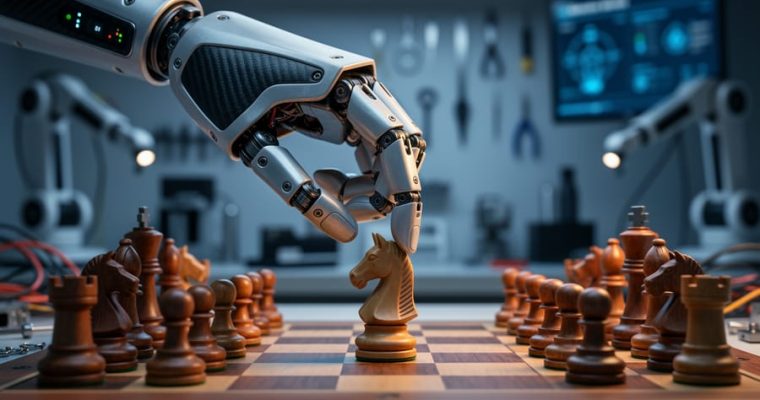
Reinforcement learning agents master complex tasks through trial and error, but beneath this simple concept lies an elegant mathematical framework that transforms vague notions of “learning from experience” into precise, computable algorithms. If you’ve wondered how a computer program learns to play chess at superhuman levels or how robots develop the ability to walk, the answer begins with understanding Markov Decision Processes, value functions, and the Bellman equation.
Think of reinforcement learning as teaching a child to ride a bicycle. The child doesn’t receive explicit instructions for every muscle movement; instead, they receive feedback—staying upright feels …

Why NVIDIA’s H100 GPU Changed Everything About Training AI Models

Why NVIDIA’s H100 GPU Changed Everything About Training AI Models

The artificial intelligence revolution isn’t happening in the cloud—it’s happening inside specialized processors that can handle trillions of calculations per second. Among these technological marvels, NVIDIA’s H100 GPU stands as the powerhouse driving everything from ChatGPT’s conversational abilities to breakthrough drug discoveries that traditionally took years to achieve.
Unlike the graphics cards in gaming computers, the H100 represents a fundamental reimagining of what a processor can do. While your laptop GPU renders video games at 60 frames per second, the H100 simultaneously trains AI models on datasets containing billions of parameters, processes natural language …

Why Your Procurement Team Needs AI Before Your Competitors Get It

Why Your Procurement Team Needs AI Before Your Competitors Get It

Procurement teams waste countless hours on repetitive tasks like purchase order processing, invoice matching, and vendor communications—tasks that artificial intelligence now handles with remarkable efficiency. AI transforms procurement from a largely manual, reactive function into a strategic powerhouse that predicts supply chain disruptions, identifies cost-saving opportunities, and optimizes vendor relationships in real-time.
Consider how AI analyzes spending patterns across thousands of transactions to flag duplicate payments or negotiate better contract terms based on market data. Machine learning algorithms evaluate vendor performance by processing delivery times, quality metrics, and …

Why AI Leaders Need Three Levels of Thinking (Not Just One)

Why AI Leaders Need Three Levels of Thinking (Not Just One)

Leading AI teams requires mastering three distinct levels that transform capable technicians into visionary leaders. Whether you’re managing your first machine learning project or scaling an enterprise AI division, understanding how to operate effectively at the personal, team, and organizational level determines your impact.
The personal level demands technical credibility combined with emotional intelligence. You must code alongside your team while recognizing when a data scientist needs support versus space. This foundation of self-awareness and continuous learning establishes trust that purely theoretical management cannot achieve.
At the team level, your focus shifts to orchestrating…

Why Your Phone Can’t Handle That AI Model (Yet)

Why Your Phone Can’t Handle That AI Model (Yet)

Your phone can stream 4K video and run photorealistic games, yet struggles to generate a simple paragraph using AI. This isn’t a design flaw—it’s the reality of running large language models on consumer devices. The same ChatGPT that responds instantly through your browser would crawl to a halt if installed directly on your laptop, assuming it could even fit.
Device limitations for on-device LLMs stem from three fundamental constraints: memory capacity, processing power, and energy consumption. Modern AI models like GPT-4 require hundreds of gigabytes of RAM and specialized hardware that most personal devices simply don’t possess. When a model needs 175 billion parameters to …

Why Your AI Is Making Unfair Decisions (And How Fairness Data Fixes It)

Why Your AI Is Making Unfair Decisions (And How Fairness Data Fixes It)

In 2018, Amazon scrapped an AI recruiting tool that systematically downgraded resumes from women. The algorithm had learned bias from a decade of hiring data that predominantly featured male candidates. This failure wasn’t about bad code—it was about bad data and the absence of fairness considerations baked into the system from day one.
Fairness data refers to the information deliberately collected, curated, and analyzed to identify, measure, and mitigate bias in AI systems throughout their entire lifecycle. Unlike traditional training data, fairness data includes demographic attributes, protected characteristics, performance metrics across different groups, and contextual information about …