

Your machine learning model performed beautifully during testing, achieving 95% accuracy on validation data. Two months after deployment, customer complaints flood in. The model is making bizarre predictions, but your standard monitoring dashboards show everything running normally. Server uptime? Perfect. API response times? Excellent. Model accuracy in production? You have no idea.
This scenario plays out daily across organizations deploying ML systems. Traditional software monitoring tools track infrastructure health—servers, memory, latency—but remain blind to the unique challenges of machine learning. They cannot detect when your model encounters data it has never seen before, when predictions drift from expected patterns, or when training-serving skew silently degrades performance.
ML observability fills this critical gap. Unlike basic monitoring that asks “Is the system running?”, observability for machine learning answers deeper questions: “Is the model behaving as expected? Has the incoming data changed? Are predictions still reliable?” It provides visibility into model inputs, outputs, performance metrics, and data distributions over time.
The stakes are substantial. A recommendation engine showing irrelevant products costs revenue. A fraud detection model missing obvious patterns exposes financial risk. A healthcare prediction system making unreliable diagnoses threatens patient safety. Without observability, these failures remain invisible until business impact becomes unavoidable.
Understanding ML observability transforms how you build production systems. Instead of reacting to failures after they occur, you detect issues early—spotting data drift before accuracy plummets, identifying feature anomalies before they corrupt predictions, and maintaining model quality as real-world conditions evolve. This shift from reactive troubleshooting to proactive maintenance represents the difference between ML systems that merely run and those that reliably deliver business value.
What Is ML Observability (And Why It’s Different from Regular Monitoring)
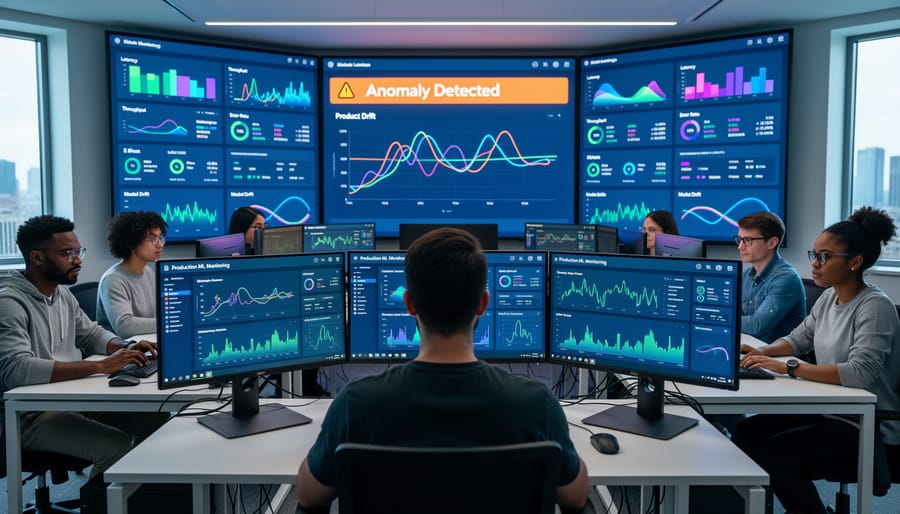
The Three Pillars of ML Observability
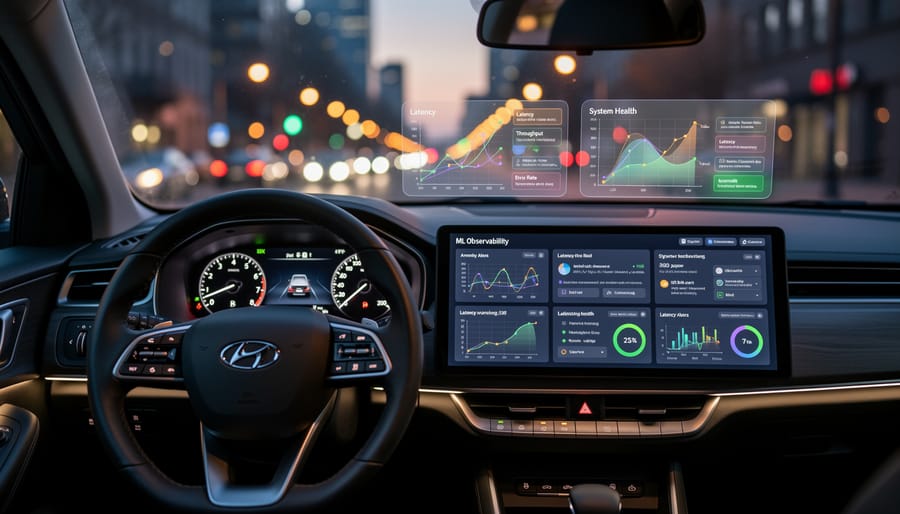
Think of ML observability like a car dashboard. Just as your dashboard displays critical information about your vehicle’s health, ML observability provides essential insights into your machine learning system. There are three fundamental pillars that keep everything running smoothly.
First is model performance monitoring, which tracks how well your ML model makes predictions over time. This is like your speedometer—it tells you if you’re moving at the right pace. Your model might have worked perfectly during development, but real-world data can cause accuracy to drift. This pillar catches when your fraud detection system starts missing suspicious transactions or your recommendation engine begins suggesting irrelevant products.
Second is data quality monitoring, the equivalent of your fuel gauge. It ensures the data feeding your model remains clean and consistent. If your training data showed customers aged 18-80, but production data suddenly includes impossible values like age 150, you have a problem. This pillar detects missing values, unexpected formats, or distribution shifts that could poison your model’s predictions.
Third is infrastructure health, your engine temperature warning. Even when built with reliable ML frameworks, systems need computing resources, memory, and network connectivity to function. This pillar monitors response times, server loads, and system errors. If your model takes 10 seconds instead of 100 milliseconds to respond, users will notice.
Together, these three pillars provide complete visibility into your ML system’s wellness, allowing you to spot and fix issues before they impact users.
The Silent Killers: What Goes Wrong When You Can’t See Inside Your Models
Model Drift: When Your AI Starts Making Bad Decisions
Imagine you built a restaurant recommendation system in 2019 that worked beautifully, learning from millions of user preferences. Then 2020 arrived. Suddenly, your AI started suggesting fine-dining establishments to users who now only wanted contactless delivery options. What happened? Your model encountered drift.
Model drift occurs when the relationship between your AI’s inputs and outputs changes over time, causing performance to degrade silently. There are two main types you need to understand.
Data drift happens when the input data itself changes. Think of a fraud detection system trained on normal spending patterns. When everyone suddenly started shopping online during the pandemic instead of in physical stores, the data looked completely different from what the model learned. The system wasn’t broken, but the world around it had shifted.
Concept drift is sneakier. This occurs when the relationship between inputs and desired outcomes changes. Consider a job applicant screening tool trained on successful hires from 2015. By 2023, the skills that predict success might be entirely different due to remote work and new technologies, even though applicant profiles might look superficially similar.
The dangerous part? Drift happens gradually. Your model doesn’t throw errors or crash. It just quietly starts making worse decisions, day by day. Without proper monitoring, you might not notice until your users complain or business metrics tank. That’s precisely why ML observability has become essential for anyone running production AI systems.

Data Quality Issues That Poison Your Predictions
Even the most sophisticated ML model can fail spectacularly when fed poor-quality data. Think of it like cooking with spoiled ingredients—no matter how skilled the chef, the meal won’t turn out right.
Missing values represent one of the most common culprits. Imagine a pricing model that predicts product costs based on features like category, weight, and supplier rating. If null values suddenly appear in the weight field due to a sensor malfunction, your model might default to bizarre predictions, recommending a $5 price for a luxury item or $500 for a basic widget.
Outliers can be equally destructive. A single erroneous transaction showing a customer age of 250 years could skew your entire customer segmentation model, leading to misguided marketing campaigns.
Schema changes in your data pipeline infrastructure pose another threat. When a data source renames a column from “customer_age” to “age” without warning, your model suddenly loses access to a critical feature, degrading performance overnight.
Data pipeline failures can create gaps in your training data or introduce duplicate records, silently corrupting model accuracy. Without proper monitoring, these issues often go undetected until customers complain or revenue takes a hit.
Performance Degradation You Never See Coming
Unlike traditional software where bugs announce themselves with error messages and crashes, machine learning models fail quietly. Your model might still return predictions every single time, but those predictions could be getting worse without triggering a single alert.
Consider accuracy degradation. A fraud detection model trained on 2023 data might slowly lose effectiveness as scammers adapt their tactics in 2024. The model runs perfectly from a technical standpoint, but catches fewer fraudulent transactions each month. Without proper monitoring, you might only discover this when quarterly reports show rising fraud losses.
Bias creep presents an even trickier challenge. Imagine a hiring recommendation system that gradually shifts its suggestions toward certain demographics because the training data reflected past hiring patterns. The model didn’t break, it just learned and amplified existing biases that compound over time.
Prediction distribution shifts are equally subtle. If your customer churn prediction model suddenly starts flagging 40% of users as high-risk instead of the usual 10%, something has changed. Maybe your user base evolved, maybe the model drifted, but traditional monitoring tools designed for uptime and latency won’t catch this.
These issues slip past conventional monitoring because the system never technically fails. It keeps running, keeps predicting, and keeps deceiving you into thinking everything works fine.
How ML Observability Infrastructure Actually Works

Metrics That Matter: What to Track
Knowing what to measure is half the battle in ML observability. Think of these metrics as your model’s vital signs – each tells you something important about its health and performance.
Prediction accuracy should be your starting point. This tracks how often your model makes correct predictions in the real world. Unlike training accuracy, which shows historical performance, production accuracy reveals whether your model still works as intended. For example, if your spam filter suddenly drops from 95% to 75% accuracy, you know something’s wrong. Monitor this daily or even hourly for mission-critical applications.
Latency measures how quickly your model responds to requests. A recommendation engine that takes 10 seconds to suggest products will frustrate users, even if its suggestions are perfect. Track both average latency and 95th percentile latency – the latter catches those occasional slowdowns that can ruin user experience. Aim to keep latency consistent; sudden spikes often signal infrastructure problems or model complexity issues.
Data distribution statistics help you spot data drift. These metrics compare incoming data to your training data. Imagine you trained a loan approval model on 2022 data, but in 2024, interest rates have dramatically changed. Distribution statistics would flag this shift, alerting you that your model might make unreliable predictions because it’s seeing patterns it never learned.
Feature importance changes reveal when your model starts relying on different patterns. If your fraud detection system suddenly weighs location less heavily than before, it might indicate the model has adapted to new fraud patterns – or that something’s broken. Regular monitoring helps you understand whether your model is evolving appropriately or drifting off course.
Logging and Tracking Model Inputs and Outputs
At the heart of ML observability lies a simple but powerful practice: systematically logging what goes into your models and what comes out. Think of it as creating a detailed flight recorder for your machine learning system—capturing every prediction your model makes, the input data it received, and eventually, the actual outcomes (ground truth labels) once they’re available.
Why does this matter? Imagine your fraud detection model suddenly flags legitimate transactions as suspicious. Without proper logging, you’re essentially flying blind, unable to pinpoint when the problem started or what inputs triggered the faulty predictions. With comprehensive logs, you can replay scenarios, identify patterns in misclassifications, and trace issues back to their source—whether that’s data drift, a bug in preprocessing, or changes in user behavior.
This logging creates an invaluable audit trail. When stakeholders question a model’s decision (like why a loan application was denied), you can retrieve the exact inputs and reasoning. For compliance-heavy industries like healthcare or finance, this documentation isn’t just helpful—it’s often legally required.
However, logging everything raises important privacy considerations. You’re potentially storing sensitive personal information, so implementing proper data anonymization, encryption, and retention policies is essential. Consider pseudonymizing user identifiers, redacting sensitive fields, and establishing clear data deletion schedules that balance operational needs with privacy regulations like GDPR or CCPA. The goal is comprehensive observability without compromising user trust or regulatory compliance.
Alerting: Getting Notified Before Disaster Strikes
Imagine you’re a pilot flying a plane. You don’t want alarms blaring constantly for every minor fluctuation, but you definitely need warnings when something serious goes wrong. That’s exactly how alerting works in ML observability.
Automated alerts act as your early warning system, monitoring your models around the clock. When your model’s accuracy drops below a certain threshold, when prediction patterns suddenly shift, or when data drift threatens your model’s reliability, alerts notify your team immediately. Modern cloud AI platforms make setting up these alerts straightforward, letting you define specific conditions that trigger notifications.
The trick is finding the right balance. Too many alerts and your team experiences “alarm fatigue,” where important warnings get lost in the noise. Imagine receiving dozens of notifications daily for minor issues. Eventually, you’ll start ignoring them all, potentially missing critical problems. Too few alerts, however, and you might discover major failures only when customers complain.
The solution lies in smart alert configuration. Focus on metrics that truly matter to your business outcomes. Set thresholds based on actual impact rather than arbitrary numbers. For example, alert when model accuracy drops by 10 percent rather than every 1 percent fluctuation. Use severity levels to differentiate between “check this soon” and “fix this now” situations.
Consider implementing alert escalation policies. Minor anomalies might trigger email notifications, while severe drift could page an on-call engineer. This tiered approach ensures urgent issues get immediate attention while routine monitoring stays manageable.
Real-World Applications: ML Observability in Action
E-commerce: Catching Recommendation Engine Problems
A major online retailer discovered their recommendation engine was suggesting winter coats to customers browsing swimwear—a puzzling mismatch that could cost them sales. The culprit? A silent data pipeline failure that their ML observability system caught before it spiraled into a PR nightmare.
The problem started when a scheduled data refresh failed, causing the model to rely on outdated seasonal inventory data from three months prior. Without observability tools monitoring data freshness and prediction patterns, this could have gone unnoticed for weeks. Instead, their system flagged unusual spikes in recommendation diversity scores and detected that product categories weren’t aligning with current customer browsing behavior.
The observability dashboard revealed the exact moment the data pipeline stopped updating, allowing engineers to trace the issue back to a server timeout during the nightly batch process. Within hours, they restored the pipeline and retrained the model with current data.
This incident highlights why monitoring your ML systems isn’t optional—it’s essential insurance against silent failures that can damage customer trust and revenue. Even well-designed models fail when fed incorrect data, making continuous observation of your entire ML pipeline a business necessity.
Financial Services: Detecting Fraud Model Drift
Imagine a bank’s fraud detection system that’s been working perfectly for months, catching suspicious transactions with 95% accuracy. Then suddenly, fraudulent charges start slipping through unnoticed. What happened?
This real-world scenario illustrates model drift in action. Fraudsters constantly evolve their tactics—switching from large, obvious purchases to smaller, legitimate-looking transactions spread across different merchants. When this happens, the patterns your model learned during training no longer match current fraud behavior.
Without ML observability, you might only discover this problem after customers report unauthorized charges. But with proper monitoring, you can catch drift early. Key observability metrics to track include prediction confidence scores (are they dropping?), transaction approval rates (are they changing unexpectedly?), and feature distributions (are fraudsters using new merchant categories?).
For example, if your model suddenly shows decreased confidence in its predictions or if the distribution of transaction amounts shifts significantly, these are red flags. Banks using observability dashboards can spot these changes within hours, not weeks, allowing them to retrain models with fresh data before fraud losses mount. This proactive approach transforms a reactive problem into a manageable challenge.
Healthcare: Ensuring Diagnostic Model Reliability
In medical imaging, ML observability can literally be a matter of life and death. Consider a diagnostic model trained to detect lung cancer from chest X-rays. Without proper monitoring, the model might perform exceptionally well on images from one hospital’s equipment but miss critical indicators when deployed across facilities with different imaging machines or patient demographics.
ML observability tracks this model’s performance across diverse patient populations, monitoring for prediction confidence drops, unusual error patterns, or demographic disparities. For instance, if the model’s accuracy suddenly decreases for images from a specific age group or shows inconsistent results between morning and evening shifts (when different equipment settings might be used), observability tools flag these issues immediately. This continuous monitoring ensures the model maintains its diagnostic reliability regardless of where or when it’s used, protecting patient safety while building trust in AI-assisted healthcare decisions.
Getting Started: Building Your ML Observability Stack
Popular Tools and Platforms
The ML observability landscape offers several robust tools to help you monitor your models effectively. Let’s explore some popular options that teams are using today.
For those starting out, Evidently AI provides an open-source solution that’s particularly beginner-friendly. It helps track data drift and model performance with intuitive visualizations, making it easy to spot when something goes wrong. Another open-source favorite is Prometheus combined with Grafana, which many teams already use for infrastructure monitoring and can extend to ML metrics.
On the commercial side, Arize AI specializes in ML observability with features like automated drift detection and root cause analysis. It’s designed specifically for machine learning workflows, offering pre-built dashboards that connect directly with popular Python ML libraries. Datadog has also expanded into ML monitoring, letting teams view model metrics alongside their existing infrastructure data in one place.
For enterprise environments, Fiddler focuses on model explainability and monitoring, helping teams understand not just that a model is failing, but why. Similarly, WhyLabs offers a privacy-first approach, allowing you to monitor models without exposing sensitive data.
The right tool depends on your needs. If you’re experimenting with your first production model, starting with open-source options like Evidently AI makes sense. As your ML systems grow more complex, commercial platforms offer advanced features like automated alerting, team collaboration tools, and deeper integration capabilities. Many teams actually combine multiple tools, using open-source solutions for development and commercial platforms for production monitoring.
Start Simple: Your First Observability Dashboard
Building your first observability dashboard doesn’t have to be overwhelming. Think of it like learning to drive—you start with the basics before mastering advanced maneuvers. Let’s break down the essential first steps.
Begin with the fundamental performance metrics that directly impact your users. Start tracking your model’s prediction latency (how long it takes to generate results), throughput (how many predictions you’re handling per minute), and error rates. These three metrics provide immediate visibility into whether your model is functioning properly. For example, if your recommendation engine suddenly takes 10 seconds instead of 2 seconds to respond, you’ll spot it immediately.
Next, monitor data quality at the input level. Set up simple checks for missing values, unexpected data types, or values outside expected ranges. If your model expects customer ages between 18-100 but suddenly receives negative numbers, that’s a red flag worth catching early.
Most cloud ML platforms offer built-in monitoring tools that make this setup straightforward. Start with their default dashboards and customize as you learn what matters most for your specific use case.
For your first alerts, focus on critical failures rather than minor fluctuations. Set thresholds that trigger notifications when error rates exceed 5 percent or when latency doubles from baseline levels. This prevents alert fatigue while ensuring you catch serious issues.
Once your basic dashboard is running for a week or two, review the data patterns. You’ll naturally discover which additional metrics deserve attention. Maybe you notice prediction confidence scores dropping on weekends, or certain features consistently missing. Let these insights guide your next iteration, gradually building a more sophisticated monitoring system that grows with your needs.
As machine learning systems become increasingly embedded in critical business operations, ML observability has evolved from a nice-to-have feature into essential infrastructure. Think of it as insurance against silent failures—those invisible issues that can erode model performance, user trust, and business value without triggering any alarms.
The good news? You don’t need to build a comprehensive observability platform on day one. Start with the basics: track your model’s key performance metrics, log predictions alongside inputs, and set up simple alerts for obvious anomalies. As you gain experience with what matters most for your specific use case, you can gradually expand to more sophisticated monitoring like data drift detection, feature quality checks, and automated retraining triggers.
Consider how a simple e-commerce recommendation system might begin by just monitoring click-through rates, then add tracking for recommendation diversity, and eventually implement full pipeline observability including data freshness checks and model latency metrics. This incremental approach makes the task manageable while still providing value at each stage.
Looking ahead, ML observability will become as standard as version control and testing are in traditional software development. As organizations deploy more AI systems and regulatory frameworks mature, the ability to explain, monitor, and maintain machine learning models won’t just be a competitive advantage—it will be a baseline requirement. The question isn’t whether to invest in ML observability, but how quickly you can make it part of your standard practice.