

YOLO (You Only Look Once) revolutionized object detection by introducing real-time processing capabilities that transformed how AI perceives and analyzes visual data. As a groundbreaking approach to optimizing AI model speed, YOLO processes entire images in a single forward pass through its neural network, achieving unprecedented efficiency in computer vision tasks.
Unlike traditional object detection methods that require multiple passes and region proposals, YOLO divides images into a grid system and simultaneously predicts bounding boxes and class probabilities. This unified approach delivers inference speeds up to 1000 times faster than conventional models while maintaining impressive accuracy levels.
Today, YOLO stands at the forefront of modern computer vision, powering applications from autonomous vehicles to medical imaging analysis. Its latest iterations, including YOLOv5 and YOLOv7, continue pushing boundaries in speed-accuracy trade-offs, making real-time object detection accessible across diverse computing platforms, from powerful GPUs to resource-constrained edge devices.
For developers and researchers seeking state-of-the-art performance in computer vision tasks, YOLO represents more than just an algorithm—it’s a paradigm shift in how we approach visual AI, combining simplicity, speed, and precision in one elegant solution.
What Makes YOLO AI Different from Traditional Optimization Methods
The Speed-Accuracy Trade-off Revolution
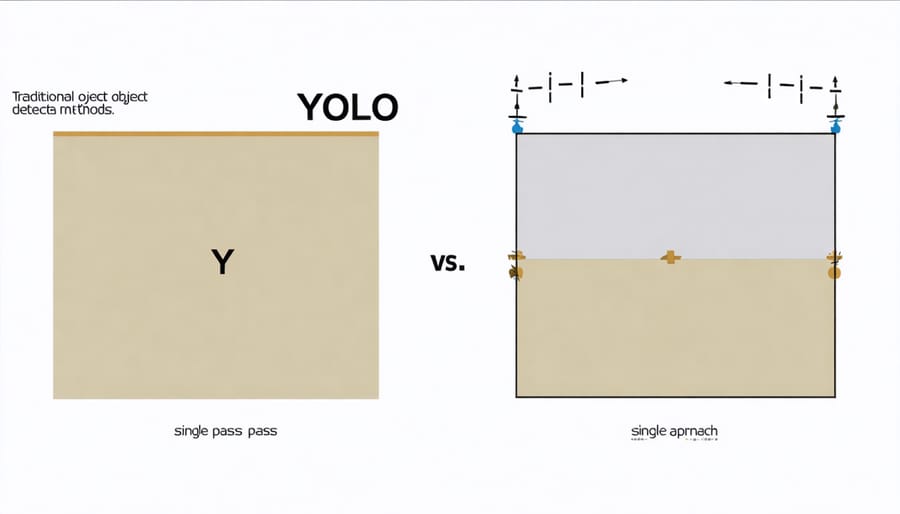
YOLO revolutionized object detection by introducing a groundbreaking approach to the classic speed-accuracy dilemma. Instead of processing images through multiple stages like traditional models, YOLO divides images into a grid and performs detection in a single pass, dramatically reducing computation time.
This innovative approach means YOLO can process images at speeds up to 45 frames per second on standard GPUs, making it suitable for real-time applications like autonomous vehicles and surveillance systems. While early versions sacrificed some accuracy for speed, newer iterations have significantly narrowed this gap through architectural improvements and training optimizations.
The model achieves this balance through several clever design choices. It uses anchor boxes to predict object boundaries, employs feature pyramids for better scale handling, and implements sophisticated loss functions that weigh both localization and classification accuracy. These elements work together to ensure that YOLO maintains high detection accuracy while operating at speeds that were previously thought impossible.
Modern YOLO variants now offer different model sizes, allowing developers to choose the perfect balance between speed and accuracy for their specific use case, from lightweight mobile applications to high-precision industrial systems.
Single-Pass Architecture Explained
YOLO’s single-pass architecture revolutionized object detection by processing images through a single neural network in one go, unlike traditional methods that required multiple passes. Think of it as looking at a photograph once and immediately identifying all objects, their locations, and classifications – just as humans do naturally.
The network divides an input image into a grid of cells, where each cell is responsible for detecting objects that appear within its boundaries. In a single forward pass, the network simultaneously predicts bounding boxes, confidence scores, and class probabilities for all potential objects. This unified approach eliminates the need for complex pipelines and separate region proposal networks.
What makes this architecture particularly efficient is its ability to consider the entire image’s context at once. By processing the full image in a single pass, YOLO can understand global features and relationships between objects, leading to fewer background errors compared to systems that look at isolated regions separately.
This streamlined approach not only makes YOLO faster than previous detection systems but also more accurate in real-world applications, as it learns generalizable representations of objects in their natural context.
Real-World Applications of YOLO AI Optimization
Computer Vision Breakthroughs
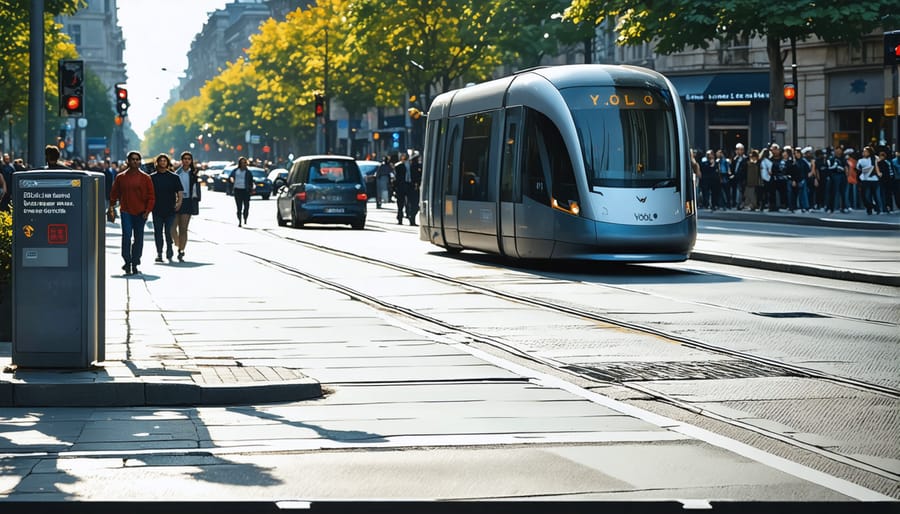
YOLO has revolutionized computer vision applications with remarkable breakthroughs in real-time object detection. One of the most impressive achievements is its ability to identify multiple objects in a single frame simultaneously, making it invaluable for autonomous vehicles and surveillance systems. For instance, Tesla’s autopilot system uses YOLO-inspired architectures to detect cars, pedestrians, and road signs in milliseconds.
In retail environments, YOLO has transformed inventory management by accurately tracking products on shelves and monitoring customer behavior patterns. Amazon Go stores leverage similar technology to enable their checkout-free shopping experience, detecting when items are picked up or returned to shelves with remarkable precision.
Sports analytics has also benefited significantly from YOLO’s capabilities. During live broadcasts, it can track player movements, ball positions, and game statistics in real-time, enhancing viewer experience and providing valuable insights for coaches and analysts.
Medical imaging has seen particular advancement, with YOLO-based systems helping radiologists identify potential tumors and anomalies in X-rays and MRI scans. These systems can process hundreds of images quickly while maintaining high accuracy rates, serving as a reliable second opinion for healthcare professionals.
The model’s efficiency in processing video streams has made it essential for modern security systems, enabling real-time threat detection and crowd monitoring at large events or public spaces.
Industrial Implementation Success Stories
YOLO’s impact in real-world industrial applications has been remarkable, with numerous companies successfully implementing the model to solve complex vision-based challenges. Amazon, for instance, uses YOLO in their Amazon Go stores for real-time customer tracking and automated checkout processes, processing thousands of simultaneous detections with minimal latency.
In the automotive industry, Tesla has incorporated YOLO-based systems into their autonomous driving technology. The model helps identify road signs, pedestrians, and other vehicles in real-time, contributing to safer self-driving capabilities. The fast processing speed of YOLO makes it particularly suitable for this time-critical application.
Manufacturing giant Siemens has implemented YOLO in their quality control systems, where it inspects products on assembly lines at speeds of up to 30 frames per second. This implementation has reduced defect rates by 27% while increasing production throughput by 15%.
Security firm Axis Communications utilizes YOLO in their surveillance cameras for intelligent threat detection. Their system processes video feeds in real-time, identifying suspicious activities and potential security breaches with 95% accuracy.
Agricultural technology company John Deere has integrated YOLO into their precision farming equipment, enabling automated weed detection and targeted spraying. This implementation has reduced herbicide usage by up to 90% while maintaining crop yield, demonstrating both environmental and economic benefits.
These success stories highlight YOLO’s versatility and effectiveness across diverse industrial applications, showcasing its ability to deliver reliable results in demanding real-world conditions.
Getting Started with YOLO AI Model Optimization
Essential Setup Requirements
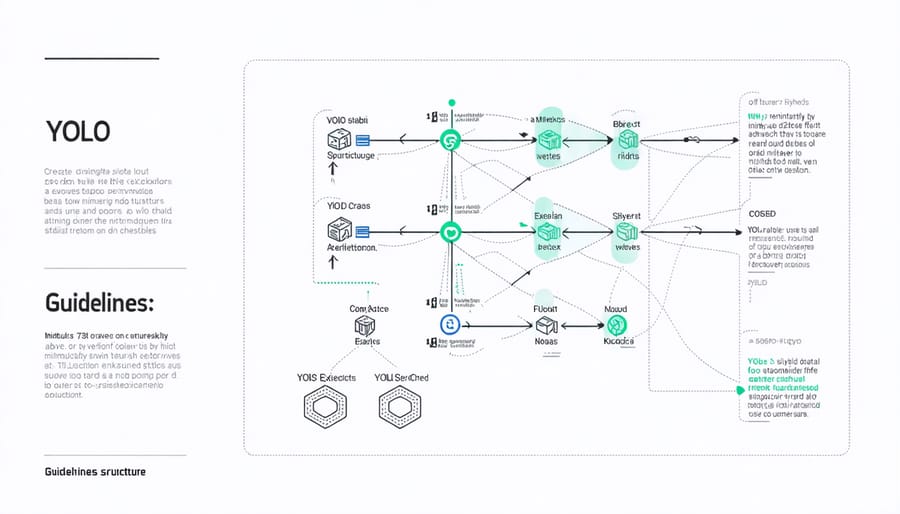
To get started with YOLO AI model implementation, you’ll need to ensure your system meets specific hardware and software requirements. For optimal performance, a GPU with at least 8GB VRAM is recommended – NVIDIA cards are preferred due to their excellent CUDA support. While CPU-only setups can work for testing, they’re not ideal for training or real-time inference.
Your system should have minimum 16GB RAM and sufficient storage space (at least 100GB) for datasets and model weights. For software dependencies, Python 3.7 or higher is essential, along with PyTorch as the primary deep learning framework. You’ll also need OpenCV for image processing and NumPy for numerical computations.
Before diving into YOLO implementation, it’s crucial to have a proper AI development environment setup with all necessary libraries and tools. Consider using virtual environments (like conda or venv) to manage dependencies effectively and avoid conflicts with other projects. Git installation is also recommended for version control and accessing pre-trained models from repositories.
Remember to install CUDA and cuDNN if you’re using an NVIDIA GPU to leverage hardware acceleration for faster model training and inference.
First Steps in Implementation
Getting started with YOLO (You Only Look Once) implementation is straightforward when you follow a systematic approach. First, ensure your development environment has Python installed, along with essential libraries like PyTorch or TensorFlow, depending on your preferred framework.
Begin by installing the necessary dependencies using pip:
“`
pip install ultralytics
pip install opencv-python
pip install numpy
“`
Once the setup is complete, you can import the YOLO model from the ultralytics library. The basic implementation requires just a few lines of code:
“`python
from ultralytics import YOLO
model = YOLO(‘yolov8n.pt’)
“`
For your first object detection task, you can use a pre-trained model, which eliminates the need for immediate training. YOLOv8 offers several pre-trained weights optimized for different scenarios, from ‘nano’ (smallest and fastest) to ‘extra-large’ (most accurate).
To perform inference on an image:
“`python
results = model(‘path/to/image.jpg’)
results.show()
“`
This simple implementation will detect common objects in your image and display the results with bounding boxes and confidence scores. The model can identify up to 80 different object classes out of the box.
For real-time detection using your webcam:
“`python
results = model.predict(source=0, show=True)
“`
Remember to handle the model’s output appropriately for your specific use case. The results object contains detailed information about detected objects, including their positions, classes, and confidence scores, which you can process further based on your application’s needs.
Common Challenges and Solutions
While YOLO is a powerful object detection model, developers often encounter several challenges during implementation. One common issue is dealing with small object detection, where the model struggles to identify objects that occupy a tiny portion of the image. This can be addressed by increasing input resolution or implementing feature pyramid networks.
Memory constraints pose another significant challenge, especially when working with larger YOLO variants. To tackle this, practitioners can employ techniques like model performance optimization through pruning, quantization, or using lighter versions of YOLO architectures.
False positives and confidence thresholds often require careful balancing. Setting too low a threshold leads to numerous false detections, while too high a threshold might miss important objects. The solution typically involves experimenting with different confidence thresholds and implementing non-maximum suppression carefully.
Training data quality and quantity can significantly impact model performance. To overcome this, augment your dataset with techniques like rotation, scaling, and lighting variations. Transfer learning can also help when working with limited datasets.
Real-time processing requirements can be challenging, especially on edge devices. Consider using TensorRT optimization, model compression techniques, or hardware acceleration to achieve better inference speeds. Some developers also find success by reducing input resolution or using smaller backbone networks when speed is crucial.
Class imbalance in training data can lead to biased predictions. Combat this by implementing techniques like focal loss or adjusting class weights during training to ensure balanced learning across all object categories.
YOLO AI models have revolutionized object detection and computer vision by offering an exceptional balance of speed and accuracy. Their ability to process images in real-time while maintaining high precision has made them invaluable across various industries, from autonomous vehicles to security systems and retail analytics. The continuous evolution of YOLO architecture, from its initial version to the latest iterations, demonstrates its adaptability and growing potential in addressing complex AI challenges.
Looking ahead, YOLO models are poised to play an even more significant role in AI development. The integration of advanced features like dynamic learning rates and automated hyperparameter tuning suggests a future where model optimization becomes increasingly automated and efficient. As hardware capabilities improve and new optimization techniques emerge, we can expect YOLO models to become even faster and more accurate.
The democratization of YOLO technology through open-source implementations and user-friendly frameworks has made it accessible to a broader community of developers and researchers. This accessibility, combined with its proven effectiveness, positions YOLO as a cornerstone technology in the future of computer vision applications. As AI continues to evolve, YOLO’s commitment to balancing performance with practical usability ensures its lasting impact on the field of artificial intelligence.