
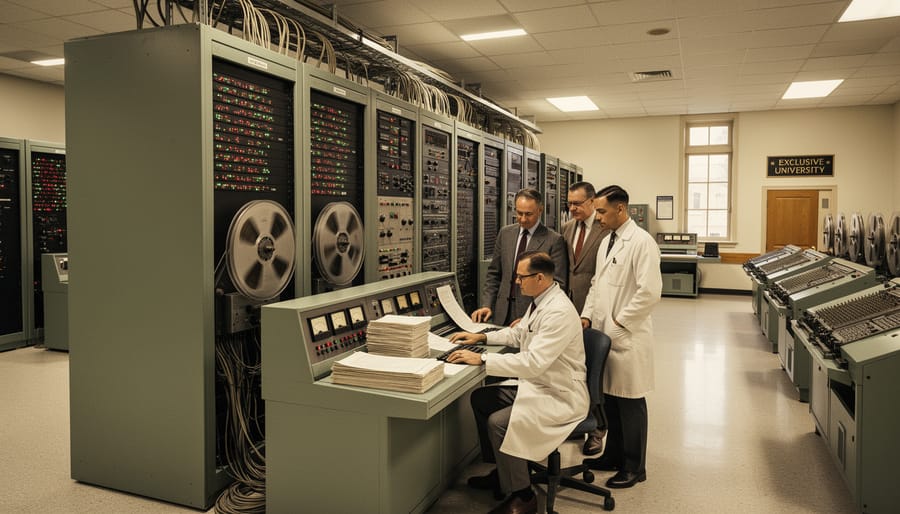
Artificial intelligence wasn’t always the subject you could learn from your laptop at midnight. In the 1950s, when pioneers like Alan Turing and John McCarthy first explored machine thinking, AI education existed only in hushed university labs and classified government facilities. A handful of elite PhD students at institutions like MIT and Stanford had access to million-dollar mainframe computers, learning programming languages most people had never heard of.
Fast forward seventy years, and a teenager in rural India can now take the same machine learning courses that once required security clearance and institutional affiliation. This dramatic transformation didn’t happen overnight. AI education evolved through distinct phases: the exclusive academic era of the 1960s-80s when knowledge stayed locked in ivory towers, the corporate training boom of the 1990s when businesses realized AI’s commercial potential, the MOOC revolution of the 2010s that first cracked open access to millions, and today’s democratized landscape where free tutorials, bootcamps, and certification programs compete for learners worldwide.
Understanding this journey reveals why modern AI curriculum looks the way it does: modular rather than monolithic, application-focused instead of purely theoretical, and increasingly accessible across economic and geographic boundaries. The shift from teaching “what AI could theoretically do” to “what you can build with AI today” reflects decades of educational experimentation, technological breakthroughs, and expanding access. For anyone learning AI now, recognizing this evolution provides essential context for navigating today’s overwhelming array of educational choices and understanding where the field is headed next.
The Early Days: When AI Was Reserved for the Privileged Few (1950s-1980s)
The Dartmouth Conference and Academic Beginnings
In the summer of 1956, a small group of researchers gathered at Dartmouth College for a workshop that would change computing forever. John McCarthy, Marvin Minsky, Nathaniel Rochester, and Claude Shannon organized this event with an ambitious goal: to explore whether machines could truly think. The Dartmouth Conference lasted eight weeks and, while it didn’t immediately solve artificial intelligence, it did something equally important—it convinced participants that AI was worth studying seriously.
This gathering marked the moment when AI transformed from speculative theory into an academic discipline. The researchers at Dartmouth agreed on fundamental questions about machine learning, natural language processing, and neural networks that would guide research for decades. More importantly, they left convinced that universities needed to teach these concepts.
Within a few years, elite universities and research labs began developing the first AI curricula. MIT and Stanford led this charge, establishing dedicated AI laboratories in the early 1960s. MIT’s AI Lab, founded by Minsky and McCarthy, became the training ground for the next generation of researchers. Stanford followed with its own AI lab in 1963, where students could take specialized courses in machine intelligence.
These early programs were incredibly exclusive—only graduate students in computer science or mathematics could access them. The coursework focused heavily on theoretical foundations: logic, problem-solving algorithms, and symbolic reasoning. Real-world applications seemed distant, but these pioneers were laying groundwork that would eventually democratize AI education for everyone.
What Early AI Students Actually Learned
If you had walked into an AI classroom in the 1980s, you would have encountered a dramatically different world from today’s machine learning bootcamps. Early AI students spent their time mastering symbolic reasoning—the art of teaching computers to manipulate symbols and apply logical rules, much like solving complex puzzles using formal logic.
The programming language LISP became the backbone of AI education during this era. Unlike today’s Python-dominated curriculum, students had to wrestle with LISP’s unique parenthesis-heavy syntax and functional programming concepts. This language excelled at processing lists and recursive functions, making it ideal for the symbolic manipulation that defined early AI work.
Expert systems took center stage in these courses. Students learned to build rule-based programs that mimicked human decision-making in narrow domains. Picture a medical diagnosis system with thousands of if-then rules: “If the patient has fever AND cough AND fatigue, then consider influenza.” These systems required extensive knowledge engineering—the painstaking process of extracting expertise from human specialists and encoding it into rules.
The curriculum also emphasized knowledge representation, teaching students various ways to structure information for computers. Semantic networks, frames, and production rules dominated coursework. There was minimal statistics, virtually no neural networks, and certainly no discussion of training data or gradient descent.
This knowledge-driven approach assumed intelligence came from carefully crafted rules and logical reasoning. Students graduated believing AI meant building expert systems and proving theorems—a stark contrast to today’s data-driven, pattern-recognition focus that powers modern AI applications.
The Expert Systems Era: AI Education Meets Industry Needs (1980s-1990s)
When Businesses Started Demanding AI Skills
The shift from theoretical AI research to practical business applications created an unprecedented demand for AI talent in the early 2010s. Tech giants like Google, Facebook, and Amazon began competing fiercely for machine learning engineers and data scientists, offering six-figure salaries to fresh graduates with AI expertise. This talent war sent a clear signal to universities: students needed marketable AI skills, not just theoretical knowledge.
Companies didn’t just hire AI specialists; they reshaped what those specialists needed to know. When Netflix built its recommendation engine or when banks deployed fraud detection systems, they needed people who understood both algorithms and real-world implementation. This practical focus prompted universities to rethink their approach entirely.
By 2015, major universities introduced AI concentrations within computer science programs, blending traditional computer science fundamentals with specialized courses in neural networks, natural language processing, and computer vision. Stanford’s AI track became a model that others followed, emphasizing hands-on projects over pure theory.
The emergence of dedicated AI degree programs followed shortly after. Carnegie Mellon launched the first undergraduate AI major in 2018, recognizing that a few elective courses weren’t enough anymore. Universities partnered directly with companies like IBM and Microsoft to ensure curriculum matched industry needs, creating internship pipelines and collaborative research projects that gave students real-world experience before graduation.
The First AI Winter and Its Impact on Education
The first AI winter of the mid-1970s brought a harsh reality check to academic AI programs. When early promises of human-level machine intelligence failed to materialize, government agencies and private foundations dramatically cut funding. The British government’s Lighthill Report in 1973 was particularly devastating, leading to near-total elimination of AI research funding in the UK.
American universities felt the impact too. Many schools shuttered their AI labs entirely, while others absorbed them into traditional computer science departments. Only a handful of institutions, including MIT, Stanford, and Carnegie Mellon, maintained dedicated AI programs, though even these operated on skeleton budgets.
This funding crisis forced a complete curriculum overhaul. Gone were the ambitious courses on building thinking machines. Instead, programs focused on narrow, achievable goals like expert systems and specific algorithms. Professors emphasized mathematical foundations and provable results rather than grand visions of artificial intelligence.
The silver lining? This conservative approach created more rigorous academic standards. Students learned to appreciate incremental progress and realistic expectations, lessons that remain valuable today. The survivors of this period built AI education on solid ground, preparing it for the renaissance that would eventually come.
The Machine Learning Revolution: Curriculum Gets a Complete Makeover (2000s-2010s)
When Statistics and Mathematics Became the New Foundation
By the 1980s and 1990s, a dramatic transformation swept through AI education. The symbolic, logic-based approaches that had dominated the field for decades began giving way to something entirely different: mathematics became the new language of artificial intelligence.
This shift wasn’t merely a minor curriculum adjustment. It represented a fundamental reconception of how machines could learn and make decisions. Instead of programming explicit rules and logical statements, researchers discovered they could use statistical patterns and mathematical models to teach computers. Think of it like the difference between giving someone turn-by-turn directions versus teaching them to read a map and navigate independently.
Three mathematical pillars emerged as essential foundations. Linear algebra became crucial because AI systems needed to process vast amounts of data represented as matrices and vectors. When a computer recognizes your face in a photo, it’s performing millions of linear algebra calculations in milliseconds. Calculus entered the picture through optimization problems, helping AI systems learn by gradually adjusting parameters to minimize errors. Probability theory and statistics provided the framework for handling uncertainty and making predictions based on incomplete information.
This mathematical revolution had profound implications for AI education. Students who once studied formal logic and symbolic reasoning now needed solid grounding in calculus, statistics, and matrix operations. Universities redesigned their AI curricula accordingly, often requiring mathematical prerequisites that would have seemed unnecessary just a decade earlier.
The practical payoff was enormous. These mathematical approaches enabled breakthroughs in pattern recognition, natural language processing, and machine learning that logic-based systems had struggled to achieve. AI was no longer just about following rules, it was about learning from data.
The Andrew Ng Effect: MOOCs Democratize AI Education
In 2011, something remarkable happened that would forever change how people learn about artificial intelligence. Andrew Ng, a Stanford professor, decided to offer his machine learning course online for free. What started as an experiment attracted over 100,000 students from around the world, shattering every expectation about online education’s potential.
This overwhelming response revealed a hunger for AI knowledge that traditional universities simply couldn’t satisfy. Students from countries without top-tier computer science programs suddenly had access to the same lectures Stanford students received. A software developer in India could learn alongside an entrepreneur in Brazil and a teacher in South Africa, all without paying tuition or relocating.
The success of this initial course led Ng and his colleague Daphne Koller to co-found Coursera in 2012. Within just two years, the platform enrolled over 10 million learners. Ng’s machine learning course alone has now been completed by over 4 million people, making it one of the most influential AI courses in history. Other platforms like edX and Udacity quickly followed, each contributing to what became known as the MOOC revolution: Massive Open Online Courses.
Real success stories emerged from these platforms. Sarah, a marketing professional from Nigeria, completed Ng’s course and transitioned into a data science role at a tech startup. Countless similar stories demonstrated that quality AI education could genuinely transform careers, regardless of geography or economic background.
The MOOC movement did more than provide access to lectures. It proved that AI education could scale globally while maintaining quality. This democratization laid the groundwork for today’s thriving AI learning ecosystem, where anyone with internet access can begin their journey into artificial intelligence.

The Modern AI Curriculum: What Students Learn Today
The Core Building Blocks Every AI Student Needs
Today’s AI curriculum has crystallized around six fundamental pillars that work together like pieces of a puzzle, each essential to understanding the bigger picture.
Python programming serves as the gateway. Think of it as learning to speak the language AI systems understand. Unlike older programming languages that required verbose syntax, Python’s readable code lets beginners write their first machine learning program within days rather than months. It’s the tool that translates your ideas into working AI applications.
Mathematical prerequisites form the theoretical backbone. You’ll need linear algebra to understand how data transforms through layers, calculus to grasp how models improve through training, and statistics to evaluate whether your AI actually works. Don’t let this intimidate you—modern courses teach these concepts alongside practical applications, showing you why matrix multiplication matters when processing images or why probability helps chatbots understand context.
Neural networks represent the heart of modern AI education. These brain-inspired systems learn patterns from data, whether recognizing faces in photos or predicting stock prices. Students now build their first neural network within weeks of starting, experiencing firsthand how adjusting connections between digital “neurons” teaches machines to perform complex tasks.
Natural language processing opens the door to understanding how computers comprehend human language. From chatbots to translation services, this field shows students how AI breaks down sentences, grasps meaning, and generates human-like responses.
Computer vision teaches machines to “see” by processing images and videos, powering everything from medical diagnosis tools to self-driving cars.
Ethics rounds out the curriculum, addressing crucial questions about bias, privacy, and responsible AI deployment. This ensures tomorrow’s AI builders create technology that benefits everyone fairly.

Traditional Degrees vs. Bootcamps vs. Self-Learning
Today’s aspiring AI professionals face a wealth of educational choices, each with distinct advantages and trade-offs. Understanding these pathways helps you make informed decisions about your learning journey.
Traditional four-year computer science degrees offer the most comprehensive foundation. You’ll gain deep theoretical knowledge in mathematics, statistics, and algorithmic thinking that underpins AI systems. Universities provide structured curricula, access to research opportunities, and credentials valued by employers. However, this path requires significant time investment—typically four years—and can cost tens of thousands of dollars. The pace may feel slow for career changers eager to enter the field quickly.
Coding bootcamps emerged as a faster alternative, condensing practical skills into intensive 12-24 week programs. These accelerated courses focus on hands-on projects and job-ready skills like building machine learning models or deploying AI applications. Bootcamps cost substantially less than degrees and emphasize portfolio development over theory. The downside? They often skimp on foundational mathematics and may not dive deep enough into advanced AI concepts. They’re ideal for professionals pivoting careers who need practical skills immediately.
Self-learning through online platforms represents the most flexible and affordable option. Resources like Coursera, YouTube tutorials, and open-source projects let you learn at your own pace, often for free or minimal cost. This path demands exceptional self-discipline and the ability to curate quality resources from overwhelming options. Self-learners must also work harder to build credibility without formal credentials, though a strong portfolio of projects can compensate.
Consider your circumstances: career changers might prefer bootcamps, while students with time and resources benefit from degrees. Those juggling jobs or family responsibilities often thrive with self-paced learning. Many successful AI practitioners actually combine approaches—perhaps starting with online courses before pursuing formal education, creating personalized pathways that match their unique situations.
How AI Education Continues to Evolve Right Now
Why Ethics and Responsible AI Are Now Mandatory
A turning point came in 2018 when Amazon scrapped its AI recruiting tool after discovering it systematically discriminated against women. This wasn’t an isolated incident. Facial recognition systems misidentifying people of color, predictive policing algorithms perpetuating racial bias, and loan approval systems denying qualified applicants based on flawed data patterns—these real-world failures forced academia to confront an uncomfortable truth: technical excellence alone wasn’t enough.
Today, AI ethics and responsible deployment are no longer optional add-ons but core curriculum requirements. Students learn to identify bias in training data before writing their first algorithm. They study the Cambridge Analytica scandal alongside neural network architecture, understanding how AI can manipulate democracy as easily as it can recognize faces.
Universities now require ethics components in AI courses, teaching students to ask critical questions: Who does this system serve? What data are we using, and who’s been excluded? What happens when our model fails?
This shift reflects a maturing field recognizing its societal impact. Modern AI education produces professionals who understand that every line of code carries ethical weight, and that building powerful systems means accepting responsibility for their consequences in the real world.
Learning in the Age of ChatGPT and Generative AI
The arrival of ChatGPT in late 2022 forced educators to completely reimagine how they teach. Rather than banning these tools, forward-thinking schools now integrate them into curricula, treating AI as a collaborator rather than a threat.
Today’s classrooms focus on what researchers call “AI literacy” – understanding how these systems work, their limitations, and when to trust their outputs. Students learn to craft effective prompts, a skill as valuable as learning to ask good questions. They’re taught to verify AI-generated information, recognizing that these models can confidently present incorrect facts.
Programming courses have shifted dramatically. Instead of memorizing syntax, students now learn computational thinking and problem-solving. When AI can generate code instantly, the valuable skills become understanding what problem you’re solving, evaluating whether the AI’s solution is efficient and secure, and debugging when things go wrong.
Real-world applications drive this new pedagogy. Students might use ChatGPT to brainstorm project ideas, then critically analyze its suggestions. They learn to spot AI-generated content in academic work and understand ethical considerations around attribution and originality.
The consensus among educators is clear: technical skills remain important, but creativity, critical thinking, and the ability to ask the right questions have become paramount. In this new landscape, humans don’t compete with AI – they learn to direct it effectively.
What This Evolution Means for You as a Learner
Understanding how AI education has evolved offers valuable lessons for anyone starting their learning journey today. The shift from exclusive academic programs to democratized online learning means you have unprecedented access to knowledge—but it also means you need to be strategic about how you use it.
First, recognize that foundational knowledge remains your anchor in a rapidly changing field. While specific tools and frameworks will come and go, core concepts like machine learning principles, neural network architecture, and algorithmic thinking have remained relevant for decades. When choosing learning resources, prioritize those that teach you why things work, not just how to implement them. A course that helps you understand backpropagation will serve you longer than one that only teaches you to use a particular library.
The democratization of AI education also means you can curate your own curriculum. Start with structured courses from reputable platforms to build your foundation, then supplement with research papers, documentation, and hands-on projects. This mirrors how AI education evolved—from rigid academic programs to flexible, practical learning paths.
To future-proof your education, adopt a layered approach. Build a strong mathematical foundation in linear algebra, calculus, and statistics. These fundamentals haven’t changed since AI’s early days and won’t become obsolete. Then, stay current with emerging techniques through blogs, research summaries, and community forums. Think of it as building a pyramid: solid base, adaptable top.
Remember that today’s accessible AI education exists because pioneers spent decades refining teaching methods and identifying what actually matters. Take advantage of this refined knowledge by seeking resources that balance theory with application. Work on real-world projects early and often—the shift toward practical AI education happened because hands-on experience proved essential for true understanding.
Finally, embrace continuous learning as a permanent mindset. The evolution from exclusive to accessible education means the bar keeps rising. What once required a PhD now demands consistent self-directed learning. But here’s the good news: the resources to stay current are at your fingertips, updated constantly by a global community of learners and practitioners.

You’re entering the field of artificial intelligence at an unprecedented moment in history. What once required access to elite universities, expensive mainframe computers, and exclusive academic circles now sits at your fingertips through free online courses, open-source tools, and vibrant learning communities. The transformation from AI education as a privilege to AI education as a right represents one of the most dramatic democratizations in modern learning.
The historical lessons are clear: AI has always evolved through experimentation, collaboration, and the willingness to learn from failure. The symbolic AI pioneers didn’t have all the answers, and neither will you at first. The researchers who weathered the AI winters demonstrated resilience. The modern architects of deep learning succeeded by combining old theories with new computational power. Your journey will follow a similar pattern of steady progress punctuated by breakthrough moments.
Start your learning path by choosing one practical project that genuinely interests you, whether that’s building a chatbot, analyzing data patterns, or creating image recognition systems. Leverage the free resources that weren’t available to previous generations: interactive coding platforms, pre-trained models, and supportive online forums. Remember that today’s AI experts were once beginners who simply refused to stop learning. The door to AI education stands wider open than ever before. Walk through it.