

The story of artificial intelligence didn’t emerge from garages or startup incubators. It took shape behind the closed doors of corporate research labs, where companies like IBM, Bell Labs, and Xerox PARC invested millions to transform theoretical concepts into practical tools that would reshape entire industries.
While government and academic labs laid AI’s theoretical foundation, industrial research environments solved a different puzzle: how to make these technologies work in the real world. They had budgets, deadlines, and customers demanding solutions to actual problems, not just elegant theories.
Between 1956 and today, corporate labs transformed AI from symbolic logic experiments into technologies you use daily. IBM’s Deep Blue didn’t just beat a chess champion in 1997; it proved that industrial research could tackle grand challenges with engineering rigor. Bell Labs didn’t just study neural networks; they built speech recognition systems that evolved into today’s voice assistants. Xerox PARC researchers developed graphical interfaces that made AI-powered computing accessible to everyone, not just programmers.
This timeline reveals how quarterly earnings reports, patent portfolios, and product launches shaped AI’s development as profoundly as any academic paper. Understanding this corporate evolution explains why today’s AI landscape looks the way it does, dominated by tech giants with the resources to train massive models and deploy them at scale. The industrial research lab wasn’t just where AI grew up; it was where AI learned to matter.
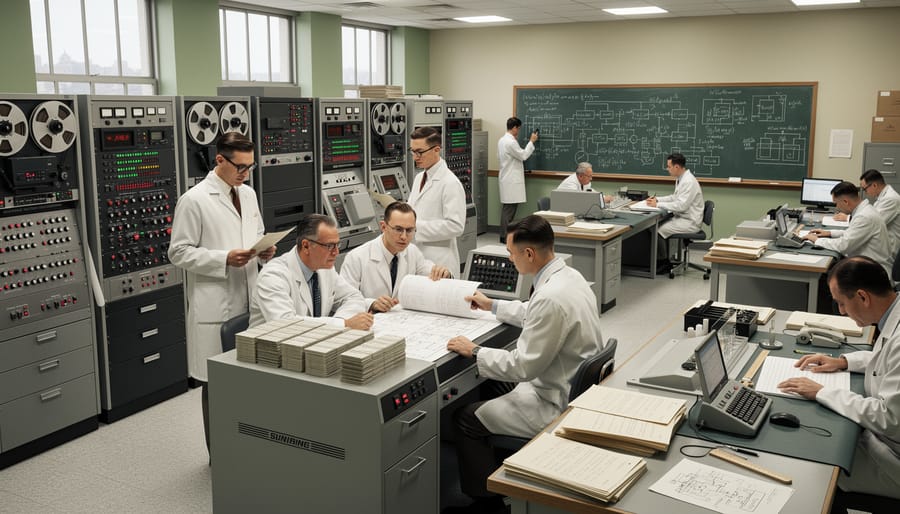
The Unlikely Birthplace: Industrial Labs in the 1950s-1960s
Bell Labs: Where AI Met Real-World Problems
While universities explored AI’s theoretical possibilities, Bell Labs faced a practical challenge: millions of phone calls needed routing every day. This real-world pressure sparked some of AI’s earliest practical applications in the 1950s and 1960s.
Bell Labs researchers worked on pattern recognition systems that could understand spoken numbers, aiming to let callers dial by voice instead of rotary phones. Though primitive by today’s standards, this speech recognition research laid groundwork for modern voice assistants. The telephone network became an unexpected testing ground for machine learning concepts.
The lab’s work on pattern matching extended beyond speech. Engineers developed algorithms to identify signals in noisy telephone lines, distinguishing actual voice data from interference. These techniques required machines to “learn” what normal patterns looked like and detect anomalies—essentially early neural network concepts applied to telecommunications.
What made Bell Labs unique was its marriage of theoretical research with immediate practical needs. Researchers couldn’t just publish papers; their innovations needed to work on equipment handling millions of calls daily. This constraint drove efficient, robust solutions that influenced AI development for decades.
The lab’s contributions often went unrecognized in AI history books focused on academic achievements. Yet their work on signal processing, pattern recognition, and automated decision-making systems demonstrated that AI could solve messy, real-world problems—not just play games or prove theorems. This practical orientation foreshadowed today’s corporate AI labs, where theoretical breakthroughs must translate into products customers actually use.
IBM’s Big Bet on Thinking Machines
In the 1950s, while universities explored abstract theories, IBM recognized something crucial: businesses needed machines that could handle complex decision-making. This practical focus pushed the company to invest heavily in artificial intelligence research, fundamentally shaping how AI evolved from academic concept to business tool.
IBM’s journey began with support for the Logic Theorist in 1956, a program that could prove mathematical theorems. Though developed by researchers Allen Newell and Herbert Simon, IBM provided the computing power that made it possible. This collaboration demonstrated how corporate resources could accelerate early AI breakthroughs, bridging the gap between theory and implementation.
By the 1960s, IBM shifted focus toward expert systems—programs designed to mimic human expertise in specific domains. Unlike general-purpose AI, these systems solved real business problems: scheduling production lines, diagnosing equipment failures, and optimizing supply chains. The company understood that businesses would pay for AI that improved their bottom line, not just impressive demonstrations.
This pragmatic approach had lasting consequences. IBM’s emphasis on business applications meant AI development prioritized reliability, scalability, and clear return on investment. When academic AI research hit roadblocks during the 1970s “AI winter,” IBM’s focus on practical expert systems kept progress moving forward. The company proved that AI didn’t need to replicate human thinking completely—it just needed to solve specific problems better than existing methods, a philosophy that continues driving enterprise AI development today.
The First AI Winter: When Corporate Labs Kept the Faith (1970s)
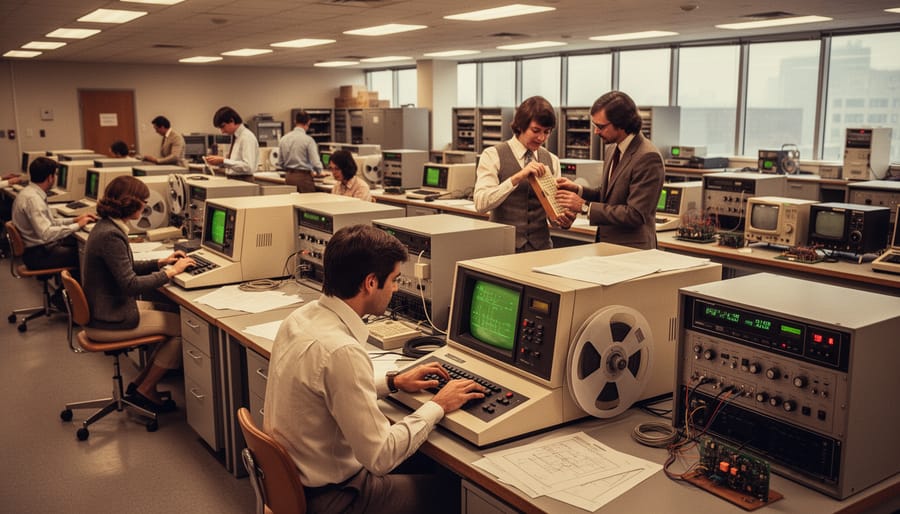
Xerox PARC’s Hidden AI Legacy
When people think of Xerox PARC, they picture the revolutionary graphical user interface that Steve Jobs famously “borrowed” for the Macintosh. But this legendary research lab made equally profound contributions to artificial intelligence that rarely get the spotlight they deserve.
In the 1970s and early 1980s, PARC researchers weren’t just creating better ways to interact with computers—they were building the conceptual foundations that would make AI systems more practical and accessible. Their work on object-oriented programming, particularly through the Smalltalk language, gave AI developers a new way to organize knowledge and represent complex relationships between concepts. This approach proved invaluable for building expert systems and knowledge bases that could mirror how humans categorize information.
PARC’s contributions extended beyond programming paradigms. The lab pioneered work in knowledge representation languages, developing systems that could capture and manipulate symbolic information more efficiently. Think of it as creating better filing systems for machine intelligence—not glamorous, but essential for making AI applications actually work in business environments.
Perhaps most importantly, PARC demonstrated how AI could integrate seamlessly into workplace tools. Their vision wasn’t about creating standalone intelligent machines, but embedding smart features into everyday computing experiences. This philosophy directly influenced how modern companies approach AI deployment—not as separate systems, but as invisible assistants woven into our software.
While PARC’s GUI grabbed headlines, their AI legacy quietly shaped how we build and interact with intelligent systems today, proving that sometimes the most transformative innovations hide in plain sight.
Expert Systems Era: AI Gets Down to Business (1980s)

DENDRAL: Chemistry’s AI Pioneer
In the mid-1960s, while most AI research focused on abstract puzzles and games, a team at Stanford University partnered with NASA’s Ames Research Center to tackle a pressing real-world problem: identifying the molecular structure of unknown organic compounds. The result was DENDRAL, a system that would become the first AI program to demonstrate genuine scientific value outside academia.
The challenge facing chemists was daunting. When analyzing samples from Mars missions or pharmaceutical research, scientists would receive mass spectrometry data—essentially a numerical fingerprint of a molecule—but determining the actual structure from this data required exhaustive manual analysis. DENDRAL changed this by encoding the knowledge of expert chemists into a computer program that could systematically generate and evaluate possible molecular structures.
What made DENDRAL revolutionary wasn’t just its technical achievement. It proved that AI could augment human expertise in specialized domains by capturing and applying the reasoning patterns of experts. The system didn’t replace chemists; it made them dramatically more productive by narrowing down possibilities from thousands to a manageable few.
By the 1970s, DENDRAL’s success rippled through chemical research labs worldwide. It spawned an entire field called expert systems—AI programs designed to mimic human decision-making in specific domains. Pharmaceutical companies began exploring similar approaches for drug discovery, while other industries recognized that corporate R&D could benefit from AI-assisted analysis.
DENDRAL’s legacy extends beyond chemistry. It demonstrated that the real value of AI lay not in replicating human intelligence broadly, but in solving concrete, high-value problems where speed and systematic analysis mattered most.
From Theory to Factory Floor
While universities debated the theoretical possibilities of artificial intelligence, chemical giants DuPont and Dow Chemical were quietly transforming AI from an academic curiosity into a bottom-line business tool during the 1980s and 1990s.
DuPont’s approach was refreshingly practical. Rather than trying to replicate human intelligence broadly, they focused on specific manufacturing challenges that cost them millions annually. Their engineers developed expert systems that monitored chemical reactions in real-time, adjusting temperature, pressure, and ingredient ratios to maintain optimal conditions. Think of it like having a master chef’s knowledge programmed into your kitchen—except this chef never took breaks and could monitor dozens of pots simultaneously.
The results were impressive. DuPont’s polymer production facilities used AI systems that reduced waste by identifying subtle patterns in quality control data that human operators might miss. When a batch started deviating from specifications, the system could pinpoint exactly which variables needed adjustment, often before defects became visible.
Dow Chemical took a similar path, implementing AI for predictive maintenance. Their systems analyzed vibration patterns, temperature fluctuations, and pressure readings from thousands of sensors across their plants. By detecting early warning signs of equipment failure, they could schedule maintenance during planned downtime rather than dealing with costly emergency shutdowns. One plant manager famously noted that their AI system “learned to hear what our machines were trying to tell us.”
These weren’t glamorous applications making headlines, but they proved something crucial: AI could generate measurable value in messy, real-world environments. The factory floor became AI’s proving ground, demonstrating that practical problem-solving often mattered more than theoretical elegance. This shift from “Can we build intelligent machines?” to “How can intelligent systems solve today’s problems?” would define AI’s trajectory for decades to come.
The Neural Network Renaissance: Labs Compete Again (1990s-2000s)
AT&T Bell Labs and the Deep Learning Foundations
In the late 1980s, AT&T Bell Labs faced a very practical problem: processing millions of handwritten checks every day. Banks were drowning in paperwork, and automated reading systems kept failing. This business challenge became the catalyst for one of deep learning’s most important breakthroughs.
Yann LeCun, a young researcher at Bell Labs, developed convolutional neural networks (CNNs) specifically to solve this check-reading problem. His system, called LeNet, mimicked how human vision works by recognizing patterns in small sections of an image before combining them into a complete understanding. Instead of analyzing every pixel independently, LeNet learned to identify edges, curves, and eventually full numbers through layers of processing.
The genius of LeCun’s approach was its practicality. While universities explored theoretical AI concepts, Bell Labs needed something that actually worked on millions of real checks with smudged ink, varied handwriting, and imperfect scanning. By 1998, LeNet was reading approximately 10-20% of all checks in the United States, saving banks countless hours and demonstrating that neural networks could handle messy, real-world data.
This success story illustrates a crucial pattern in AI development: breakthrough research often emerges when corporate needs meet talented researchers and sufficient computing power. Bell Labs provided LeCun with the resources, data, and business justification to refine his ideas beyond academic papers. The hardware breakthroughs of the era, combined with a clear commercial application, transformed CNNs from theoretical curiosity into practical technology that would eventually power modern image recognition, from smartphone cameras to self-driving cars.
Microsoft Research: The New Corporate Lab Model
When Microsoft launched Microsoft Research in 1991, they introduced a fresh blueprint for how corporations could pursue AI innovation. Unlike earlier corporate labs that often operated in isolation from business units or focused narrowly on product development, Microsoft Research struck a deliberate balance between academic-style exploration and practical business impact.
The lab’s founding philosophy was simple but powerful: give researchers the freedom to pursue fundamental questions while maintaining connections to real products. Scientists could publish papers, attend conferences, and collaborate with universities—just like academics. But they also worked alongside product teams, ensuring their discoveries could eventually reach millions of users.
This approach paid off quickly. Throughout the 1990s and 2000s, Microsoft Research teams made significant contributions to natural language processing, computer vision, and machine learning. Their work on speech recognition directly improved products like Windows, while research into machine translation laid groundwork for services used globally today.
What made this model revolutionary was its scalability and sustainability. By embedding researchers within a profit-generating company rather than relying on government grants or academic budgets, Microsoft could fund long-term AI research consistently. Other tech companies took notice—Google, Amazon, and Facebook would later adopt similar structures for their AI labs.
This hybrid model proved that corporations didn’t have to choose between advancing AI science and building practical applications. They could do both, creating a virtuous cycle where research insights fueled better products, and product challenges inspired new research directions. This approach has become the dominant paradigm for AI development in the 21st century.
The Modern Era: From Labs to Products (2010s-Present)

The Cloud Computing Catalyst
By the 2000s, AI researchers faced a familiar frustration: their algorithms worked brilliantly in theory but crumbled under real-world complexity. The problem wasn’t intelligence—it was infrastructure. Training sophisticated neural networks required massive computational power and enormous datasets that simply didn’t exist in traditional lab environments.
Then cloud computing changed everything.
When Amazon Web Services launched in 2006, followed by Google Cloud and Microsoft Azure, corporate labs suddenly gained access to virtually unlimited computing resources without building expensive data centers. A researcher could now spin up thousands of servers for a weekend experiment, then shut them down Monday morning. This pay-as-you-go model democratized computational power in ways previously unimaginable.
Simultaneously, the internet generated an explosion of data. Social media posts, online transactions, smartphone sensors, and connected devices created petabytes of information—the fuel deep learning algorithms needed to learn patterns and make accurate predictions.
Google’s research team demonstrated this synergy perfectly in 2012 when they trained a neural network using 16,000 computer processors to recognize cats in YouTube videos without being explicitly programmed. This breakthrough wasn’t just about cats; it proved that combining massive computing power with big data could teach machines to see, understand, and classify the world around them.
Corporate labs at Google, Microsoft, Facebook, and IBM quickly realized they possessed both ingredients: cloud infrastructure and proprietary data from billions of users. This unique combination positioned them to lead the deep learning revolution that would define modern AI.
When Labs Became Product Teams
Around 2018, something fundamental shifted in the AI world. The walls between research laboratories and product development teams started crumbling. What once took years of careful research before any commercial application now happened in mere months—sometimes even weeks.
Google’s release of BERT (Bidirectional Encoder Representations from Transformers) in 2018 perfectly illustrates this transformation. The model went from research paper to production deployment in Google Search within months, fundamentally changing how the search engine understood natural language queries. Previously, this journey might have taken several years of additional testing and refinement.
OpenAI’s trajectory tells an even more dramatic story. GPT-2, released in 2019, sparked debates about responsible AI release. By the time GPT-3 arrived in 2020, the company had already established commercial partnerships. The research lab had essentially become a product company, with paying customers accessing cutting-edge models while researchers continued refining them.
This compression of timelines happened because labs discovered they could learn faster by deploying models in real-world conditions. Traditional research cycles involved publishing papers, waiting for peer review, and slowly iterating. The new approach meant releasing models to limited audiences, gathering feedback, and improving rapidly based on actual usage data.
Tech giants like Microsoft, Amazon, and Meta followed similar patterns. Their AI research teams now work hand-in-hand with product developers from day one. A breakthrough in computer vision might appear in a smartphone app within months. A language model improvement could update customer service chatbots almost immediately.
This shift created both opportunities and concerns. Innovation accelerated dramatically, bringing AI capabilities to millions of users far faster than traditional academic pathways allowed. However, it also meant less time for careful consideration of potential risks and societal impacts before technologies reached the public.
What Industrial Labs Taught Us About AI Development
The story of industrial AI labs offers profound lessons that remain relevant as we witness today’s generative AI revolution. These insights help us understand not just what happened, but why it matters for the future of AI development.
First, sustained funding without pressure for immediate returns proved essential. Bell Labs scientists spent years on fundamental research that seemed impractical at the time. Their patience yielded breakthroughs like Unix and early speech recognition systems that changed computing forever. This contrasts sharply with the quarterly earnings mentality that often dominates modern business. The lesson? Groundbreaking AI innovations need breathing room to mature.
Second, real-world constraints sparked creativity rather than limiting it. When IBM built Deep Blue to play chess, they weren’t just pursuing an academic exercise. They were solving concrete problems about processing speed, memory management, and decision-making under pressure. Similarly, Xerox PARC’s work on intelligent document processing addressed actual business needs, pushing researchers to make AI practical rather than theoretical. These constraints forced teams to move beyond abstract algorithms and create systems that actually worked.
Third, the power of interdisciplinary collaboration cannot be overstated. Stanford’s DENDRAL project succeeded because chemists, computer scientists, and mass spectrometry experts worked side by side. No single discipline held all the answers. Today’s most exciting AI applications still require this cross-pollination between domains, whether that’s combining medical expertise with machine learning or merging linguistics with neural networks.
Finally, perseverance through AI winters taught resilience. When funding dried up and public enthusiasm waned in the 1970s and 1980s, industrial labs kept core teams intact. IBM didn’t abandon AI research during the lean years. This continuity meant that when conditions improved, these organizations could rapidly capitalize on new opportunities. They understood that progress isn’t linear and that seemingly dormant periods often lay groundwork for future breakthroughs.
These lessons remind us that transformative AI development requires vision, resources, diverse expertise, and most importantly, patience to weather inevitable setbacks while maintaining focus on long-term goals.
Looking back through AI’s history, a clear pattern emerges: the corporate research labs weren’t just funding AI development—they were fundamentally shaping how we approach artificial intelligence itself. From Bell Labs’ emphasis on practical problem-solving to IBM’s marriage of theoretical breakthroughs with real-world computing power, these environments taught us that revolutionary AI often comes from patient, long-term investment rather than quick wins.
These labs survived AI winters by staying grounded in tangible applications. When academic funding dried up, industrial researchers kept pushing forward because they understood something crucial: breakthrough technology rarely announces itself with fanfare. DENDRAL didn’t seem world-changing in 1965, yet it pioneered the expert systems that would transform industries. Neural networks languished for decades before companies like Google turned them into the foundation of modern AI.
Today’s AI labs at OpenAI, DeepMind, and Anthropic are following a similar playbook—massive computational resources, interdisciplinary teams, and a mix of pure research with practical deployment. But here’s what history teaches us: the most transformative work happening right now probably doesn’t look revolutionary yet. Somewhere in today’s corporate labs, researchers are developing techniques, architectures, or applications that seem incremental or niche. In twenty years, we might look back and realize those quiet experiments were actually the seeds of AI’s next major paradigm shift. The corporate labs that nurtured AI through its difficult decades understood this truth: patience and persistence often matter more than brilliance alone.