

Artificial intelligence is transforming industries at breakneck speed, but without proper compliance frameworks, organizations risk hefty fines, reputational damage, and legal consequences that can halt AI initiatives entirely. As governments worldwide rush to regulate AI systems—from the EU’s AI Act to sector-specific requirements in healthcare and finance—understanding compliance has shifted from optional to mission-critical.
Compliance in AI means ensuring your systems meet legal, ethical, and regulatory standards throughout their entire lifecycle. This encompasses data privacy laws like GDPR and CCPA, industry-specific regulations, fairness and bias prevention requirements, and transparency obligations that demand explainable AI decisions. The challenge isn’t just understanding these rules but implementing them in technologies that learn and evolve over time.
The stakes are tangible. Companies have faced multimillion-dollar penalties for discriminatory AI hiring tools, privacy violations in facial recognition systems, and inadequate documentation of algorithmic decision-making. Beyond financial costs, non-compliance erodes customer trust and can exclude organizations from entire markets where regulatory approval is mandatory.
This article provides a practical roadmap for building compliant AI systems. You’ll discover the core components of AI compliance frameworks, including risk assessment methodologies that identify high-risk applications before deployment. We’ll explore essential documentation practices that satisfy auditors and regulators, data governance strategies that protect privacy while enabling innovation, and monitoring systems that detect compliance drift as models evolve.
Whether you’re launching your first AI project or formalizing governance for existing systems, understanding compliance fundamentals empowers you to innovate responsibly. The following sections break down complex regulatory requirements into actionable steps, helping you navigate this rapidly evolving landscape with confidence and clarity.
Why AI Compliance Matters More Than You Think

The Real Cost of Getting It Wrong
When AI systems fail to meet compliance standards, the consequences extend far beyond theoretical concerns—they hit companies where it hurts most. Take Amazon’s recruiting tool debacle: the company scrapped an AI hiring system in 2018 after discovering it systematically discriminated against women. While the exact financial cost wasn’t disclosed, the reputational damage and wasted development resources served as an expensive lesson in algorithmic bias.
The financial penalties can be staggering. Under GDPR, companies face fines up to 4% of global annual revenue or €20 million, whichever is higher. In 2020, British Airways received a £20 million fine for data protection failures, demonstrating regulators’ willingness to impose significant penalties. As AI becomes more prevalent in data processing, similar violations tied to algorithmic decision-making are increasingly likely.
Healthcare provides particularly sobering examples. IBM Watson for Oncology faced severe criticism when reports emerged in 2018 that it provided unsafe treatment recommendations. Multiple hospitals discontinued use of the system, representing millions in lost contracts and damaged credibility in a sector where trust is paramount.
Perhaps most concerning are the hidden costs. Goldman Sachs faced investigation in 2019 when its Apple Card algorithm appeared to offer women lower credit limits than men with similar profiles. Beyond regulatory scrutiny, the company weathered a public relations crisis and mandatory reviews of its AI systems—expenses that far exceeded any initial savings from automated decision-making. These cases underscore a fundamental truth: cutting corners on AI compliance isn’t just risky—it’s expensive.
What Regulators Are Actually Looking For
As AI regulations crystallize globally, three core principles consistently emerge across frameworks like the EU AI Act, NIST AI Risk Management Framework, and emerging legislation worldwide. Understanding these fundamentals helps demystify compliance requirements.
First, transparency stands at the forefront. Regulators want organizations to document how AI systems make decisions, what data trains them, and how they impact users. This doesn’t mean revealing proprietary algorithms—rather, providing clear explanations about system capabilities, limitations, and potential risks. Think of it as creating a user manual that both technical teams and everyday users can understand.
Second, fairness requires demonstrating that AI systems don’t perpetuate discrimination or bias. Regulators expect ongoing testing across different demographic groups and documentation showing how you identify and mitigate unfair outcomes. This involves regular audits and establishing processes to address disparities when they surface.
Third, accountability demands clear ownership. Someone in your organization must be responsible for AI system oversight, risk management, and corrective actions. This is where structured approaches like AI governance certification become valuable, providing frameworks for establishing responsible oversight.
These requirements aren’t arbitrary hurdles—they’re designed to ensure AI systems serve people reliably and equitably while maintaining public trust in these powerful technologies.
Understanding AI Compliance: The Building Blocks
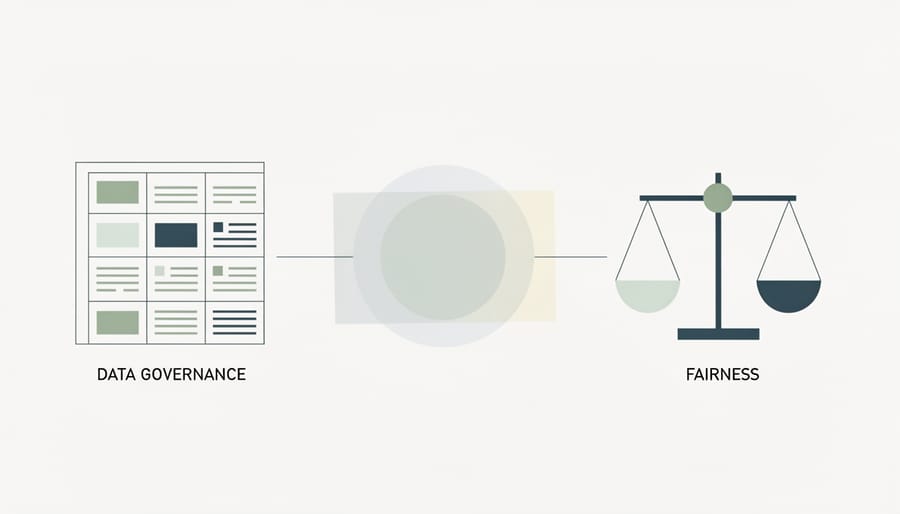
Data Governance: Your Foundation
Think of data governance as the blueprint for your AI’s foundation. Without proper data governance practices, even the most sophisticated AI system risks compliance failures.
Start with data lineage—knowing exactly where your data comes from, how it’s transformed, and where it goes. This creates an audit trail that regulators love and your team needs. Imagine explaining to a regulator how your AI made a decision; data lineage gives you that story from start to finish.
Consent management is equally critical. Your AI should only use data that people have explicitly agreed to share, especially under regulations like GDPR. This means tracking permissions, honoring withdrawal requests, and ensuring your AI respects these boundaries automatically.
Quality controls complete the picture. Poor data quality doesn’t just produce bad AI outcomes—it creates compliance risks. Implement validation checks, monitor for bias in your datasets, and establish clear ownership. One financial services company discovered their loan approval AI was trained on incomplete data, leading to discriminatory patterns they had to completely unwind.
Building these governance layers takes effort upfront, but they transform compliance from a checkbox exercise into a competitive advantage.
Transparency and Explainability
Imagine trying to defend a decision in court when you can’t explain how it was made. That’s the challenge organizations face with black-box AI systems. Regulators worldwide are increasingly rejecting opaque algorithms, especially in sensitive areas like healthcare, finance, and hiring. The EU’s AI Act and similar regulations now explicitly require that AI decisions be explainable to affected individuals.
The shift toward transparency isn’t just about regulatory compliance—it’s about building trust. When a loan application gets denied or a job candidate rejected by an AI system, stakeholders deserve to understand why. This has sparked growing adoption of explainable AI techniques that make machine learning models interpretable.
Practical approaches include using model-agnostic methods like LIME (Local Interpretable Model-agnostic Explanations) or SHAP (SHapley Additive exPlanations), which reveal which factors influenced specific decisions. For non-technical audiences, visual dashboards showing feature importance or decision trees work remarkably well. Some organizations maintain simpler, transparent models alongside complex ones for validation purposes.
Documentation is equally crucial. Maintaining clear records of training data sources, model limitations, and decision-making processes creates an audit trail that satisfies regulators while helping internal teams understand system behavior. The goal is translating technical outputs into human-understandable explanations that empower informed decision-making.
Fairness and Bias Mitigation
AI bias isn’t theoretical—it’s been documented in real hiring tools that screened out qualified women, facial recognition systems with higher error rates for people of color, and lending algorithms that unfairly denied loans to certain communities. These examples highlight why fairness must be built into AI decision-making processes from the start.
To detect bias, regularly audit your training data for representation gaps. Ask whether certain groups are underrepresented or stereotyped in your datasets. Test your AI’s outputs across different demographic groups to identify performance disparities—if accuracy varies significantly between populations, you’ve likely uncovered bias.
Mitigation strategies include diversifying your training data, using fairness-aware algorithms that balance outcomes across groups, and implementing human oversight for high-stakes decisions. Establish clear metrics for fairness that align with your specific use case—sometimes equal treatment means different things in different contexts.
Transparency matters too. Document what fairness means for your application and how you’re measuring it. Regular testing and updates ensure your systems remain fair as they encounter new data and evolving societal standards.
AI Audits: Your Compliance Reality Check

What Actually Gets Audited
When organizations deploy AI systems, auditors don’t just glance at outputs and call it a day. They conduct thorough examinations of multiple interconnected components that reveal how your AI actually operates.
Model performance takes center stage in most audits. Auditors examine accuracy rates, error patterns, and whether the model performs consistently across different demographic groups. For example, if your hiring algorithm shows a 95% accuracy rate for one group but only 70% for another, that’s a red flag requiring immediate attention.
Data practices receive intense scrutiny because your model is only as good as what it learns from. Auditors trace data from collection through processing, checking for biases in source data, proper consent mechanisms, and adequate data quality controls. They’ll ask pointed questions: Where did this training data come from? Who labeled it? What steps prevented historical biases from being baked into the model?
Documentation serves as your audit trail. Think of it as a detailed recipe book for your AI system. Auditors want to see records of design decisions, testing results, known limitations, and update histories. Without proper documentation, proving compliance becomes nearly impossible.
Decision-making processes get examined to understand how AI recommendations translate into real-world actions. This matters especially for AI-powered analytics systems where automated insights drive business strategies. Auditors verify whether humans review high-stakes decisions and if override mechanisms exist.
Monitoring systems demonstrate ongoing compliance. Auditors check whether you’re actively tracking performance drift, user complaints, and emerging issues rather than deploying AI and forgetting about it.
How to Prepare for an AI Audit
Preparing for an AI audit doesn’t have to feel overwhelming. Think of it like getting your house ready for important guests—you want everything organized, accessible, and easy to understand. Here’s how to get your AI systems audit-ready.
Start by creating comprehensive documentation for each AI model. Model cards are your best friend here—these are simple one-page summaries that describe what your model does, what data it uses, its intended purpose, and known limitations. Imagine explaining your AI system to someone unfamiliar with it; that’s the level of clarity you’re aiming for.
Next, establish clear audit trails. This means tracking every decision point in your AI’s lifecycle: when data was collected, who trained the model, what changes were made, and why. Many organizations use version control systems similar to those software developers use, creating timestamps and records for every update.
Gather your compliance documentation in one central location. This includes data privacy assessments, fairness evaluations, security protocols, and any testing results. Create a checklist covering data handling practices, model performance metrics, and risk assessments.
Don’t forget the human element. Prepare your team for stakeholder interviews by identifying who built the model, who maintains it, and who makes decisions about its deployment. Auditors will want to speak with these people to understand your processes.
Finally, run a mock audit internally. Have someone unfamiliar with the project review your documentation and ask questions. This reveals gaps you might have missed and gives you practice explaining your AI systems in accessible terms.
Model Risk Management: Keeping Your AI Systems Healthy
Identifying and Measuring Model Risk
AI models face several distinct risks that can compromise their reliability and compliance status. Understanding these threats is essential for maintaining systems that meet regulatory standards.
Performance degradation occurs when models become less accurate over time, even without any changes to the code. Imagine a loan approval AI trained on 2020 economic data—it might struggle with decisions during different market conditions, potentially leading to biased or unfair outcomes that violate fair lending regulations.
Data drift happens when the real-world data your model encounters differs from its training data. For example, a fraud detection system trained before the pandemic might miss new fraud patterns that emerged with remote work and digital transactions. This shift can cause compliance issues if the model fails to protect customers adequately.
Adversarial attacks involve deliberate attempts to fool AI systems. Researchers have shown that adding tiny, invisible changes to images can trick facial recognition systems, raising serious security and privacy concerns for organizations using these technologies.
Changing business contexts present another challenge. New regulations, market shifts, or updated company policies might render a previously compliant model non-compliant overnight.
To measure these risks, organizations should implement continuous monitoring systems that track key metrics like accuracy scores, prediction confidence levels, and error rates across different demographic groups. Establishing baseline performance benchmarks allows teams to detect when models deviate from acceptable standards. Regular audits comparing model outputs against known correct answers help quantify degradation, while A/B testing can reveal how models perform under various conditions. Documentation of these measurements becomes crucial evidence of due diligence during regulatory reviews.
Building a Model Risk Framework
Building a robust model risk framework doesn’t have to be overwhelming. Think of it as creating a safety net that catches issues before they become problems.
Start by establishing a governance committee that includes diverse voices: data scientists, legal experts, compliance officers, and business stakeholders. This team becomes your central decision-making body, meeting regularly to review AI initiatives and their associated risks.
Next, clearly define roles and responsibilities. Assign model owners who take accountability for specific AI systems, validators who independently assess model performance, and compliance champions who ensure regulatory alignment. Document these roles in writing so everyone knows their part.
Setting risk thresholds is crucial. Create a simple classification system like low, medium, and high risk based on factors such as the decision’s impact on individuals, data sensitivity, and potential for bias. For example, an AI chatbot answering product questions poses lower risk than an algorithm making loan decisions.
Finally, establish clear escalation procedures. Define when issues should move up the chain: perhaps medium-risk concerns go to the governance committee within 48 hours, while high-risk issues trigger immediate executive notification. Create templates and checklists to make escalation straightforward, ensuring problems get addressed quickly and consistently.
Monitoring and Maintenance in Practice
Effective monitoring starts with establishing clear performance baselines during your AI model’s initial deployment. Think of it like a health checkup schedule for your system. Leading organizations typically implement dashboard systems that track key compliance metrics in real-time, such as prediction accuracy across different demographic groups, decision fairness indicators, and data drift patterns.
Automated alert systems serve as your early warning mechanism. Configure alerts to notify your team when model performance drops below predetermined thresholds or when input data begins deviating from training patterns. For example, a lending AI might trigger alerts if approval rates for specific groups shift unexpectedly, prompting immediate investigation.
Retraining schedules depend on your industry’s pace of change. Financial institutions often retrain quarterly to capture market shifts, while healthcare models may follow annual cycles aligned with clinical guideline updates. The key is balancing freshness with stability.
Know when to retire a model. If retraining no longer maintains compliance standards, underlying data patterns have fundamentally shifted, or regulatory requirements have evolved beyond the model’s design capabilities, it’s time to build anew rather than patch existing systems.
Putting It All Together: Your Compliance Roadmap

For Beginners: Your First 30 Days
Starting your AI compliance journey doesn’t require a massive overhaul. Think of your first month as a discovery phase where you map the landscape before building.
Begin with a complete AI inventory. You might be surprised how many AI tools your organization actually uses. That chatbot in customer service, the fraud detection system in finance, even predictive analytics in marketing—catalog everything. Create a simple spreadsheet listing each AI application, its purpose, the data it uses, and who manages it.
Next, assign clear ownership. Every AI system needs a responsible person who understands both its technical function and business impact. This isn’t about blame—it’s about accountability and creating a network of people who can spot compliance issues early.
Finally, establish basic documentation practices. For each AI system, record three essentials: what decisions it makes, what data it processes, and how humans can override it. This doesn’t need to be lengthy—a one-page summary per system works perfectly.
Think of these 30 days as laying your foundation. You’re not solving every compliance challenge immediately, but you’re creating visibility into your AI ecosystem. This groundwork makes everything else—risk assessments, policy development, and regulatory responses—significantly easier down the road.
Scaling Your Compliance Program
As your organization grows, relying on spreadsheets and manual checks becomes unsustainable. Scaling your compliance program means transitioning from reactive fixes to proactive systems that grow alongside your AI initiatives.
Start by identifying automation opportunities in your current workflow. Routine tasks like documentation updates, version control tracking, and basic audit trails can be automated, freeing your team to focus on complex judgment calls. For example, automated logging systems can capture every model prediction and decision point without human intervention, creating a comprehensive audit trail that would be impossible to maintain manually.
Selecting the right compliance platform requires understanding your specific needs. If you’re deploying customer-facing chatbots, you’ll need different tools than a team building internal analytics models. Look for platforms that integrate with your existing development environment rather than creating separate workflows. The best solutions feel like natural extensions of your current processes, not additional burdens.
Building an effective compliance program also means assembling cross-functional teams. Your compliance efforts shouldn’t live solely within your legal department or exclusively with your data scientists. Successful organizations create teams that include technical developers who understand model architecture, legal experts who interpret regulations, ethicists who consider societal impact, and business leaders who understand practical constraints. These diverse perspectives catch issues that homogeneous teams might miss.
Remember, scaling doesn’t mean perfect from day one. Start with core processes, measure their effectiveness, and iterate. A modest but functioning compliance system beats an ambitious plan that never launches.
AI compliance, auditing, and model risk management aren’t hurdles to slow down innovation—they’re the foundation that makes trustworthy AI possible. Think of them as guardrails on a highway: they don’t prevent you from reaching your destination; they ensure you arrive safely. When organizations embrace these practices, they build AI systems that users can rely on, regulators can trust, and teams can confidently scale.
The good news? You don’t need to implement everything at once. Starting small beats waiting for the perfect moment. Begin with basic documentation of your AI models, establish simple review processes, or create a checklist for bias testing. These early steps create momentum, and you’ll find that governance practices become more intuitive over time.
The AI governance landscape is maturing rapidly, with clearer frameworks, better tools, and growing communities sharing best practices. What feels complex today will become standard procedure tomorrow. By building compliance into your AI journey now, you’re not just meeting today’s requirements—you’re preparing your organization to thrive as artificial intelligence continues reshaping our world. The question isn’t whether to start, but when. The answer is simple: today.