
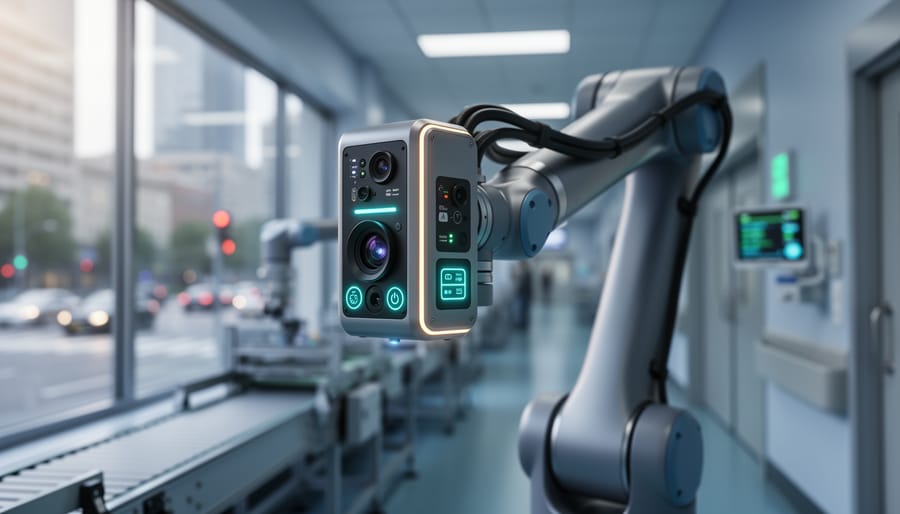
Imagine a factory floor where machines predict equipment failures before they happen, adjusting production schedules automatically. Or picture a smart building that learns occupant patterns, optimizing temperature and lighting without human intervention. This is AI-powered automation—the convergence of artificial intelligence and automated systems that transforms passive machines into intelligent decision-makers.
Traditional automation follows rigid, pre-programmed rules: if sensor A detects condition B, execute action C. AI-powered automation breaks this limitation. By analyzing vast streams of sensor data in real-time, AI systems recognize patterns, predict outcomes, and adapt their responses based on changing conditions. The difference is profound—instead of simply reacting, these systems learn and improve continuously.
The impact spans every industry. Manufacturing facilities use AI-driven sensors to reduce downtime by up to 50% through predictive maintenance. Healthcare providers deploy intelligent monitoring systems that detect patient deterioration hours before traditional methods. Smart cities leverage sensor networks powered by AI to manage traffic flow, reduce energy consumption, and improve public safety—all without constant human oversight.
This technological shift raises essential questions: How do these systems actually work? What makes an AI-powered sensor different from conventional alternatives? Which technologies enable machines to learn from their environment? Understanding these fundamentals empowers you to recognize opportunities, evaluate solutions, and participate in discussions shaping our automated future.
The journey from basic automation to intelligent, self-improving systems represents one of technology’s most significant transformations—and it’s accelerating faster than most realize.
What Makes AI-Powered Sensors Different from Traditional Sensors
The Intelligence Layer: Where Sensors Meet Machine Learning
The magic happens when sophisticated algorithms meet sensor hardware, creating systems that can think and act independently. At this critical intersection, raw sensor data transforms into intelligent insights and automated actions.
Think of it this way: traditional sensors are like messengers that simply report what they detect. They might tell you the temperature is rising, but they can’t interpret what that means or decide what to do about it. AI-powered sensors, however, combine detection with decision-making capabilities. This is how AI sensors work to create truly autonomous systems.
The secret lies in edge computing, which brings processing power directly to the sensor location. Instead of sending all data to distant cloud servers, neural networks operate right where the data is collected. Imagine a smart camera in a manufacturing plant: it doesn’t just capture images and send them elsewhere for analysis. The AI algorithms run locally on the device itself, identifying defects in milliseconds and triggering immediate responses.
These neural networks are trained on thousands of examples, learning to recognize patterns much like our brains do. A temperature sensor in a smart building doesn’t just measure heat; it learns your preferences, predicts occupancy patterns, and automatically adjusts climate control. Meanwhile, the system continues learning from each interaction, becoming more accurate over time without requiring constant internet connectivity or creating privacy concerns by transmitting personal data externally.
From Reactive to Predictive: The Automation Advantage
Traditional sensors operate like smoke alarms—they react when something goes wrong, triggering alerts only after crossing predefined thresholds. AI-powered sensors, however, act more like attentive guardians, constantly learning normal patterns and spotting subtle deviations that signal trouble ahead.
Consider a manufacturing plant where motors drive production lines. A conventional sensor monitors temperature and sounds an alarm at 80 degrees Celsius. But an AI sensor does something smarter: it learns that Motor A typically runs at 62 degrees on Tuesdays at 2 PM. When it detects the motor climbing to 68 degrees—still well below the alarm threshold—the AI recognizes an anomaly. By analyzing vibration patterns, power consumption, and historical failure data simultaneously, it predicts a bearing failure three days before breakdown occurs.
This predictive capability transforms maintenance schedules. Instead of fixing broken equipment or replacing parts prematurely, teams can intervene at precisely the right moment. In agriculture, AI sensors predict irrigation needs by analyzing soil moisture trends, weather forecasts, and plant growth stages together—preventing crop stress before visible wilting occurs. The shift from reactive to predictive doesn’t just save money; it fundamentally reimagines how we interact with our physical environment.
Real-World Applications Transforming Industries Right Now
Smart Manufacturing: Factories That Fix Themselves
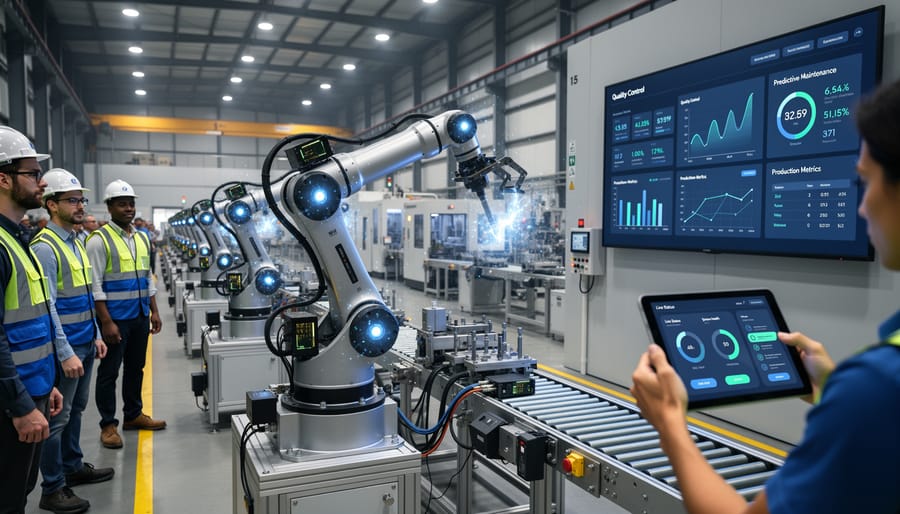
Modern manufacturing plants are transforming into self-healing environments where machines predict their own failures before they happen. Instead of waiting for equipment to break down and halt production, AI-powered sensors continuously monitor machinery health, analyzing vibrations, temperature fluctuations, and acoustic patterns to detect the earliest signs of wear.
Consider a car manufacturing plant where robotic arms assemble vehicles 24/7. Traditional maintenance schedules would shut down production at fixed intervals, whether the equipment needed servicing or not. With predictive maintenance, AI sensors track each robot’s performance in real-time. When a sensor detects an unusual vibration pattern in a motor bearing, it alerts maintenance teams days or weeks before failure, allowing repairs during planned downtime rather than costly emergency shutdowns.
Quality control has also become automated and incredibly precise. AI-powered visual inspection systems examine thousands of products per hour, spotting microscopic defects that human inspectors might miss after hours of repetitive work. These systems learn what “good” looks like by analyzing millions of product images, then flag any deviation from perfection. A smartphone manufacturer might use these sensors to detect screen imperfections smaller than a human hair, ensuring only flawless devices reach customers.
The financial impact is substantial. Manufacturers report reducing unplanned downtime by 30-50% and cutting maintenance costs by up to 40%. More importantly, workers shift from reactive firefighting to proactive problem-solving, focusing on continuous improvement rather than emergency repairs. The factory doesn’t just run automatically; it actively maintains itself.
Healthcare Monitoring: Sensors That Save Lives
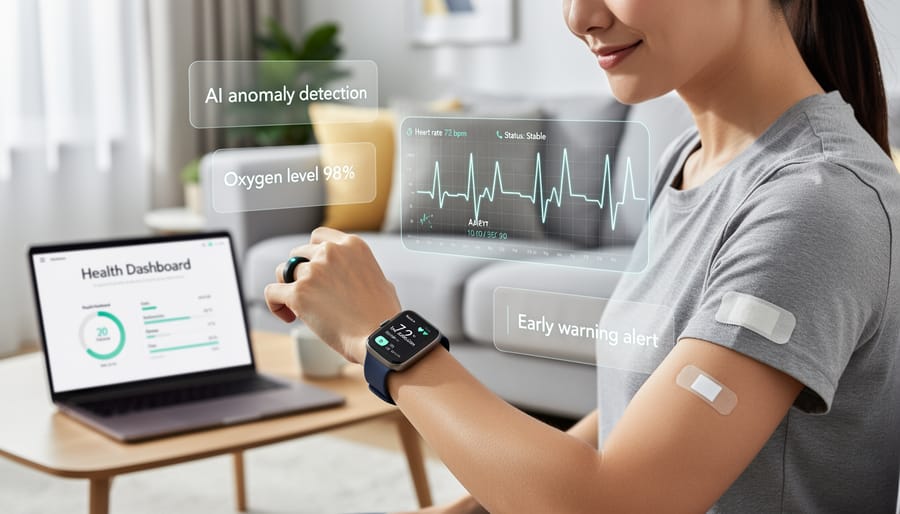
In healthcare settings, AI-powered sensors are transforming patient care from reactive to proactive. Modern wearable health monitors do far more than count steps or track heart rate. They continuously analyze patterns in vital signs like blood oxygen levels, heart rhythm irregularities, and body temperature fluctuations. When AI detects concerning trends, it immediately alerts medical staff before a patient’s condition becomes critical.
Consider how smartwatches can now identify atrial fibrillation, a dangerous heart rhythm disorder. The AI analyzes electrical signals from your heart, comparing them against millions of other readings to spot abnormalities you wouldn’t notice yourself. This early detection has literally saved lives by prompting users to seek medical attention.
Inside hospitals, AI-powered automation systems monitor intensive care patients around the clock. These systems track dozens of parameters simultaneously, learning what’s normal for each individual patient. If someone’s breathing pattern shifts or their blood pressure trends downward, the AI triggers early warning alerts hours before traditional monitoring would catch the problem.
Remote patient monitoring has become especially valuable for elderly individuals and those with chronic conditions. Smart sensors in homes detect falls, medication adherence, and changes in daily activity patterns, allowing healthcare providers to intervene quickly when something goes wrong.
Agriculture and Environmental Monitoring
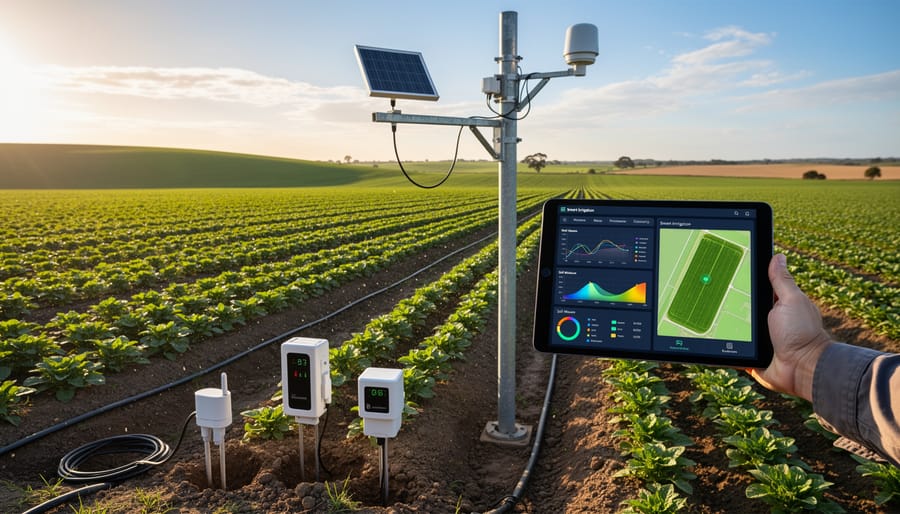
Modern farms are transforming into smart, data-driven operations thanks to AI-powered sensors that make real-time decisions about crop care. Imagine sensors embedded throughout a field that don’t just measure soil moisture—they analyze weather patterns, predict upcoming conditions, and automatically trigger irrigation systems only when and where needed. This precision agriculture approach can reduce water usage by up to 50% while improving crop yields.
These intelligent systems work by combining multiple sensor types: soil monitors track nutrient levels and moisture, drones equipped with multispectral cameras detect early signs of disease or pest damage invisible to the human eye, and weather stations predict optimal planting and harvesting times. The AI processes all this information simultaneously, learning from seasonal patterns to make increasingly accurate recommendations.
Environmental monitoring extends beyond farms too. AI sensors track air quality in cities, monitor wildlife populations in conservation areas, and detect early warning signs of natural disasters like floods or wildfires. For instance, forest sensors can identify temperature and humidity changes that indicate fire risk, alerting authorities before flames ever appear. This proactive approach protects both agricultural investments and our natural environment.
Smart Cities and Infrastructure
Urban environments are transforming into intelligent ecosystems through AI-powered sensors that manage everything from traffic flow to energy consumption. Picture a city where traffic lights adapt in real-time to congestion patterns. Smart traffic management systems use camera sensors and AI algorithms to analyze vehicle density, predict bottlenecks, and adjust signal timing automatically. Cities like Singapore and Barcelona have reduced traffic congestion by up to 25% using these systems, while also cutting emergency response times.
Energy grids benefit equally from this technology. AI sensors monitor electricity demand across neighborhoods, automatically balancing power distribution to prevent outages and reduce waste. These systems can predict peak usage hours and shift loads accordingly, making renewable energy integration more efficient. For example, sensors detect when solar panels produce excess power and route it to areas with higher demand.
Perhaps most crucial for public safety, structural health monitoring systems use vibration and stress sensors to continuously assess bridges, tunnels, and buildings. The AI detects tiny changes in structural integrity that humans might miss, predicting maintenance needs before dangerous failures occur. This proactive approach saved San Francisco’s Golden Gate Bridge millions in repair costs by identifying stress points early, demonstrating how automation protects both lives and infrastructure investments.
The Technologies Behind the Automation
Computer Vision Sensors
Cameras have evolved from simple recording devices into intelligent sensors that can understand what they’re seeing. Through AI algorithms, particularly deep learning and neural networks, cameras now process visual information in real-time, making split-second decisions without human intervention.
Consider facial recognition systems at airports. These cameras don’t just capture images; they analyze facial features, compare them against databases, and verify identities within seconds. The AI has learned to recognize faces from various angles, lighting conditions, and even with partial obstructions like glasses or hats.
In manufacturing, AI video analytics powers quality control systems that spot defects invisible to the human eye. A camera positioned on an assembly line can inspect thousands of products per hour, identifying microscopic scratches, misaligned components, or color variations. The system learns what “perfect” looks like and flags anything that deviates from the standard.
Retail stores use computer vision sensors to track customer movement patterns, manage inventory automatically, and even enable checkout-free shopping experiences. The cameras recognize products as customers pick them up and automatically charge their accounts when they leave.
These intelligent sensors combine traditional optics with AI processing, transforming raw visual data into actionable insights that drive automated decisions across countless applications.
IoT Integration and Edge Computing
Imagine a smart factory where hundreds of sensors monitor temperature, vibration, and equipment performance. These sensors generate massive amounts of data every second, but here’s the challenge: sending all that information to a distant cloud server creates delays that could mean the difference between preventing a machine failure and experiencing costly downtime.
This is where IoT (Internet of Things) integration meets edge computing. IoT connects physical sensors and devices through networks, allowing them to communicate and share data. Think of it as giving your automation system a nervous system where sensors act as touch receptors, constantly gathering information about their environment.
Edge computing solves the speed problem by processing critical data right where it’s collected, rather than sending everything to the cloud. When a sensor detects an anomaly, edge AI processors built into the device can analyze the information and trigger immediate responses in milliseconds. A self-driving car, for example, can’t afford to wait for cloud processing when detecting an obstacle—it needs instant decision-making at the edge.
This combination enables truly autonomous systems that respond in real-time while still connecting to broader networks for learning and updates.
Deep Learning Models for Sensor Data
Deep learning models act as the brain behind intelligent sensors, learning to recognize patterns in data much like how you learn to identify a friend’s voice in a crowded room. These neural networks—computer systems inspired by the human brain—process raw sensor readings and automatically discover meaningful patterns without being explicitly programmed for each scenario.
Here’s how the magic happens: imagine a temperature sensor in a factory. Initially, the neural network observes normal operating conditions, learning what “healthy” patterns look like. Over time, it detects subtle anomalies that humans might miss—perhaps a gradual temperature drift that precedes equipment failure. The network adjusts its internal connections based on this experience, becoming increasingly accurate at predicting problems before they occur.
The beauty of deep learning lies in its self-improvement capability. Each new piece of sensor data refines the model’s understanding. In smart buildings, these systems learn occupancy patterns and adjust lighting and climate automatically. In agriculture, they analyze soil moisture sensors to optimize irrigation schedules based on weather forecasts and crop needs.
Unlike traditional programming where engineers must define every rule, deep learning models discover relationships independently. They can handle complex, multi-sensor environments where thousands of data points interact simultaneously, making decisions in milliseconds and continuously adapting to changing conditions.
The Benefits and Challenges You Should Know About
Why Businesses Are Racing to Adopt This Technology
The business case for AI-powered automation has become impossible to ignore. Companies implementing these systems report cost reductions of 25-40% in operational expenses, primarily through reduced labor needs and fewer errors. A manufacturing plant using AI-driven quality control, for example, can catch defects with 99.5% accuracy compared to 85-90% with human inspection alone.
The 24/7 operational advantage stands out as a game-changer. Unlike human workers, AI systems don’t require breaks, shifts, or sleep. A retail distribution center can process orders continuously, responding to customer demands at 3 AM just as efficiently as noon. This round-the-clock capability translates directly to faster service and higher customer satisfaction scores.
Scalability offers another compelling benefit. Traditional automation required expensive hardware upgrades to handle increased workload. Modern AI systems, powered by tiny AI chips and cloud computing, can scale rapidly through software updates. A customer service chatbot handling 1,000 daily interactions can expand to 10,000 with minimal additional investment.
Real-world metrics paint a clear picture. Healthcare facilities using AI-powered diagnostic tools report 30% faster patient processing times. Financial institutions detect fraudulent transactions 50 times faster than manual review methods. These numbers explain why global investment in AI automation reached $50 billion in 2023, with projections doubling by 2027.
The Hurdles Still Being Overcome
While AI-powered automation offers tremendous potential, organizations face several significant hurdles during adoption. Understanding these challenges helps set realistic expectations for implementation.
Data privacy stands at the forefront of concerns. AI systems require vast amounts of information to learn effectively, but collecting sensor data from manufacturing floors, smart buildings, or healthcare facilities raises questions about who owns this data and how it’s protected. Companies must navigate complex regulations like GDPR while ensuring sensitive information remains secure from breaches.
The financial investment can be daunting, especially for smaller organizations. Beyond purchasing AI-enabled sensors, businesses need robust infrastructure for data processing and storage. A mid-sized manufacturer might spend hundreds of thousands on initial setup before seeing returns.
Training requirements present another obstacle. Employees accustomed to traditional systems need time to understand AI-driven processes. Maintenance teams must learn to troubleshoot intelligent sensors differently than conventional equipment, requiring ongoing education programs.
Integration complexity compounds these challenges. Legacy systems weren’t designed to communicate with AI platforms, creating compatibility headaches. Merging old and new technologies often demands custom solutions, extending implementation timelines and increasing costs. Despite these hurdles, organizations increasingly find that strategic planning and phased rollouts make the transition manageable while unlocking long-term benefits.
What’s Coming Next: The Future of Automated Sensor Intelligence
The future of automated sensor intelligence is unfolding faster than many experts predicted, with several groundbreaking developments already moving from research labs into real-world testing.
Self-learning sensors represent one of the most exciting frontiers. Unlike today’s AI sensors that require periodic retraining, these next-generation devices will continuously adapt their algorithms based on new data patterns. Imagine a security camera that automatically learns to distinguish between a delivery person’s regular route and suspicious behavior, without any human programming. Researchers at leading universities are already demonstrating prototypes that update their neural networks in real-time, becoming smarter with every observation.
Swarm intelligence takes inspiration from how bees and ants work together. Instead of relying on individual sensors, future systems will use networks of simple, inexpensive sensors that collectively make intelligent decisions. A warehouse might deploy hundreds of small sensors that communicate with each other to optimize inventory tracking, reroute around obstacles, and even predict maintenance needs. This distributed approach makes systems more resilient since the failure of a single sensor doesn’t compromise the entire network.
Quantum sensors, while still in early development, promise unprecedented sensitivity. These devices exploit quantum mechanics to detect minute changes in magnetic fields, gravity, or temperature that conventional sensors miss entirely. Current research focuses on making them stable enough for practical applications like underground infrastructure monitoring or medical diagnostics.
Perhaps most importantly, edge computing integration will allow sensors to process complex AI models locally rather than sending data to distant servers. This means faster responses, better privacy protection, and systems that work reliably even without internet connectivity. Early implementations are already appearing in autonomous vehicles and smart manufacturing equipment, pointing toward a future where intelligent automation becomes truly ubiquitous.
AI-powered sensor automation is transforming how we interact with technology, making our environments smarter, safer, and more responsive to our needs. From healthcare devices that predict medical emergencies before they happen to manufacturing systems that prevent costly breakdowns, these intelligent sensors are reshaping industries and improving lives in remarkable ways.
The journey from traditional sensors to AI-enhanced systems represents more than just a technological upgrade—it’s a fundamental shift in how machines understand and respond to the world around us. As we’ve explored throughout this article, the combination of advanced sensors, machine learning algorithms, and edge computing creates automated systems that learn, adapt, and make decisions with minimal human intervention.
If you’re excited about the possibilities of AI-powered automation, now is the perfect time to dive deeper. Start by exploring specific applications that interest you most, whether that’s smart home technology, industrial automation, or environmental monitoring. Consider taking online courses in machine learning basics or experimenting with beginner-friendly sensor platforms. Many resources and communities exist to support your learning journey, regardless of your current technical background.
The future of AI-powered sensors is bright and full of opportunity. By understanding these technologies today, you’re positioning yourself at the forefront of tomorrow’s innovations.