
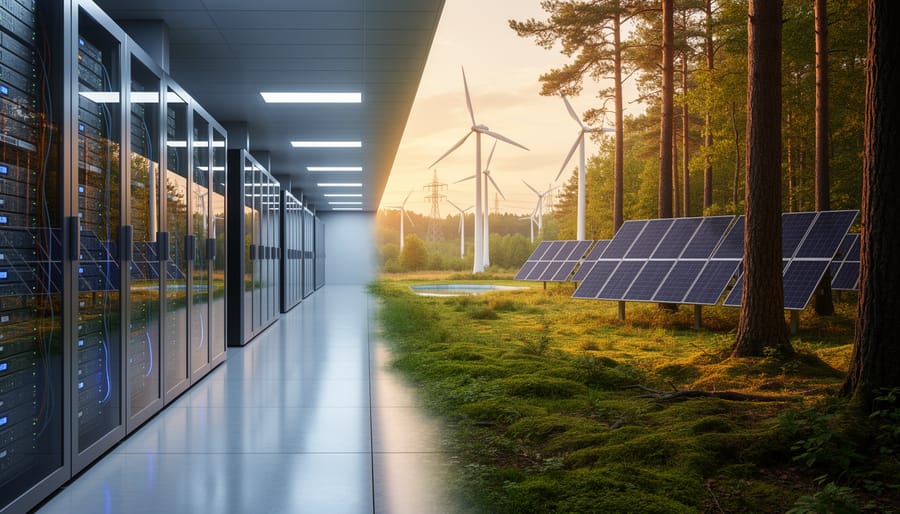
Every time you ask ChatGPT a question, you’re leaving an environmental footprint equivalent to charging your smartphone multiple times. Behind the sleek interfaces of AI assistants and machine learning models lies a sprawling infrastructure of data centers consuming massive amounts of electricity and water, contributing significantly to carbon emissions. The environmental toll of AI presents a paradox: the same technology promising to solve climate change through predictive modeling and resource optimization is itself an accelerating contributor to environmental degradation.
Consider this: training a single large language model can emit as much carbon as five cars over their entire lifetimes. Data centers supporting AI operations already consume about 1% of global electricity demand, a figure projected to surge as AI adoption accelerates across industries. Meanwhile, the mining of rare earth minerals for AI hardware chips disrupts ecosystems and depletes finite resources at unprecedented rates.
Yet this story has another side. AI is simultaneously becoming our most powerful tool for environmental protection. Machine learning algorithms now predict deforestation patterns with 95% accuracy, optimize renewable energy grids to reduce waste by 20%, and monitor wildlife populations in real-time to prevent extinction. Coastal cities use AI to model sea-level rise and plan climate adaptation strategies. Agricultural AI reduces water consumption by precisely targeting irrigation needs.
This creates an urgent ethical dilemma: How do we harness AI’s environmental benefits while minimizing its ecological costs? Should companies be required to disclose the carbon footprint of their AI models? What responsibility do developers have to build energy-efficient algorithms? As AI becomes deeply embedded in our daily lives, understanding this tension between technological promise and environmental impact isn’t just academic—it’s essential for anyone concerned about our planet’s future. The choices we make today about AI infrastructure will shape environmental outcomes for generations.
The Hidden Environmental Toll of AI Infrastructure
Energy Consumption: The Power-Hungry Reality
Artificial intelligence’s appetite for energy is staggering. To understand the scale, consider this: training GPT-3, one of the most advanced language models, consumed approximately 1,287 megawatt-hours of electricity. That’s equivalent to what 120 average American homes use in an entire year, all for a single training session.
The carbon footprint of AI queries extends beyond initial training. Every time you use ChatGPT or similar tools, it requires computational power. A single AI-powered search can consume up to ten times more energy than a traditional Google search. Multiply that by billions of daily queries worldwide, and the numbers become eye-opening.
Data centers powering AI operations are energy-intensive facilities. These massive warehouses filled with servers operate around the clock, requiring not just electricity to run processors but also substantial cooling systems to prevent overheating. According to recent studies, data centers already account for roughly 1-2% of global electricity consumption, and AI workloads are accelerating this demand exponentially.
The comparison to traditional computing reveals a stark difference. Training a single large AI model can emit as much carbon as five cars produce over their entire lifetimes, including manufacturing. While your laptop might use 50-100 watts during typical use, a single AI training run requires the equivalent power of hundreds or thousands of computers working simultaneously for weeks or months.
This energy demand poses a critical question: as AI becomes more integrated into our daily lives, from virtual assistants to autonomous vehicles, how do we balance innovation with environmental responsibility? Understanding these consumption patterns is the first step toward developing more sustainable AI practices.
Water Usage: The Thirst Behind the Code
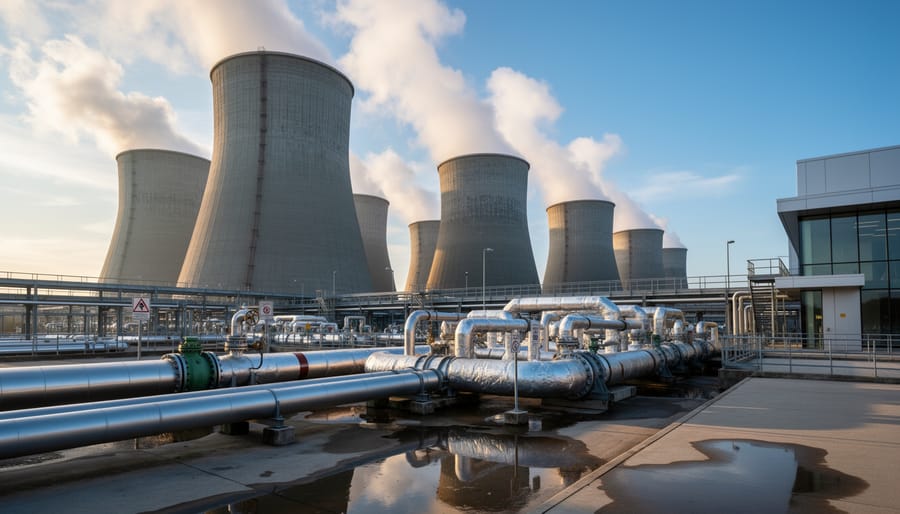
When you ask ChatGPT a question or generate an image with DALL-E, you’re tapping into massive data centers that need constant cooling to prevent overheating. These facilities consume staggering amounts of water, and AI’s water consumption is becoming an urgent environmental concern.
To understand the scale, consider this: training a single large AI model can consume as much water as it takes to fill an Olympic-sized swimming pool. Microsoft’s data centers alone used approximately 1.7 billion gallons of water in 2021, a figure that jumped significantly as AI operations expanded. Google reported similar increases, with their water usage rising by billions of gallons annually.
The cooling process works through evaporation, meaning this water doesn’t return to local supplies. In water-scarce regions like Arizona and Nevada, where tech companies have built sprawling data centers, this creates serious problems. Residents in these communities face competing demands for a limited resource, especially during droughts.
The impact hits hardest in developing countries. When data centers locate in regions already struggling with water access, local agriculture and household needs suffer. In Uruguay, for example, Google’s data center operations sparked protests from communities concerned about water availability during severe drought conditions. This raises critical questions about who bears the environmental cost of AI advancement and whether convenience for some justifies resource depletion for others.
E-Waste and Hardware Lifecycles
Training sophisticated AI models demands specialized processors—particularly Graphics Processing Units (GPUs) and Tensor Processing Units (TPUs)—that function as the heavy machinery of artificial intelligence. Unlike standard computers, these high-performance chips consume enormous amounts of energy and require frequent upgrades to keep pace with rapidly evolving AI capabilities.
The hardware lifecycle problem creates a troubling cycle: as AI companies race to develop more powerful models, they often replace functional equipment every 2-3 years, generating mountains of electronic waste. A single data center can house thousands of these processors, each containing precious metals like gold, silver, and rare earth elements such as neodymium and tantalum.
The environmental damage begins even before these chips power up. Extracting rare earth minerals devastates landscapes through strip mining, contaminates water supplies with toxic runoff, and displaces local communities. For perspective, producing one kilogram of rare earth elements can generate up to 2,000 kilograms of toxic waste.
When these processors reach end-of-life, the challenge intensifies. Electronic waste often ends up in landfills where hazardous materials leach into soil and groundwater, or gets shipped to developing nations where informal recycling operations expose workers to dangerous chemicals. This creates an environmental justice issue where the benefits of AI advancement accrue globally while pollution concentrates in vulnerable communities.

Environmental AI: When Technology Becomes Part of the Solution
Climate Modeling and Prediction
AI is transforming how we understand and respond to climate challenges through powerful real-world applications. Google’s DeepMind has partnered with meteorological agencies to improve rainfall predictions, achieving forecasts up to 90 minutes ahead with remarkable accuracy. This helps communities prepare for flash floods and severe weather events with precious extra time.
In climate modeling, Microsoft’s AI for Earth program processes vast amounts of satellite imagery and environmental data to track deforestation, monitor coral reef health, and predict ecosystem changes. These models can analyze decades of climate patterns in hours rather than months, helping scientists identify trends that would otherwise remain hidden.
Early warning systems have become significantly more effective with AI integration. IBM’s GRAF system generates high-resolution weather forecasts for the entire planet, updating every hour. In developing nations, AI-powered systems now predict cyclones and typhoons earlier, enabling evacuations that save thousands of lives annually.
Perhaps most importantly, AI helps visualize future climate scenarios by processing complex interactions between oceans, atmosphere, and land masses. These predictions inform policy decisions and help governments plan infrastructure investments for climate resilience, making abstract climate data actionable for decision-makers worldwide.
Optimizing Energy Grids and Resource Management
While AI infrastructure consumes significant energy, AI technologies are simultaneously revolutionizing how we manage and conserve resources across multiple sectors. Think of it as using intelligence to combat waste at a massive scale.
Smart grids represent one of AI’s most impactful environmental applications. These systems use machine learning algorithms to predict electricity demand patterns, balance supply from renewable sources like solar and wind, and automatically route power where it’s needed most. For example, Google’s DeepMind reduced energy used for cooling their data centers by 40% through AI optimization. On a larger scale, utility companies now deploy AI to prevent blackouts, reduce transmission losses, and integrate intermittent renewable energy sources more effectively into the grid.
In agriculture, AI-powered precision farming is transforming an industry responsible for roughly 10% of greenhouse gas emissions. Sensors and computer vision systems analyze soil conditions, weather patterns, and crop health in real-time, allowing farmers to apply water, fertilizers, and pesticides only where needed. John Deere’s AI tractors, for instance, can identify and spray individual weeds rather than entire fields, reducing herbicide use by up to 90%. This targeted approach saves resources while minimizing environmental impact.
Supply chains also benefit enormously from AI optimization. Machine learning models predict demand more accurately, reducing overproduction and waste. Route optimization algorithms help delivery trucks consume less fuel, while warehouse management systems minimize energy use. These improvements collectively reduce emissions while cutting costs, demonstrating how environmental responsibility and economic efficiency can align through intelligent automation.
Wildlife Conservation and Ecosystem Monitoring
Despite AI’s environmental footprint, it’s becoming a powerful ally in protecting our planet’s biodiversity. Conservation organizations are deploying AI-powered systems that analyze camera trap images to track endangered species populations in real-time, a task that once required thousands of hours of manual review. For example, wildlife researchers now use machine learning algorithms to identify individual animals by their unique markings, enabling more accurate population counts and migration pattern studies.
Anti-poaching efforts have been transformed through AI-driven predictive analytics. By analyzing historical poaching data, ranger patrol routes, and environmental factors, these systems can forecast where illegal activities are most likely to occur, allowing wildlife rangers to position resources more effectively. Some protected areas have reported up to 70% reductions in poaching incidents using these intelligent deployment strategies.
Satellite imagery combined with computer vision algorithms has revolutionized deforestation monitoring. AI systems can detect illegal logging activities within hours rather than weeks, analyzing vast forest areas to spot changes as small as individual tree removals. Organizations like Global Forest Watch use these technologies to send alerts to authorities and local communities, enabling rapid response to environmental threats. This democratization of monitoring capabilities empowers even remote communities to become active guardians of their local ecosystems.

The Ethical Dilemma: Balancing Innovation and Responsibility
Who Pays the Environmental Price?
The benefits of artificial intelligence may be global, but its environmental costs fall disproportionately on specific communities. AI’s massive data centers rarely appear in affluent neighborhoods. Instead, they’re typically built in regions where land is cheaper and regulations are more lenient, often near communities with limited political power.
Consider the water consumption issue. A single large data center can use millions of gallons of water daily for cooling. In 2022, communities in South Carolina raised environmental justice concerns when Google’s data center operations coincided with water shortages affecting local residents. Similar patterns emerge worldwide, with developing nations hosting data infrastructure while bearing the brunt of resource depletion and electronic waste.
The e-waste problem compounds this inequality. As AI requires constant hardware upgrades, discarded servers and components often end up in countries like Ghana and India. There, workers without proper safety equipment dismantle toxic materials, exposing themselves to lead, mercury, and other harmful substances.
Energy infrastructure presents another disparity. Building new power plants or expanding electrical grids to support AI facilities can displace communities or damage local ecosystems. Indigenous lands and areas with vulnerable populations frequently become sites for these developments, with residents having minimal say in decisions that fundamentally alter their environment.
These patterns reveal an uncomfortable truth: the communities least likely to benefit from advanced AI technologies often pay the highest environmental price for their development.
The Necessity Question: Which AI Applications Justify Their Cost?
Not every AI application carries equal weight when we consider its environmental cost. As we develop an ethical framework for AI deployment, we must ask a fundamental question: does this application justify the energy it consumes and the resources it demands?
Consider two contrasting examples. On one end, we have AI systems generating personalized horoscopes or creating endless variations of cat memes. These applications, while entertaining, consume computational resources with minimal societal benefit. Each image generation or text prediction requires energy that ultimately translates to carbon emissions.
On the other end, we find AI applications addressing critical challenges. Machine learning models predicting natural disasters can save thousands of lives and prevent billions in damages. AI systems optimizing renewable energy grids reduce waste and accelerate our transition from fossil fuels. Medical AI detecting diseases in their earliest stages improves patient outcomes while reducing the environmental burden of late-stage treatments.
The distinction becomes clearer when we apply a simple test: does this AI application solve a problem we cannot effectively address otherwise? Climate modeling AI processes vast datasets beyond human capability, revealing patterns that inform crucial policy decisions. Precision agriculture AI helps farmers reduce water usage by 30 percent while maintaining crop yields, directly addressing resource scarcity.
This necessity question extends beyond individual applications to how we deploy AI. Do we need a massive language model running constantly to answer simple customer service queries, or would a smaller, more efficient model suffice? The environmental cost of AI demands we become more intentional about where and how we apply this powerful technology, prioritizing applications that generate genuine value for society and our planet.
Making AI Greener: Innovations and Solutions Taking Root
Renewable-Powered Data Centers
Leading tech companies are making significant strides toward powering their AI infrastructure with renewable energy. Google has been carbon-neutral since 2007 and achieved a milestone in 2017 by matching 100% of its global electricity consumption with renewable energy purchases. The company now operates several data centers powered by wind and solar energy, including facilities in Finland and Iowa. Microsoft has committed to becoming carbon-negative by 2030 and is investing heavily in solar and wind projects to power its growing AI operations. Similarly, Amazon Web Services has launched multiple renewable energy projects worldwide, aiming for 100% renewable power by 2025.
However, this transition faces notable challenges. The intermittent nature of solar and wind power creates reliability concerns for data centers that must operate continuously. Energy storage solutions remain expensive and limited in scale. Geographic constraints also pose difficulties, as optimal locations for renewable energy generation don’t always align with existing data center infrastructure. Additionally, the sheer pace of AI growth means energy demand often outstrips renewable capacity expansion. Companies must balance ambitious sustainability goals with the practical realities of maintaining reliable, high-performance computing systems that power modern AI applications.
More Efficient AI Models
Researchers are pioneering “green AI” by rethinking how we build and train artificial intelligence models. Think of it like the difference between driving a gas-guzzling SUV versus a fuel-efficient hybrid – both get you where you need to go, but one uses far fewer resources.
One breakthrough approach is creating smaller, more efficient models that deliver comparable results to their larger cousins. Instead of training massive neural networks with billions of parameters, scientists are developing compact models that can run on less powerful hardware. It’s similar to compressing a high-resolution photo without losing the important details.
Model pruning is another game-changing technique. Imagine trimming dead branches from a tree – by removing unnecessary connections in neural networks, researchers can reduce computational requirements by up to 90% while maintaining accuracy. This means less energy consumption and lower carbon emissions per AI task.
Additionally, efficient training methods like transfer learning allow models to build on existing knowledge rather than learning everything from scratch. Picture teaching someone to play tennis when they already know badminton – they’ll learn much faster because the foundational skills transfer over. These innovations are making AI both more accessible and environmentally responsible.
Transparency and Carbon Tracking
As AI’s environmental impact gains attention, the tech industry is developing tools and standards to measure what was once invisible. Think of it like nutrition labels for AI models—standardized ways to understand their environmental cost before deployment.
Several organizations now offer carbon tracking tools specifically designed for machine learning. For example, CodeCarbon is an open-source tool that automatically estimates the carbon emissions produced during model training by monitoring your computer’s energy consumption and cross-referencing local energy grid data. Google and Meta have introduced similar tracking systems within their own infrastructure, allowing researchers to see the real-time carbon footprint of their experiments.
The ML CO2 Impact calculator represents another breakthrough, enabling researchers to estimate emissions based on hardware type, training duration, and geographic location. These tools have revealed surprising insights—training the same model in Quebec (which relies heavily on hydroelectric power) produces significantly less carbon than training it in regions dependent on coal.
Industry standards are also emerging. The AI Sustainability Working Group is developing frameworks for consistent carbon reporting, while some academic conferences now require researchers to disclose the computational resources and estimated emissions of their work, promoting accountability and encouraging more efficient practices.
What You Can Do: Personal and Professional Action Steps
For AI Developers and Engineers
If you’re building AI systems, you have direct power to reduce their environmental footprint. Start by choosing efficient model architectures. Smaller models like DistilBERT or MobileNet can achieve comparable results to larger counterparts while using a fraction of the energy. Before training from scratch, consider transfer learning or fine-tuning existing models, which dramatically cuts computational costs.
Use carbon calculators such as ML CO2 Impact or CodeCarbon to measure your training emissions. These tools provide concrete data that helps you understand your environmental impact and make informed decisions about where to train your models. For instance, training in regions powered by renewable energy can reduce your carbon footprint by up to 30 times compared to coal-heavy grids.
Implement simple optimization practices like mixed-precision training, which speeds up computation while reducing energy consumption. Set up early stopping criteria to avoid unnecessary training cycles, and regularly prune redundant model parameters.
Finally, advocate for sustainability within your organization. Push for green hosting providers, propose energy efficiency metrics alongside accuracy benchmarks, and share environmental impact reports with stakeholders. Remember, every optimization you implement creates a ripple effect across thousands of future model runs.
For Businesses and Decision-Makers
If you’re a business leader considering AI solutions, evaluating environmental impact should be part of your decision-making process. Start by asking potential AI vendors about their environmental policies. Do they use renewable energy in their data centers? Can they provide transparency about their carbon footprint? Companies like Google and Microsoft now publish detailed sustainability reports, setting a standard you should expect from any AI provider.
Before implementing AI systems, conduct an environmental impact assessment. Calculate the estimated energy consumption based on model size and training frequency. For example, if you’re deploying a customer service chatbot, determine whether you need a large language model or if a smaller, more efficient model would suffice. Often, simpler solutions deliver 80% of the benefits with 20% of the environmental cost.
Implement responsible AI procurement by including environmental criteria in your vendor selection process. Request information about model efficiency, energy sources, and carbon offset programs. Consider building these requirements into contracts. You might also explore federated learning approaches, where AI models train on decentralized data, reducing the need for massive centralized computing.
Finally, remember that environmental responsibility and cost efficiency often align. Energy-efficient AI systems typically cost less to operate, making sustainability a smart business decision beyond ethical considerations.
For Everyday Users and Consumers
As an everyday user, you have more power than you might think to reduce AI’s environmental footprint. Start by choosing AI services from companies that prioritize renewable energy and publish transparency reports about their carbon emissions. For instance, when selecting a cloud storage provider or virtual assistant, research whether they operate carbon-neutral data centers.
You can also optimize your own AI usage. Limit unnecessary cloud backups, reduce reliance on power-hungry AI features when simpler alternatives exist, and consider whether you truly need that AI-powered photo enhancement or if basic editing suffices. Think of it like choosing energy-efficient appliances for your home—small decisions add up.
Support companies that invest in green AI research by voting with your wallet and voice. Leave feedback requesting sustainability information, and share articles about environmental AI impacts on social media. Your informed choices create market pressure for better practices, encouraging tech companies to prioritize efficiency alongside innovation in their AI development.
As we’ve explored throughout this article, artificial intelligence presents us with a fascinating paradox. On one hand, AI infrastructure demands enormous amounts of energy, water, and raw materials, contributing significantly to carbon emissions and environmental degradation. On the other hand, AI offers some of our most powerful tools for addressing climate change, optimizing resource use, and protecting ecosystems. This dual nature isn’t contradictory; it’s a reflection of the choices we make today.
The key insight is that AI’s environmental impact isn’t predetermined. Every decision matters, from the energy sources powering data centers to the algorithms we choose to develop and deploy. When tech companies opt for renewable energy, when developers prioritize efficient model architectures, and when organizations conduct environmental impact assessments before launching AI projects, they’re actively shaping a more sustainable future.
Consider this: a single AI model can either consume as much energy as five cars in their lifetimes or help optimize an entire city’s energy grid to reduce emissions by millions of tons. The difference lies in intentionality. By understanding the hidden environmental costs of our digital infrastructure, we can make informed decisions that maximize AI’s benefits while minimizing its footprint.
The next generation of environmental AI ethics will be defined by transparency, accountability, and innovation. We’re already seeing promising developments like carbon-aware computing, edge AI that reduces data center loads, and open-source tools for measuring AI’s environmental impact. As awareness grows, so does our collective responsibility to demand better practices from technology companies and to support sustainable AI development.
The question isn’t whether AI will shape our environmental future; it already is. The real question is whether we’ll guide that influence consciously and responsibly. With informed choices and sustained commitment, we can harness AI’s transformative potential while protecting the planet that sustains us all. The future of environmental AI ethics begins with understanding, continues with action, and depends on all of us.