

Your AI model just failed in production, and you discovered it three weeks too late. The customer complaints piled up, revenue dropped, and worst of all, you had no idea why the model started making incorrect predictions. This scenario plays out daily across organizations deploying machine learning systems without proper observability.
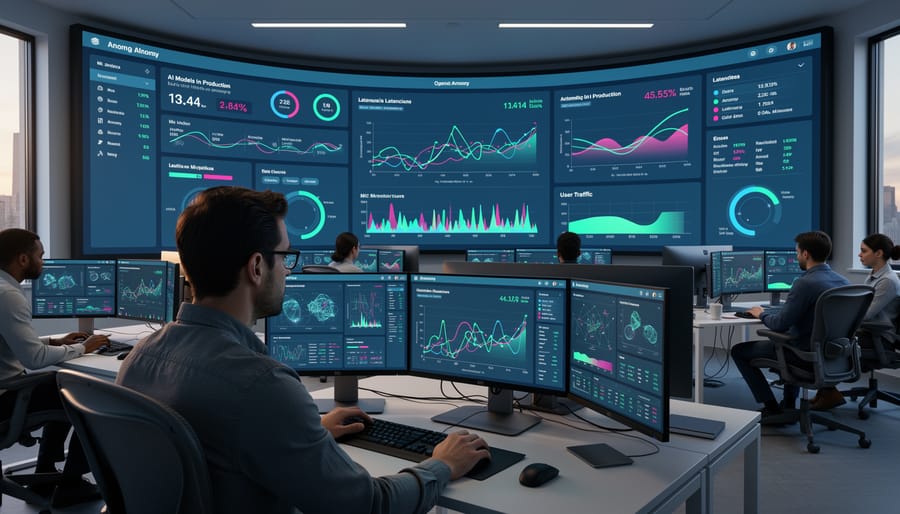
AI model observability means understanding what’s happening inside your models during production, not just whether they’re running. Think of it like the dashboard in your car: you don’t just need to know the engine is on, you need to see speed, fuel level, temperature, and warning lights to drive safely. Similarly, observability tracks model inputs, outputs, performance metrics, and data quality in real-time to catch problems before they escalate.
The challenge is that traditional software monitoring doesn’t work for machine learning. A model can execute perfectly from a technical standpoint while producing terrible predictions because the incoming data has shifted, a phenomenon called data drift. Your API might return 200 status codes while your model recommends products nobody wants or flags legitimate transactions as fraudulent.
This creates a blind spot that costs organizations millions. A fraud detection model that degrades slowly might let suspicious transactions through unnoticed. A recommendation engine serving irrelevant content erodes user trust gradually. Without observability, these failures remain invisible until business impact becomes undeniable.
Understanding observability means gaining visibility into model behavior, detecting when predictions deviate from expectations, and diagnosing root causes quickly. It transforms ML systems from black boxes into transparent, manageable components of your production infrastructure, enabling you to maintain model performance and business value over time.
What Makes AI Model Observability Different from Traditional Monitoring
Imagine you’re driving a car versus piloting a self-driving vehicle. With traditional software monitoring, you’re essentially checking if the engine is running, if the wheels are turning, and if the dashboard lights are working properly. But with AI model observability, you need to monitor whether the car is actually making good driving decisions in real-time, adapting to changing road conditions, and maintaining its ability to navigate safely over time.
Traditional application monitoring focuses on straightforward metrics: Is the server up? How fast is the response time? Are there any error codes? These are binary questions with clear answers. Your software either works as programmed or it doesn’t. When you’re training your AI models, you might achieve excellent results, but maintaining that performance in production is an entirely different challenge.
AI models operate in a fundamentally different way. They make predictions based on probability rather than deterministic rules. A traditional application will always produce the same output for the same input, but an AI model might give you different confidence levels depending on various factors. This probabilistic nature means you can’t simply monitor for errors in the conventional sense.
The most critical difference lies in three unique challenges. First, there’s data drift, where the real-world data your model encounters gradually differs from the training data. Think of it like learning to recognize cats from photos taken in your hometown, then suddenly being asked to identify cats in a completely different country where they look slightly different. Your accuracy suffers, but traditional monitoring wouldn’t catch this degradation.
Second, model performance can degrade silently without any technical failures. Your application isn’t crashing or throwing errors. The model is still generating predictions, but those predictions are becoming less accurate over time. Traditional monitoring tools would show everything running smoothly while your model quietly fails at its actual job.
Finally, the inputs and outputs of AI models are complex and high-dimensional. Unlike monitoring a simple API that returns status codes, you’re dealing with images, text, audio, or massive datasets. You need specialized tools to track feature distributions, prediction confidence scores, and output quality in ways that standard monitoring dashboards simply weren’t built to handle.
The Three Pillars of AI Model Observability
Data Observability: Watching What Goes In
Before your AI model can make predictions, it needs data—and the quality of that data determines everything. Data observability is like having a security camera on your model’s front door, monitoring what information flows in and flagging anything suspicious.
Think of it this way: imagine you’ve built a model to predict customer purchases based on shopping patterns. If your data pipelines suddenly break and start sending incomplete information, your model will make poor predictions without you even realizing it. Data observability prevents these silent failures.
One critical aspect is detecting data drift—when the statistical properties of your input data change over time. For example, an e-commerce recommendation model trained on pre-pandemic shopping habits might struggle when people suddenly shift to buying home office equipment instead of travel accessories. By tracking metrics like feature distributions and value ranges, you can spot these shifts early.
Distribution shifts matter too. Consider a loan approval model that sees a sudden influx of applications from a new demographic group. If you’re not monitoring the incoming data distribution, you might miss that your model wasn’t trained on similar cases and could produce biased or inaccurate results.
Practical data observability includes tracking missing values, checking data freshness, monitoring feature correlations, and setting alerts for unexpected patterns. When seasonal changes affect user behavior—like fitness app usage spiking in January—observability tools help you distinguish between normal variations and genuine problems requiring intervention.

Model Performance Observability: Tracking What Comes Out
Once your model is deployed and making predictions, the real work begins. Model performance observability focuses on tracking what happens when your AI meets the real world—and spoiler alert: things rarely go exactly as planned.
Imagine training a fraud detection model on historical transaction data. During testing, it achieves 95% accuracy—impressive! But three months into production, you notice something troubling: accuracy has quietly slipped to 78%. What happened?
This phenomenon, called model degradation or model drift, occurs when the real-world data your model encounters changes over time. Perhaps fraudsters adapted their tactics, or customer shopping behaviors shifted after a major holiday season. Your model, trained on yesterday’s patterns, struggles with today’s reality.
Effective performance observability tracks several key metrics. Prediction accuracy measures how often your model gets it right in production. Response latency monitors how quickly predictions are delivered—critical when customers expect instant results. You’ll also want to watch prediction distribution patterns, which reveal whether your model encounters scenarios it wasn’t trained for.
Consider a medical diagnosis AI that was trained primarily on data from one demographic group. In production, serving a more diverse patient population, its accuracy might unexpectedly drop for certain groups—a serious issue that only careful monitoring would reveal.
The gap between training performance and production reality exists because controlled test environments can’t perfectly replicate the messy, evolving real world. By continuously monitoring these output metrics, you can detect problems early and retrain or adjust your models before small issues become major failures.
System Observability: Ensuring Everything Runs Smoothly
While monitoring your AI model’s predictions is crucial, you also need to keep a close eye on the infrastructure supporting it. Think of it like owning a car: even if the engine (your model) runs perfectly, problems with the fuel system or electrical components (your infrastructure) can leave you stranded.
System observability focuses on the technical foundation that keeps your AI models running. This includes tracking server health, memory consumption, CPU usage, and GPU utilization. For instance, if your recommendation engine suddenly slows down during peak shopping hours, the culprit might not be the model itself but insufficient server resources struggling to handle the load.
Key metrics to monitor include API response times, which measure how quickly your system delivers predictions to users. If a fraud detection system takes ten seconds to respond instead of milliseconds, transactions get delayed and customers grow frustrated. Error rates are equally important, tracking how often requests fail completely due to timeouts, crashes, or connectivity issues.
Here’s where things get tricky: system problems often disguise themselves as model performance issues. Imagine your chatbot starts giving poor responses. You might assume the model needs retraining, but the real problem could be database latency causing the system to retrieve outdated context. By monitoring both infrastructure and model performance together, you can quickly pinpoint whether you’re dealing with a technical glitch or an actual AI problem, saving valuable time and resources in troubleshooting.
Critical Metrics Every AI Model Needs to Track
Imagine launching your first AI model into production—a recommendation system that suggests products to thousands of users daily. Everything seems fine initially, but without the right metrics, you’re essentially flying blind. Let’s explore the critical measurements that illuminate how your model actually performs in the real world.
Prediction drift stands as your first line of defense against model degradation. This metric tracks how your model’s outputs change over time compared to its initial behavior. Think of it like a car’s alignment—when predictions start veering from expected patterns, something’s shifted. For instance, if your fraud detection model suddenly flags 40% of transactions as suspicious when it historically flagged only 5%, you’ve spotted prediction drift. Monitoring this helps you catch problems before they impact users.
Closely related is feature drift, which examines whether your input data still looks like the data your model trained on. Picture training a model to identify spam emails in 2020, then deploying it in 2024. Language evolves, new slang emerges, and scammers develop fresh tactics. Feature drift captures these changes in your data’s statistical properties. When the average length of incoming messages suddenly doubles or new emoji patterns appear, these shifts signal that your model might struggle because the world has changed.
Model confidence scores reveal how certain your AI feels about its predictions. A recommendation system might suggest a product with 95% confidence or 55% confidence—vastly different scenarios. Low confidence scores across many predictions indicate your model is uncertain, possibly encountering situations it hasn’t seen before. This metric works hand-in-hand with model interpretability, helping you understand not just what your model predicts, but how confident it feels.
Inference latency measures how quickly your model responds to requests. Users expect instant results, whether they’re getting product recommendations or translating text. If your model takes five seconds instead of 500 milliseconds, user experience suffers dramatically. Tracking latency trends helps you identify performance bottlenecks before they frustrate users.
Finally, error patterns provide invaluable insights. Rather than just counting total errors, examine when and why they occur. Does your image classifier struggle specifically with nighttime photos? Does your chatbot fail particularly with questions about new product features? Understanding these patterns transforms generic failures into actionable improvement opportunities, guiding where to focus your optimization efforts.
Common Problems AI Observability Helps You Catch Early
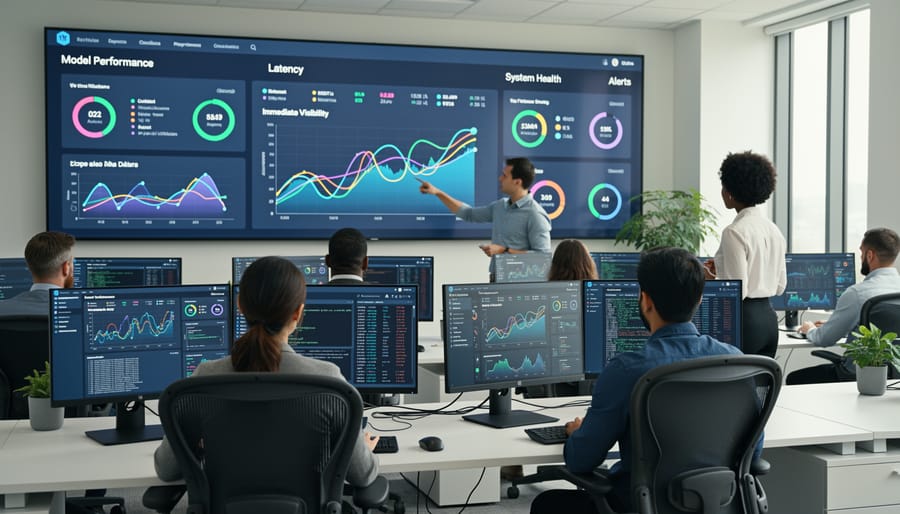
Understanding why AI models fail becomes much clearer when we examine real-world cases where observability could have prevented disaster.
Consider what happened to a major e-commerce platform in 2022. Their recommendation system suddenly started suggesting winter coats in July and swimsuits in December. The culprit? Data drift. The model had been trained on historical seasonal patterns, but a database migration accidentally shuffled timestamps. For three weeks, customers saw bizarre recommendations before engineers discovered the issue through customer complaints. Observability tools monitoring input data distributions would have caught this mismatch within hours, flagging that incoming data no longer matched the expected patterns.
Training-serving skew created silent failures for a fintech startup’s loan approval system. During training, they preprocessed data by removing outliers and normalizing income values. But in production, the preprocessing pipeline had a subtle bug that handled missing values differently. The model appeared to work fine, showing no errors or crashes. However, it was quietly rejecting qualified applicants and approving risky loans. This discrepancy went unnoticed for two months, costing the company millions in bad loans. An observability platform tracking feature distributions between training and production environments would have immediately spotted that the data shapes didn’t align.
Perhaps most concerning is concept drift, illustrated by a fraud detection system at a payment processor. The model was trained to catch fraudulent transactions based on 2020 patterns. By mid-2022, fraudsters had evolved their tactics, using new social engineering techniques and cryptocurrency-based schemes the model had never seen. The system’s precision slowly degraded from 94% to 67% over eighteen months. Because there were no sudden spikes in errors, the gradual decline went unnoticed until a major fraud ring exploited the blind spots. Observability tools monitoring model performance metrics over time would have triggered alerts as accuracy degraded, prompting a timely model refresh before significant damage occurred.
These stories share a common thread: problems festered because teams lacked visibility into their models’ behavior. Observability transforms these cautionary tales into preventable incidents.
Building Your AI Observability Stack: Where to Start
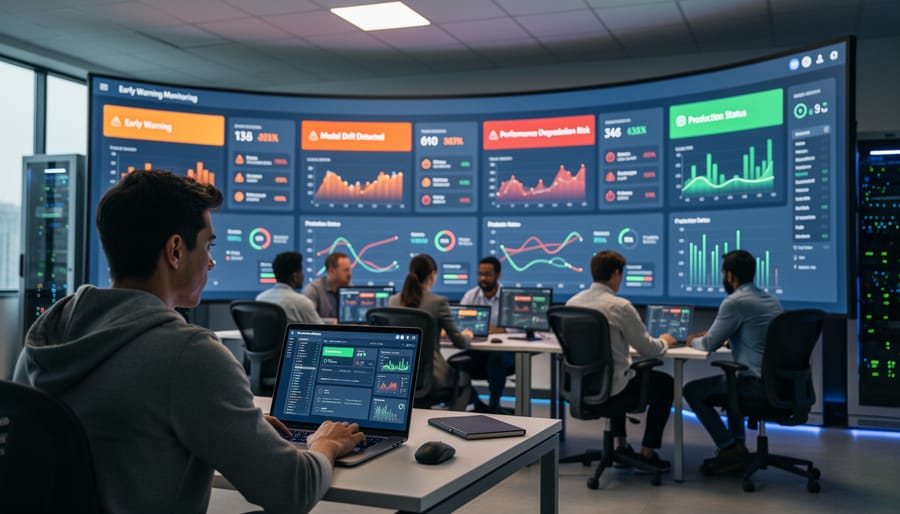
Starting your AI observability journey doesn’t require building complex infrastructure from day one. Think of it like learning to cook—you don’t need a professional kitchen to make your first meal. Begin with the essentials and expand as your needs grow.
The first decision you’ll face is whether to build custom observability solutions or use existing tools. For most teams, especially those just starting out, existing platforms offer the fastest path to value. Tools like Weights & Biases, MLflow, or Amazon SageMaker Model Monitor provide pre-built dashboards and monitoring capabilities that integrate smoothly with common model deployment tools. Building custom solutions makes sense only when you have unique requirements that off-the-shelf tools can’t address, or when you have dedicated engineering resources.
Start by identifying your three most critical metrics. For a recommendation system, this might be prediction latency, click-through rate, and data drift in user features. Don’t try to monitor everything at once—you’ll drown in data and miss what truly matters. Focus on metrics that directly impact user experience or business outcomes.
When integrating observability into your machine learning pipeline, adopt a layered approach. Begin with basic logging of predictions and model inputs. Next, add performance metrics like accuracy and latency. Finally, implement drift detection and more sophisticated monitoring as your system stabilizes.
Setting up alerts requires balance. Too many alerts create noise that teams learn to ignore—a phenomenon called alert fatigue. Too few, and you’ll miss critical issues. Start with alerts for severe problems only: model errors, extreme latency spikes, or significant accuracy drops. Use percentage thresholds rather than absolute numbers. For example, alert when accuracy drops 10% below baseline, not when it hits a specific number.
Remember, observability is a journey, not a destination. Start simple, learn from your data, and iterate based on what your specific models and users need.
In production AI systems, observability isn’t a luxury—it’s essential infrastructure. The difference between models that reliably serve users and those that fail silently often comes down to whether teams can see what’s happening under the hood. Without proper observability, you’re essentially flying blind, unable to detect when your model starts making poor predictions or when data patterns shift unexpectedly.
The good news? You don’t need to build a perfect observability system on day one. Start simple: implement basic performance metrics, set up alerts for obvious failures, and log prediction inputs and outputs. As you gain experience, gradually add more sophisticated monitoring like drift detection and explainability tools. Think of it as building muscle—consistency matters more than perfection.
Remember, every production AI model will eventually encounter unexpected situations. The question isn’t if problems will arise, but whether you’ll detect them quickly enough to respond. By making observability a priority from the start, you’re investing in the long-term reliability and trustworthiness of your AI systems, ensuring they continue delivering value to users rather than accumulating technical debt in the shadows.