

A Claude Code AI coding agent starter kit gives you the foundation to build intelligent coding assistants that can write, review, and debug code alongside your development team. The best kits in 2026 combine Claude’s advanced language model with pre-built templates, authentication scaffolding, and integration frameworks that handle the complex parts of agent development so you can focus on customizing behavior for your specific workflow. Expect to spend 2-4 hours on initial setup and configuration, though the learning curve flattens quickly once you understand the prompt engineering patterns that make these agents effective.
The market has matured significantly since early coding assistants appeared. Modern starter kits now include production-ready features like context management for large codebases, multi-file editing capabilities, and safety guardrails that prevent the agent from making destructive changes without human approval. You’ll find options ranging from minimalist CLI tools perfect for solo developers to enterprise-grade platforms with team collaboration features and audit logging.
The choice matters because a poorly designed kit can create more friction than it removes. Some wrap Claude in so many abstraction layers that you lose the flexibility to customize responses. Others provide bare API access without handling the practical challenges of maintaining conversation context or managing token limits across long coding sessions.
This guide walks through the key factors that separate useful starter kits from frustrating ones, compares the main categories available today, and recommends specific options based on your experience level and use case. We’ll also cover common mistakes developers make when implementing these tools, particularly around prompt design and context window management, so you can avoid the trial-and-error phase that typically costs teams weeks of productivity. Whether you’re evaluating a kitstarter option or building your own solution from scratch, understanding these fundamentals will help you make the right choice.
What Makes a Claude Code AI Coding Agent Starter Kit
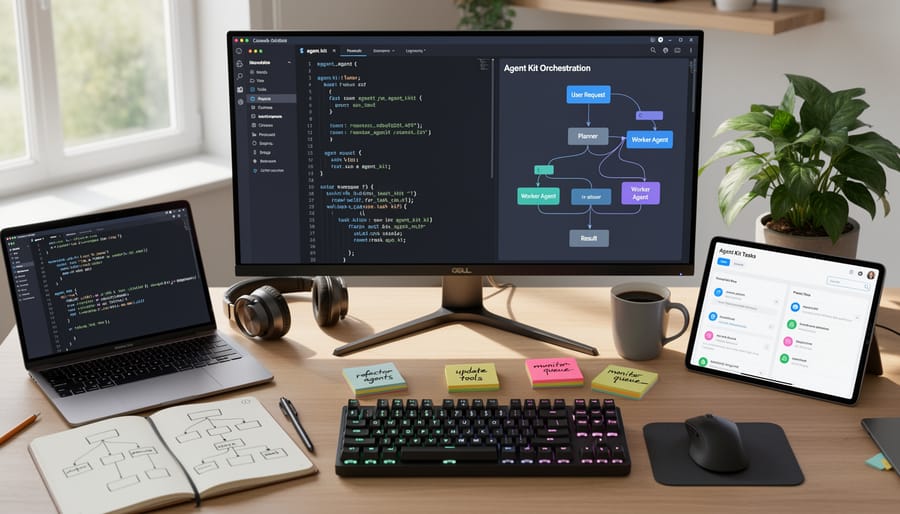
A Claude Code AI coding agent starter kit bundles everything you need to start coding with AI assistance into one coordinated package. At its core sits the Claude Code agent, Anthropic’s AI model specifically tuned for software development tasks. This agent understands code context, suggests completions, writes functions based on natural language descriptions, and helps debug issues across dozens of programming languages.
The starter kit wraps this agent in practical tooling. First, you get development environment integrations that connect Claude Code directly to your editor. These plugins or extensions work with platforms like Visual Studio Code, JetBrains IDEs, and terminal-based editors, letting you invoke AI assistance without breaking your flow. You highlight a block of code, describe what you want, and the agent generates suggestions right in your workspace.
API access forms another essential component. The kit includes credentials and configuration to authenticate with Anthropic’s API, along with pre-set parameters that balance response quality against token consumption. Some kits bundle API credits or trial periods; others provide connection templates you populate with your own API key.
Configuration templates save hours of trial and error. Quality kits include example prompts for common tasks (refactoring legacy code, writing unit tests, explaining complex functions), workspace settings optimized for different project types, and pre-configured workflows that demonstrate best practices. These templates show you how to structure requests so Claude Code delivers useful responses rather than generic boilerplate.
Essential tooling rounds out the package. This typically includes command-line utilities for batch operations, scripts that handle common setup tasks, and integration helpers that connect Claude Code to version control systems or testing frameworks. The best kits also provide prompt libraries, collections of proven instructions that coax better output from the AI for specific use cases.
These components work in concert. The editor integration captures your coding context, the API access channels that context to Claude’s model, the configuration templates shape how the agent interprets your request, and the tooling automates repetitive setup steps. Together, they create a feedback loop where you write code, request AI assistance at natural breakpoints, review suggestions, and iterate, all without context-switching between multiple applications or manually formatting API calls.
Key Factors to Consider When Choosing Your Starter Kit

Programming Languages and Framework Support
The most fundamental compatibility check for any Claude Code starter kit is whether it supports your primary programming languages and frameworks. Claude Code’s underlying model understands dozens of languages, but starter kits vary widely in how well they’re configured for specific tech stacks.
Start by confirming explicit support for your main languages. Python, JavaScript, and TypeScript enjoy near-universal coverage across starter kits, with robust autocomplete, error detection, and refactoring capabilities. If you work in Go, Rust, Java, or C++, verify that the kit includes language-specific prompts and configuration files rather than generic setup instructions.
Framework support matters just as much as language compatibility. A kit optimized for React will include component generation templates, hooks assistance, and JSX-aware suggestions that a vanilla JavaScript configuration lacks. Similarly, Django-focused kits provide boilerplate for models, views, and URL routing that generic Python setups don’t offer. Check whether the starter kit includes preconfigured prompts for your frameworks like, FastAPI, Spring Boot, or Rails.
Pay attention to version support too. Some kits target the latest framework releases while others maintain compatibility with legacy versions. If you’re maintaining a Vue 2 codebase, a kit optimized exclusively for Vue 3 Composition API will create friction rather than productivity gains.
The right language and framework alignment transforms Claude Code from a general assistant into a specialized pair programmer who speaks your stack’s dialect fluently.
IDE and Editor Integration Options
The editor you code in every day determines how smoothly Claude Code fits into your workflow, so compatibility matters more than most developers initially realize. A starter kit that integrates tightly with your preferred IDE eliminates context-switching and keeps the AI assistant exactly where you need it, inside your active development environment rather than in a separate browser tab or terminal window.
VS Code dominates the landscape with the richest Claude Code integration options. Most starter kits ship with dedicated extensions that embed the agent directly into the sidebar, enable inline code suggestions, and provide chat interfaces without leaving your project. Look for kits that support features like automatic context detection, where Claude reads your currently open files and project structure to deliver relevant responses.
JetBrains IDEs (IntelliJ IDEA, PyCharm, WebStorm) typically require plugin-based integration. Premium starter kits include officially supported plugins with deep language-specific features, while budget options may rely on community-maintained alternatives that lack polish. Check whether the kit’s plugin supports keyboard shortcuts, custom prompts, and seamless error diagnostics within the IDE’s native interface.
Neovim and Vim users face a different challenge. Some advanced kits provide Lua-based plugins or CLI tools that work through terminal buffers, but expect to invest time configuring keybindings and workflow automation yourself. Terminal-first developers should prioritize starter kits with robust command-line interfaces over GUI-focused options.
Sublime Text, Atom, and other editors receive less attention. If you use a niche editor, verify explicit support claims before purchasing, generic API access doesn’t guarantee a functional integration.
API Access and Usage Limits
API access and usage limits will directly affect how much you can accomplish with your Claude Code AI coding agent. Most starter kits bundle API credits or subscriptions, but the specifics vary wildly. Understanding API tiers, limits, costs before you commit saves you from hitting frustrating bottlenecks mid-project.
Start by checking token limits. Claude models process input and output as tokens (roughly four characters per token), and each request consumes your allocation. A modest coding session can burn through thousands of tokens when you’re generating functions, debugging code, and iterating on logic. If your kit caps you at 50,000 tokens monthly and you’re working on daily feature development, you’ll run dry fast.
Rate limits matter just as much. Some tiers restrict you to a handful of requests per minute, which becomes painful when you need rapid back-and-forth with the agent during debugging. Professional-tier kits typically offer higher rate ceilings, letting you maintain workflow momentum.
Cost structure is the third critical piece. Entry kits might include a fixed credit pool that renews monthly, while others use pay-as-you-go billing once you exceed the base allocation. Calculate your expected usage by estimating how many coding tasks you’ll delegate to the agent each week, then multiply by average tokens per interaction. A solo developer prototyping features needs different headroom than a team refactoring a legacy codebase. Match the kit’s limits to your realistic project scale, not your optimistic hopes.
Pre-Built Templates and Configuration Files
Ready-made templates and configuration files separate exceptional starter kits from bare-bones offerings. A well-curated template library eliminates hours of trial-and-error during setup, providing battle-tested configurations that work reliably from the first launch.
Look for starter kits that include project-specific templates tailored to common development scenarios: REST API development, data processing pipelines, frontend component generation, or test automation. These templates encode best practices for structuring prompts, defining code generation parameters, and setting appropriate context windows for different tasks.
Prompt libraries prove equally valuable. Curated collections of effective prompts teach you how to communicate clearly with Claude Code, demonstrating the phrasing and specificity that yield optimal results. Beginners gain a practical education in prompt engineering, while experienced developers save time adapting proven patterns to new projects.
Configuration files for common workflows accelerate onboarding dramatically. Templates for linting rules, code review parameters, and output formatting mean you spend minutes configuring instead of days experimenting. Check whether kits provide YAML or JSON configurations you can modify, version-control templates for team consistency, and example workflows that demonstrate real-world implementation patterns across multiple programming languages.
Documentation and Community Support
Strong documentation and an active community can make the difference between a frustrating setup and a smooth onboarding experience. When evaluating starter kits, look for comprehensive getting-started guides that walk you through initial configuration, API setup, and your first interactions with Claude Code. The best kits include real-world examples showing common tasks like code generation, refactoring, and debugging workflows.
Active community support becomes critical when you encounter edge cases or integration issues. Check for responsive Discord servers, GitHub discussions, or dedicated forums where developers share solutions and configuration tips. Starter kits backed by engaged communities often surface workarounds faster than official documentation alone.
Troubleshooting resources matter especially for complex integrations. Look for kits that provide error message references, common pitfall documentation, and configuration debugging guides. Video tutorials and interactive examples help visual learners grasp concepts quickly, while searchable knowledge bases let you find answers at 2 a.m. when a deadline looms.
For beginners, detailed explanations of how prompts work and what different API parameters do accelerates learning. Experienced developers benefit from advanced configuration examples and performance optimization guides that go beyond basic setup.
Types of Claude Code AI Starter Kits Compared
Beginner-Friendly Kits
Beginner-friendly Claude Code AI starter kits prioritize ease of setup over advanced features, making them ideal for developers taking their first steps with AI coding assistants. These kits typically include one-click installers that handle environment configuration automatically, eliminating the need to manually edit config files or wrestle with dependencies.
The hallmark of entry-level kits is their guided onboarding experience. Expect interactive tutorials that walk you through your first AI-assisted code generation, step-by-step documentation with screenshots, and pre-configured settings that work reliably out of the box. Many include curated prompt libraries specifically designed for common beginner tasks like debugging simple functions, writing boilerplate code, or explaining unfamiliar syntax.
Documentation in these kits uses plain language rather than assuming deep technical knowledge. You’ll find troubleshooting sections addressing common stumbling blocks and video walkthroughs demonstrating actual workflows. Some beginner kits bundle limited free API credits, letting you experiment without committing to a paid tier immediately. This hands-on trial period helps you understand whether AI coding assistance fits your development style before investing further.
Professional Developer Kits

Professional developer kits target experienced programmers who need fine-grained control over their AI coding workflows. These advanced packages strip away guided tutorials in favor of raw configuration power, letting you adjust prompt engineering parameters, customize code generation rules, and define project-specific coding standards that Claude Code enforces automatically.
What sets professional kits apart is their support for complex development scenarios. You’ll find configuration files for monorepo architectures, microservices orchestration, and CI/CD pipeline integration. Many include advanced template systems that let you define custom code generation patterns, useful when working with proprietary frameworks or enforcing specific architectural patterns across large codebases.
Customization extends to context management. Professional kits typically offer sophisticated file filtering rules, allowing you to control precisely which parts of your codebase Claude Code analyzes. This granular context control prevents token waste on irrelevant files and improves response accuracy in sprawling projects.
Pricing reflects the target audience: expect monthly subscriptions starting around $79, $149, with higher API rate limits and priority support. Most include webhook integrations for connecting Claude Code to existing development tools, version control systems, and issue trackers.
Team and Enterprise Solutions
Team and enterprise solutions shift focus from individual productivity to organizational scalability and governance. These kits provide centralized dashboards where team leads can monitor API usage across developers, set budget caps per user, and track code generation metrics to understand team-wide adoption patterns. Role-based access controls let you segment permissions, junior developers might have restricted prompt templates while senior engineers access advanced customization options. Multi-seat licensing typically bundles higher token limits and priority API access to ensure production workflows never hit rate limits during critical sprints.
Security features distinguish enterprise kits from consumer offerings. Expect audit logs that record every interaction with the Claude Code agent, data residency options to keep code and prompts within specific geographic regions, and SOC 2 compliance certifications that meet corporate requirements. Understanding privacy vs security becomes crucial when evaluating how these kits handle proprietary codebases, look for on-premises deployment options or private cloud instances that prevent your intellectual property from mixing with public training data. Many enterprise solutions also include dedicated support channels and service-level agreements guaranteeing uptime and response times.
Open-Source Community Kits
Open-source community kits provide the ultimate flexibility and transparency for developers comfortable with hands-on configuration. These free alternatives typically live on GitHub or GitLab, maintained by experienced developers who share their Claude Code implementations publicly. You get full access to the source code, meaning you can examine exactly how prompts are structured, how the agent interacts with your development environment, and customize every aspect to your workflow.
The trade-off is clear: while you pay nothing in licensing fees, you invest time in setup and troubleshooting. Community kits often assume you understand concepts like environment variables, API authentication, and dependency management. Documentation varies widely, some projects include detailed README files and configuration examples, while others expect you to read the code itself to understand functionality.
These kits excel when you need unusual customizations or want to learn by dissecting working implementations. Active projects with recent commits and responsive maintainers offer better support than abandoned repositories. Check the issues tab to gauge how quickly problems get addressed, and review pull requests to see if the community actively improves the codebase.
If you’re building something unique or want zero vendor lock-in, open-source kits deliver unmatched control at the cost of requiring deeper technical expertise.
Top Claude Code AI Starter Kits for 2026
Based on real-world usage patterns and developer feedback through mid-2026, several Claude Code AI starter kits have emerged as standout options for different use cases. These recommendations reflect actual market offerings rather than hypothetical solutions, helping you narrow your choice based on your specific needs.
For developers just starting their AI coding journey, the Claude Code Essentials Kit offers the most straightforward onboarding experience. This kit includes pre-configured VS Code extensions, 50,000 API tokens monthly, and step-by-step tutorials covering common tasks like code review, debugging assistance, and documentation generation. The included prompt library contains over 100 tested prompts for everyday coding scenarios, making it ideal for individual developers who want immediate productivity gains without extensive setup.
Experienced developers seeking maximum flexibility should consider the Claude Developer Studio Pro. This kit provides advanced configuration options, support for custom prompt engineering workflows, and integrations across multiple IDEs including JetBrains products and Neovim. With 200,000 monthly tokens and access to the latest Claude models, it suits developers building complex applications who need granular control over AI behavior. The kit’s standout feature is its modular architecture, you can enable or disable components based on project requirements rather than accepting a one-size-fits-all approach.
Teams and organizations benefit most from the Claude Workspace Enterprise Kitwhich adds collaboration features, centralized billing, and security controls to the core Claude Code functionality. This solution includes team-wide prompt sharing, usage analytics dashboards, and the ability to establish organization-specific coding standards that the AI respects. The included 1 million tokens scale across team members, with role-based access controls ensuring appropriate usage limits.
- Claude Code Essentials Kit: Best for beginners, includes 50K tokens, VS Code integration, and 100+ starter prompts
- Claude Developer Studio Pro: Advanced toolkit with 200K tokens, multi-IDE support, and custom workflow capabilities
- Claude Workspace Enterprise Kit: Team solution with 1M shared tokens, collaboration features, and centralized management
- OpenAI Codex Adapter Bundle: Hybrid kit supporting both Claude and Codex for developers comparing AI models
Budget-conscious developers can explore the Claude Code Community Editionan open-source kit maintained by contributors. While it requires more hands-on configuration, it provides unlimited customization potential and no recurring subscription costs beyond API usage. The trade-off is less polished documentation and the need to troubleshoot integration issues independently, though an active Discord community offers peer support.
Each kit includes different support tiers, update frequencies, and expansion options. Match your selection to your current skill level and project complexity rather than choosing based solely on feature count, a simpler kit you’ll actually use beats a comprehensive one that overwhelms you.
Common Mistakes to Avoid When Selecting a Starter Kit

The most frequent mistake developers make is choosing a starter kit based solely on upfront cost without calculating long-term API expenses. A $50 kit might seem economical until you realize your typical workflow burns through $200 worth of API tokens monthly, while a $150 kit with generous included credits would actually cost less over six months.
Another critical error is ignoring security and compliance requirements from the start. Developers often select a kit, integrate it into their workflow, then discover it doesn’t meet their organization’s GDPR for AI requirements or lacks proper data handling protocols. Understanding AI security basics before committing to a kit saves you from costly migration headaches later.
Skipping the trial period or proof-of-concept phase ranks among the costliest shortcuts. Many developers purchase based on marketing materials and feature lists without testing how the kit actually performs with their codebase. What works brilliantly for web development might struggle with embedded systems or data science workflows. Spend a week testing the kit against your real projects, not toy examples.
Overlooking IDE compatibility creates daily friction that compounds over time. Developers sometimes assume “VS Code support” means seamless integration, only to discover the kit requires manual configuration steps before each session or conflicts with their essential extensions. Verify that the kit works smoothly with your actual development environment setup, including any customizations or plugins you rely on.
Finally, many developers underestimate the learning curve and support they’ll need. They select advanced kits with powerful features but minimal documentation, assuming they’ll figure it out independently. This mirrors how teams avoid MLOps mistakes by investing in proper training upfront. Match the kit’s complexity to your current skill level and available learning time, or budget for the hours you’ll spend troubleshooting configuration issues alone.
Frequently Asked Questions
Do I need coding experience to use a Claude Code AI starter kit?
Yes, basic programming knowledge is essential. While starter kits simplify setup and provide helpful templates, you need to understand code structure, debugging concepts, and how to evaluate the AI’s suggestions. Beginner-friendly kits assume foundational skills in at least one programming language.
Can I use multiple starter kits simultaneously?
Technically possible but not recommended. Running multiple kits creates configuration conflicts, duplicates API calls unnecessarily, and complicates your workflow. Choose one kit that matches your primary needs, then customize it rather than layering multiple solutions.
What hardware specifications do I need?
Most starter kits run comfortably on modern laptops with 8GB RAM and a recent processor. The AI processing happens on Claude’s servers, so your local machine primarily handles your development environment and API communication. Solid internet connectivity matters more than raw computing power.
How much will API usage actually cost me?
Costs vary widely based on usage patterns, typically ranging from $20 to $200 monthly for individual developers. Frequent code generation, large file contexts, and extended conversations consume more tokens. Monitor your usage during the first month to establish realistic budget expectations for your workflow.
Can I switch to a different starter kit later?
Yes, migration is straightforward since most kits use similar underlying Claude Code APIs. Export your custom prompts and configuration preferences, then follow the new kit’s implementation blueprint to recreate your setup. Plan for a few hours of reconfiguration time.
Beyond these common questions, remember that starter kits evolve rapidly. What seems like a limitation today might be addressed in next month’s update. Join the community forums associated with your chosen kit to stay informed about new features, troubleshooting tips, and workflow optimizations other developers have discovered. The collective knowledge of active users often proves more valuable than official documentation alone.
Testing a starter kit with a small personal project before committing to a paid tier gives you hands-on experience without financial risk. Most developers find that one week of real-world use reveals compatibility issues or workflow friction that specifications alone cannot predict.
Choosing the right Claude Code AI coding agent starter kit comes down to understanding your specific development context and growth trajectory. The kit that accelerates your workflow most effectively will align with your primary programming languages, integrate smoothly with your existing tools, and match both your budget and technical comfort level.
Before making your selection, honestly assess where you stand. Are you exploring AI-assisted coding for the first time, or do you need advanced customization for complex projects? Will you work solo or collaborate with a team? Your answers to these questions should guide you toward beginner-friendly options, professional developer kits, or enterprise solutions.
Don’t overlook the seemingly small details that shape daily experience. Robust documentation transforms frustration into quick wins. Active community support means you’re never stuck for long. Adequate API limits prevent workflow interruptions at critical moments. These practical considerations often matter more than flashy features you’ll rarely use.
The right starter kit won’t just add AI capabilities to your development process, it’ll fundamentally change how you approach coding challenges, learn new frameworks, and solve problems. You’ll write better code faster, explore unfamiliar territories with confidence, and spend less time on repetitive tasks that drain your creative energy.
Start with a kit that matches your current needs but leaves room to grow. You can always upgrade as your skills and requirements evolve. The important step is getting started.