

The artificial intelligence revolution isn’t happening in the cloud—it’s happening inside specialized processors that can handle trillions of calculations per second. Among these technological marvels, NVIDIA’s H100 GPU stands as the powerhouse driving everything from ChatGPT’s conversational abilities to breakthrough drug discoveries that traditionally took years to achieve.
Unlike the graphics cards in gaming computers, the H100 represents a fundamental reimagining of what a processor can do. While your laptop GPU renders video games at 60 frames per second, the H100 simultaneously trains AI models on datasets containing billions of parameters, processes natural language queries for thousands of users, and accelerates scientific simulations that predict protein structures. This isn’t just an incremental upgrade—it’s the difference between a calculator and a supercomputer.
What makes the H100 extraordinary isn’t simply raw power. This architecture introduces Transformer Engine technology, which automatically optimizes the precision levels AI models need during training, cutting processing time nearly in half. It features 80 billion transistors working in concert through an innovative design that moves data between computing cores at speeds reaching 3 terabytes per second—faster than reading 600 DVDs simultaneously.
For anyone trying to understand why AI suddenly seems everywhere, the H100 provides the answer. Companies deploying large language models can now run inference tasks 30 times faster than previous generations. Researchers training computer vision systems complete in days what once required weeks. The architecture doesn’t just make AI faster; it makes previously impossible applications practical and affordable enough for widespread adoption.
This deep dive explores how the H100’s architecture achieves these remarkable capabilities and why it matters for AI’s future trajectory.
What Makes a GPU ‘AI-Specific’?
Think of a Swiss Army knife versus a surgical scalpel. A traditional GPU is like that Swiss Army knife—designed to handle graphics rendering, video editing, gaming, and various visual tasks. It’s versatile and good at many things. An AI-specific GPU, on the other hand, is like that surgical scalpel—precision-engineered for one primary purpose: accelerating artificial intelligence calculations.
The evolution from graphics processors to AI powerhouses happened somewhat accidentally. Researchers discovered that the parallel processing capabilities GPUs used to render millions of pixels simultaneously were remarkably similar to what neural networks needed. Both tasks involve performing thousands of similar calculations at once. A GPU rendering a complex video game scene calculates color, lighting, and texture for every pixel simultaneously. Similarly, training an AI model requires calculating adjustments across millions of parameters at the same time.
However, general-purpose GPUs weren’t optimized for AI’s specific mathematical operations. Traditional graphics work focuses heavily on floating-point calculations for rendering realistic visuals. AI workloads, particularly deep learning, require different types of computations—especially matrix multiplications and tensor operations that form the backbone of neural networks.
This is where AI-specific architectures enter the picture. These specialized GPUs include dedicated hardware components called Tensor Cores that accelerate the exact mathematical operations AI models need most. They also feature high-bandwidth memory systems designed to feed data to thousands of processing cores without creating bottlenecks, and interconnect technologies that allow multiple GPUs to work together seamlessly on massive AI models.
To understand how AI GPUs work at a deeper level, imagine the difference between a factory assembly line optimized for building one specific product versus a general workshop. The specialized assembly line moves faster because every station, tool, and workflow is purpose-built for that exact task. AI-specific GPUs apply this same principle to machine learning calculations, delivering performance improvements of 10x or more compared to their general-purpose counterparts.

The H100’s Revolutionary Architecture: Built for AI from the Ground Up
Tensor Cores: The AI Calculation Powerhouse
At the heart of the H100’s AI prowess lies a specialized component called Tensor Cores—purpose-built processors designed specifically for the matrix multiplication operations that dominate modern AI workloads. Think of them as mathematical specialists that excel at one particular job, much like how a food processor slices vegetables faster than doing it by hand.
Traditional GPU cores handle graphics and general computing tasks well, but AI training involves countless calculations with large matrices of numbers. Tensor Cores streamline this process by performing multiple operations simultaneously in a single clock cycle. The H100’s fourth-generation Tensor Cores can execute mixed-precision calculations, meaning they intelligently balance speed and accuracy by using different numerical formats depending on what the calculation requires.
Here’s where the performance gains become remarkable. When training a large language model like GPT-3, which requires processing billions of parameters, Tensor Cores can accelerate the training process by up to 30 times compared to using standard GPU cores alone. A model that might take weeks to train on conventional hardware could potentially complete in days on the H100.
The secret lies in their architecture. Each Tensor Core can process a 4×4 matrix operation in one step, and the H100 packs hundreds of these cores across its chip surface. NVIDIA enhanced this generation with 3D chip stacking techniques and improved data pathways, allowing information to flow between cores with minimal delay.
For practical context, researchers at major AI labs report that fine-tuning computer vision models for medical imaging—a task requiring precise pattern recognition across thousands of scan images—completes in hours rather than days when leveraging H100 Tensor Cores. This acceleration isn’t just about convenience; it fundamentally changes what’s possible in AI research and deployment timelines.

Transformer Engine: Purpose-Built for Modern AI
If you’ve ever wondered how ChatGPT generates coherent paragraphs in seconds or how AI image generators like DALL-E create stunning visuals from text descriptions, you’re witnessing transformer models in action. These AI architectures have revolutionized machine learning, but they’re incredibly demanding on hardware. NVIDIA recognized this and built the Transformer Engine directly into the H100 to address this challenge.
Think of transformer models as pattern-recognition powerhouses that process information by paying attention to relationships between different parts of data. When you ask ChatGPT a question, it analyzes how each word relates to every other word in your prompt, creating a web of connections. This process, called self-attention, requires massive amounts of calculation. A single large language model can perform trillions of these operations to generate just one response.
The Transformer Engine tackles this computational mountain through specialized hardware acceleration. It’s essentially a dedicated processor within the H100 that speaks the native language of transformers. Instead of the GPU struggling to adapt general-purpose computing resources to transformer workloads, the Transformer Engine handles these calculations with purpose-built circuits.
Here’s where it gets impressive: the Transformer Engine uses a technique called dynamic precision scaling. During AI training, it automatically switches between different numerical formats, using lower precision when possible to speed things up without sacrificing accuracy. This is like a chef knowing exactly when to use precise measurements versus eyeballing ingredients based on experience.
The real-world impact is substantial. Companies training large language models report up to 6x faster training times compared to previous-generation GPUs. For businesses deploying AI chatbots or recommendation systems, this means getting products to market faster and reducing the massive energy costs associated with AI development. When you interact with modern AI applications, there’s a good chance transformer-optimized hardware like this made that experience possible.
Memory and Bandwidth: Feeding the AI Beast
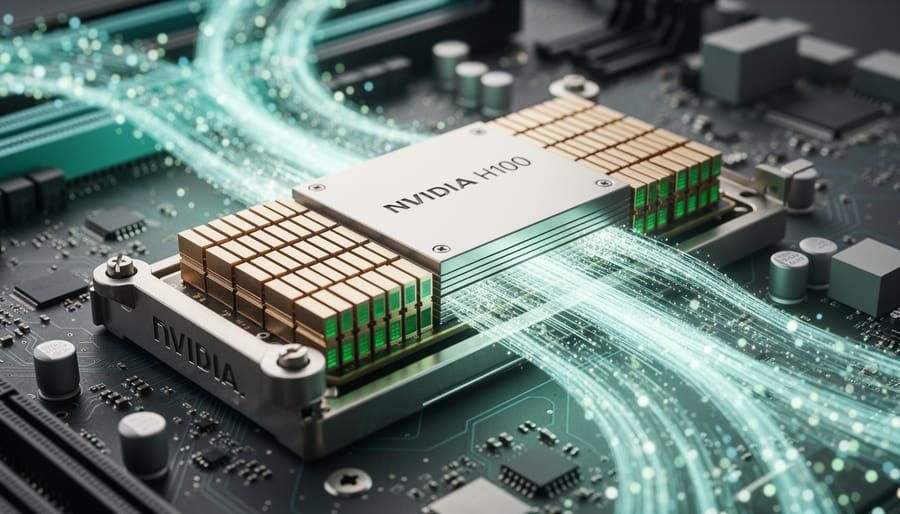
Imagine trying to feed a hungry giant through a tiny straw—that’s what happens when a powerful GPU lacks adequate memory bandwidth. The H100 solves this problem with HBM3 (High Bandwidth Memory 3), a cutting-edge memory system that delivers up to 3 terabytes per second of bandwidth. That’s like upgrading from a garden hose to a fire hydrant when it comes to moving data.
Here’s why this matters: AI models, especially large language models like ChatGPT, constantly shuffle massive amounts of data between memory and processors during training. The GPU might be incredibly fast at calculations, but if it’s sitting idle waiting for data to arrive, all that processing power goes to waste. Think of it like having a celebrity chef in your kitchen but making them wait hours for ingredients—the talent doesn’t matter if the supply chain fails.
The H100’s 80GB of HBM3 memory provides both capacity and speed. When training a model with billions of parameters, those parameters need to live somewhere accessible. Previous generation memory systems would create bottlenecks, slowing down the entire training process. With HBM3, the H100 can feed its thousands of Tensor Cores continuously, maintaining peak performance throughout lengthy training sessions.
Modern memory architectures for AI have become just as critical as raw computing power. The H100’s memory design ensures that breakthrough AI models can train in days rather than weeks, directly translating to faster innovation and reduced costs for AI development teams.
Real-World Impact: What the H100 Actually Does for AI
Training Large Language Models Faster
The H100’s impact on training large language models is nothing short of remarkable. To put this into perspective, consider training a model similar to GPT-3, which contains 175 billion parameters. On previous generation hardware like the A100, this process could take several weeks and consume millions of dollars in computing costs. The H100 slashes this timeline dramatically.
Real-world testing shows that the H100 can reduce training time for large language models by up to 3x compared to its predecessor. What once took three weeks might now complete in just seven to ten days. For companies developing AI applications, this translates to faster iteration cycles and significantly lower electricity bills. Imagine your company could test three different model versions in the time it previously took to train just one.
The cost savings are equally impressive. Training a large language model on a cluster of eight H100 GPUs might cost around $150,000 in cloud computing fees, compared to roughly $400,000 using older hardware. That’s a quarter-million dollars saved on a single training run.
For research teams and startups, these improvements mean the difference between affordable experimentation and prohibitive costs. A university research lab that could barely afford one training run per semester might now conduct multiple experiments, accelerating breakthroughs. The H100 essentially democratizes access to cutting-edge AI development, making it feasible for more organizations to participate in building the next generation of intelligent systems.
Enabling Bigger, Smarter AI Models
Think of AI models like buildings. Just a few years ago, we could only construct small cottages—useful, but limited in what they could accommodate. The H100’s architecture is essentially revolutionary construction technology that allows us to build skyscrapers instead.
The key breakthrough lies in the H100’s massive memory bandwidth and capacity. With 80GB of HBM3 memory and a bandwidth of 3 terabytes per second, the H100 can hold and process enormous AI models that simply wouldn’t fit on previous hardware. This is like expanding your workspace from a small desk to an entire warehouse—suddenly, projects that seemed impossible become manageable.
Take large language models as a practical example. GPT-3, which powers many of the conversational AI tools you might use daily, contains 175 billion parameters. Each parameter is like a tiny piece of knowledge the AI has learned. Training and running models of this scale requires GPUs that can juggle billions of calculations simultaneously while keeping all that information readily accessible. The H100 makes this feasible where older GPUs would simply run out of memory or take impractically long to process.
But bigger doesn’t just mean more impressive numbers on paper. Larger models translate directly into AI capabilities you can actually experience: chatbots that understand context better, image generators that produce more realistic results, and translation tools that capture nuance more accurately.
The H100’s Transformer Engine specifically accelerates the type of calculations these massive models rely on, making training times shorter and inference faster. What previously might have taken weeks to train can now happen in days, allowing researchers to experiment more freely and iterate faster. This acceleration doesn’t just save time—it fundamentally expands what’s possible in AI development, pushing the boundaries of machine intelligence into territories we’re only beginning to explore.

How the H100 Compares to Previous GPU Generations
To truly appreciate the H100, let’s take a step back and see how it stacks up against its predecessors. Think of GPU evolution like smartphone generations—each new release brings notable improvements, but occasionally there’s a leap that changes everything.
The A100, released in 2020, was NVIDIA’s workhorse for AI applications. It delivered impressive performance with 312 teraflops of AI computing power and introduced the Ampere architecture that powered countless machine learning projects. For context, one teraflop means a trillion calculations per second. The A100 made training complex models feasible for many organizations and became the go-to choice for data centers worldwide.
Enter the H100 in 2022, and the difference is staggering. With up to 1,000 teraflops dedicated to AI tasks, the H100 delivers roughly three times the raw computing power. But raw numbers only tell part of the story. The H100 introduces the Hopper architecture, which reimagines how data flows through the chip. It’s like comparing a city with regular traffic lights to one with a smart traffic management system—both get cars from point A to point B, but one does it far more efficiently.
Memory bandwidth, which determines how quickly data can move in and out of the chip, jumped from 1.6 terabytes per second in the A100 to 3.35 terabytes per second in the H100. This matters tremendously for AI workloads that constantly shuffle massive amounts of data. Training a large language model on an A100 might take weeks; the same task on an H100 could finish in days.
The energy efficiency improvements deserve attention too. The H100 accomplishes more work per watt of electricity consumed, making it not just faster but also more environmentally conscious—an increasingly important consideration as AI scales globally.
Comparing the H100 to even earlier generations like the V100 reveals an exponential trajectory. What once required entire server racks can now fit into fewer, more powerful units. This evolution parallels developments in other specialized AI hardware, such as Google’s TPU architecture, which takes different design approaches to solve similar computational challenges.
For practitioners, this generational leap means training larger models, experimenting more freely, and bringing AI applications to market faster than ever before.
Why This Matters for the Future of AI
The H100 GPU represents more than just faster hardware—it signals a fundamental shift in how accessible and powerful AI development is becoming. For anyone starting their journey in artificial intelligence today, understanding this architecture offers a glimpse into where the field is heading and what opportunities are emerging.
Consider this: five years ago, training sophisticated AI models required massive data centers and budgets only tech giants could afford. The H100’s efficiency improvements mean that cloud providers can now offer more computational power at lower costs. This democratization matters tremendously for students, researchers, and startups. You no longer need to work at a major corporation to experiment with cutting-edge AI models. Cloud platforms equipped with H100s make it possible to rent time on these powerful systems, turning what was once prohibitively expensive into something accessible for individual developers.
The H100’s architecture also reflects broader trends in specialized AI hardware. As AI applications become more diverse—from medical imaging to autonomous vehicles—the hardware needs to adapt. The H100’s Transformer Engine, for instance, directly responds to the dominance of transformer models in natural language processing and computer vision. Learning about these architectural choices helps you understand not just how current AI works, but where it’s likely to evolve.
For beginners entering the field, the H100 highlights an important lesson: AI advancement isn’t just about better algorithms. The hardware running these algorithms shapes what’s possible. As you learn to build AI models, understanding the capabilities and limitations of GPUs like the H100 helps you make smarter decisions about model design, training strategies, and resource allocation.
Looking forward, the principles embedded in the H100—energy efficiency, specialized processing units, and optimized data movement—will influence AI development for years to come. Whether you’re a student planning a career in AI or a professional expanding your skills, this knowledge positions you to take advantage of the tools shaping tomorrow’s breakthroughs.
The H100 GPU represents a significant leap forward in AI-specific hardware design, demonstrating how specialized architectures can dramatically accelerate machine learning workloads. Through innovations like the fourth-generation Tensor Cores, Transformer Engine, and massive memory bandwidth improvements, NVIDIA has created a chip purpose-built for the demanding requirements of modern AI applications. These aren’t just incremental upgrades—they’re fundamental reimaginings of how GPUs handle the mathematical operations that power everything from chatbots to autonomous vehicles.
As you continue exploring AI and machine learning, understanding the hardware layer becomes increasingly valuable. The H100’s architecture reveals why certain AI models train faster, why some applications run more efficiently, and how hardware constraints shape the development of AI technologies. For those looking to deepen their knowledge, consider experimenting with cloud platforms that offer GPU instances, exploring open-source machine learning frameworks, or following the latest announcements from chip manufacturers. The AI hardware landscape evolves rapidly, and staying informed about these architectural innovations will help you better understand the capabilities and limitations of the AI systems shaping our future. The journey from curious learner to informed practitioner starts with grasping these foundational technologies.