

Treat your AI portfolio as your professional storefront—it should immediately demonstrate what you can build, solve, and deliver. Start by selecting three to five projects that showcase different skills: one end-to-end machine learning project with real-world data, one that solves a specific business problem, and one that demonstrates your understanding of ethical AI considerations. Document each project with clear problem statements, your approach, results with measurable metrics, and honest reflections on what you learned from failures.
Structure your portfolio to tell a coherent story about your capabilities. Include a concise homepage that states your specialty within AI—whether that’s natural language processing, computer vision, or predictive analytics—and guide visitors through your best work first. Write project descriptions for non-technical stakeholders who make hiring decisions, then provide technical deep-dives through GitHub repositories or Jupyter notebooks for engineers who will evaluate your code quality.
Choose platforms strategically based on your target audience. GitHub serves as your technical foundation, while a personal website or portfolio platform like Notion provides narrative context. For those serious about building an AI career, your portfolio becomes more valuable than your resume—it proves you can execute, not just list credentials.
Focus on quality over quantity. Two well-documented projects that demonstrate problem-solving, clean code, and business impact outweigh ten half-finished tutorials. Include visualizations of your results, explain your model choices, and show how you validated your work. Make everything reproducible with clear instructions and dependencies listed. Your portfolio should answer the question every employer asks: can this person solve our problems?
What Makes an AI Portfolio Different from Regular Project Collections
An AI portfolio goes beyond showcasing finished products. While a traditional portfolio might display websites you’ve built or graphic designs you’ve created, an AI portfolio tells the story of how you solved complex problems using data and algorithms. Think of it as opening the hood of a car rather than just showing pictures of the exterior.
The key difference lies in demonstrating your thought process and technical capabilities. When you include a machine learning project, you’re not just presenting a model that predicts housing prices or classifies images. You’re showing potential employers or collaborators how you approached the problem from multiple angles: What data did you collect? How did you clean and prepare it? Which algorithms did you test, and why did you choose one over another?
Data handling skills form a crucial component that sets AI portfolios apart. In real-world scenarios, you’ll spend roughly 80 percent of your time wrestling with messy, incomplete datasets. Your portfolio should reflect this reality by documenting how you dealt with missing values, balanced skewed data, or engineered meaningful features from raw information. These aren’t glamorous tasks, but they separate practitioners who can actually deploy AI solutions from those who only understand theory.
Another distinguishing factor is interpretability. A machine learning model might achieve 95 percent accuracy, but can you explain why it works? Your portfolio should include visualizations, performance metrics, and plain-language explanations of your results. If you built a customer churn prediction model, walk viewers through which factors most influenced customer decisions and what business insights emerged from your analysis.
Finally, AI portfolios uniquely emphasize iterative improvement. Unlike a static design project, machine learning work involves constant experimentation. Documenting failed approaches alongside successful ones demonstrates intellectual honesty and shows you understand that AI development is rarely a straight path from problem to solution. This transparency makes your portfolio authentic and valuable to anyone evaluating your capabilities.

The Three Portfolio Types That Actually Get You Hired
The Problem-Solver Portfolio
The Problem-Solver Portfolio takes a holistic approach by demonstrating your ability to tackle real-world challenges from start to finish. Rather than showcasing isolated technical experiments, this portfolio style tells complete stories of how you identified problems, developed solutions, and delivered measurable results.
This approach works exceptionally well for professionals transitioning into AI roles, career changers, and anyone targeting positions at companies focused on practical business outcomes rather than pure research. It resonates with hiring managers who want to see that you understand not just the technology, but also its application in solving actual business or societal problems.
What should you include? Start with 3-5 comprehensive case studies that walk viewers through your entire process. For each project, clearly define the problem you addressed. Perhaps you built a customer churn prediction system that reduced cancellations by 25%, or developed an image classification tool that streamlined a manufacturing quality control process. Document your methodology, the data challenges you faced, the AI techniques you applied, and most importantly, the impact of your solution.
Include visualizations showing before-and-after comparisons, metrics demonstrating success, and honest reflections on what worked and what didn’t. This transparency shows maturity and critical thinking. Add a brief explanation of the tools and technologies you used, but keep the focus on the problem-solving journey rather than getting lost in technical minutiae.
Remember, employers want to see that you can translate AI capabilities into tangible value, making this portfolio style particularly powerful for demonstrating real-world readiness.
The Research-Focused Portfolio
If you’re aiming for research positions at universities, think tanks, or advanced AI labs, your portfolio should showcase intellectual curiosity and methodological rigor. This portfolio type goes beyond standard implementations to demonstrate your ability to push boundaries and contribute new insights to the field.
Start by featuring projects that explore cutting-edge techniques or propose novel solutions to existing problems. For example, you might document experiments comparing different neural network architectures for a specific task, complete with detailed analysis of why certain approaches outperformed others. Include failed experiments too—they show your scientific thinking and learning process.
Deep dives are essential here. Choose one or two AI techniques that fascinate you, whether that’s reinforcement learning, natural language processing, or computer vision, and create comprehensive case studies. Document your hypothesis, methodology, results, and interpretations just as you would in academic research.
Make your experimental notebooks publicly accessible through platforms like Jupyter or Google Colab. These living documents should walk readers through your thought process, showing code alongside explanations and visualizations. Think of them as teaching tools that demonstrate both technical skill and communication ability.
Finally, consider publishing your findings on platforms like arXiv or Medium. Even informal write-ups about interesting discoveries or comparative analyses can establish your voice in the research community and show potential employers you’re genuinely invested in advancing the field.
The Implementation Portfolio
If you’re following an AI engineering roadmap, showcasing your deployment skills is essential. The Implementation Portfolio demonstrates you can take AI models from notebooks to production-ready systems that real users depend on.
This portfolio type focuses on the engineering side of AI rather than just model development. Think of projects where you’ve deployed a chatbot that handles thousands of conversations daily, built an API serving machine learning predictions with low latency, or created a recommendation system integrated into a live website. What matters here is showing reliability, scalability, and real-world performance.
For example, you might document how you containerized a sentiment analysis model using Docker, deployed it on cloud infrastructure, and implemented monitoring to track its accuracy over time. Include metrics like response times, uptime percentages, and how you handled edge cases or errors.
Your portfolio should highlight technical infrastructure choices, such as which cloud platforms you used, how you managed version control for models, and your approach to continuous integration. Screenshots of monitoring dashboards, API documentation, and user analytics tell compelling stories about your ability to maintain AI systems in production. This portfolio type particularly appeals to employers seeking engineers who can bridge the gap between data science experimentation and business-critical applications.

Essential Projects That Belong in Every AI Portfolio
Your Signature End-to-End Project
While multiple small projects demonstrate breadth, one comprehensive end-to-end project proves you can handle real-world complexity. Think of it as your portfolio’s centerpiece—the project that makes hiring managers stop scrolling and pay attention.
This signature project should walk through every stage of the AI development lifecycle. Start with a genuine problem that matters, then show how you collected and cleaned messy data (because real data is never perfect). Document your exploratory analysis, explain why you chose specific algorithms, and detail how you trained and fine-tuned your models. But don’t stop there—this is where many portfolios fall short.
The magic happens when you demonstrate deployment. Build a simple web interface, create an API, or package your model as a usable application. Show how you monitored performance after deployment and handled edge cases. This proves you understand that AI models don’t live in Jupyter notebooks—they need to solve actual problems for actual users.
For example, rather than just predicting house prices, create a deployed web app where users input features and receive predictions, complete with confidence intervals and explanations. This comprehensive approach signals to employers that you’re ready to contribute from day one, not just run experiments in isolation.
The Data Story Project
Real-world data is rarely clean and organized. That’s why including a data story project in your portfolio demonstrates a crucial skill that employers value: the ability to transform messy information into actionable insights.
Choose a dataset that genuinely interests you, perhaps from sources like Kaggle, government databases, or public APIs. The key is selecting data that requires significant cleaning and preparation. For example, you might analyze trends in climate data, explore patterns in healthcare records, or investigate social media sentiment around a current event.
Your project should walk viewers through your entire process. Start by documenting the initial state of your data and the challenges you encountered. Did you have missing values, inconsistent formatting, or duplicate entries? Show how you addressed these issues and explain your reasoning behind each decision.
The real magic happens when you extract meaningful insights. Use visualizations to tell a compelling story about what the data reveals. Create charts, graphs, or interactive dashboards that make complex patterns immediately understandable to non-technical audiences.
Finally, present your findings in a clear narrative format. Explain what you discovered, why it matters, and what actions someone might take based on your analysis. This approach demonstrates not just technical competence, but also your ability to communicate effectively with stakeholders.
Your Domain Expertise Showcase
Choosing a specific industry focus for your AI project demonstrates that you understand real-world applications beyond theoretical concepts. This targeted approach shows potential employers you can translate AI skills into practical solutions for their business challenges.
Start by identifying an industry that genuinely interests you or aligns with your career goals. Healthcare, finance, retail, agriculture, and logistics all face unique challenges where AI can make a significant impact. For example, if you’re targeting healthcare positions, you might build a system that predicts patient readmission risks or classifies medical images for early disease detection.
The key is going beyond generic implementations. Research actual pain points within your chosen industry. If you’re interested in retail, don’t just build another recommendation engine. Instead, create something like an inventory optimization tool that predicts stockouts based on seasonal trends and local events, or a customer churn prediction system that identifies at-risk subscribers before they leave.
Document your industry research thoroughly in your project presentation. Explain the specific problem you’re solving, why it matters to that sector, and how your solution addresses it. Include relevant metrics that matter to industry professionals, such as cost savings, efficiency improvements, or accuracy rates.
Consider interviewing professionals in your target field or reviewing case studies to understand their actual needs. This research adds authenticity to your project and demonstrates initiative that hiring managers value. When you can speak their language and show you understand their challenges, your portfolio becomes far more compelling than one filled with textbook examples.
Building Your Portfolio Without Years of Experience
Breaking into the AI field without years of professional experience might seem daunting, but the beauty of artificial intelligence is that your skills matter more than your job title. Here’s how to build a portfolio that captures attention, even if you’re just starting out.
Start with open datasets, which are treasure troves for portfolio projects. Platforms like Kaggle, UCI Machine Learning Repository, and Google Dataset Search offer thousands of real-world datasets you can explore. Pick a dataset that genuinely interests you, whether it’s analyzing movie recommendations, predicting housing prices, or examining climate patterns. When you’re passionate about the subject matter, your enthusiasm shows through in your work, and you’ll naturally dive deeper into the problem.
Competitions provide another excellent launchpad. Kaggle competitions allow you to tackle real business problems alongside thousands of other learners. Even if you don’t win, participating demonstrates initiative and problem-solving ability. Document your approach, what worked, what didn’t, and what you learned. Employers value this kind of reflective thinking because it shows you can iterate and improve.
Contributing to open source projects offers practical experience while building your professional network. Start small by improving documentation, fixing bugs, or adding features to existing AI libraries. Repositories on GitHub related to TensorFlow, PyTorch, or scikit-learn welcome contributions from all skill levels. These contributions prove you can collaborate with other developers and work with production-level code.
Passion projects are where you truly stand out. Create something that solves a problem you’ve personally encountered. Built a chatbot to help students navigate course selection? Developed a model to identify bird species from photos during your hikes? These unique projects tell your story and showcase your creativity. They demonstrate that you possess essential AI skills while revealing your personality and interests.
Document everything meticulously. For each project, explain the problem you tackled, your methodology, challenges you faced, and insights you gained. Include visualizations, code snippets, and clear explanations that someone outside the field could understand. This documentation becomes your portfolio’s narrative, showing not just what you built, but how you think.
Remember, everyone starts somewhere. What matters is demonstrating curiosity, persistence, and the ability to learn. A well-crafted portfolio with three solid projects often outweighs a resume listing years of tangentially related experience.

How to Present Your AI Work So People Actually Look at It
The Documentation That Makes You Stand Out
Great documentation transforms your projects from code repositories into compelling career assets. Think of your README as a welcome mat that invites visitors to understand and appreciate your work, even if they’re not AI experts.
Start every project description with a clear problem statement. Instead of diving into model architecture, explain what real-world challenge you’re solving. For instance, “This chatbot helps small businesses respond to customer inquiries 24/7” immediately shows purpose and impact.
Your README should follow a storytelling structure. Begin with the motivation behind your project, then explain your approach in plain language. When you must use technical terms like “neural network” or “natural language processing,” add a one-sentence explanation. Remember, hiring managers often review portfolios before technical teams do.
Include a “Quick Start” section that lets others run your project with minimal setup. This demonstrates thoughtful engineering and makes your work tangible. Add screenshots or demo videos whenever possible, as visual elements help non-technical reviewers grasp your project’s value instantly.
Document your decision-making process in a separate technical write-up. Explain why you chose a particular algorithm, what alternatives you considered, and how you measured success. This reveals your analytical thinking and problem-solving approach, qualities employers actively seek.
Finally, be transparent about limitations and future improvements. This honesty signals maturity and self-awareness. A section titled “Lessons Learned” or “What I’d Do Differently” shows you’re reflective and continuously growing, making you stand out as someone who learns from experience rather than just completing assignments.
Visualizing Your Results for Maximum Impact
Your AI models might be incredibly sophisticated, but if you can’t communicate their value effectively, they won’t make the impact you’re hoping for. Think of visualizations and demos as the storytelling tools that transform technical achievements into compelling narratives that anyone can appreciate.
Start with interactive demos that let viewers experience your model in action. If you’ve built a sentiment analysis tool, create a simple web interface where visitors can type text and instantly see results. Tools like Streamlit or Gradio make this surprisingly straightforward, even if you’re not a web development expert. These platforms turn Python scripts into interactive applications with just a few lines of code.
For computer vision projects, side-by-side comparisons work wonders. Show the original image next to your model’s output, whether that’s object detection boxes, segmentation masks, or style transfers. This before-and-after approach instantly communicates what your model accomplishes without requiring technical explanations.
Data visualizations tell the story of your model’s performance. Create clear charts showing accuracy improvements over training epochs, confusion matrices that reveal where your model excels, or feature importance graphs that explain decision-making processes. Keep these visuals clean and annotated so viewers understand what they’re seeing at a glance.
Consider creating short video walkthroughs for complex projects. A two-minute screen recording where you demonstrate your model solving real problems can be more persuasive than pages of documentation. Explain your thought process, highlight interesting results, and point out challenges you overcame.
Remember that different audiences need different presentation styles. A technical recruiter might appreciate detailed performance metrics, while a business stakeholder wants to see practical applications. Design your visualizations to serve both audiences by providing multiple layers of information, from high-level overviews to detailed technical deep-dives available on demand.
Platform Choices That Actually Matter for Your Career Goals
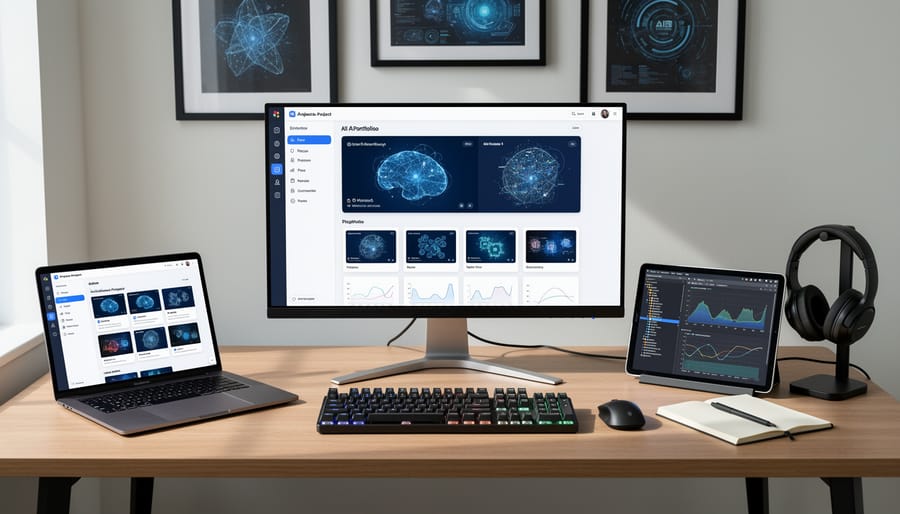
Choosing where to showcase your AI portfolio isn’t just about finding a place to dump your code. Different platforms serve different purposes, and the smartest move is often using a combination that aligns with your specific career goals.
Let’s start with GitHub, the workhorse of any AI portfolio. This is non-negotiable for technical roles. Recruiters and hiring managers expect to see your code here, complete with clear documentation and well-organized repositories. GitHub excels at demonstrating your coding standards, collaboration skills through pull requests, and your ability to maintain long-term projects. The downside? It’s not visually engaging, and non-technical stakeholders might struggle to appreciate your work. If you’re targeting data scientist, machine learning engineer, or research positions, GitHub should be your primary home base.
Personal websites offer something GitHub can’t: control over your narrative. Here’s where you can weave together your projects with compelling visualizations, interactive demos, and the story behind your work. A personal site works beautifully for those targeting diverse audiences or leadership roles where communication matters as much as technical skill. Think of it as your digital handshake. The challenge is maintenance and the initial setup investment, but platforms like GitHub Pages or simple website builders make this more manageable than ever.
Kaggle serves a specific but powerful purpose. If you’re breaking into AI or looking to prove your skills in competitive data science, Kaggle provides instant credibility through rankings and competition medals. It’s particularly valuable for beginners who lack professional experience but can demonstrate problem-solving abilities. However, Kaggle profiles alone won’t cut it for senior positions where stakeholders want to see end-to-end project ownership.
Medium and similar blogging platforms help you stand out by showcasing your ability to communicate complex ideas. Writing about your projects, methodologies, or industry insights demonstrates thought leadership. This matters increasingly for roles involving client interaction, team leadership, or consulting. Pair Medium articles with technical implementations on GitHub for maximum impact.
The winning strategy? Use GitHub as your technical foundation, create a personal website to tell your story and showcase polished projects, and selectively use Kaggle or Medium depending on whether you need to prove competitive skills or communication abilities. Your career stage and target role should drive this combination, not what feels easiest to set up.
Common Portfolio Mistakes That Cost You Opportunities
Building an AI portfolio is exciting, but certain missteps can undermine your efforts and cause recruiters to pass over your work. Let’s explore the most common mistakes and how to avoid them.
The Tutorial Trap is perhaps the most frequent pitfall. Many aspiring AI professionals showcase projects that are carbon copies of popular tutorials—think the Titanic survival predictor or MNIST digit classifier without any modifications. While these exercises are valuable for learning, they don’t demonstrate original thinking. The solution? Take that tutorial project and make it yours. If you built a digit classifier, extend it to recognize handwritten equations or create a real-world application like reading house numbers from street photos. This shows you can adapt knowledge to solve unique problems.
Projects That Are Too Simple present another challenge. A linear regression on a toy dataset might demonstrate basic understanding, but it won’t capture attention in a competitive job market. Instead, tackle problems with real complexity—datasets with missing values, class imbalances, or multiple data types. Show you can handle the messy realities of actual AI work, not just textbook examples.
The Documentation Desert kills many promising portfolios. You might have built something impressive, but if visitors can’t understand what problem you solved, why it matters, or how you approached it, your work becomes invisible. Every project needs a clear problem statement upfront. Imagine explaining to a friend who isn’t technical: “Hospitals struggle with predicting patient readmissions, costing millions annually. I built a model that identifies at-risk patients 72 hours before discharge.” This context transforms your project from a technical exercise into a meaningful contribution.
Using Outdated Techniques signals you’re not keeping pace with the field. If your portfolio only shows decision trees and logistic regression while ignoring modern approaches like transformer models or transfer learning, you’re sending the wrong message. Stay current by incorporating recent techniques relevant to your target roles, and explain why you chose specific methods for each problem.
Finally, the Missing Code Repository mistake leaves recruiters unable to verify your skills. Always include a GitHub link with clean, commented code. Think of it as showing your work in mathematics class—the solution matters, but so does demonstrating you understand the process. Add README files that guide visitors through your thinking, setup instructions, and results. This transparency builds trust and showcases your communication skills alongside your technical abilities.
Building a strong artificial intelligence portfolio is your gateway to standing out in one of the fastest-growing fields in technology. Whether you’re just starting your journey or looking to advance your career, your portfolio serves as tangible proof of your skills, creativity, and problem-solving abilities. It transforms abstract knowledge into concrete demonstrations that employers, clients, and collaborators can evaluate and appreciate.
The impact of a well-crafted AI portfolio cannot be overstated. It opens doors to opportunities across diverse AI career paths, from machine learning engineering to data science and AI research. Your portfolio becomes your professional story, showing not just what you know, but what you can create and contribute.
Ready to take action? Start small but start today. Choose one project that excites you, something that solves a real problem or explores a question you find interesting. Document your process thoroughly, sharing both successes and challenges. This authenticity resonates with viewers far more than a perfectly polished project with no context.
Next, select a platform that fits your style. GitHub remains essential for code repositories, but complement it with visual presentations on personal websites or platforms like Medium to explain your thinking. Make your work accessible to both technical and non-technical audiences.
Remember that your portfolio is never truly finished. As artificial intelligence evolves at breakneck speed, your portfolio should evolve with it. Set a quarterly reminder to review and update your projects, add new work, and refine your presentations. Embrace continuous learning by exploring emerging AI trends and incorporating them into fresh projects.
Your AI portfolio journey begins now. Each project you complete, each algorithm you implement, and each insight you document builds the foundation for your future success.