

Yale University has quietly established itself as a powerhouse in artificial intelligence research, offering aspiring AI professionals a unique pathway into one of technology’s most transformative fields. Whether you’re a prospective graduate student mapping your academic journey, an early-career researcher seeking collaboration opportunities, or a professional eyeing a transition into AI, understanding Yale’s research ecosystem can open doors to groundbreaking work in machine learning, natural language processing, computer vision, and computational neuroscience.
The university’s approach stands apart through its interdisciplinary model. Yale’s AI initiatives span multiple departments—from Computer Science and Statistics to Medicine and Environmental Studies—creating rare opportunities to work at the intersection of artificial intelligence and real-world challenges. Faculty members are actively tackling everything from healthcare diagnostics using deep learning to climate modeling with predictive algorithms, giving researchers practical contexts for developing cutting-edge AI solutions.
What makes Yale particularly valuable for career development is its accessible entry points at various stages. Undergraduate students can engage through research assistant positions and specialized courses. Graduate programs offer focused tracks in machine learning and data science. Professionals can access opportunities through postdoctoral positions, visiting scholar programs, and industry partnerships that bridge academic research with commercial applications.
This guide walks you through Yale’s AI research landscape and provides actionable strategies for building a successful AI career within this ecosystem, regardless of where you currently stand in your professional journey.
Yale’s AI Research Landscape: What Makes It Different
The Major Research Centers You Should Know
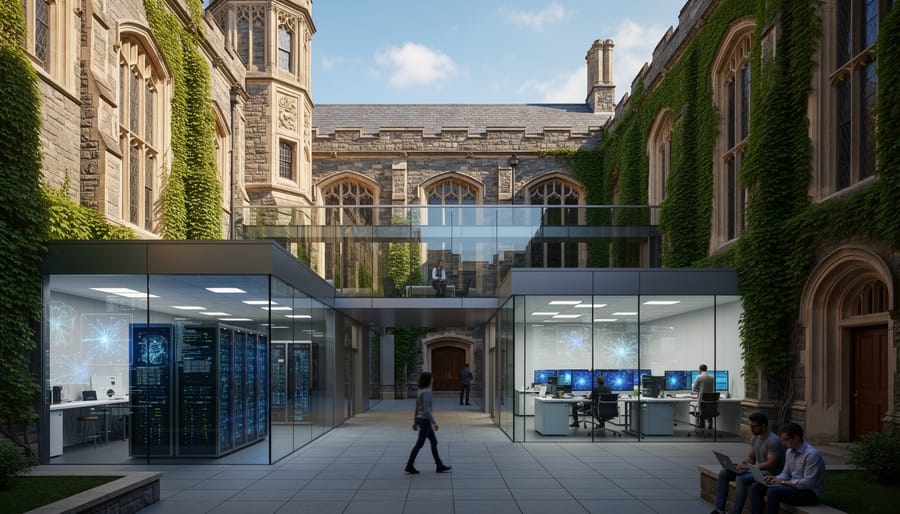
Yale’s AI research landscape centers around several key facilities that are pushing boundaries in meaningful ways. At the heart of this ecosystem is the Yale Institute for Network Science (YINS), where researchers study how complex systems interact, from social networks to biological processes. Think of it as a hub where mathematicians, computer scientists, and social scientists collaborate to understand patterns in everything from disease spread to information flow online.
The computational biology labs at Yale deserve special attention if you’re interested in healthcare applications. Here, researchers are developing AI systems that can predict protein structures and identify potential drug candidates faster than traditional methods. One notable project involves using machine learning to analyze medical imaging data, helping doctors detect cancers earlier and more accurately.
Yale’s Center for Biomedical Data Science brings together clinicians and data scientists to tackle real healthcare challenges. They’re currently working on predictive models that can forecast patient outcomes and personalize treatment plans, moving medicine from a one-size-fits-all approach to truly individualized care.
What sets Yale apart is its strong emphasis on AI ethics. The university hosts several initiatives examining the societal impact of artificial intelligence, from algorithmic bias to privacy concerns. These programs ensure that technical innovation moves forward responsibly, addressing questions like how to make AI systems fair and accountable.
These centers regularly welcome graduate students, postdoctoral researchers, and visiting scholars, making them accessible entry points for anyone looking to contribute to cutting-edge AI research with real-world impact.
Interdisciplinary Collaboration: Your Career Advantage
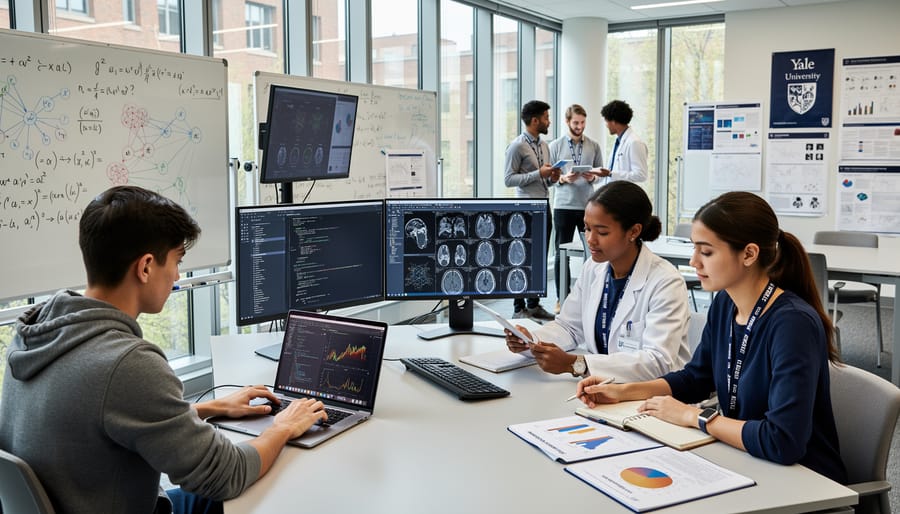
Yale’s approach to AI research breaks down traditional academic silos, creating a collaborative environment where computer scientists work alongside physicians, economists, linguists, and environmental scientists. This cross-pollination of ideas isn’t just academically interesting; it’s a significant career advantage.
Consider a real-world example: researchers at Yale have combined machine learning with healthcare expertise to develop diagnostic tools that can detect diseases earlier than traditional methods. This kind of work requires understanding both the technical aspects of AI and the practical needs of medical professionals. When you participate in such projects, you gain dual expertise that makes you valuable across multiple industries.
The practical benefits are tangible. Graduate students and postdoctoral researchers who engage in interdisciplinary work develop a broader skill set and professional network spanning different fields. You might start a project in the Computer Science department but find yourself collaborating with the School of Medicine or the School of the Environment. These connections often lead to unexpected career paths and opportunities.
For those entering AI research, this interdisciplinary model means you’re not limited to purely technical roles. You can become a bridge between technology and application domains, positioning yourself as someone who can translate complex AI concepts for non-technical stakeholders while understanding real-world constraints and opportunities.
Breaking Into Yale AI Research: Pathways for Different Career Stages
For Undergraduate and Master’s Students
Yale welcomes undergraduate and master’s students into its AI research community through several pathways. The most direct route is applying for research assistant positions through individual faculty labs. Students typically reach out to professors whose work aligns with their interests, attaching a CV and explaining their relevant background. For example, computer science major Sarah Chen secured a position in a natural language processing lab after taking CS 181 (Introduction to Machine Learning) and demonstrating her skills through a personal project analyzing Twitter sentiment.
Relevant coursework forms your foundation. Core classes include Introduction to Machine Learning, Deep Learning, and Computer Vision. Yale also offers specialized seminars like AI Ethics and Fairness in Machine Learning. These courses not only build technical skills but also help you identify research areas that excite you.
The Computer Science Department hosts weekly research talks where students can meet faculty informally. Attend these sessions, ask thoughtful questions, and follow up via email. Many successful research relationships begin with genuine curiosity shown during these events.
For those serious about breaking into AI engineering, consider Yale’s summer research programs. The Summer Research Fellowship Program pairs undergraduates with faculty mentors for 10 weeks of intensive research. Applications open in February, and strong candidates demonstrate both technical competence and research potential through their coursework and prior projects.
Master’s students often transition into research through teaching assistantships, which provide closer faculty contact. After proving themselves as TAs, many receive invitations to contribute to ongoing projects. This organic pathway has launched numerous PhD applications and industry research careers.
PhD Opportunities and What Yale Looks For
Yale’s Computer Science Department offers PhD programs where students can dive deep into AI research across multiple specialty areas. The typical path begins with a competitive application process that evaluates your academic background, research experience, and fit with faculty interests.
When applying, Yale looks for strong technical foundations, typically demonstrated through coursework in computer science, mathematics, or related fields. Your application package should include transcripts, GRE scores (when required), letters of recommendation from professors or research supervisors, and a statement of purpose that clearly articulates your research interests. The statement matters enormously because it shows how your goals align with specific faculty members at Yale.
Here’s the practical approach: Before applying, spend time researching potential advisors. Browse the Yale Computer Science faculty directory and read recent publications from professors whose work excites you. Look for labs working on topics like machine learning, computer vision, natural language processing, or robotics. Reach out to two or three faculty members whose research resonates with your interests, briefly introducing yourself and explaining why their work appeals to you.
Funding shouldn’t be a barrier. Yale typically offers full funding packages for admitted PhD students, including tuition coverage, health insurance, and a living stipend. Students usually receive funding through teaching assistantships, research assistantships, or fellowships.
The application deadline generally falls in mid-December for fall admission. Start preparing at least six months in advance to gather materials, strengthen your application, and make meaningful connections with potential advisors. Remember, demonstrating genuine curiosity about specific research questions sets successful applicants apart.
Postdoctoral and Early Career Researcher Positions
Yale’s AI research community offers multiple pathways for postdoctoral researchers and early-career scientists to build their expertise while contributing to groundbreaking projects. The university hosts several prestigious fellowship programs that provide dedicated funding, mentorship, and research independence.
Postdoctoral positions are available across Yale’s various AI-focused departments, including Computer Science, Statistics and Data Science, and Biomedical Informatics. These roles typically involve collaboration on specific research projects while allowing fellows to develop their own research agendas. Many positions come with opportunities to co-author publications, present at conferences, and network with leading researchers in the field.
The Yale Institute for Network Science and other interdisciplinary centers regularly advertise postdoc openings that combine AI with domain-specific applications. These positions often provide unique exposure to real-world problems in healthcare, climate science, or social systems.
Career development support includes grant writing workshops, teaching opportunities, and access to industry partnership programs. Yale’s location in the Northeast corridor facilitates connections with both academic institutions and tech companies, creating dual pathways for graduates. Many postdocs transition to tenure-track faculty positions at research universities, while others move into leadership roles at AI companies or launch their own startups.
Prospective postdocs should monitor departmental websites and reach out directly to faculty whose research aligns with their interests.
Key Faculty Members and Their Research Impact
Machine Learning and Computer Vision Leaders
Yale’s machine learning and computer vision labs are led by researchers who are actively pushing the boundaries of what AI can accomplish in practical settings. These faculty members welcome students and researchers at various career stages, from undergraduates exploring their first research project to doctoral candidates seeking groundbreaking dissertation work.
Professor Brian Scassellati directs the Social Robotics Lab, where machine learning meets human interaction. His team develops robots that can recognize emotions, understand social cues, and assist children with autism spectrum disorders. Students working in his lab gain hands-on experience with real-world applications, collaborating with healthcare professionals and educational institutions. The lab regularly accepts undergraduate research assistants, providing mentorship that helps students build portfolios for graduate school applications or industry positions.
In computer vision, Professor Steven Zucker focuses on computational models of perception and shape analysis. His research explores how machines can understand visual information similarly to human cognition. Projects in his lab often bridge mathematics, neuroscience, and engineering, offering interdisciplinary exposure that’s invaluable for career development. Graduate students appreciate the lab’s emphasis on publishing research and presenting at top-tier conferences.
Professor Smita Krishnaswamy leads work in data geometry and topology for machine learning, developing methods to analyze complex biological and medical datasets. Her lab actively recruits students interested in healthcare applications of AI, providing opportunities to work with medical institutions and publish impactful research. The collaborative environment encourages professional growth through regular seminars, industry partnerships, and conference participation.
AI in Healthcare and Computational Biology
Yale’s medical school and Department of Molecular Biophysics and Biochemistry have become hubs for AI-driven healthcare innovation, where computer scientists collaborate directly with clinicians and biologists to tackle real-world medical challenges. This interdisciplinary approach creates exceptional career opportunities that bridge technology and life sciences.
Researchers at Yale are using machine learning to analyze medical imaging data, helping radiologists detect diseases like cancer earlier and more accurately. One team developed AI models that predict patient outcomes by analyzing electronic health records, potentially saving lives through earlier interventions. These projects demonstrate how AI can augment human expertise rather than replace it, a philosophy that resonates throughout Yale’s healthcare AI initiatives.
In computational biology, Yale scientists apply deep learning to understand protein structures and drug interactions. This work accelerated during the pandemic when researchers used AI to identify potential therapeutic compounds. By training algorithms on vast biological datasets, they can now predict how different molecules might interact with disease targets, dramatically reducing the time and cost of drug discovery.
For those interested in these fields, Yale offers specialized programs that don’t require a traditional medical background. Computer science students can take courses in biomedical informatics, while biology majors learn programming and machine learning fundamentals. Many researchers started in one discipline and gradually acquired skills in the other through collaborative projects.
The career paths emerging from this work are diverse: clinical AI developer, computational biologist, healthcare data scientist, or medical AI ethicist. These roles combine technical expertise with domain knowledge, making professionals uniquely valuable in an increasingly data-driven healthcare landscape.
Building Your Research Career: Skills and Strategies From Yale’s Approach

Technical Skills That Matter Most
Yale’s AI research community places strong emphasis on a well-rounded technical foundation that combines programming proficiency with mathematical rigor. Python stands as the primary programming language across most labs, with researchers extensively using libraries like PyTorch and TensorFlow for deep learning projects. Understanding NumPy and pandas for data manipulation is equally important, as real-world research involves substantial data processing before any model training begins.
The mathematical foundations matter just as much as coding ability. Linear algebra forms the backbone of neural network operations, while probability theory and statistics help researchers understand model behavior and experimental results. Calculus, particularly multivariable calculus and optimization theory, proves essential when diving into how algorithms actually learn and improve over time.
Research methodologies at Yale emphasize reproducibility and rigorous experimental design. Familiarity with version control through Git, experiment tracking tools like Weights & Biases, and proper documentation practices distinguishes serious researchers from casual practitioners. These essential AI skills extend beyond pure technical knowledge.
To build these capabilities, start with online platforms like Coursera’s Machine Learning Specialization or fast.ai’s practical courses. MIT OpenCourseWare offers excellent mathematics refreshers at no cost. Demonstrate your skills through GitHub repositories showcasing personal projects, contributions to open-source AI libraries, or Kaggle competitions where you apply techniques to real datasets. Yale professors often look for applicants who can point to concrete examples of their work, making a strong portfolio your most valuable asset during the application process.
Publishing, Conferences, and Building Your Academic Profile
Publishing your research is essential for building credibility in AI, and Yale researchers strategically target venues that maximize impact. Top-tier conferences like NeurIPS, ICML, and CVPR are primary destinations for Yale AI work, with faculty often guiding students through the rigorous peer-review process. These conferences not only disseminate findings but also provide networking opportunities with global leaders in the field.
Start building your academic profile early by contributing to research projects, even in supporting roles. Co-authorship on papers, presenting at workshops, and engaging with the AI community on platforms like Twitter and GitHub demonstrate your active participation. Yale’s Social Robotics Lab and Computer Vision groups regularly publish findings that tackle real-world problems, from healthcare diagnostics to climate modeling, making their work both impactful and accessible to broader audiences.
For newcomers, focus on reading recent papers from Yale researchers to understand current trends and identify potential mentors whose work aligns with your interests. Attend departmental seminars and take advantage of Yale’s collaborative culture. Building relationships with faculty and peers creates pathways to co-authorship opportunities. Remember, a strong academic presence develops through consistent engagement, quality contributions, and making your research accessible to both technical and non-technical audiences.
Networking Within Yale’s AI Community
Building meaningful connections within Yale’s AI community opens doors to collaborations, mentorship, and career advancement. Start by attending the Yale Computer Science Department’s AI seminars, held weekly during the academic year, where leading researchers present cutting-edge work. The Yale Institute for Foundations of Data Science hosts regular workshops that bring together faculty and students across disciplines.
Connect with researchers by reaching out via email to discuss their publications. Most Yale professors welcome curious students and professionals. Attend the annual Yale AI Symposium, which features poster sessions and networking opportunities with labs across campus.
Join student organizations like Yale’s AI Society, which organizes hackathons, reading groups, and industry speaker events. Graduate students should explore the Machine Learning and Data Science working groups that meet monthly.
For remote engagement, follow Yale AI labs on social media and participate in virtual seminars. Many research groups post open positions and collaboration opportunities on their websites. Building these relationships takes time, so start with genuine interest in specific research areas rather than broad requests.
Beyond Academia: How Yale AI Research Opens Industry Doors
Industry Collaborations and Internship Opportunities
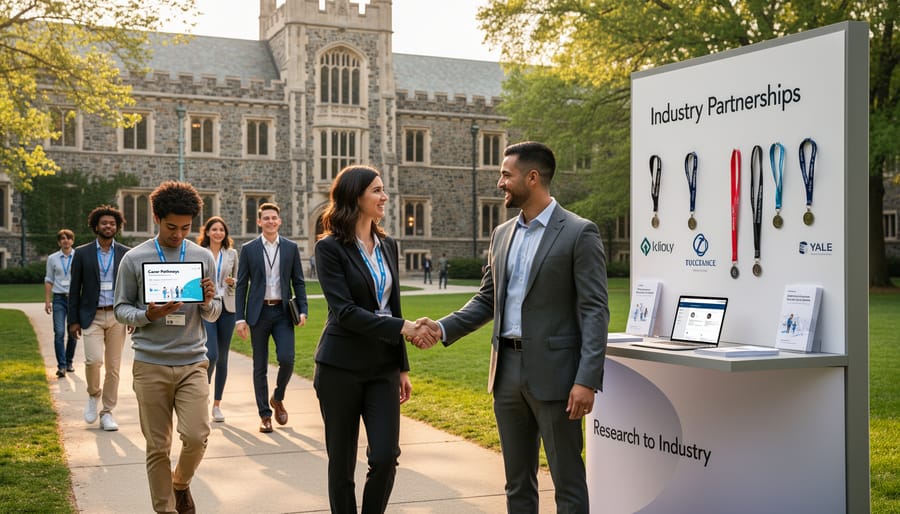
Yale recognizes that bridging academic research with real-world industry applications creates valuable opportunities for both researchers and the broader AI community. The university has established partnerships with leading technology companies including Google, Microsoft, and IBM, enabling researchers to tackle practical challenges while maintaining their academic positions.
These collaborations take various forms, from joint research projects to sponsored fellowships. For instance, researchers might work on developing AI solutions for healthcare diagnostics alongside industry partners, gaining exposure to production-scale systems and commercial constraints that differ from purely academic settings. This dual perspective enriches their research approach and opens doors to future career possibilities.
Yale’s Institute for Foundations of Data Science facilitates many of these industry connections, organizing regular seminars where company representatives share current challenges and potential collaboration areas. Graduate students and postdoctoral researchers can participate in internship programs during summer breaks, typically lasting three to four months, without interrupting their academic progress.
The university also supports sabbatical arrangements for faculty members interested in spending time at partner companies. These experiences often lead to published research, patents, and ongoing consulting relationships that benefit both parties. For those considering an AI research career, this flexibility demonstrates how Yale enables scholars to gain practical industry insights while building their academic credentials.
Career Transitions: From Yale Research to Tech Companies
Yale AI researchers have successfully transitioned to leading tech companies by leveraging a specific set of transferable skills developed during their academic work.
Dr. Sarah Chen, who spent three years researching natural language processing at Yale’s Department of Computer Science, joined Google AI in 2022. She credits her success to her experience managing large datasets and her ability to communicate complex findings to non-technical stakeholders—skills she honed while collaborating across Yale’s interdisciplinary AI initiatives.
Similarly, former Yale postdoctoral researcher James Martinez transitioned to Amazon’s machine learning division. His background in experimental design and statistical analysis, combined with hands-on experience with neural networks, made him an attractive candidate. Martinez emphasizes that his publication record demonstrated not just technical ability, but also persistence in solving real-world problems.
The most valued skills these researchers brought to industry include: proficiency in Python and deep learning frameworks like PyTorch, experience working with large-scale data, strong documentation habits from academic publishing, and the ability to iterate quickly on projects. Additionally, their involvement in Yale’s AI collaborations with healthcare and social science departments gave them unique perspectives on applying AI to practical business challenges, setting them apart from candidates with purely theoretical backgrounds.
Engaging with Yale’s AI research ecosystem offers tremendous advantages for career development, regardless of where you currently stand in your professional journey. The university’s collaborative environment, cutting-edge projects, and interdisciplinary approach create a unique learning environment that can accelerate your growth in artificial intelligence.
If you’re an undergraduate or prospective student, start by exploring Yale’s course offerings in AI and machine learning, then reach out to professors whose research aligns with your interests. Don’t hesitate to ask about undergraduate research assistant positions—many faculty members actively seek motivated students to join their teams.
For graduate students and early-career researchers, focus on identifying specific labs or projects that match your research goals. Attend departmental seminars, connect with current graduate students, and prepare a thoughtful research statement that demonstrates how your interests complement Yale’s strengths in areas like computational social science, AI ethics, or biomedical applications.
Professionals considering a transition should leverage Yale’s executive education programs, workshops, and public lectures to build connections while deepening your technical knowledge.
Remember, success in engaging with Yale’s AI research community comes from authentic alignment between your passions and their ongoing work. Take that first step today—whether it’s sending an introductory email, attending a virtual seminar, or submitting an application. Your AI research journey at Yale begins with one deliberate action forward.