

Build three to five substantial AI projects that solve real problems, not tutorial replicas. A loan default predictor using actual financial datasets demonstrates more value than following a generic image classifier walkthrough. Focus on end-to-end solutions that show data collection, model development, deployment, and results measurement.
Document each project with clear explanations of your decision-making process. Employers want to understand why you chose a particular algorithm, how you handled data quality issues, and what trade-offs you considered. Include visualizations of your results, code snippets highlighting key techniques, and honest discussions of what didn’t work initially.
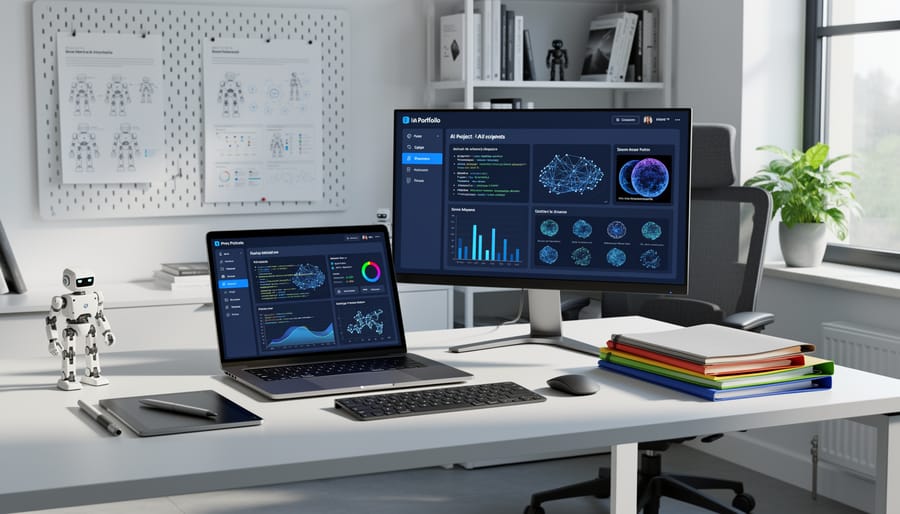
Create a centralized online portfolio using GitHub Pages, a personal website, or platforms like Kaggle. Structure your presentation so hiring managers can grasp your capabilities within 30 seconds: lead with your strongest project, include live demos or screenshots, and provide README files that explain business impact alongside technical implementation.
Tailor your portfolio to your target role. Aspiring data scientists should emphasize statistical modeling and experimental design. Those pursuing machine learning engineering positions need to showcase model optimization, API development, and deployment infrastructure. This strategic curation matters more than quantity when building a successful AI career.
Update your portfolio quarterly with new projects or improvements to existing ones. The AI field evolves rapidly, and a stagnant portfolio signals disconnection from current practices. Even small additions like implementing a new technique or improving model performance by 5% demonstrate continuous learning and commitment to excellence.
Why Your AI Portfolio Matters More Than Your Resume
In today’s competitive AI job market, a polished resume listing your degree and coursework might get you past the first screening, but it’s your portfolio that lands you the interview—and ultimately, the job offer. Here’s why: hiring managers receive hundreds of applications from candidates with similar educational backgrounds, but they can’t distinguish genuine capability from credential inflation until they see actual work.
Think of it this way. Two candidates apply for the same role. Candidate A has a master’s degree in computer science with a perfect GPA. Candidate B has the same degree but also showcases three deployed machine learning projects on GitHub, complete with documented results and real-world impact metrics. Who gets the callback? Industry data consistently shows Candidate B wins, often by a significant margin.
A 2023 survey of tech hiring managers revealed that 78% consider a strong project portfolio more valuable than academic credentials when evaluating AI and machine learning candidates. This shift reflects a fundamental reality: employers need people who can solve problems immediately, not those who might potentially learn to do so. Your portfolio proves you’ve already crossed that bridge—you’ve debugged models, handled messy datasets, and navigated the challenges that textbooks can’t fully prepare you for.
This matters even more when you consider AI engineer salary expectations. Companies investing six-figure salaries want evidence you can deliver value from day one. Your resume tells them where you studied; your portfolio shows them how you think, how you code, and how you approach real problems.
Sarah Chen, a machine learning engineer at a Fortune 500 company, puts it bluntly: “I can teach someone a new framework in weeks. I can’t teach problem-solving instincts or the persistence to see a messy project through to completion. Those qualities shine through in portfolios, not transcripts.”
The message is clear: your portfolio isn’t supplementary material—it’s your primary professional credential in the AI field.
The Core Components Every AI Portfolio Needs
Foundational Projects That Show Technical Competence
Starting with foundational projects helps you build credibility while mastering essential AI skills. Think of these as the building blocks of your portfolio—projects that prove you understand core machine learning concepts and can apply them to solve real problems.
Classification models make excellent entry points. A classic example is building an email spam detector using supervised learning techniques. You’ll work with labeled data, train algorithms like logistic regression or decision trees, and learn to evaluate model performance using metrics such as accuracy and precision. This project demonstrates your grasp of fundamental machine learning workflows, from data preprocessing to model evaluation.
Natural language processing (NLP) sentiment analysis projects showcase your ability to work with text data. Consider creating a movie review analyzer that determines whether reviews are positive or negative. You’ll explore techniques like tokenization, word embeddings, and classification algorithms. This type of project has clear real-world applications in customer feedback analysis and social media monitoring, making it highly relevant to potential employers.
Computer vision basics can be illustrated through image classification projects. Building a handwritten digit recognizer using datasets like MNIST demonstrates your understanding of neural networks and image processing. You might also create a simple object detection system that identifies everyday items in photographs.
These foundational projects align perfectly with your AI engineering roadmap, providing tangible proof of your technical competence. Remember to document your process thoroughly, including challenges faced and solutions implemented. This transparency shows problem-solving abilities that employers value just as much as the technical outcomes.

Advanced Projects That Set You Apart
Once you’ve mastered the basics, advanced projects demonstrate your ability to handle real-world complexity and deliver production-ready solutions. These sophisticated endeavors show employers you can go beyond tutorials and create meaningful impact.
Consider building an end-to-end stock prediction pipeline that doesn’t just train a model, but also handles data collection, preprocessing, model retraining, and automated reporting. For example, you might create a system that scrapes financial news daily, analyzes sentiment, combines it with technical indicators, and generates weekly investment insights. This showcases your understanding of the complete machine learning lifecycle, not just model building.
Another impressive project involves deploying a portfolio optimization tool as a web application. Using frameworks like Streamlit or Flask, you can create an interactive dashboard where users input their risk tolerance and investment goals, then receive personalized asset allocation recommendations. This demonstrates both technical skills and user-focused design thinking.
Domain-specific applications really make portfolios shine. A credit risk assessment model for peer-to-peer lending platforms, a recommendation system for ESG-focused investments, or an automated trading bot with backtesting capabilities all show specialized knowledge. The key is solving genuine problems that businesses face.
Remember to document your deployment process, including how you handled challenges like model versioning, monitoring performance drift, or scaling for multiple users. These details prove you understand what it takes to move from experimentation to production, a capability that hiring managers actively seek in candidates.
The Documentation That Makes Recruiters Take Notice
Your project’s documentation is the front door to your portfolio—it’s often the first thing recruiters examine, and it needs to make an immediate impression. Think of your README file as a compelling story that answers three essential questions: What does this project do? Why does it matter? And how did you build it?
Start with a clear, jargon-free description that any hiring manager can understand. Instead of writing “Implemented a CNN-based image classifier using transfer learning,” try something like “Built an AI system that identifies plant diseases from photos, helping farmers catch problems early—achieving 94% accuracy using deep learning techniques.” See the difference? You’ve made the impact tangible while still showcasing your technical skills.
Document your decision-making process throughout the project. Create a dedicated section explaining why you chose specific algorithms, how you handled data challenges, and what trade-offs you considered. For example, if you opted for a simpler model over a complex one, explain that you prioritized deployment speed for real-world usability. This demonstrates critical thinking—something recruiters value enormously.
Present your results visually whenever possible. Include before-and-after comparisons, performance graphs, or screenshots of your working application. A confusion matrix might excite technical reviewers, but pair it with a simple bar chart showing accuracy improvements that anyone can grasp.
Finally, add a “Getting Started” section with clear installation instructions. If a recruiter can actually run your project in five minutes, you’ve just separated yourself from 90% of other candidates. Remember, accessibility in documentation signals that you can communicate effectively across teams—an essential skill in any AI role.
Strategic Project Selection: Quality Over Quantity
When building your AI portfolio, resist the temptation to showcase every project you’ve ever touched. Instead, think of your portfolio as a curated gallery rather than a storage closet. Three well-executed projects will always outperform ten half-finished experiments.
Start by identifying your target destination. Are you aiming for a data science role at a healthcare startup? A machine learning position at a fintech company? Understanding what companies hiring AI engineers are looking for helps you make strategic choices. Review job descriptions in your desired field and note recurring requirements, preferred tools, and valued skills.
Next, apply the alignment test to potential projects. Each should satisfy at least two of these criteria: it genuinely interests you, it demonstrates skills relevant to your career goals, or it addresses a real-world problem in your target industry. A passion project about music recommendation systems might land you an interview at a streaming service, even if it started as a weekend hobby.
Depth matters more than diversity. Rather than building five basic classification models, create one comprehensive project that demonstrates your ability to handle messy data, engineer meaningful features, optimize model performance, and present results clearly. This approach reveals your problem-solving process and technical maturity, qualities that impress hiring managers far more than surface-level familiarity with multiple techniques.
Avoid the novelty trap. While it’s tempting to jump on every trending model or framework, employers value practical problem-solving over hype-chasing. A well-documented customer churn prediction project using established methods often resonates more than an experimental application of the latest research paper you barely understand.
Consider the sustainability factor too. Choose projects you can maintain and explain months later during interviews. If you can’t articulate your decisions or recreate your results, the project loses its portfolio value. Select challenges that stretch your abilities without overwhelming you, allowing for thorough documentation and genuine learning.
Finally, remember that quality projects take time. Budget weeks, not days, for meaningful work. This investment pays dividends when you confidently discuss your methodology, challenges faced, and lessons learned with potential employers who recognize authentic expertise.
Building Projects That Solve Real Problems
Finding Problems Worth Solving
The best AI projects solve real problems, not imaginary ones. Start by observing your daily routine: What repetitive tasks drain your time? Perhaps you spend too long sorting emails, tracking expenses, or searching for recipes based on ingredients you have. These frustrations are goldmines for portfolio projects.
Industry pain points offer another rich source. If you work in healthcare, retail, or finance, you’ve likely noticed inefficiencies that AI could address. A customer service chatbot for common questions, a tool that predicts inventory needs, or a system detecting fraudulent transactions all demonstrate practical thinking to potential employers.
Open datasets from platforms like Kaggle, Google Dataset Search, and government databases provide ready-made opportunities. Choose datasets aligned with industries you’re targeting. A job seeker interested in e-commerce might build a recommendation engine using retail data, while someone pursuing environmental work could create models predicting air quality patterns.
The key is specificity. Rather than building “another image classifier,” create a tool that identifies plant diseases to help gardeners. Instead of generic sentiment analysis, analyze customer reviews to extract actionable business insights. Projects with clear purposes and defined audiences show you understand how AI creates value beyond technical capability.

Demonstrating Business Impact
When presenting your AI projects to potential employers, remember that hiring managers care most about one thing: results. While it’s tempting to dive into the technical brilliance of your neural network architecture, what truly captures attention is demonstrating how your work creates tangible value.
Start by translating technical achievements into business metrics. Instead of saying “I built a sentiment analysis model with 92% accuracy,” frame it as “I developed a customer feedback system that helped identify product issues 3 days faster, potentially saving the company from negative reviews.” This approach shows you understand the why behind the work, not just the how.
Consider a real-world example: if you created a recommendation system for an e-commerce platform, highlight the practical impact. Did it increase user engagement? Reduce search time? Even in personal projects, you can estimate potential benefits. For instance, “This image classification tool could reduce manual sorting time by approximately 15 hours per week for small photography businesses.”
Break down your project impact into three key areas. First, efficiency gains: how much time or resources does your solution save? Second, cost implications: does it reduce expenses or prevent losses? Third, revenue opportunities: could it help generate income or improve customer satisfaction?
When discussing class projects or self-taught work, be honest but strategic. Use phrases like “designed to address” or “demonstrates potential to improve” rather than claiming direct business impact you haven’t measured. Include specific numbers whenever possible, even if they’re from testing datasets or simulated scenarios. Quantifiable results, even small ones, matter far more than vague claims of improvement.
Presenting Your Portfolio: Platforms and Best Practices
Once you’ve built impressive AI projects, presenting them effectively can make the difference between landing an interview and being overlooked. Think of your portfolio as your digital storefront—it needs to be inviting, organized, and easy to navigate.
GitHub remains the go-to platform for technical portfolios. Start by crafting a compelling profile README that introduces who you are and what you’re passionate about. Pin your strongest 4-6 repositories to your profile, ensuring each has a detailed README file that explains the problem you solved, your approach, and the results. Include clear installation instructions, screenshots or demo videos, and a section on lessons learned. This documentation demonstrates communication skills that employers highly value.
Beyond GitHub, consider creating a personal website to showcase your work more visually. Platforms like GitHub Pages, Netlify, or Vercel offer free hosting with custom domains. Your website should feature an engaging homepage, an about section highlighting your journey into AI, and a projects gallery with both technical depth and visual appeal. For each project, include before-and-after comparisons, data visualizations, or interactive demos when possible. Real-world applications resonate with visitors, so explain how your sentiment analysis tool could help businesses or how your image classifier solves actual problems.
Portfolio platforms like Kaggle and Hugging Face Spaces serve dual purposes: they host your projects and connect you with the AI community. Kaggle showcases your competition rankings and notebooks, while Hugging Face lets you deploy interactive model demos that recruiters can try instantly. These platforms add credibility through community engagement metrics.
For visual presentation, maintain consistency across all platforms. Use clean layouts with plenty of white space to avoid overwhelming visitors. Include brief project descriptions upfront, followed by technical details for those who want to dig deeper. This layered approach makes your portfolio accessible to both technical and non-technical reviewers.
Remember accessibility matters. Ensure your portfolio loads quickly, works on mobile devices, and includes alt text for images. Add a clear contact section with links to your LinkedIn and email. Finally, keep everything updated—an abandoned portfolio suggests you’ve stopped learning, which contradicts the growth mindset essential in AI careers.
Common Portfolio Mistakes That Kill Your Chances
Even brilliant AI practitioners can undermine their career prospects with portfolio mistakes that signal inexperience. Understanding these pitfalls helps you avoid them before they cost you opportunities.
The most damaging mistake is showcasing tutorial clones without modification. If your portfolio features projects that look identical to popular courses on Coursera or YouTube, recruiters will notice immediately. Instead, take the tutorial concept and extend it meaningfully. Did you complete a sentiment analysis tutorial? Apply those techniques to a unique dataset, like analyzing customer reviews for local businesses or tracking sentiment trends in scientific publications. This demonstrates you can transfer knowledge, not just follow instructions.
Over-complicated projects often backfire spectacularly. Building a neural network with ten layers when a simpler model would work better shows poor judgment rather than expertise. Employers value practical problem-solving over complexity for its own sake. Include a section in your project documentation explaining why you chose your approach and what alternatives you considered. This reveals critical thinking skills that matter more than architectural gymnastics.
Poor code quality kills credibility faster than weak results. Messy notebooks with uncommented code blocks, inconsistent variable names, and no explanations suggest you can’t work in professional environments. Clean up your code before publishing. Add docstrings, organize your imports, remove debugging cells, and ensure someone could understand your logic without speaking to you directly.
Missing context leaves reviewers confused about what problem you solved and why it matters. Every project needs a clear problem statement upfront. Don’t assume viewers understand the business case or domain challenges. A fraud detection model means nothing without explaining the real-world impact of false positives versus false negatives.
Finally, outdated work signals stagnation. A portfolio frozen in 2019 technologies suggests you’ve stopped learning. Regularly refresh your projects with current frameworks and techniques, even if you’re just updating one or two showcase pieces annually. This communicates ongoing professional development and adaptability.
Maintaining and Evolving Your Portfolio Over Time
Your AI portfolio isn’t a static monument to past achievements—it’s a living reflection of your evolving skills and the rapidly changing AI landscape. Think of it like a garden that needs regular tending to flourish and stay relevant.
Start by scheduling quarterly portfolio reviews. During these check-ins, evaluate each project through fresh eyes. Does that sentiment analysis project from 2022 still showcase your best work? Could you enhance it with more recent transformer models or better data visualization? Small updates can breathe new life into solid foundational projects without starting from scratch.
As you learn new techniques, consider retrofitting existing projects rather than always building new ones. For example, if you originally built a recommendation system using collaborative filtering, you might update it to incorporate deep learning approaches. This demonstrates growth while showing you can iterate and improve—a crucial skill employers value.
Don’t be afraid to archive outdated work. That chatbot built with pre-2020 technology might now seem primitive compared to current standards. Instead of letting it drag down your portfolio’s overall impression, move it to an “archived projects” section or remove it entirely. Quality always trumps quantity.
Stay current by following AI research communities, attending virtual conferences, and experimenting with emerging tools. When GPT-4 launched or when new computer vision techniques emerge, ask yourself: “How could I demonstrate this in my portfolio?”
Set up Google Alerts for AI trends in your focus area, whether that’s natural language processing, computer vision, or reinforcement learning. This proactive approach ensures your portfolio remains a competitive advantage rather than becoming a liability that signals you’ve fallen behind in this fast-moving field.
From Portfolio to Interview: Making Your Work Count
Your portfolio is only as powerful as your ability to tell its story. Think of each project as a chapter in your professional narrative—one that demonstrates not just what you built, but how you think, solve problems, and create value.
When preparing for job applications, resist the urge to simply list your projects. Instead, craft a compelling narrative around each one. Start with the problem you addressed: “Users were spending 30 minutes daily on repetitive data entry tasks.” Then explain your approach: “I developed a natural language processing tool that automated 80% of this work.” Finally, quantify the impact: “This saved the team approximately 10 hours per week.” This problem-solution-impact framework transforms technical work into business value that hiring managers immediately understand.
During interviews, preparation is everything. Select three to four projects you can discuss in depth rather than superficially covering everything. For each, prepare a two-minute overview and be ready to dive into technical details if asked. Practice explaining your code choices, challenges you faced, and what you’d do differently now. This shows growth mindset and technical maturity.
Create a “greatest hits” document that maps your projects to common interview questions. When asked about handling messy data, you’ll instantly recall your sentiment analysis project. When discussing teamwork, you’ll reference your collaborative recommendation system. This preparation prevents the dreaded “I know I did something relevant, but I can’t remember which project” moment.
Consider using personalized career guidance tools to refine your interview strategy and identify which portfolio pieces resonate most with specific roles.
Remember, interviewers aren’t just evaluating your technical skills—they’re assessing whether you can communicate complex ideas clearly. Your portfolio becomes proof that you can translate AI concepts into solutions that real people understand and use. Practice explaining your work to non-technical friends; if they grasp the value, you’re ready for any interview room.

Building an AI portfolio isn’t a one-time task you check off and forget. It’s an ongoing investment in your professional growth that evolves alongside your skills and the rapidly changing AI landscape. Think of it as a living document that tells the story of your journey in artificial intelligence.
The good news? You don’t need ten impressive projects to get started. Begin with one quality project that genuinely interests you. Whether it’s a sentiment analysis tool for movie reviews or a simple image classifier, what matters most is that you complete it, document your process thoroughly, and reflect on what you learned. Employers aren’t just looking for perfect outcomes; they’re seeking people who can tackle problems, learn from setbacks, and iterate on solutions.
As you add projects over time, you’ll naturally refine your approach to documentation, improve your code quality, and develop a stronger sense of what makes work portfolio-worthy. This iterative process itself demonstrates the growth mindset and continuous learning attitude that hiring managers value above all else. Your portfolio becomes proof not just of what you can do, but of who you are as a learner and problem-solver in the AI field.