

Evaluate your current position honestly: if you’re managing 2-3 product managers or leading cross-functional teams of 15+ people on complex initiatives, you’re likely ready to pursue director-level roles. The transition from senior PM to Director of Product Management represents more than a title upgrade—it’s a fundamental shift from building products to building product organizations, from tactical execution to strategic vision-setting, and from individual contributions to multiplying impact through others.
Director roles in AI product management demand a distinct skill combination rarely found elsewhere. You’ll need to translate ambiguous AI capabilities into concrete business value, navigate ethical considerations that didn’t exist five years ago, and build roadmaps for technologies that evolve monthly. Unlike traditional product directors who focus primarily on market fit and user needs, AI product directors must balance technical feasibility constraints, data infrastructure requirements, model performance tradeoffs, and rapidly shifting competitive landscapes where breakthroughs can render your strategy obsolete overnight.
The compensation reflects this complexity, with directors earning $180,000-$300,000+ depending on company size and location, but the real challenge lies in the expanded scope. You’ll spend 60% of your time on people development, stakeholder management, and organizational strategy—not product decisions. You’ll advocate for resources, resolve conflicts between engineering and business priorities, and make calls with incomplete information while your team’s career growth depends on your judgment.
This career path isn’t for everyone, and that’s precisely what makes it valuable for those who thrive on organizational challenges rather than hands-on product work.
What Makes AI Product Management Directors Different

The Technical-Business Translator Role
One of the most challenging yet crucial responsibilities for directors is bridging the gap between technical AI teams and business stakeholders. Unlike traditional AI product managers who focus on feature-level decisions, directors must translate complex machine learning concepts into business language that executives, investors, and cross-functional teams can understand and act upon.
Consider a scenario where your data science team proposes a new recommendation engine. As director, you need to explain to the CFO why this model requires six months of user data before deployment, why accuracy might start at 70% rather than 95%, and why the initial investment of $500K makes business sense despite these limitations. This means understanding concepts like training data requirements, model accuracy metrics, and inference costs well enough to set realistic expectations.
Successful directors develop frameworks for communicating technical constraints. For example, when stakeholders request real-time personalization, you might explain the tradeoff between response time and accuracy using relatable analogies, like comparing it to the difference between instant coffee and a carefully brewed espresso. You also need to anticipate questions about edge cases, bias mitigation, and regulatory compliance, translating these technical considerations into risk assessments that resonate with business leaders.
Leading Teams Through AI Uncertainty
Traditional product management relies on predictable outcomes: build feature X, users will do Y. AI product directors operate in a fundamentally different reality where probabilistic models replace deterministic systems. Your sentiment analysis might work perfectly 85% of the time, but that remaining 15% creates genuine uncertainty in planning and execution.
This shift demands a new decision-making framework. Instead of guaranteeing specific outcomes, you’re managing confidence intervals and acceptable error rates. When your machine learning engineer says a model achieves “90% accuracy,” you need to understand what that means for real users—and whether that threshold meets business requirements.
Consider a practical example: launching an AI-powered recommendation engine. A traditional product approach would promise “personalized recommendations.” An AI-aware director frames it differently: “recommendations that match user preferences in 8 out of 10 cases, with continuous improvement through user feedback loops.” This transparency changes how you communicate with stakeholders and set expectations.
You’ll also need to embrace iterative validation over upfront certainty. Rather than lengthy specification documents, AI products require rapid experimentation cycles. Your team builds a minimum viable model, tests it with real data, and adjusts based on actual performance—not predicted behavior.
The director’s role becomes managing this ambiguity across the organization, helping executives understand why AI timelines differ from traditional software projects, and building team confidence despite inherent unpredictability.
The Skills That Actually Matter
Technical Fluency Without the PhD
Here’s the truth: you don’t need a machine learning PhD to excel as a director of product management in AI. What you do need is what we call “technical fluency”—the ability to ask the right questions, understand trade-offs, and communicate effectively with engineering teams.
Think of it like being a film director. You don’t need to know how to operate every camera or edit footage yourself, but you must understand what’s possible, what’s expensive, and how long things take. Similarly, AI product directors need to grasp concepts like model accuracy versus speed, training data requirements, and when a rule-based system might outperform a complex neural network.
In practice, this means understanding that your recommendation engine needs thousands of examples to learn effectively, or recognizing when your team mentions “overfitting” that your model might perform beautifully on test data but fail in the real world. You’ll learn to translate between stakeholders who want “AI that just works” and data scientists who need clear success metrics.
Most successful directors come from product management backgrounds and build their AI knowledge through hands-on experience, online courses, and—most importantly—curiosity-driven conversations with their technical teams. The misconception that you need a computer science degree creates unnecessary barriers. What matters is your ability to bridge business problems with technical solutions.
Data Strategy and Ethics Leadership
Directors of product management play a crucial role in embedding ethical considerations into AI product development from the ground up. Rather than treating ethics as an afterthought, they establish frameworks that help teams identify potential bias, ensure fairness, and make principled decisions throughout the product lifecycle.
In practice, this means creating scalable processes for bias detection. For example, a director might implement regular audits of training data, ensuring datasets represent diverse populations and use cases. They work with engineering teams to establish testing protocols that check for discriminatory outcomes across different demographic groups before products launch.
Directors also translate abstract ethical principles into concrete decision-making tools. Think of it as building guardrails: they create decision trees that help product managers evaluate trade-offs between innovation speed and user safety, or develop scorecards that assess privacy implications of new features. These frameworks ensure consistent responsible AI practices across multiple teams and products.
Beyond internal processes, directors champion transparency with users. They guide teams in communicating how AI systems make decisions, what data they collect, and how users can challenge automated outcomes. This leadership position requires balancing business objectives with societal impact, making ethical considerations a competitive advantage rather than a constraint.
Stakeholder Management in High-Uncertainty Environments
Managing stakeholders in AI product development requires a different playbook than traditional products. When your machine learning model might deliver 85% accuracy one week and 78% the next, you need transparent communication strategies.
Start by educating stakeholders about AI’s inherent uncertainties. When presenting to executives, frame progress through metrics they understand. Instead of saying “our model achieved 0.92 F1 score,” translate it: “our system correctly identifies customer issues 92% of the time, up from 85% last quarter.” This bridges the gap between technical achievements and business outcomes.
For customers, set expectation ranges rather than fixed promises. If your AI feature will improve response times, communicate “15-30% faster” instead of committing to a specific number that may fluctuate during early deployment.
With engineering teams, establish regular checkpoint conversations that celebrate incremental wins while acknowledging setbacks. Create a shared vocabulary around acceptable variance in model performance.
The most successful directors develop a reporting rhythm that combines quantitative metrics with qualitative context. Your monthly update might show accuracy trends alongside real-world examples of how the AI performed in edge cases, helping stakeholders understand both progress and limitations without losing confidence in the project’s direction.
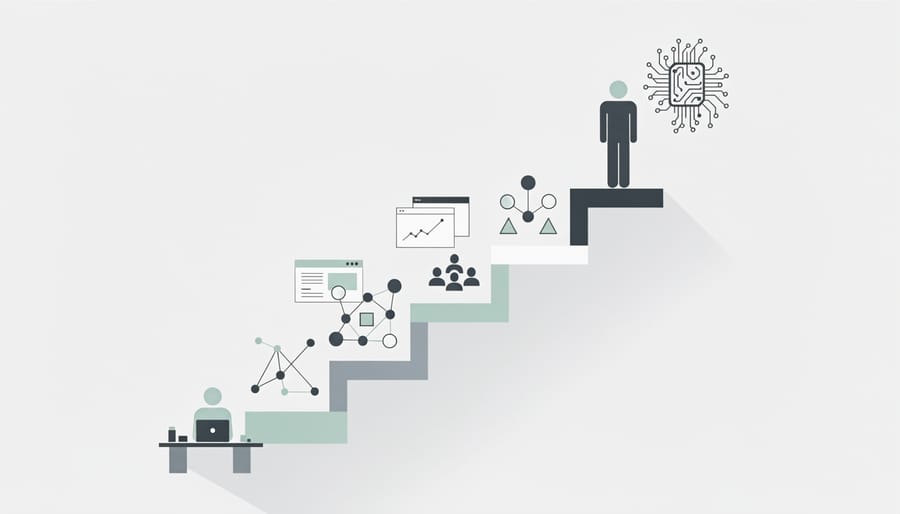
Your Roadmap from Product Manager to Director
Building Your AI Foundation (Years 1-2)
Start by volunteering for AI-adjacent projects within your current organization. Look for opportunities where machine learning could improve existing features—perhaps a recommendation system, predictive analytics dashboard, or automated classification tool. Even small projects build essential experience and demonstrate initiative to leadership.
Create a structured self-education plan focused on practical application rather than theoretical depth. Platforms like Coursera’s “AI for Everyone” by Andrew Ng provide product-focused foundations without requiring coding expertise. Supplement this with case studies from companies like Netflix, Spotify, or Airbnb to understand how AI solves real product challenges. Dedicate 3-5 hours weekly to learning, treating it as seriously as any work commitment.
Build credibility by becoming your team’s AI translator. Attend engineering discussions about machine learning implementations, then create documentation explaining these capabilities in business terms. This positions you as someone who bridges technical and strategic thinking—a critical skill for building an AI career in product leadership.
Partner with data scientists on a pilot project, even if it’s outside your immediate responsibilities. Offer to handle user research, define success metrics, or manage stakeholder communication. This hands-on collaboration teaches you how AI projects differ from traditional product work—particularly around data requirements, model limitations, and iterative improvement cycles.
Document your learnings publicly through internal presentations or external blog posts. Share both successes and failures, focusing on lessons learned about AI product development. This creates a track record that future employers can verify.
Expanding Your Leadership Scope (Years 3-4)
As you approach your third and fourth years in product management, you’ll naturally begin shifting from pure execution to broader leadership responsibilities. This transition marks a crucial turning point in your director-level career trajectory.
Start by seeking opportunities to mentor junior product managers. Think of mentorship as a two-way street: while you’re sharing hard-won lessons about stakeholder management or roadmap prioritization, you’ll also sharpen your communication skills and gain fresh perspectives on problems you’ve encountered. One product manager at a voice AI company described how mentoring a new PM through their first feature launch helped her realize she’d developed systematic approaches she hadn’t even consciously documented.
During this phase, actively pursue ownership of multi-product initiatives. Rather than managing a single feature or product line, you might oversee an entire AI-powered customer experience ecosystem. For example, instead of just the recommendation engine, you’d coordinate how recommendations, personalization, and search work together to create a cohesive user journey.
Practice delegating tactical decisions while maintaining strategic oversight. This doesn’t mean disconnecting from day-to-day work, but rather focusing your energy on high-impact activities like cross-functional alignment, resource allocation, and removing organizational blockers. You’re building the muscle memory needed for true director-level leadership, where your success depends less on what you personally ship and more on how effectively you enable others to deliver exceptional AI products.
Making the Director Leap (Year 5+)
Breaking into director-level positions requires more than tenure—it demands demonstrable strategic impact. Start building your director portfolio now by documenting measurable outcomes from your current role. Did you lead a product that increased user engagement by 40%? Reduce customer churn through AI-powered personalization? These specific achievements matter more than titles.
Networking becomes critical at this stage, but focus on quality over quantity. Attend AI product conferences not just to collect business cards, but to contribute meaningfully—speak on panels, write thought leadership pieces, or mentor junior PMs. Hiring managers want directors who represent the company externally and influence the broader industry conversation.
What actually gets you hired? Three things stand out consistently. First, evidence of managing cross-functional teams through ambiguity—directors must navigate uncertainty without clear playbooks. Second, experience balancing technical feasibility with business viability, especially around AI capabilities versus realistic timelines. Third, a track record of developing talent, as directors spend significant time coaching and elevating their teams.
Consider taking interim leadership opportunities—acting director roles or special projects reporting to executives—to test the waters and build your case. These experiences provide concrete examples for interviews and reveal whether the increased strategic focus truly energizes you more than hands-on product work.
Real Career Paths: How People Actually Got There

The Traditional PM Pivot
Sarah Chen spent eight years building consumer mobile products at a major social media company before making the leap to AI product director at an enterprise software firm. The transition wasn’t as dramatic as she expected. “I thought I’d need a computer science PhD,” Sarah recalls, “but my years of user research and stakeholder management became my foundation.”
What transferred seamlessly? Her ability to translate technical capabilities into business value, run experiments to validate assumptions, and coordinate cross-functional teams. Product thinking remains product thinking, regardless of the underlying technology.
What required learning? Sarah invested six months in understanding machine learning fundamentals through online courses, not to build models herself, but to ask informed questions and recognize when her data science team was heading down an unproductive path. She also had to adapt her product roadmapping approach to account for AI’s inherent unpredictability—you can’t always guarantee a model will reach target accuracy on schedule.
Her advice for traditional PMs considering the pivot: “Start by working closely with AI teams in your current role. Volunteer for projects that touch machine learning, even tangentially. The technical concepts become far less intimidating when you’re solving real problems.”
The Technical Background Route
Engineers and data scientists often make exceptional product directors because they understand technical constraints and can evaluate AI feasibility—but the transition requires intentional skill-building. The most common pitfall? Remaining too solution-focused rather than problem-focused. Technical professionals sometimes jump to implementation details before fully exploring customer needs.
To bridge this gap, start attending customer interviews even before formally transitioning. Shadow your product manager, observe how they ask open-ended questions, and notice how they prioritize features based on business impact rather than technical elegance. Many successful transitions happen when engineers volunteer for cross-functional initiatives that expose them to marketing, sales, and finance perspectives.
Consider Sarah, a machine learning engineer who began writing quarterly business cases for her model improvements, translating accuracy gains into revenue projections. This practice helped her develop the commercial thinking that later distinguished her director applications.
Take online courses in product strategy and business fundamentals. Read competitor analysis reports. Calculate customer acquisition costs for your products. These small steps build the business acumen that complements your technical foundation, creating the balanced perspective AI product leadership demands.
The Cross-Industry Jump
Domain expertise from traditional industries can be a powerful differentiator when transitioning into AI product management leadership. Consider Sarah, who spent eight years managing healthcare information systems before becoming a Director of Product Management at a medical AI startup. Her deep understanding of HIPAA compliance, clinical workflows, and provider pain points proved invaluable when designing AI diagnostic tools—knowledge that purely technical product leaders lacked.
Similarly, Marcus leveraged his background in financial risk modeling to lead fraud detection AI products at a fintech company. He could anticipate regulatory concerns and speak the language of compliance officers, making product adoption smoother.
This cross-industry advantage works because AI products don’t exist in a vacuum. They solve real problems in specific contexts. A director who understands insurance claims processing, supply chain logistics, or legal document review brings critical insights about user needs, industry constraints, and market dynamics that purely technical teams often miss. This domain knowledge helps you ask better questions during product discovery, identify meaningful use cases, and build credibility with stakeholders who might otherwise be skeptical of AI solutions.
Avoiding the Biggest Career Mistakes
The Over-Specialization Trap
Many aspiring directors make the mistake of becoming experts in just one narrow slice of AI—perhaps focusing exclusively on recommendation systems or conversational AI. While deep expertise has value, over-specialization creates career fragility. Consider the product director who spent five years perfecting chatbot products only to watch the market shift dramatically with large language models. Their narrow focus left them unprepared for the strategic pivot their company needed.
Directors of Product Management succeed by maintaining what I call “T-shaped expertise”—deep knowledge in one area with broad understanding across multiple domains. This means staying current on emerging AI capabilities beyond your immediate product area. Read case studies from different industries. Attend conferences outside your specialty. Most importantly, develop fluency in the business fundamentals that transcend any single technology: user research, market dynamics, and cross-functional leadership.
The antidote to over-specialization is strategic curiosity. Allocate time each week to explore adjacent technologies and their applications. This breadth enables you to spot opportunities others miss, adapt when markets shift, and lead teams through technological transitions—exactly what organizations need from their product directors.
Jumping Too Soon or Waiting Too Long
Timing your transition to director-level product management resembles catching a wave—jump too early and you’ll wipe out, wait too long and you’ll miss the momentum. Here’s how to gauge your readiness.
Start with an honest capabilities audit. Can you articulate a product vision that spans 12-18 months and persuade executives to fund it? Have you successfully coached others through challenging product decisions, not just made those decisions yourself? Director roles demand strategic thinking over tactical execution. If you’re still drawn to writing user stories or conducting customer interviews yourself rather than enabling your team to excel at these tasks, you might need more senior PM experience first.
Consider the “influence without authority” test. Directors spend 60-70% of their time influencing stakeholders across engineering, sales, and customer success. Ask yourself: Have I successfully navigated political complexity to drive outcomes? Can I build coalitions among leaders who don’t report to me?
The market timing matters too. If you’re at a company where director roles rarely open up, staying might mean waiting years. Conversely, jumping to a director title at a struggling startup might offer impressive credentials but limited growth opportunities.
Create a specific readiness checklist: managed multiple PMs or products simultaneously, owned P&L responsibility, presented strategy to C-suite executives, and resolved cross-functional conflicts at scale. If you can’t check most boxes, invest another year building these experiences deliberately.
What to Expect When You Get There
The director-level transition comes with significant changes that extend far beyond the title upgrade. Your day-to-day reality shifts from crafting product roadmaps to navigating organizational politics, securing budget allocations, and defending strategic decisions to skeptical executives who may not fully grasp AI’s technical nuances.
Let’s start with the financial picture. Compensation expectations for AI product directors typically range from $180,000 to $350,000 annually, depending on company size, location, and funding stage. Equity packages can add substantial value, particularly at pre-IPO companies, but remember that stock options are only valuable if the company succeeds. The financial upgrade is real, but it comes with proportional pressure.
Work-life balance becomes more complex at this level. You’ll face evening calls with international teams, weekend emergencies when production models fail, and the constant mental load of managing multiple stakeholders. The notion of “leaving work at the office” largely evaporates. One director I spoke with candidly shared that she checks Slack before her morning coffee and again before bed, six days a week.
The unglamorous reality includes spending considerable time in meetings that feel unproductive, managing interpersonal conflicts between engineering and design teams, and creating PowerPoint presentations to justify budget requests. You’ll also handle uncomfortable situations like performance improvement plans for underperforming team members and delivering disappointing news about deprioritized projects to passionate engineers.
The role demands constant context-switching. One hour you’re discussing transformer architecture limitations with your ML team, the next you’re explaining customer churn metrics to finance executives using non-technical language. This mental gymnastics exhausts even experienced professionals.
Despite these challenges, directors consistently report high job satisfaction when they successfully ship impactful AI products that solve real problems. The key is entering the role with open eyes, understanding that influence and impact come packaged with complexity and stress.

The path to becoming a Director of Product Management in AI isn’t reserved for tech prodigies or those with computer science PhDs. It’s a career trajectory built through deliberate skill development, strategic positioning, and consistent learning. Whether you’re coming from traditional product management, transitioning from engineering, or pivoting from another field entirely, the opportunity exists for those willing to invest in both technical literacy and leadership capabilities.
Timing matters, but preparation matters more. You don’t need to wait until you feel completely ready. The professionals who successfully make this leap typically start positioning themselves 12-18 months before formally stepping into the role. They build credibility gradually, one AI-informed decision at a time.
This week, take three concrete actions. First, identify one AI product in your current company or industry and spend two hours understanding how it was built and what trade-offs the team faced. Second, reach out to one person currently in an AI product leadership role and ask them about their biggest challenge this month. Third, audit your own skill gaps using the framework we’ve discussed and create a 90-day learning plan focusing on your weakest area, whether that’s technical fundamentals, stakeholder management, or strategic thinking.
The director-level AI product management career is accessible to motivated professionals from diverse backgrounds. Your unique perspective, whether it comes from healthcare, finance, education, or another domain, becomes an asset when combined with the right technical foundation and leadership skills. Start now, learn consistently, and position yourself strategically. The next generation of AI product leaders is being shaped today.