

Monitor your AI model’s predictions in real-time by implementing logging systems that capture input data, output predictions, confidence scores, and processing times for every inference request. This creates an audit trail that reveals when your model starts making questionable decisions, helping you catch issues before they impact users.
Track performance drift by establishing baseline metrics during deployment and setting automated alerts when accuracy drops below acceptable thresholds. Your production model might perform brilliantly during AI model training but degrade over time as real-world data patterns shift, making continuous monitoring essential rather than optional.
Instrument your data pipeline to detect anomalies in incoming requests, including unusual feature distributions, missing values, or out-of-range inputs that could trigger unpredictable model behavior. A sudden spike in null values or unexpected data types often signals upstream problems that will cascade into poor predictions if left unaddressed.
The challenge facing AI teams today extends beyond building accurate models to maintaining their reliability in production environments where conditions constantly evolve. Traditional software monitoring tools capture server health and response times but miss the nuanced problems unique to machine learning systems: gradual accuracy decay, biased predictions on specific demographic groups, or unexplainable confidence scores that erode user trust.
AI observability tools bridge this gap by providing specialized capabilities for understanding what happens inside your models and data pipelines. They answer critical questions that keep practitioners awake at night: Why did my recommendation engine suddenly start suggesting irrelevant products? Which customer segments are receiving less accurate predictions? Has my fraud detection model learned to discriminate based on protected attributes?
This guide explores the landscape of AI observability solutions designed to make your machine learning systems transparent, reliable, and trustworthy.
What AI Observability Actually Means (In Plain English)

The Three Pillars of AI Observability
Think of AI observability as a three-legged stool. Remove any leg, and the whole thing topples over. Each pillar serves a distinct purpose in keeping your AI systems reliable and trustworthy.
The first pillar is model performance monitoring. Imagine you’re a chef who’s perfected a recipe. Initially, your dish tastes amazing, but over time, something changes. Maybe your supplier switched ingredients, or the humidity in your kitchen is different. Model performance monitoring is like constantly taste-testing your dish to catch when something’s off. In AI terms, this means tracking metrics like accuracy, precision, and response times. When your customer service chatbot suddenly starts giving unhelpful answers, or your recommendation engine stops suggesting relevant products, performance monitoring catches these issues before they frustrate users.
The second pillar is data quality tracking. This is your ingredient inspection system. Just as a chef wouldn’t cook with spoiled vegetables, AI models can’t make good predictions with corrupted or outdated data. Data quality tracking monitors whether incoming information matches what the model expects. Are there missing values? Has the format changed? Is there unusual data that doesn’t fit expected patterns? These checks prevent the “garbage in, garbage out” problem that plagues AI systems.
The third pillar is prediction behavior analysis. This examines not just whether predictions are accurate, but how and why the model makes specific decisions. Think of it as understanding the reasoning behind each dish you serve. Is your model consistently biased toward certain outcomes? Does it behave unexpectedly with specific inputs? This pillar helps identify fairness issues and ensures your AI behaves ethically and consistently.
The Hidden Problems These Tools Detect
Data Drift: When Your Model Gets Confused
Imagine a retail company that trained its recommendation system in 2019 using years of shopping data. The AI learned that customers who bought business attire often purchased luggage and travel accessories. Then 2020 happened. Suddenly, people stopped buying suits and started ordering home office furniture and loungewear. The model, still confident in its pre-pandemic patterns, kept suggesting briefcases to customers browsing yoga pants.
This is data drift, one of the most common reasons AI models falter in production. It occurs when the real-world data your model encounters differs significantly from the training data it learned from. Think of it like teaching someone to navigate using a map from ten years ago. The roads might have changed, new buildings appeared, and old landmarks vanished.
Data drift happens gradually or suddenly. Consumer preferences shift, market conditions evolve, or external events like pandemics reshape behavior entirely. Your model doesn’t automatically know these changes occurred. It continues making predictions based on outdated patterns, leading to poor recommendations, inaccurate forecasts, or even costly business decisions.
This is where AI observability tools become essential. They monitor the incoming data flowing through your AI data pipelines, comparing it against the original training data distribution. When statistical differences cross certain thresholds, these tools alert your team that something has changed, allowing you to retrain or adjust your model before users notice degraded performance.
Model Performance Degradation
Imagine launching an AI model that achieves 95% accuracy in testing, only to discover months later it’s barely hitting 70% in production. This silent degradation happens more often than you’d think, and here’s why regular testing misses it.
Your model learned patterns from historical data, but the real world keeps evolving. A fraud detection system trained on 2023 transaction patterns might struggle with new scam techniques emerging in 2024. Customer preferences shift, market conditions change, and suddenly your recommendations feel outdated.
Consider a hiring algorithm trained when remote work was rare. As work-from-home became standard, job descriptions changed, candidate expectations shifted, and the model’s predictions became increasingly irrelevant. The model didn’t break; the world around it transformed.
Traditional testing can’t catch this because it uses static datasets. You’re essentially asking, “Does this model still work on last year’s data?” when you should be asking, “Does it work on today’s reality?”
Data drift occurs when input patterns change. Concept drift happens when the relationship between inputs and outputs evolves. Both erode accuracy gradually, making them nearly invisible without continuous monitoring. By the time user complaints surface, significant damage may already be done to customer experience and business outcomes.
Bias and Fairness Issues
AI models can develop hidden biases once they’re deployed, even when testing showed no problems. For example, Amazon’s recruitment AI began favoring male candidates because it learned from historical hiring data that skewed male. Similarly, healthcare algorithms have shown racial bias by allocating fewer resources to Black patients, despite passing initial fairness checks.
These biases emerge because production data often differs from test data—real users behave unpredictably, and data distributions shift over time. A loan approval model might start discriminating against certain zip codes, or a chatbot could pick up problematic language from user interactions.
Observability tools help catch these issues by tracking prediction patterns across different demographic groups and alerting teams when disparities appear. Combined with AI interpretability tools and ethical AI tools, teams can identify why bias occurs and address it before it causes real harm to users.
Essential Features to Look For in AI Observability Tools
Automated Alerts That Actually Make Sense
Not all alerts deserve your attention at 3 AM. The difference between effective AI observability tools and frustrating ones often comes down to alert quality. Good tools understand context and prioritize what truly matters.
Consider the difference: A noisy alert might notify you every time model accuracy drops by 0.5%, flooding your inbox with false alarms when minor fluctuations are completely normal. A meaningful alert, however, recognizes patterns and tells you “Customer churn predictions have dropped 15% accuracy over the past three days, affecting high-value accounts” – that’s actionable information.
Quality observability platforms use intelligent thresholds that adapt to your system’s behavior. Instead of rigid rules, they establish baselines and detect genuine anomalies. For instance, if your chatbot’s response time typically varies between 200-400ms depending on traffic, a smart alert won’t fire at 350ms. It will alert you when responses suddenly spike to 2 seconds, indicating a real problem.
The best tools also correlate multiple signals. Rather than separate alerts for increased latency, higher error rates, and memory usage, they connect these dots and report: “Deployment v2.3 is causing performance degradation” – giving you both the problem and likely cause in one notification.
Visual Dashboards You Can Understand
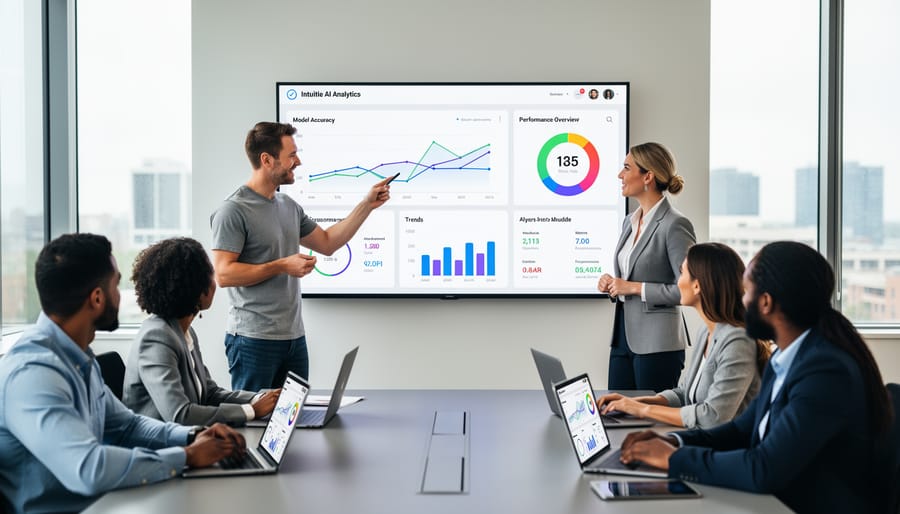
The best observability tools transform complex AI system data into visual stories that anyone can understand, regardless of their technical background. Think of dashboards as the control panel of your AI system—they should provide instant clarity about what’s happening without requiring a data science degree to interpret them.
Effective dashboards use intuitive visual elements like color-coded health indicators that instantly show whether your model is performing well (green), experiencing minor issues (yellow), or facing critical problems (red). Real-world applications demonstrate this perfectly: a retail company might display their recommendation engine’s performance using simple bar charts showing click-through rates over time, making trends immediately visible to marketing teams.
Key features that make dashboards truly accessible include interactive trend lines that reveal model accuracy changes, simple metric cards displaying core statistics like prediction latency or error rates, and comparison views that place current performance alongside historical baselines. Some tools even incorporate plain-language alerts that explain issues in everyday terms—saying “Your model is making fewer accurate predictions today” rather than displaying cryptic error codes.
The goal is democratizing AI monitoring so product managers, business leaders, and technical teams can all interpret the same information and make informed decisions together.
Integration with Your Current Workflow
The good news? Modern AI observability tools are designed to slide into your existing workflow rather than force you to rebuild everything from scratch. Think of them as adding guardrails to a road you’re already traveling, not constructing an entirely new highway.
Most observability platforms integrate directly with popular frameworks like TensorFlow, PyTorch, and Scikit-learn through simple SDK installations or API calls. You might add just a few lines of code to your training scripts to start tracking metrics automatically. For instance, wrapping your model inference with an observability SDK can capture prediction latency, input distributions, and output patterns without modifying your core logic.
During model deployment, these tools connect seamlessly with containerized environments like Docker and orchestration platforms like Kubernetes. Many offer pre-built integrations with cloud services such as AWS SageMaker, Google Vertex AI, or Azure ML, meaning you won’t need custom infrastructure work.
The key is choosing tools that support your current tech stack. Check whether they offer plugins for your CI/CD pipeline tools like Jenkins or GitLab, and whether they can push alerts to communication channels your team already uses, such as Slack or PagerDuty.
Start small by instrumenting one model or service first. This pilot approach lets you understand the overhead and benefits before scaling across projects. The goal isn’t perfection from day one but rather progressive visibility that grows alongside your AI systems.
Popular AI Observability Tools Worth Knowing About
Open-Source Options for Getting Started
If you’re just starting your AI observability journey, open-source tools offer an excellent entry point without straining your budget. These platforms let you explore monitoring capabilities hands-on, helping you understand what your AI systems actually need before committing to enterprise solutions.
Evidently AI stands out as a beginner-friendly option that makes model monitoring surprisingly straightforward. This Python library helps you track how your models perform over time by detecting data drift and model quality issues. Imagine you’ve built a customer churn prediction model that worked beautifully during testing. Evidently AI can alert you when your incoming customer data starts looking different from your training data, which often signals declining accuracy. You can generate visual reports showing exactly what changed, making it easier to explain problems to your team. The tool works seamlessly with popular frameworks like scikit-learn and integrates into Jupyter notebooks, so you can experiment within your existing workflow.
WhyLabs takes a slightly different approach by focusing on data quality monitoring with a generous free tier. It’s particularly useful for catching data pipeline issues before they affect your models. For example, if you’re running a recommendation engine and suddenly receive incomplete user profiles, WhyLabs can flag these anomalies immediately. The platform profiles your data automatically, learning what “normal” looks like and alerting you to deviations.
Both tools offer extensive documentation and community support, making them ideal for learning the fundamentals of AI observability while solving real problems in your projects.
Enterprise-Ready Platforms
When your organization deploys dozens or hundreds of AI models simultaneously, managing them individually becomes impossible. This is where enterprise-ready platforms step in, offering comprehensive solutions that handle AI observability at scale.
Think of enterprise platforms like mission control centers for AI operations. Just as NASA doesn’t monitor each spacecraft component separately, these tools provide unified dashboards where teams can oversee their entire AI ecosystem from one place.
Arize AI specializes in helping organizations understand why their models behave the way they do. Imagine you’re running a recommendation system that suddenly starts suggesting irrelevant products to customers. Arize’s platform doesn’t just alert you to the problem—it helps you trace back through the data to discover that a recent change in customer browsing patterns triggered the shift. The platform excels at detecting data drift and explaining model predictions, making it easier for teams to troubleshoot issues quickly.
Fiddler takes a different approach by emphasizing explainability and fairness. If you’re in a regulated industry like finance or healthcare, Fiddler helps ensure your models meet compliance requirements. It can show you exactly which factors influenced each decision your model makes, which is crucial when you need to explain why a loan was denied or a treatment was recommended.
DataRobot offers an end-to-end solution that covers the entire AI lifecycle, from model building to monitoring in production. For organizations just beginning their AI journey, DataRobot’s integrated approach means you don’t need to piece together multiple tools—everything works together seamlessly.
These enterprise platforms typically require significant investment but deliver value through reduced downtime, faster problem resolution, and the ability to scale AI operations confidently.
Getting Started: Your First Steps with AI Observability

Start with Your Most Critical Model
When you’re ready to implement AI observability, resist the urge to monitor everything at once. Instead, identify your most critical model—the one that directly impacts your users or business outcomes. This might be a customer-facing chatbot, a recommendation engine driving sales, or a fraud detection system protecting transactions.
Think of it like learning to drive: you start in a parking lot, not on the highway. Choose a single model where problems would be most noticeable or costly. If your e-commerce recommendation system crashes, customers see generic products and sales drop. That’s your starting point.
Begin with basic tracking: log each prediction your model makes, capture input data, and record the output. Most observability tools make this straightforward with simple code snippets. For example, you might track how many predictions happen per hour, what the average confidence score is, and whether response times stay consistent.
Set up a simple dashboard showing these metrics over time. You’re looking for obvious changes—sudden drops in predictions, confidence scores drifting lower, or response times spiking. These patterns tell you when something needs attention.
Once you’re comfortable monitoring one model, you can gradually expand to others. Starting small builds your confidence and helps you understand what normal behavior looks like before tackling more complex scenarios.
Build Your Monitoring Strategy Gradually
You don’t need to monitor everything on day one. Think of building your observability strategy like learning to drive—you start with the basics before tackling highway merges and parallel parking.
Begin with your most critical AI model, the one that directly impacts users or revenue. Set up basic tracking for three essential metrics: how often it’s used (request volume), how quickly it responds (latency), and how accurate its predictions are. This foundation gives you immediate visibility without overwhelming your team.
Once you’re comfortable reviewing these metrics weekly, expand to your second-most-important model. Add one new dimension to your monitoring, perhaps tracking how input data quality affects performance. You’re building expertise gradually rather than drowning in dashboards you don’t understand yet.
After a month or two, you’ll notice patterns. Maybe latency spikes every Tuesday afternoon, or accuracy drops when processing certain data types. These insights guide your next expansion phase—adding alerts for specific thresholds or monitoring data drift.
This phased approach means you’re always learning from real experience rather than theoretical possibilities. You’ll discover which metrics actually matter for your specific use cases, avoiding the common trap of monitoring everything but understanding nothing. Within three to six months, you’ll have comprehensive coverage that evolved alongside your team’s growing observability skills.
Here’s the reality: AI observability isn’t a luxury feature you can add later when things go wrong. It’s the insurance policy that actually pays dividends every single day your models are in production. Think of it like the difference between driving with working dashboard gauges versus flying blind—you might make it to your destination without them, but you won’t know you’re low on fuel until you’re stranded on the side of the road.
The good news? You don’t need a perfect monitoring setup from day one. Starting small beats waiting for the ideal configuration that may never come. Begin with tracking just a few key metrics that matter most to your use case—maybe it’s response latency and token usage for your chatbot, or prediction accuracy for your recommendation engine. As you grow more comfortable, you can expand your monitoring capabilities.
The landscape of AI observability is evolving rapidly, with new tools and capabilities emerging as quickly as AI itself advances. What remains constant is the fundamental need: understanding what your AI systems are actually doing in the real world. The teams that embrace observability now, even imperfectly, will be the ones who build trust with their users, catch problems before they escalate, and ultimately deliver AI solutions that work reliably when it matters most. Your future self will thank you for starting today.